Touristic
Information : Egypt
Alexandria and the immediate area around the City. It could in fact be argued
that this area extends to Marsa Matruh to the west on the coast.
The area has a Mediterranean feel about it, and the attraction is
the Mediterranean Sea, and to the people of Cairo, a somewhat cooler
climate.
Cairo and the immediate area around the City.
Cairo has everything. Cairo has great hotels, entertainment, restaurants,
all manner of monuments from throughout the history of Egypt and
it is often the entry point for most people visiting Egypt. It even
has bowling allies and several golf courses to chose from.
Luxor, and the surrounding area. Luxor is a living
museum with vast numbers of ancient Egyptian monuments. It is also
highly oriented to tourists, and might be thought of in the same
regard as a theme park, where the attractions just happen to be
real monuments.
Aswan and the surrounding area. Aswan is probably
the least of the super-site tourist areas, but has great hotels,
along with the huge Lake Nasser just to the south.
Hurghada and the surrounding area, particularly
El Gouna. Not to far apart are El Gouna, Hurghada and Safaga, and
these areas contain just about everything a tourist would like to
have, with the exception of ancient monuments. They make up for
that with every variety of water sports, several golf courses, casinos
and more. The Red Sea area has less of an Egyptian feel, but not
as European as the Sinai.
Sharm El Sheikh, and the surrounding area including
Sharks Bay. This is the Sinai super-site, again with most everything
any tourist might wish. There are even some wonderful Christian
monuments nearby, and the water sports, as at Hurghada, are all
inclusive.
For many, the
scope of Egypt's historyis difficult to comprehend. Its history
spans some five millenniums, and encompasses the origin of civilization,
the rise of the Greeks and Romans , the establishment of the Jewish,
Christian and Islamic religions, the colonial era when first France
and then the English ruled the country, and finally, a return to
independence. Egypt has played an important role through all of
these eras, and today one can find monuments that evidence Egypt's
role in most of the world's historic events.
In Egypt, we find
the earliest detailed records of warfare recorded thousands of years
ago, but we also find the cemeteries and monuments of the world's
last global war, World War II. In Egypt, we find some of the first
written words of civilization, but we also find great thinkers and
writers through the Greek period, into the Christian era, the archaic
Islamic period and even modern Nobel Literates. In Egypt, we find
ancient pyramids and giant columns supporting massive temples , but we can now find these architectural
elements spread throughout the world. Here, along with the first
monumental buildings made of stone, we also find the first paved
roads, the first wines and beer and even the first peace treaties
between organized governments. However, we also find the world's
first scientists architects and mathematicians.
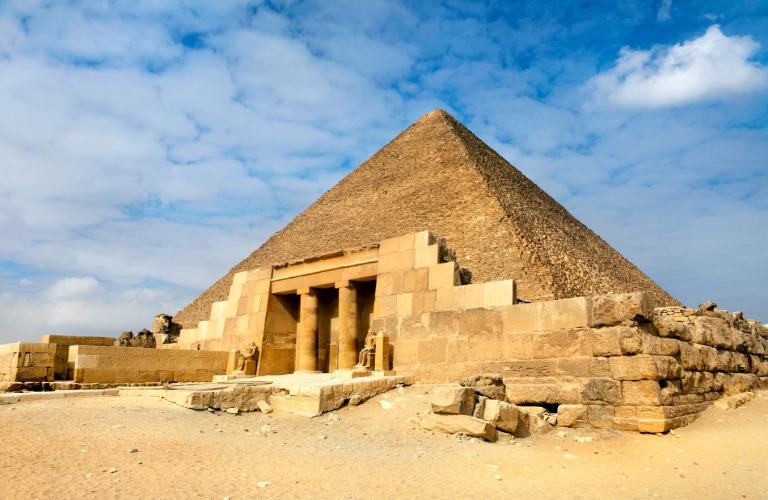
Egypt,
the name itself inspires thoughts of one of mankind's earliest
triumphs, the Pyramids. Probably one of the the world's oldest
civilization having emerged from the Nile Valley, it is an exciting
country, both for its antiquities and variety of holiday activities.
From scuba diving in the Red Sea to romantic Nile Cruises, sightseeing
and shopping in the bustling capital city of Cairo to secluded
nomadic oasies, Egypt has a spot for any traveller to enjoy.
Historians divide Egyptian civilization into
four epochs: the Old, Middle, and New kingdoms, and the Late Period.
These eras are separated from each another by, respectively, the
First, Second, and Third Intermediate periods. During these times
the political divisions of Middle and Upper Egypt broke apart under
the influence of weak rulers, fragmenting the central government
and disrupting the administrative authority of the country.
Early Egyptians lived under an absolute ruler,
the pharaoh, who was revered as a god. Only the pharaohs' responsibility
to their people constrained their divine right. In later eras,
pharaohs were still considered divine but ruled primarily through
political and military power.
The
first great period of Egyptian culture is known as the Old Kingdom
(about 2755–2255 BC), which included the Third to Sixth dynasties.
The Third Dynasty is known as a golden age of cultural freshness
and energy. Literature and medicine advanced, and the priests,
attempting to reconcile the chaotic collection of gods and goddesses,
codified Egypt's theologies. In order to deal with affairs of state
and to administer construction projects, the king began to develop
an effective bureaucracy. The first pyramids were built at this
time.
A vigorous cultural renaissance known as the
Middle Kingdom (2134–1784 BC) developed under the Eleventh Dynasty
Theban rulers. Architecture was characterized by purity of line
and controlled proportions. Superb decorative arts were produced,
especially precious metal jewelry and faience—including the well-known
blue-glazed hippopotamuses decorated with painted water plantsFor
nearly seven centuries after the death of Cleopatra, the Romans
controlled Egypt. They treated Egypt as a valuable source of wealth
and profit and were dependent on its supply of grain. Egypt is
located in Africa continent and now is an islamic country
When Roman Emperor Constantine came to power,
he converted to Christianity; in AD 313 he gave imperial sanction
to the Church doctrine. The new Roman orthodoxy was somewhat at
variance with the established Christianity of Egyptians, known
as Coptic Christianity. Religious conflicts erupted. In the end,
the Copts formally seceded and appointed their own patriarch of
Alexandria. From AD 641–1517 Egypt was ruled by governors appointed
by the caliph, leader of the Muslim community. In 1517, the Turkish
Sultan Selim declared Egypt a Turkish possession, part of the Ottoman
Empire.
Napoleon Bonaparte invaded Egypt in 1798 and
occupied the country until 1801, marking the beginning of renewed
European interest in Egypt. In 1805 Muhammad Ali, an Ottoman general
of Albanian origin, seized power with the cooperation of the local
population. He established Egypt on a firm economic footing, importing
Western technology and culture. Through warfare, Ali extended the
Egyptian empire to the Arabian Peninsula and the Sudan.
Due to the color of a variety of mountain ranges
bordering the sea, the Europeans have called the Red Sea “red”
since antiquity, the Romans called it "Mare Rubum" and the Arabs have taken over the name and call it El Bahr El Ahmer. The Red
Sea is nature’s gift to the Middle East, running from north to
southeast about 1600 miles in length, and 120 to 240 miles in width.
The Red Sea one of nature’s last frontiers has
recently been discovered by avid adventurers and water sport enthusiasts.
This tropical sea has slightly varying climatic conditions all
year round, not to mention spectacular clear water, and wonderful
marine life including coral reefs and their habitants.
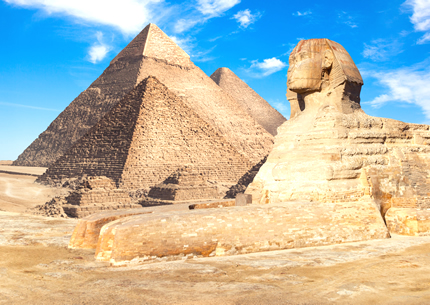
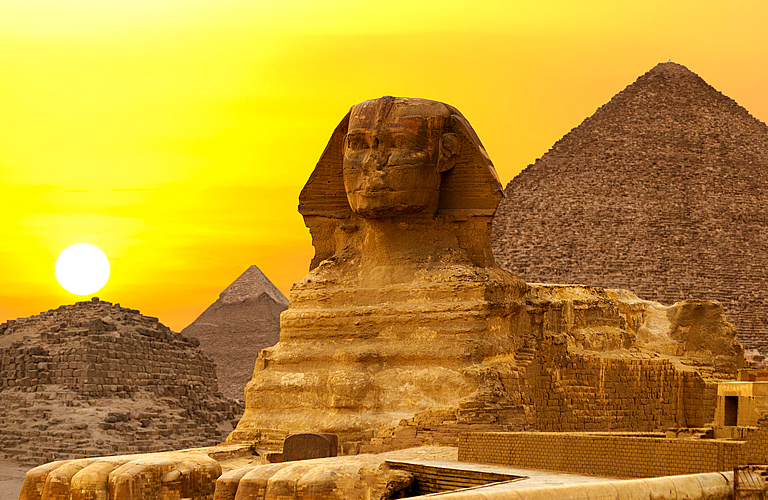
The
Sphinx, which embodies the body of a lion and the head
of a pharaoh, is believed to be the head of Khafre and
his guardian spirit for his entire burial complex. Carved
from the natural limestone of Giza, the sphinx has disintegrated
over the years, entire pieces dropping off to the desert
floor below. It is not known to have chambers inside, like
those found in the pyramids at Giza.
In a depression to the south of Chephren's Pyramid
sits a creature with a human head and a lion's body. The sphinx
appears to have started in Egypt in the form of a sun god. The
sphinx is usually a head of a king wearing his head dress and the
body of a lion. The Great Sphinx is to the north east of Chephren's
Valley Temple. Where it sits was once a quarry. Chephren's workers
shaped the stone into the lion and gave it their king's face over
4,500 years ago. The sphinx faces the rising sun with a temple
to the front, which resembles the sun temples, which were built
later by the kings of the 5th Dynasty.
The body is 60m in length and 20m tall. The
face of the sphinx is 4m wide and its eyes are 2m high. Part of
the uraeus (sacred obra), the nose and the ritual beard are now
missing. The beard from the sphinx is displayed in the British
Museum. It is possible that it is Chephren. If that is so, it would
then be the oldest known royal portrait in such large scale.
The Great Sphinx is to the northeast of Chephren's Valley Temple.
Where it sits was once a quarry. Chephren's workers shaped the stone
into the lion and gave it their king's face over 4,500 years ago.
The sphinx faces the rising sun with a temple to the front which
resembles the sun temples which were built later by the kings of
the 5th Dynasty. The figure was buried for most of its life in the
sand. King Thutmose IV (1425 - 1417 BC) placed a stela between the
front paws of the figure. It describes when Thutmose, while still
a prince, had gone hunting and fell asleep in the shade of the sphinx.
During a dream, the sphinx spoke to Thutmose and told him to clear
away the sand because it was choking the sphinx. The sphinx told
him that if he did this, he would be rewarded with a kingship. Thutmose
carried out this request and the sphinx held up his end of the deal.
resource