Denizli Pamukkale Colossae

COLOSSAE

It's situated 25 km east of Denizli and 2 km north of Honaz Town. The road passing through Colossae connects the Organized Industry Zone to Honaz Town, which is situated at the 16th km of the Denizli-Ankara Highway. The ancient city is situated on the west foothills of Mount Honaz (Mt. Cadmos) next to the Aksu River. It's on the southeast road, which was used in ancient times as well. It was one of the most important centers in greater Phrygia. According to Xenephon, Colossae was one of the six largest cities.

Its golden age was during Persian Sovereignty. It decreased in importance after Hierapolis and Laodicea were founded in the 3rd century B.C. The city was destroyed by the earthquake in the 1st century A.D. during the reign of Nero. Another city called Chonae, which was built from 692-787 AD where Honaz Town is now, was also destroyed by an earthquake. Old sources inform us that there was a St. Michael's Church in Chonae. There are also ruins of castle from the Ottoman Period. Unfortunately, there are not any important ruins left from Colossae except rock tombs and rooms on the rocky hill.

In Philadelphia, we saw how little of what we knew from both ancient writings and archaeology tied in with the words of Jesus to His Church in the city, but, here, there is a wealth that provides us with a very rich backdrop.

Laodicea lay on the south bank of the River Lycus about two miles from its flow, approximately one hundred feet above the valley floor on a flat plateau at the junction of both the Lycus and the Maender valleys, and was situated in a ‘triangle’ of cities along with Colossae (to the south-east) and Hierapolis (to the north-east) - each some 10 miles, approximately, from one another.

The city stood at the head of the valley where a road division directly reached five of the other six churches mentioned in Revelation - to the west, Ephesus lay at the end of the most used route while, to the north-west, the road rose to traverse Philadelphia, Sardis, Thyatira and, the capital, Pergamum.

It is impossible to speak of Laodicea without speaking of the other two cities sited as near neighbours, seeing as they were tied up together in the area and that even Paul lists the three together in his letter to the Colossians (4:13).

Very little archaeological work has been performed on the city and most of the remains lie in ruins, the dressed stones of the city having been used for rebuilding throughout the centuries since its demise. The aqueduct which brought water in to the city has, at least, been traced and detailed but nothing much else has been mapped out for further investigation.

There are archaeological points of interest in the ruins today, such as inscriptions, theatres, a stadium, a gate and a large visible building thought to be a bathhouse, but detailed excavations are yet to be performed, in contrast to Philadelphia which remains hidden below the modern city on its ancient site.

Pliny relates that Laodicea was formerly known as both Diosopolis and Rhoas (it lay on the main route from Ephesus eastwards up the valley through Colossae to the east and was probably an important place for travellers and tradesmen at which to stop over for rest and food from ancient times) before being renamed and rebuilt by Antiochus II after his wife, Laodike, whom he divorced eight years after ascending the throne in 261BC. It would seem logical, therefore, that the city referred to in Revelation was founded and built between these two inclusive dates of ascendency and divorce.

Colossae was originally the more important of the two towns and is mentioned by Herodotus (7:30) with reference to Xerxes who, marching against Greece to the west, arrived at Colossae c.480BC. He records that

‘When Xerxes had so spoken and had made good his promises to Pythius, he pressed forward upon his march; and passing Anaua, a Phrygian city, and a lake from which salt is gathered, he came to Colossae, a Phrygian city of great size, situated at a spot where the river Lycus plunges into a chasm and disappears. This river, after running under ground a distance of about five furlongs, reappears once more, and empties itself, like the stream above mentioned, into the Maeander. Leaving Colossae, the army approached the borders of Phrygia where it abuts on Lydia...’

That Colossae is noted as being a ‘city of great size’ is significant and also that this period of Colossae’s history is over two centuries before Antiochus II founded or refounded Laodicea around ten miles away.

Around eighty years later c.400BC, Cyrus marched east from Sardis to attempt to capture the Persian throne and remained in Colossae for around seven days before departing. That the city was able to support the size of the army is significant and worthy of note, more especially as Xenophon (1.2.6) says that Colossae at this time was

‘...an inhabited city, prosperous and large...’

Laodicea, however, once established, grew rapidly and soon became of equal or of even more importance than her rival Colossae, though it is difficult to be accurate as to which city was regarded as being wealthier at the time of the writing of Jesus’ letter to the fellowship.

Certainly, Colossae’s importance waned during Rome’s possession of the area when the Empire used the city as a way station for the large volume of shipments that were brought to Rome from Syria and Israel. It was also developed as a military outpost after 133 BC when its trade seems to have expanded rapidly.

Hierapolis, the other of the three cities located in this area, was probably founded during the reign of Antiochus I (281-261BC) though some date it much later to Eumenes II of Pergamum (197-160BC ) when it seems to have first received the status of ‘city’. It lay on the route out from Laodicea which separated from the main Ephesus road and traversed the high land to pass through Philadelphia and Sardis.

This was the road which Xerxes took after leaving Colossae c.480BC and Herodotus notes (7.31) that

‘Where [the river Lycus?] quits Phrygia and enters Lydia the road separates; the way on the left leads into Caria, while that on the right conducts to Sardis. If you follow this route, you must cross the Maeander, and then pass by the city Callatebus, where the men live who make honey out of wheat and the fruit of the tamarisk. Xerxes, who chose this way, found here a plane-tree so beautiful, that he presented it with golden ornaments, and put it under the care of one of his Immortals. The day after, he entered the Lydian capital’

This is significant because there is no mention of any major city being on this route. This would indicate, as other historical records show, that Hierapolis had not yet been founded or, at the very least, it was no more than a small village or town.

Hierapolis stood three hundred feet high above the valley of the Lycus on its north bank, overlooking the junction of the rivers Maender and Lycus in the plain below.

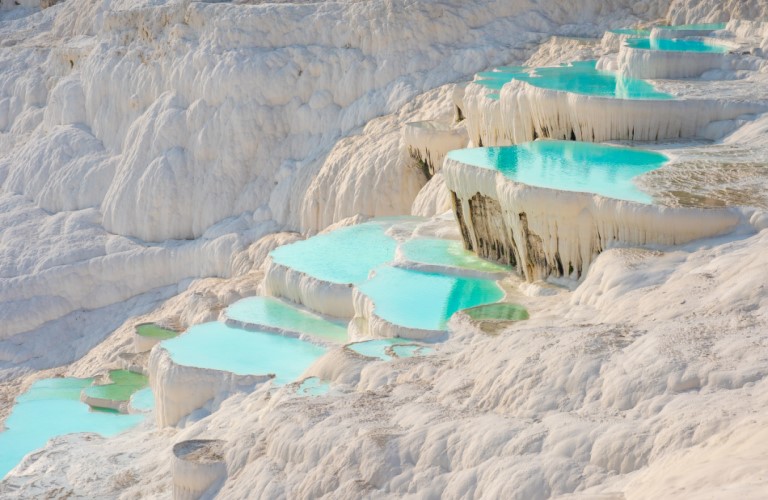
‘Behind the site a hot mineral spring wells up, covering the rocks beneath with white deposits of lime, producing stalactite formations which have given the place its Turkish name Pamukkale (“Cotton Castle”)...visitors came to bathe in the hot water and their presence added to the prosperity of the city’

Having seen a modern picture of these white deposits, I can say assuredly that they must have been quite a sight!

The major industry of the entire Maender and Hermus valleys was the manufacture and preparation of woollen fabrics. Even though the three cities began their production of such textiles later than the older cities of Lydia and Ionia, their products soon came to be regarded as of the finest quality.

Of specific note is Laodicea’s black wool which earned a reputation for itself for numerous centuries, Hierapolis which was famed for its superior dyeing processes and Colossae whose unique colour known as colossinus was mentioned by Pliny.

Laodicea suffered repeated earthquakes and more than one ancient writer notes specific occurrences. Suetonius (Tiberius 5) notes a petition which was brought before the emperor Augustus (who began ruling as first Emperor from c.30BC) by his stepson Tiberius for the relief of the inhabitants not only of this city but also of Thyatira and Chios.

A later earthquake destroyed the city c.60AD but it was rebuilt with finance from the wealth of the Laodicean inhabitants during the reign of Emperor Nero. Tacitus (14:27) simply notes that

‘One of the famous cities of Asia, Laodicea, was that same year overthrown by an earthquake, and, without any relief from us, recovered itself by its own resources’

This indicates the wealth of the city and ties in with the date of Paul’s letter to the fellowship that he noted as being sent when he wrote at the same time to the Colossians (4:16). If an early date is proposed for John’s writing, there is more in Jesus’ words that the fellowship regards itself as self-sufficient than just it’s financial prosperity but would be rooted in it’s recent success at rebuilding its city with its own resources - most cities needed to appeal to Caesar for financial aid in such a crisis.

The city appears to have been a centre of banking and financial institutions, being a place where money-changing was common practice. It minted its own coins a number of centuries before the first century AD due to its wealth. This seems to have been a result, however, of the city’s success in agricultural products such as the black wool for which it was renowned.

It is probable that Antiochus (the founder of Laodicea) settled a number of Jewish families in this region after his conquest of Israel. The Jews had already been forbidden to send monetary aid by the Emperor to the Jewish nation around 62BC and estimates (Barclay according to Mounce) put the number of Jewish citizens at around 7,000. This event of itself indicates that they had become fairly wealthy. There is, however, no real indication in the text of the letter of Revelation that a strong and powerful Jewish community existed and neither is there any apparent reference to the Caesar-cult which had its centre in the city - the church’s problems do not appear to be outside its boundaries but solely within in the attitudes and lifestyle of its members.

Laodicea has also often been labelled as the chief medical centre of Phrygia and Zondervan notes that

‘...its production of a poultice...[was] widely sought for treatment of eye ailments’

along with many other commentators, though no source is quoted to justify the statement.

Mounce comments of the medical school that it was

‘...established in connection with the temple of Men Carou thirteen miles to the north and west. It boasted such famous teachers as Zeuxis and Alexander Philalethes (who appear on coinage). Ramsay notes that the Laodicean physicians followed the teaching of Herophilos (330-250BC) who, on the principle that compound diseases require compound medicines, began a strange system of heterogeneous mixtures...Two of the most famous were an ointment from spice nard for the ears, and an eye-salve made from “Phrygian powder” mixed with oil (Galen vi.439)’

The main strategic problem for Laodicea was that it did not have an adequate water supply with which to support a long and arduous siege from an oppressing army, having been founded primarily because of its strategic importance overlooking the road system. Instead of having a local spring that could be tapped and used, the city relied on water being transported to it from a spring many miles away through three foot wide stone sections that were hollowed out. An invading army, if they could find the aqueduct, would have been able to cut off the city’s supply of water and this would have been disastrous in the dry season when the local river, the Lycus (around two miles distant), is known to dry up.

‘In contrast to Hierapolis with its medicinal hot springs or Colossae with its refreshing supply of cold water, Laodicea had to fetch its water through high-pressure stone pipes from hot springs at Denizli, some five miles away, and by the time it reached Laodicea the water was lukewarm’

This will be of significance when we deal with Rev 3:15-16 but, for now, we can simply note Mounce’s words that, concerning this verse

‘The contrast is between the hot medicinal waters of Hierapolis and the cold, pure waters of Colossae’

It is not known when all three of the churches in the cities of Laodicea, Colossae and Hierapolis were founded and there is no established record that the apostle Paul was responsible for their inception.

In his letter to Colossae, Paul seems to treat the first two churches mentioned as closely connected (Col 2:1) going on even to command the fellowships that they swap the letters that he had written individually to them when they had completed reading them before the church (4:16 - this letter ‘to the Laodiceans’ is generally believed to have been lost even though some commentators see Paul’s letter to the Ephesians as being one and the same. There was also a letter circulated much later entitled the ‘letter to the Laodiceans’ but it is generally believed not to be Pauline in origin).

In his letter to the Colossians, Paul commends to his listeners and readers Epaphras who had been courageously working in all three cities (4:12-13) thus connecting them together. What the role or function of this believer was is uncertain but Paul’s statement is indicative of the fact that the three cities of the Lycus valley seem to have been closely associated together and would have overflowed in experience and prosperity, even though Laodicea seems to have been the most prosperous.

travertines | denizli rooster | folklore | legends | festivals | climate

sports and tourism >> hunting | water sports | parapanthing | bicycle tours | fishing | winter sports | cave tourism | river tourism | trekking | cultural tourism |
faith tourism | thermal tourism | eco tourism | youth tourism | convention tourism

ancient cities >> hierapolis - laodikya - tripolis - colossae - eumania - heraklia salbace - tabae - dianisopolis - apollon temple - sebastopolis - anava
trapezapolis - attuda - apollonia salbace

museums >> ethnography - archeology

home page >>