Fethiye Turkey Travel Guide: What to See, Where to Stay & How Long
Updated: August 2026
Fethiye is one of those Turkish destinations that becomes more interesting once you stop treating it as a single resort.
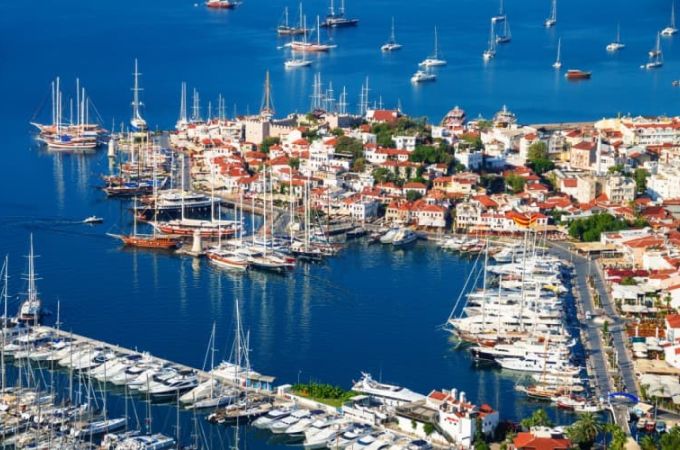
The town itself sits around a broad natural harbor on Turkey’s southwestern coast, yet many of the experiences travelers associate with “Fethiye” are scattered across a much larger area. Ölüdeniz and its famous lagoon lie south of town; abandoned stone houses cover the hillside at Kayaköy; boats leave for bays and islands; Lycian history appears in rock tombs and archaeological sites; the mountains rise almost immediately behind the coastline, while places such as Saklıkent Gorge can pull you inland for an entirely different day.
This geography explains both Fethiye’s appeal and the planning mistakes people make here.
You can come for turquoise water and spend most of the week nowhere near a conventional beach resort. You can use Fethiye as part of a wider archaeological journey through ancient Lycia, or make it the beginning of a sailing holiday. You can stay in the town and travel outward each day, base yourself near Ölüdeniz for easier beach access, or choose a quieter coastal setting and accept that restaurants, transport and evening options will be more limited.
For most first-time visitors who want more than the beach, three to five nights is the useful range. The important question is not whether Fethiye deserves those days.
It is deciding which version of Fethiye you actually came to experience.
Fethiye Is a Region Before It Is a Checklist
A first look at the map can be misleading because the names associated with Fethiye often appear together in travel guides even though they create very different days.
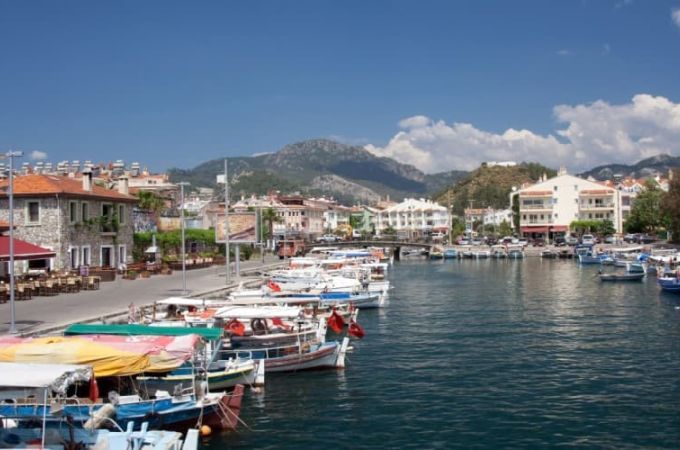
Fethiye town is practical and lived-in, with a harbor, marina, restaurants, shops and transport connections. Ölüdeniz is much more closely associated with the beach, lagoon and paragliding landscape. Kayaköy feels entirely different again, with its abandoned historic settlement set among hills rather than beside a resort strip.
Move farther out and the geography becomes even broader.
That means a traveler who books accommodation simply because it says “Fethiye” may discover that the hotel is not particularly convenient for the experiences they prioritized.
Before choosing the hotel, choose the daily rhythm.
Do you want to walk out for dinner around Fethiye each evening? Do you want early access to Ölüdeniz? Are you imagining several boat days? Will you rent a car? Are you traveling with children and trying to minimize transfers?
Those questions are more useful than searching for the “best area” in isolation.
Fethiye Town or Ölüdeniz? Choose According to How You Will Spend Your Days
This is probably the most important accommodation decision for a first visit.
Neither base is universally better.
| Your Priority | Fethiye Town | Ölüdeniz Area | Why It Matters |
|---|---|---|---|
| Restaurants and evening choice | Stronger | Good but more resort-oriented | Fethiye has a broader everyday town atmosphere |
| Beach access | Requires travel | Stronger | Ölüdeniz places the coast at the center of the stay |
| Harbor and boat access | Convenient | Depends on excursion | Useful for maritime days |
| Exploring several regional sights | Good base | Possible, but less central for some routes | Transport planning matters |
| Paragliding focus | Possible | Most convenient | Activity is closely associated with Babadağ/Ölüdeniz |
| Local town atmosphere | Stronger | More tourism-focused | Changes the evening experience |
| Pure resort holiday | Less obvious | Stronger | Beach becomes the daily default |
For travelers combining beaches, archaeological interests and regional excursions, Fethiye town often provides the more flexible base. For travelers whose main reason for coming is Ölüdeniz, swimming and paragliding, staying closer to the beach can reduce unnecessary daily movement.
There is no prize for staying in the place with the more famous name.
Convenience should follow your itinerary.
Ölüdeniz Deserves Time, but It Does Not Need to Become the Entire Trip
Ölüdeniz is one of Turkey’s most recognizable coastal landscapes, and photographs do not entirely explain why.
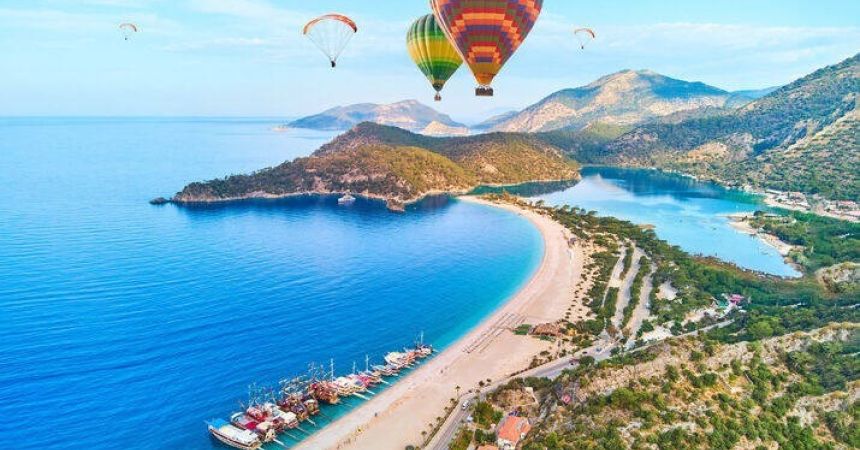
The setting matters as much as the water. Mountains rise behind the coast, Babadağ dominates the skyline, paragliders descend toward the shoreline, and the lagoon creates a calmer visual contrast with the open sea.
It is also popular.
Travelers expecting an undiscovered cove are likely to misunderstand what they are visiting, particularly during the busiest summer period. Ölüdeniz is famous precisely because its landscape is exceptional, and popularity naturally follows.
The better approach is not avoiding it simply because other people know about it, but deciding how much of your Fethiye stay should revolve around it.
One beach day may be enough for an active traveler. Someone building a slower coastal holiday may want several.
That distinction keeps this Fethiye guide separate from a dedicated Ölüdeniz page: here, Ölüdeniz is an important component of the destination, not the entire destination itself.
Paragliding Changes the Way You See the Coast
Many destinations offer paragliding. Fethiye’s version has become internationally recognizable because of the relationship between Babadağ and Ölüdeniz below.
From the air, the geography that can feel fragmented from the road suddenly makes sense. Mountain, lagoon, open Mediterranean water and settlement fit into a single landscape.
For travelers planning tandem paragliding, flexibility is valuable. Weather conditions matter, and operational decisions should always take priority over a rigid sightseeing schedule.
Do not place a time-sensitive airport transfer immediately after an activity that depends on conditions.
It is also worth separating two questions:
Do you want to see paragliders?
You will encounter that atmosphere around Ölüdeniz.
Do you personally want to paraglide?
That requires a proper activity booking, appropriate physical considerations and acceptance that conditions determine whether the flight proceeds.
You can enjoy Fethiye enormously without ever leaving the ground.
Kayaköy Is More Powerful When You Do Not Rush Through It
Kayaköy creates one of the sharpest changes of mood in the Fethiye region.
Stone houses, churches and narrow paths spread across a hillside where a substantial Greek Orthodox community once lived. The settlement’s twentieth-century history is connected with the population exchange between Greece and Turkey, making it a place that deserves more thoughtful interpretation than the label “ghost village” sometimes gives it.
The site is atmospheric, but its value is not simply photogenic abandonment.
Wear footwear suitable for uneven ground, allow enough time to walk rather than photograph the first row of buildings, and avoid treating midday summer heat as an insignificant detail. Exposed stone landscapes can feel considerably hotter once you are climbing through them.
Kayaköy also combines naturally with nearby parts of the Fethiye region, which makes it useful when designing a day around geography rather than collecting unrelated attractions.
Fethiye’s Lycian Identity Is Easy to Miss if You Only Look Toward the Sea
Long before modern resort tourism, this coastline belonged to the ancient world of Lycia.
That history remains visible around Fethiye, including the rock-cut Tomb of Amyntas overlooking the town. Beyond Fethiye itself, southwestern Turkey contains a much larger network of Lycian settlements, tombs and archaeological landscapes.
This is important because it changes who Fethiye is for.
Travelers sometimes imagine they must choose between Turkey’s archaeological interior and a coastal holiday. Fethiye can bridge those interests surprisingly well, especially when incorporated into Lycian Coast cultural journeys that connect landscapes with the ancient settlements that developed within them.
The key is resisting the urge to see every archaeological site available from the region.
Choose according to interest and driving time.
A meaningful morning at one site followed by a relaxed afternoon often works better than three ruins reached through hours of road travel.
Saklıkent Is the Day You Leave the Postcard Coast Behind
Saklıkent Gorge is useful precisely because it changes the visual language of the trip.
After days of bays, boats and beaches, heading inland toward a dramatic gorge reminds visitors how quickly the landscape changes beyond Turkey’s southwestern shoreline.
Conditions inside the gorge vary, and water, slippery surfaces and seasonal circumstances should be taken seriously. Appropriate footwear matters more here than a carefully planned outfit, while visitors with mobility concerns should evaluate the excursion according to current conditions rather than assuming every section will suit everyone.
This is also a good example of why Fethiye needs several nights if you want regional variety.
A three-night stay disappears quickly once you allocate one day to the coast, another to a boat trip and another to an inland excursion.
Adding nights does not merely provide “more relaxation.”
It allows Fethiye’s different landscapes to stop competing for the same day.
A Boat Day Is Not the Same Experience as a Beach Day
Travelers often schedule both under the heading “sea,” then wonder why their itinerary feels repetitive.
They are actually quite different.
A beach day gives you control over your pace. You can swim, read, leave for lunch, stay longer or change plans without affecting anyone else.
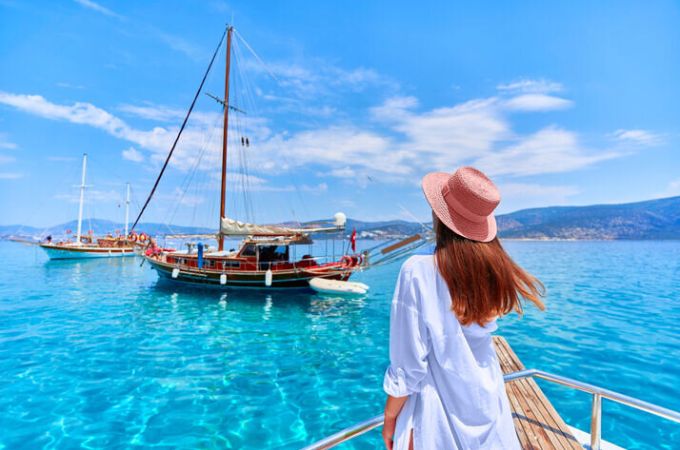
A boat trip introduces movement. Bays, islands and swimming stops become part of a sequence, and the coastline is experienced from the water rather than from one fixed point.
Fethiye’s maritime setting makes this distinction particularly valuable. If you already plan several static beach days, one boat excursion can reveal a side of the region you would otherwise miss.
Travelers particularly interested in spending several nights aboard rather than taking a day cruise should move into a different planning category entirely. Our Turkey gulet cruise experiences belong to that sailing intent and should not be confused with a standard Fethiye sightseeing day.
That cluster separation matters because sleeping aboard a gulet and taking a local boat excursion solve completely different travel desires.
Butterfly Valley Is Beautiful, but Access Determines the Experience
Butterfly Valley is another Fethiye-area name that photographs can oversimplify.
Its dramatic setting between steep cliffs makes the approach part of the experience, and many visitors encounter the valley from the sea. The landscape itself is the attraction; travelers should not build unrealistic expectations around seeing huge numbers of butterflies at every moment of the season.
This is an important general rule around Fethiye.
Do not plan nature according to the name on the brochure.
Plan around what the landscape genuinely offers.
Butterfly Valley can be memorable for its cliffs, isolation, swimming and sense of arrival even when the wildlife behaves exactly as wildlife does: independently of your schedule.
Three, Four or Five Nights? Count Experiences, Not Attractions
Fethiye is easier to plan when you stop counting landmarks and start allocating different types of days.
| Stay | What It Feels Like | Sensible Scope | Main Trade-Off |
|---|---|---|---|
| 2 nights | Brief introduction | Town + one major coastal experience | Very little flexibility |
| 3 nights | Active short stay | Ölüdeniz + Kayaköy + selected excursion | Limited slow time |
| 4 nights | Balanced first visit | Coast + history + boat/inland day | Still requires choices |
| 5 nights | Comfortable exploration | Multiple landscapes without daily rushing | Better for mixed interests |
| 6–7 nights | Coastal holiday base | Exploration plus genuine downtime | Best when Fethiye is a major trip focus |
For a broader Turkey itinerary, I would usually see three to five nights as the useful planning range.
Two nights can work, but one transport disruption or weather-dependent activity suddenly matters much more. Five nights allows travelers to change plans without feeling that something essential has been lost.
That flexibility has real value on the coast.
Summer Is Not Automatically the Best Season for Every Fethiye Traveler
Fethiye’s Mediterranean climate makes summer the obvious period for travelers prioritizing hot weather and swimming, but “best” depends on what you intend to do once you arrive.
July and August bring strong heat and peak-season energy. That can be perfect for travelers who want a classic summer coastal holiday, yet walking through archaeological sites or exposed landscapes during the hottest part of the day may become tiring.
Late spring and early autumn often suit travelers who want to mix swimming with walking, sightseeing and regional exploration.
Winter is an entirely different proposition. Fethiye remains a real town rather than disappearing when summer ends, but travelers should not expect every seasonal tourism operation, boat service or beach-oriented business to function exactly as it does in peak season.
This page should not compete with our “best time to visit Turkey” or monthly weather cluster, so the planning principle is enough:
Choose the season according to what you want to do, not simply the highest temperature available.
Dalaman Airport Is Usually the Practical Gateway
For many international and domestic visitors, Dalaman Airport is the most practical aviation gateway for reaching Fethiye.
The airport is not in Fethiye itself, so transfer time needs to be included in the arrival and departure plan. Private transfers, shared services, rental cars and other transport options may be available depending on season and travel arrangements.
This sounds obvious, but arrival-day planning often ignores it.
A flight landing late in the day should not be followed by an ambitious evening itinerary. Similarly, a morning departure means leaving the Fethiye region earlier than the flight time alone suggests.
Travelers combining Fethiye with Istanbul, Cappadocia, Ephesus or other Turkish regions should compare the whole transport chain, including airport transfers and possible connections, rather than choosing routes solely by the shortest advertised flight duration.
Do You Need a Car in Fethiye?
Not necessarily.
A traveler staying centrally, using organized excursions and focusing on established coastal attractions can visit Fethiye without renting a car.
A car becomes more useful when the trip shifts toward independent regional exploration, quieter beaches, archaeological sites or accommodation outside the main transport corridors.
There is a trade-off, however.
Parking and summer traffic can reduce the convenience of driving in popular areas, while a vehicle sitting unused during a full-day boat trip provides no benefit.
For many visitors, the smartest solution is not automatically “rent a car for the entire stay,” but to identify which days genuinely require independent road transport.
Fethiye rewards flexibility, but flexibility does not always require having your own vehicle.

Fethiye Fits Better Into Some Turkey Routes Than Others
Fethiye should not be added to a Turkey itinerary merely because the country has a coastline and the traveler wants “two beach days.”
Its location makes most sense when the wider route already has geographical logic.
Western and southwestern Turkey can connect naturally with places such as Ephesus, Pamukkale and other sections of the Mediterranean or Aegean coast. Istanbul and Cappadocia can certainly be combined with Fethiye as well, but internal flights and transfers need to justify the destination changes.
Travelers wanting a broader organized journey can look at Turkey coast and cultural tours, where Fethiye works best as a change of pace after more intensive historical sightseeing.
This is where destination planning becomes more important than destination collecting.
If reaching Fethiye costs most of a day and leaving costs another significant part of the next, two nights may not be worth the logistical investment.
Stay long enough for the coast to change the rhythm of the trip.
Fethiye Can Also Become a Gateway to Greece — but Only With the Right Route
Fethiye’s position encourages travelers to look across the water toward Greece, particularly Rhodes.
That can work when seasonal international ferry operations align with the actual travel dates, and when Rhodes genuinely belongs in the next stage of the journey.
It should not be assumed that Fethiye provides a simple ferry solution for Athens, Santorini or every Greek island.
That subject belongs to our Turkey–Greece ferry cluster, but one rule is worth repeating here: never book a multi-country itinerary around a ferry you have assumed exists from looking at a map.
Confirm the actual port pair and seasonal operation first.
The sea makes Turkey and Greece look effortlessly connected.
Operationally, the right crossing matters.
Fethiye Works Best When You Leave Something for Another Day
The temptation in Fethiye is understandable.
Ölüdeniz, Kayaköy, Butterfly Valley, Saklıkent, Lycian history, boat trips, paragliding and beaches all look possible from the same base, so the itinerary expands until every morning has a departure time.
That misses one of the main reasons to come.
Fethiye should create breathing space within a Turkey journey.
Have breakfast without immediately checking the clock. Spend longer at a bay because the water is particularly good that morning. Return from a boat trip and walk along the harbor rather than preparing for another excursion. Give yourself an evening that exists simply because you are on the Mediterranean.
Operationally efficient travel does not mean filling every available hour.
Sometimes good planning is what makes an empty afternoon possible.
Is Fethiye Worth Visiting?
For travelers who want Turkey’s Mediterranean landscape without giving up history, outdoor experiences and access to a functioning town, Fethiye is one of the most versatile bases on the southwestern coast.
It is particularly rewarding when you give it enough time to become more than Ölüdeniz.
Stay around three nights if Fethiye is one component of a fast-moving Turkey itinerary; four or five nights if you want to combine coast, history and regional exploration; longer if swimming, boating and slower evenings are central to the holiday.
Choose your accommodation according to the days you actually intend to have. Treat weather-dependent activities with flexibility, do not underestimate transfer times, and avoid turning every famous name around Fethiye into a compulsory excursion.
The destination becomes considerably better once you stop trying to complete it.
Frequently Asked Questions About Fethiye, Turkey
1. Is Fethiye worth visiting on a first trip to Turkey?
Yes, particularly for travelers who want to balance Turkey’s major cultural destinations with Mediterranean scenery. Fethiye combines beaches, boating, Lycian heritage and outdoor experiences while providing enough variety to justify several nights rather than functioning only as a resort stop.
2. How many nights should I stay in Fethiye?
Three nights can provide a useful introduction, while four or five nights create a much better balance between Ölüdeniz, regional sightseeing, a boat experience and downtime. Longer stays suit travelers treating Fethiye as the coastal centerpiece of their Turkey holiday.
3. Is it better to stay in Fethiye or Ölüdeniz?
Fethiye generally suits travelers wanting restaurants, town atmosphere, harbor access and a flexible regional base, while Ölüdeniz is stronger for travelers prioritizing the beach, lagoon and paragliding. Your planned daily activities should determine the accommodation location rather than reputation alone.
4. What is Fethiye best known for?
Fethiye is associated with its natural harbor, nearby Ölüdeniz, Babadağ paragliding, Lycian heritage, boat excursions and access to landscapes including Kayaköy and Butterfly Valley. Its real strength is the unusual variety available within one southwestern Turkish region.
5. Can I visit Fethiye without renting a car?
Yes. Travelers staying centrally and using transfers or organized excursions can experience many major attractions without driving. A rental car becomes more valuable when exploring independent beaches, archaeological sites and less accessible regional locations rather than remaining around the principal visitor areas.
6. Is Fethiye suitable for travelers who are not interested in beaches?
Yes, although the coastline remains central to its identity. Kayaköy, Lycian history, walking opportunities, Saklıkent and the surrounding mountain landscapes provide alternatives, making Fethiye considerably more varied than a destination designed exclusively around swimming and sunbathing.
7. Can I combine Fethiye and Pamukkale in the same Turkey trip?
Yes, the two destinations can fit within a southwestern Turkey route, although travelers should account for the overland travel involved rather than treating them as neighboring attractions. The combination works better when each destination receives sufficient time to justify the transfer.
8. Is Fethiye a good destination for paragliding?
Fethiye is internationally associated with tandem paragliding from the Babadağ area above Ölüdeniz, where the mountain-to-sea setting creates its distinctive appeal. Flights remain dependent on appropriate operational and weather conditions, so some flexibility should be maintained in the itinerary.
9. Is Kayaköy easy to visit from Fethiye?
Kayaköy is close enough to form part of a Fethiye-area stay and provides a strong historical contrast with the coast. Visitors should allow proper walking time, wear suitable footwear and avoid reducing the abandoned settlement to a quick photographic stop.
10. Can I take a boat trip from Fethiye?
Yes, maritime excursions are an important part of the Fethiye experience, with different styles of boat days available seasonally. A day trip should be distinguished from a multi-night gulet cruise, because the two experiences require completely different amounts of time and planning.
11. Can I travel from Fethiye to Greece?
International ferry connections between Fethiye and Rhodes can operate seasonally, making Greece a possible onward destination when schedules align. Travelers should confirm the actual service for their dates before booking dependent accommodation or transport rather than assuming year-round ferry availability.
12. Which travelers may prefer somewhere other than Fethiye?
Travelers wanting a compact city-break destination where major sights are reached almost entirely on foot may find Fethiye too geographically spread out. Its greatest rewards come from combining the town with beaches, coastal landscapes and excursions across the surrounding region.

A travel professional specializing in tailor-made travel planning, guest experience management, and multi-destination tourism operations.
With over 23 years of experience in the travel industry, he designs and manages private and cultural tours for international travelers across Türkiye, Greece, Egypt, Jordan, Morocco, and other destinations.
He has strong expertise in both online and face-to-face guest communication, sales processes, and end-to-end travel operations.
Working closely with hotels, travel agencies, and local partners, he ensures smooth coordination and high-quality travel experiences at every stage of the journey.
His focus is on delivering personalized, reliable, and seamless travel experiences for international guests worldwide.