Is Turkey in Europe or Asia? The Geography Explained
Updated: August 2026
Turkey is in both Europe and Asia.
That is the simple answer, but it leaves out the part that makes the country interesting.
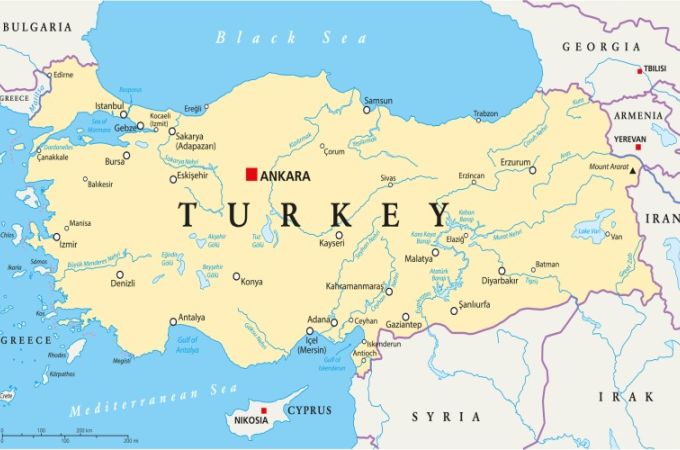
A relatively small portion of Turkey lies in southeastern Europe, while the overwhelming majority stretches across Anatolia in western Asia. The Bosphorus, Sea of Marmara and Dardanelles form part of the geographical division between the two continents, placing Istanbul in the unusual position of occupying both sides of that boundary.
This transcontinental geography is not just a trivia fact.
It helps explain why a journey through Turkey can feel so varied. Istanbul combines European and Asian districts within one metropolitan area. Edirne belongs geographically to Europe, while Cappadocia, Ankara, Ephesus, Antalya and most other well-known destinations sit in Asia. Travel across the country therefore moves through landscapes, historical regions and cultural layers that have been shaped by connections between the Balkans, Mediterranean, Caucasus, Middle East and Anatolia for thousands of years.
So when someone asks whether Turkey is European or Asian, the most accurate response is not to choose one.
It is to understand how the country belongs geographically to both.
The Short Answer: Turkey Is a Transcontinental Country
Turkey spans two continents.
The European part is generally known as Eastern Thrace, while the Asian part consists largely of Anatolia, also known as Asia Minor.
The dividing geography is associated with three major waterways:
the Bosphorus,
the Sea of Marmara,
and the Dardanelles.
These waterways connect the Black Sea with the Aegean and Mediterranean systems while also forming one of the world's most recognizable continental boundaries.
The distinction becomes especially visible in Istanbul, where crossing the Bosphorus can literally take you from Europe to Asia within the same city.
For travelers, this makes Turkey one of the easiest places in the world to experience the idea of a continental boundary physically rather than only on a map.
Most of Turkey Is in Asia
Geographically, the vast majority of Turkey lies in Asia.
Anatolia forms the enormous peninsula stretching eastward from the Bosphorus toward the Caucasus, Iran, Iraq and Syria.
This is where most of Turkey's territory and many of its famous destinations are located.
Ankara, the national capital, is in Asia.
Cappadocia is in Asia.
Izmir, Ephesus, Pamukkale, Antalya, Bodrum, Marmaris, Trabzon and most of the Mediterranean and Aegean coast also lie on the Asian side of the country.
This sometimes surprises first-time visitors because Turkey's western coastal cities can feel culturally and geographically close to Greece and the broader Mediterranean world.
Continental geography does not always match cultural expectation.
That is one reason Turkey is difficult to reduce to simple labels.
The European Part Is Small but Historically Important
Turkey's European territory lies west of Istanbul and the Bosphorus, in Eastern Thrace.
This area borders Greece and Bulgaria and includes places such as Edirne, one of the most historically important Ottoman cities.
Although European Turkey represents only a small fraction of the country's total land area, its strategic position has been extraordinarily important.
For centuries, Thrace served as a corridor between the Balkans and Anatolia.
Armies moved through it.
Trade routes crossed it.
Empires competed for control of the region because possession of the land around the Bosphorus and Dardanelles influenced movement between Europe, Asia, the Black Sea and the Mediterranean.
Therefore, the European part of Turkey may be geographically small, but its historical significance is disproportionately large.
Istanbul Is the City That Makes the Question Feel Real
The geography becomes easiest to understand in Istanbul.
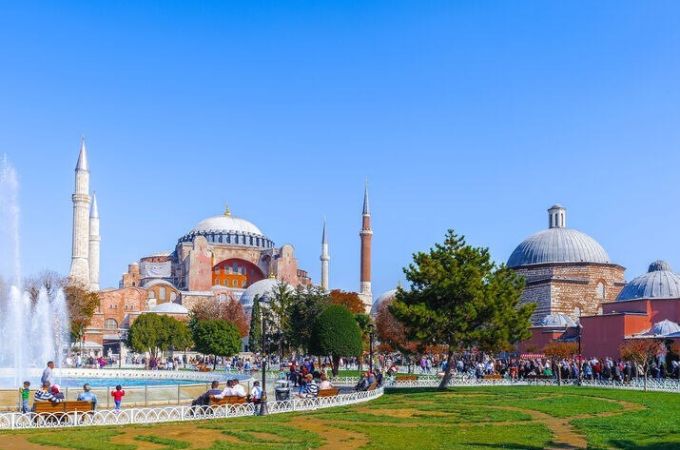
The city's European side includes many of the areas first-time visitors know best, including much of the historic peninsula and districts such as Sultanahmet, Eminönü, Beyoğlu and Beşiktaş.
Across the Bosphorus lie Asian-side districts such as Üsküdar and Kadıköy.
The remarkable thing is how ordinary the crossing feels.
You can finish breakfast in Europe, board a ferry and be in Asia shortly afterward without leaving Istanbul.
For local residents, this is part of everyday commuting.
For travelers, it creates one of the most intuitive demonstrations of transcontinental geography anywhere in the world.
If understanding Istanbul's relationship with both continents interests you, Istanbul Bosphorus tour experiences can make the geography visible through the city itself rather than treating the continental divide as an abstract fact.
What Actually Separates Europe and Asia in Turkey?
The traditional geographic boundary runs through the Turkish Straits system.
That includes:
| Geographic feature | What it separates | Travel significance |
|---|---|---|
| Bosphorus | European and Asian Istanbul | Most visible continental crossing |
| Sea of Marmara | Thrace and Anatolia | Internal sea between the straits |
| Dardanelles | European Gallipoli and Asian Çanakkale side | Historic maritime gateway |
| Eastern Thrace | European Turkey | Connection toward Greece and Bulgaria |
| Anatolia | Asian Turkey | Contains most of the country |
The Bosphorus is the best-known section because it runs directly through Istanbul, but the division continues beyond the city through the wider straits system.
This means the continental boundary is not a single bridge or one imaginary line.
It is part of a wider geographical corridor connecting major seas and regions.
The Dardanelles Matter Just as Much as the Bosphorus
The Bosphorus receives more attention because Istanbul is larger and more internationally famous, but the Dardanelles are equally important to understanding Turkey's geography.
This narrow waterway connects the Aegean Sea with the Sea of Marmara.
On its European side lies the Gallipoli Peninsula.
Across the water, in Asia, lies the Çanakkale region.
This creates another place where Europe and Asia face each other across a relatively narrow stretch of water.
The area also carries enormous historical significance because control of the Dardanelles has influenced ancient warfare, Ottoman strategy and twentieth-century history.
Travelers exploring Gallipoli and Troy tour routes can therefore encounter the Europe–Asia divide through both geography and history.
Troy Is in Asia Even Though Its Story Feels Deeply Connected to Greece
This is a good example of why geographical and cultural categories do not always align neatly.
Ancient Troy lies in northwestern Anatolia, on the Asian side of modern Turkey.
Yet its history is deeply intertwined with the Greek literary tradition through the Trojan War narratives associated with Homer's Iliad.
For travelers, this can initially feel contradictory.
It is not.
Ancient civilizations did not organize themselves according to modern national or continental categories.
The Aegean connected people as much as it separated them.
Greek settlements existed across western Anatolia. Anatolian civilizations interacted with the Aegean world. Roman and Byzantine territories later spanned regions that today belong to different countries and continents.
Turkey's geography makes much more sense once the Aegean is understood as a historical connector rather than simply a modern border.
Ephesus Is Also in Asia
Ephesus is another location that surprises some travelers.
The ancient city sits near Turkey's western Aegean coast, geographically in Asia.
Its Greek and Roman architectural identity can cause visitors to imagine it as culturally “European,” but that is applying modern continental expectations to an ancient world that functioned differently.
Ancient western Anatolia contained many major Greek cities.
Later, under Roman rule, Ephesus became one of the most important urban centers of the Roman province of Asia.
That historical fact reveals something important about the word “Asia” itself.
For Greeks and Romans, Asia referred to regions that included parts of western Anatolia long before modern continental categories developed into their current form.
Cappadocia Is Firmly in Asian Turkey
Once travelers move inland toward Cappadocia, the Asian geography becomes more intuitive.
Cappadocia lies in Central Anatolia and belongs unmistakably to the interior landscape of Asian Turkey.
Its volcanic valleys, rock formations and underground settlements feel geographically distant from the Bosphorus, even though domestic flights make Istanbul and Cappadocia easy to combine.
This contrast is useful.
A first-time visitor can begin in transcontinental Istanbul and then fly deeper into Anatolia, experiencing a dramatic change in landscape without ever leaving Turkey.
That is one reason Istanbul and Cappadocia journeys create such a strong first-trip combination.
The two destinations show how much geographic variety exists inside one country.
Ankara Is in Asia, Not Europe
Turkey's capital is Ankara, and Ankara lies in Central Anatolia on the Asian side of the country.
This sometimes surprises people who assume Istanbul is the capital because it is Turkey's largest and most internationally recognizable city.
The distinction matters.
Istanbul represents Turkey's historical imperial and transcontinental identity.
Ankara represents the modern republican political center.
Geographically, Ankara also reinforces the fact that the country's administrative heart lies in Anatolia.
For anyone trying to understand Turkey through a simple “European or Asian?” framework, this is another reminder that most of the country's territory, population centers and internal geography extend across Asia.
Does Being in Asia Mean Turkey Is a Middle Eastern Country?
Not automatically.
Geographic Asia includes enormous and extremely diverse regions, from East Asia to South Asia, Central Asia, the Caucasus and the Middle East.
Turkey's position at the western edge of Asia means it intersects several regional identities.
Parts of its history and geography connect strongly with the Middle East.
Other parts connect with the Balkans, Caucasus, Black Sea, Mediterranean and Aegean worlds.
Describing Turkey solely as Middle Eastern therefore captures only one dimension of the country.
Likewise, describing it only as European removes most of its physical geography.
The strongest way to understand Turkey is as a country located at the intersection of several regional systems rather than forcing the entire country into one cultural box.
Is Turkey Considered Part of Europe Politically?
This is where the original geography question can drift into another semantic intent, so the distinction matters.
Geographical location and political or institutional relationships are different issues.
Turkey participates in numerous European political, economic, sporting and cultural institutions while also maintaining extensive relationships across Asia and the Middle East.
That does not change the physical map.
Geographically, Turkey remains transcontinental.
A travel article about whether Turkey lies in Europe or Asia does not need to turn into a detailed discussion of European Union policy, membership negotiations or political identity.
Those are separate questions.
For travelers, the useful point is much simpler:
continental geography does not determine every aspect of cultural or political belonging.


A travel professional specializing in tailor-made travel planning, guest experience management, and multi-destination tourism operations.
With over 23 years of experience in the travel industry, he designs and manages private and cultural tours for international travelers across Türkiye, Greece, Egypt, Jordan, Morocco, and other destinations.
He has strong expertise in both online and face-to-face guest communication, sales processes, and end-to-end travel operations.
Working closely with hotels, travel agencies, and local partners, he ensures smooth coordination and high-quality travel experiences at every stage of the journey.
His focus is on delivering personalized, reliable, and seamless travel experiences for international guests worldwide.