June Weather in Cairo: More Daylight Doesn't Mean More Sightseeing
Updated: August 12, 2026
June gives Cairo travelers something that initially looks like an advantage: time.
Days are long, rain is exceptionally unlikely to interfere with plans, and the uncertainty associated with transitional spring conditions has largely disappeared. You can wake to sunshine, spend a substantial part of the day sightseeing and still discover that plenty of daylight remains.
Yet that apparent abundance creates June's most important planning trap.
Available daylight and useful sightseeing capacity are not the same thing.
Daytime temperatures commonly reach the low-to-mid 30s°C, with consistently dry conditions and strong sunshine. June is unmistakably summer, but it does not need to be written as a preview of July or August. Its defining feature for a visitor is the combination of long days and sustained warmth, which makes it remarkably easy to plan more activity than you will actually enjoy.
The smartest June itinerary therefore does not ask, “How much can we fit before sunset?”
It asks, “Which experiences deserve the longest uninterrupted periods today?”
June Removes One Uncertainty and Creates Another
Spring visitors may check forecasts to understand whether a particular day will be cooler, warmer, hazier or windier than expected. By June, Cairo's weather pattern is generally more settled.
That simplifies packing and daily preparation.
What becomes harder is judging the cumulative effect of spending two, three or four hours at a single outdoor attraction. A quick exterior stop and an extended archaeological exploration can both be labeled “outdoor sightseeing,” yet they demand completely different amounts of energy.
June therefore requires a different way of reading an itinerary.
Instead of sorting attractions only into indoor and outdoor categories, sort them by exposure duration.
A 30-minute open-air experience may fit almost anywhere in the schedule. A three-hour archaeological visit deserves much more deliberate placement.
How Long Will You Actually Be Outside?
This question becomes more useful than counting attractions.
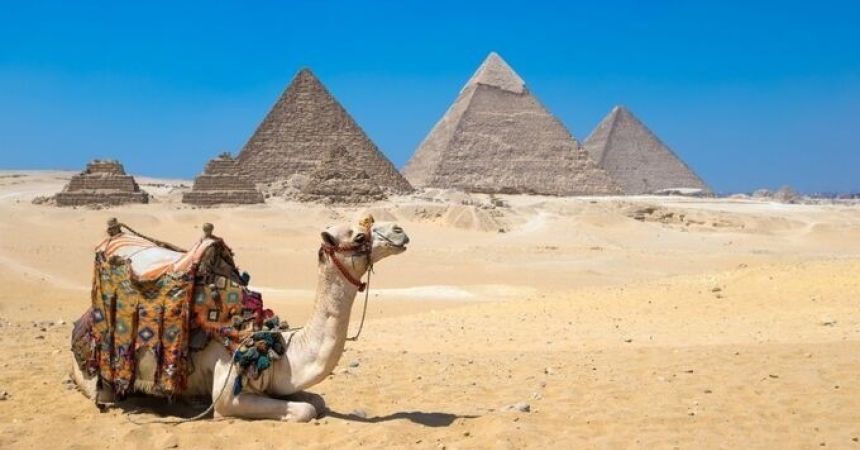
Consider Giza. Travelers visiting only the principal viewpoints experience the plateau differently from someone exploring more extensively, entering accessible pyramid areas and spending substantial time around the complex.
Saqqara creates an even wider range of possibilities. A focused visit to the Step Pyramid complex and a detailed archaeological exploration involving additional tombs and monuments may share the same destination name on an itinerary, yet the second can require several more hours.
June amplifies that difference.
Read Cairo by Exposure Duration
| Experience | Typical Exposure Pattern | June Consideration |
|---|---|---|
| Panoramic Giza stop | Short, concentrated | Easier to position |
| Detailed Giza visit | Extended outdoor periods | Treat as a major activity |
| Deep Saqqara exploration | Long, open exposure | Protect time and energy |
| Historic Cairo route | Broken exposure | Interiors interrupt the day naturally |
| Museum visit | Controlled environment | Useful between demanding activities |
| Short Nile-side stop | Limited outdoor duration | Flexible later in the day |
The important word here is not temperature. It is duration.
The Longest Visit Deserves the Freshest Part of You
June sightseeing becomes easier when the attraction requiring the greatest concentration receives more than simply a favorable position on the clock.
It should also receive your best energy.
If ancient Egyptian archaeology is the main reason for visiting Cairo, spending several fresh hours at Giza or Saqqara makes more sense than arriving after an already demanding morning elsewhere simply because the site remains open.
The same applies to travelers with specialized interests. Someone fascinated by Islamic architecture may prefer to preserve energy for a detailed historic Cairo walk rather than automatically prioritizing the Pyramids first.
Weather planning should support your travel priorities, not dictate them.
That distinction is particularly important for travelers beginning an Egypt civilization discovery tour, because Cairo may contain only the first of many historically dense sightseeing days.
June Daylight Can Encourage Bad Itineraries
A long summer day makes an overfilled schedule look surprisingly reasonable on paper.
There appears to be enough time for Giza, Saqqara, lunch, a museum, the Citadel, a market and perhaps an evening activity. Transportation times fit. Opening hours may fit. Sunset certainly fits.
The human traveler may not.
June exposes the difference between logistical possibility and experiential quality.
An itinerary can be technically achievable while leaving the final two attractions reduced to little more than photographs and hurried explanations. By then, the problem may not be dramatic heat exhaustion. It may simply be that several hours of warmth, walking, visual concentration and transfers have reduced your interest in absorbing another major historical site.
Long daylight should provide flexibility, not an excuse to expand the checklist.
Save Something for After the Sun Changes
One of June's advantages is that the day does not need to operate as a single continuous sightseeing block.
A substantial morning can be followed by lunch, downtime and a later return to the city. Because daylight extends well into the evening period, taking a meaningful break does not automatically mean sacrificing the remainder of the day.
This creates an alternative to the classic tour pattern of leaving the hotel once and returning only after dinner.
A traveler might complete the day's most important sightseeing, return to the hotel, then head out again later for an unstructured neighborhood experience or dinner. The second outing has a different purpose and does not need to carry another major archaeological objective.
That distinction helps June feel spacious rather than exhausting.
Your June Day Bag Should Get Smaller
May required travelers to think carefully about water, shade and what they carried through warm outdoor environments. June offers an opportunity to simplify further.
Every object in a day bag is something you carry for several hours.
Water, sun protection, sunglasses, necessary personal items and essential travel documents deserve their place. Multiple spare layers usually do not. Neither does a collection of items packed for weather scenarios that are unlikely during Cairo's settled early summer.
The goal is not minimalist packing for its own sake. It is reducing unnecessary physical load on a day already involving substantial walking.
Travelers continuing on a Pyramids and Nile exploration will also appreciate luggage choices that work repeatedly rather than carrying specialized items for every destination.
June Sun Can Be Easy to Underestimate From Inside a Vehicle
Air-conditioned transportation creates a peculiar summer effect.
You leave an archaeological site, cool down during the drive, then step outside at the next stop feeling temporarily refreshed. That can disguise how much total outdoor exposure has accumulated across the day.
The vehicle has changed how you feel; it has not reset the day.
This matters most on itineraries built around many separate stops. Five relatively short outdoor visits interrupted by comfortable transfers may look easier than one long archaeological excursion, yet together they can still represent hours under strong sunshine.
Rather than treating every transfer as complete recovery, consider the entire day's exposure.
June Is Not Yet the Article About Cairo's Maximum Heat
Keeping the cluster clean requires an important boundary.
June is hot. Strong sunshine matters, extended exposure matters, and an intelligently designed itinerary improves the experience.
But this article should not absorb the semantic territory belonging to July and August.
Those months will address Cairo when peak-summer conditions become the dominant planning variable. June's story is different: reliable early-summer warmth meets the year's longest daylight, creating a temptation to stretch sightseeing simply because the clock allows it.
That is the specific problem this page solves.
Use the Extra Hours as Margin
The most valuable way to use June's long day may be not to use every hour at all.
Extra daylight provides margin when traffic runs slowly, when a guide's explanation becomes more interesting than expected, when lunch lasts longer, or when you simply decide that an archaeological site deserves another forty minutes.
That flexibility is valuable on a Cairo and Upper Egypt journey, where the quality of individual experiences matters more than collecting the maximum possible number of stops.
June gives you time.
The trick is resisting the urge to spend all of it.

A travel professional specializing in tailor-made travel planning, guest experience management, and multi-destination tourism operations.
With over 23 years of experience in the travel industry, he designs and manages private and cultural tours for international travelers across Türkiye, Greece, Egypt, Jordan, Morocco, and other destinations.
He has strong expertise in both online and face-to-face guest communication, sales processes, and end-to-end travel operations.
Working closely with hotels, travel agencies, and local partners, he ensures smooth coordination and high-quality travel experiences at every stage of the journey.
His focus is on delivering personalized, reliable, and seamless travel experiences for international guests worldwide.