Five Days in Greece: Choosing Your Second Chapter
- Home
- Travel Guides for Better-Planned Trips
- Greece
- Five Days in Greece: Choosing Your Second Chapter
Five Days in Greece: Choosing Your Second Chapter
Last Updated: August 10, 2026
Five days in Greece is enough time to move beyond Athens, but not enough time to keep every option open.
That is what makes this trip interesting.
With three days, the main question is whether you should leave Athens at all. With five, the decision changes. You have enough room for a second chapter, yet not enough room to treat mainland Greece and the islands as equal partners.
Something has to come second.
That second chapter shapes the entire mood of the journey.
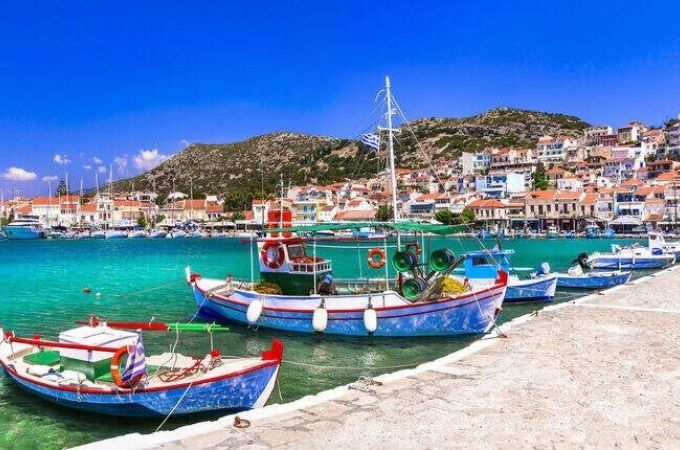
If you choose an island, the trip becomes about contrast: ancient city, sea, whitewashed villages, harbors and a slower visual rhythm. If you choose the mainland, the transition is more cultural and geographical, moving from Athens toward archaeological landscapes, mountains or monasteries without introducing ferry logistics.
Neither choice is more “Greek.”
They simply tell different stories.
The real planning task is deciding which story you want.
First Decide What Athens Has Already Given You
Before choosing where to go next, look at the role Athens has already played.
If your first part of the trip has been dominated by classical history, museums and ancient monuments, another archaeological destination may deepen that theme. That can be exactly what you want if history is the reason you traveled.
But if you are looking for contrast, the second chapter should do something Athens cannot.
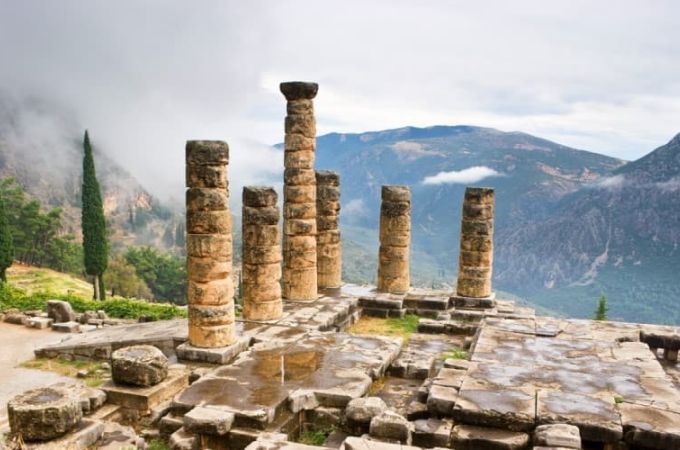
An island offers sea, harbor life, different architecture and a distinct daily rhythm. Meteora introduces vertical landscapes and monasteries. Delphi adds a mountain setting around ancient history. The Peloponnese can move the journey toward wider archaeological and rural experiences.
The mistake is choosing the second destination first and only afterward asking what it contributes.
Reverse that.
Ask what Athens has already covered, then choose what the trip is still missing.
The Island vs Mainland Decision
This is the central fork in a five-day Greece trip.
| Second Chapter | What It Adds | Main Trade-Off | Best For |
|---|---|---|---|
| Island | Sea, visual contrast, island atmosphere | Ferry or flight logistics | Travelers seeking a change of mood |
| Delphi | Archaeology + mountain setting | Less contrast from Athens' historical focus | History-driven trips |
| Meteora | Dramatic landscape + monasteries | Longer overland commitment | Scenery and cultural depth |
| Peloponnese | Archaeology + road journey | More route complexity | Travelers interested in mainland history |
| Stay in Athens longer | Urban depth | Less geographical variety | Slower travelers |
The table is not telling you what to choose.
It is showing you what each choice asks from the five days.
When an Island Is the Right Second Chapter
For many first-time visitors, an island makes immediate emotional sense.
Greece is strongly associated with the sea, and ending the trip without experiencing that side of the country can feel incomplete.
If that feeling matters to you, the island choice is easy to justify.
The important question is not “Which famous island should I add?” but “Which island gives me the contrast I want without forcing the whole trip to become transportation?”
That distinction matters on a five-day schedule.
A two-night island stay can feel substantial if the journey there is efficient and the island itself matches your priorities. It can also feel surprisingly thin if much of the first and last day disappears into transfers.
Travelers looking for a classic island contrast after Athens might consider an Athens and Santorini journey, particularly when the intention is to move from cultural sightseeing into a visibly different Aegean setting.
But Santorini should not become an automatic answer simply because it is famous.
Santorini Changes the Mood More Than the Geography
Santorini is compelling because it does not merely add another destination.
It changes the tone of the trip.
Athens is dense, historical and urban. Santorini is open, visual and shaped by the caldera. Even if both are busy, they feel fundamentally different.
That contrast is powerful on a short journey.
The challenge is that Santorini is not next door. You are committing to a ferry or flight, transfers on both sides and at least some time adapting to another base.
That is not necessarily a problem.
It becomes a problem only when the island is treated as if the travel time did not exist.
If Santorini is your second chapter, let it be a real chapter. Do not arrive late, rush through Oia, sleep once and leave before the island has had time to become more than a photograph.
Five days rewards a decisive choice.
When the Mainland Is the Better Answer
There are equally strong reasons to stay on the mainland.
A history-focused traveler may find that moving from Athens to Delphi creates a more coherent journey than switching suddenly into island mode. The experience remains rooted in ancient Greece, but the setting changes from urban archaeology to a mountain sanctuary.
Meteora shifts the trip in another direction entirely. The monasteries and rock formations introduce a visual drama that has little in common with Athens, yet the journey remains on the mainland.
That can appeal to travelers who want contrast without ferry dependence.
A Delphi and Meteora route can be particularly meaningful when the second chapter is intended to deepen Greece's cultural and landscape story rather than pivot toward island life.
The mainland choice is often underestimated because it lacks the instant visual shorthand of “Athens + island.”
It can still produce the more memorable trip.
Do Not Judge the Second Chapter by Fame
This is where five-day itineraries often become generic.
Athens is famous.
Santorini is famous.
Therefore Athens + Santorini must be the ideal five-day Greece trip.
Sometimes it is.
But fame is not a planning method.
The better question is whether the second chapter answers your strongest unmet travel priority.
If you want sea and visual contrast, an island makes sense.
If you want archaeology, Delphi or the Peloponnese may suit you better.
If you want dramatic scenery and a more unusual mainland experience, Meteora may beat an island entirely.
A short trip becomes more personal when the second chapter is chosen for fit rather than recognition.
The Two-Chapter Rule
Five days works best when the trip feels like two distinct parts rather than one long chain of stops.
Think of it as:
Chapter One: Athens
Chapter Two: one clearly different direction
That direction may be island, archaeology, landscape or coastal mainland.
What usually weakens the trip is trying to make Chapter Two contain several unrelated destinations.
For example, Athens + Santorini + Delphi may look varied on paper. In practice, the second half is no longer one chapter. It is two competing mini-trips.
The same problem appears with Athens + Meteora + island.
The calendar may technically support the moves, but the story becomes fragmented.
Two chapters allow both parts of the trip to breathe.
The Second Chapter Should Earn the Transfer
A useful test is to compare not the destination itself, but what it adds relative to the effort required.
Ask:
Does it provide an experience Athens cannot?
Will I have enough time there to feel settled?
Does the transfer support the route, or dominate it?
Would I still choose it if it were less famous?
If the answer to those questions is strong, the second chapter probably belongs.
If the destination survives only because you feel a first trip to Greece “should” include it, think again.
Short journeys expose weak choices quickly.
A Five-Day Trip Should Not Pretend to Be a Week
This is an important boundary.
Five days gives you enough time to add a second chapter.
It does not give you enough time to imitate a seven-day island-hopping trip by compressing everything.
That means resisting the urge to add a second island, a long ferry sequence or multiple mainland stops.
Those belong to a different planning problem.
The five-day question is about what comes after Athens, not about maximizing how many parts of Greece can fit.
That distinction protects the trip from becoming hurried and protects this blog from drifting into the semantic territory of longer itineraries.
Which Second Chapter Fits Your Travel Style?
Here is a more personal way to decide.
| If You Value Most... | Strongest Direction |
| Sea and iconic scenery | Island |
| Classical archaeology | Delphi or Peloponnese |
| Dramatic landscapes | Meteora |
| Slow urban depth | Stay longer in Athens |
| Minimal transport complexity | Mainland |
| Strongest mood contrast | Island |
Notice that “first-time visitor” is not a category.
That is deliberate.
First-time travelers do not all want the same trip.
Some want the sea.
Some want history.
Some want landscapes.
Planning improves when those differences are treated as real.
What If You Want Both Mainland and Island?
Then you have found the central limit of five days.
You can force both into the schedule.
The cost is that neither becomes a true second chapter.
You may spend a day traveling to a mainland site, return to Athens, then use another block of time reaching an island. The trip starts feeling like a sequence of departures rather than a progression.
If both matter equally, there are two better options.
Either extend the trip, or choose which side deserves this journey and save the other for next time.
That may sound frustrating when you are still planning.
It usually feels like a relief once you are actually traveling.
The Best Five-Day Decision Is a Clear One
A strong five-day plan should be easy to describe.
“We are starting with Athens and then spending the second half by the sea.”
“We are using Athens as the first chapter, then moving north for Delphi and Meteora.”
“We care more about history than islands, so the trip stays on the mainland.”
These choices have identity.
A weaker plan often sounds like this:
“We are doing Athens, maybe Santorini, maybe Delphi, and if the ferry works we might add something else.”
That is not flexibility.
That is indecision disguised as itinerary planning.
Five days is enough time for one meaningful transition.
Make that transition count.


The Second Chapter Should Change the Story
A useful five-day itinerary has a noticeable before-and-after quality.
Athens gives you one kind of Greece: urban, historical, layered and dense. The second chapter should introduce something that changes the way the trip feels rather than simply moving you somewhere else.
This is why the choice between island and mainland matters more than the destination name itself.
If you go to an island, the story shifts toward sea, light, harbors and a slower visual rhythm. If you go inland, the change may come through landscape, archaeology or monasteries. If you stay in Athens longer, the contrast is not geographical at all; it comes from moving beyond headline sights into neighborhoods, museums and everyday city life.
The strongest second chapter is the one that gives the trip a new dimension without making the first chapter feel rushed.
Use a Contrast Score, Not a Popularity Score
Travel planning often becomes distorted by popularity.
Places with more photographs, more reviews and more famous names start to feel as though they automatically belong in the itinerary.
A five-day trip does not have enough room for that logic.
Try scoring the second chapter on contrast instead.
| Question | Strong Answer Means... |
|---|---|
| Does it feel different from Athens? | Stronger reason to add it |
| Does it create a new travel mood? | Better narrative progression |
| Can it receive enough time to matter? | Transfer is easier to justify |
| Is it connected cleanly? | Less trip fragmentation |
| Would I choose it without social-media influence? | It is probably a genuine priority |
This simple exercise often reveals that the best choice is not the most famous one.
It is the one that changes the trip most efficiently.
When a Smaller Island Can Beat a Famous One
If island atmosphere is your priority, you do not always need to make the most ambitious island move.
A closer or more easily connected island can sometimes perform the role better in a five-day trip because it gives back more usable time.
The goal is not to find the “best Greek island” in general.
It is to find the island that fits the limited space available in this particular journey.
A smaller island may offer harbors, beaches, village life and a strong sense of being away from Athens without requiring the same logistical commitment as a distant Cycladic destination.
This is one reason short Greece trips should be planned around fit, not status.
The destination does not need to win a national ranking.
It needs to work inside five days.
When the Mainland Feels More Complete
Some travelers worry that staying on the mainland means missing “real Greece.”
That idea is misleading.
Mainland Greece contains some of the country's most important archaeological, religious and landscape experiences. Moving from Athens toward Delphi or Meteora can create a journey with as much contrast as an island extension, just of a different kind.
For history-focused travelers, the mainland can also feel more coherent.
The trip becomes a progression through different layers of Greek civilization rather than a sudden pivot from archaeology to resort atmosphere.
A traveler drawn to this kind of journey might consider a mainland Greece cultural route, particularly when the second chapter is meant to deepen history and landscape rather than introduce island life.
The point is not that mainland is better.
It is that it deserves to be treated as a first-choice direction, not a backup plan.
Do Not Build a Five-Day Trip Around Transport Anxiety
One of the signs that a route is wrong for the available time is how much mental space the transportation takes up.
If you are constantly checking ferry departure times, wondering whether luggage can be stored, calculating whether a connection is safe and worrying about reaching the airport on time, the second chapter may be asking too much from the trip.
A good five-day route should feel decisive once the major move is booked.
You should know where the second half of the trip is going and why.
That sense of certainty matters because short trips have less room to recover from logistical mistakes. The more complicated the route, the more attention you spend managing it.
The second chapter should add experience, not administrative work.
What Not to Combine in Five Days
There are combinations that may be technically possible but strategically weak.
Athens + Santorini + Meteora
This creates three completely different directions and requires multiple substantial transitions. The contrast is excellent, but the route is too fragmented for five days.
Athens + Santorini + another island
This begins drifting into the ferry-architecture problem that belongs to a longer trip. A second island reduces the time available for both Athens and the first island.
Athens + Delphi + Santorini
This can be constructed, but the mainland and island chapters compete for the same limited space.
Athens + Meteora + Peloponnese
The issue is not that these places do not belong together culturally. It is that five days does not give each region enough room.
The common pattern is clear.
The problem is not “too many destinations” in the abstract.
It is too many second chapters.
A Five-Day Trip Needs One Main Contrast
This is the simplest way to protect the itinerary.
After Athens, choose one of the following:
Sea
Archaeology
Landscape
Urban depth
Then let the second half of the trip serve that choice.
You can still include smaller experiences around it, but the journey should not keep changing direction.
This creates a cleaner emotional arc.
Athens → sea.
Athens → mountains and monasteries.
Athens → archaeology.
Athens → deeper city life.
Each has a clear identity.
A short trip gains more from identity than from quantity.
Use the Last Evening as a Test
Think about how you want the final evening to feel.
Do you imagine sitting somewhere overlooking the Aegean?
Do you want to return to Athens with a sense that the historical journey has continued rather than ended?
Would you rather finish among dramatic inland landscapes?
Or do you want the simplicity of one last dinner in a neighborhood you have learned to recognize?
This is a surprisingly useful planning tool because it forces you to imagine the experience rather than the map.
The right second chapter often becomes obvious when you think about the trip's ending instead of its middle.
Five Days Works Best When the Decision Is Made Early
Do not leave the island-vs-mainland question until after you have booked several nights in Athens.
The second chapter affects where you should stay, how much luggage you want to move and what transportation makes sense.
Decide the broad direction first.
Then organize the details.
This avoids the common situation where travelers book Athens because it is easy, then try to force an island or mainland extension into whatever dates remain.
The result is usually a route built from leftovers.
A better trip begins with two intentional chapters.
Frequently Asked Questions About 5 Days in Greece
Should I choose an island or mainland Greece after Athens?
Choose based on what you want the second half of the journey to contribute. An island gives you sea, visual contrast and a different pace, while the mainland can provide archaeology, mountain landscapes and cultural depth. The stronger choice is the one that adds what Athens did not.
Is Santorini the best island for a five-day Greece trip?
Not automatically. Santorini creates strong visual contrast and can be a memorable second chapter, but its value depends on your priorities and the transportation involved. A closer island may preserve more usable time, while a mainland extension may suit history-focused travelers better.
Can I visit Athens and Meteora in five days?
Yes, especially if dramatic landscapes and monasteries matter more to you than island time. The route should be built around this mainland contrast rather than adding Meteora as a side trip after another major destination. Five days works best when the second chapter has a clear purpose.
Is Delphi better than an island for a short Greece trip?
It depends on what you value. Delphi is stronger for travelers focused on ancient history, mythology and archaeology, while an island offers sea and a distinct change of atmosphere. Neither is objectively better; the right choice depends on which experience is missing from the Athens portion.
Should I add two islands in five days?
Usually no. Two islands introduce another transfer and divide limited island time even further. If island-hopping is central to your plans, a longer trip is better suited to that structure. With five days, one island generally creates a cleaner and more satisfying second chapter.
Can I combine Athens, Delphi and an island in five days?
It is possible, but the itinerary becomes fragmented because both Delphi and the island compete for the same limited second chapter. Travelers who strongly prioritize all three should consider extending the trip rather than forcing them into five days and reducing the quality of each section.
Is staying only in Athens a waste of five days?
Not at all. Athens can easily support a longer stay through historical sites, museums, neighborhoods, food and day trips within Attica. Staying longer makes particular sense for slower travelers or visitors who prefer urban depth over the logistical cost of changing regions during a short trip.
How do I know whether a second destination is worth the transfer?
Ask whether it adds something Athens cannot, whether you will have enough time there to feel settled and whether the transfer is proportionate to the experience gained. If the move mainly increases destination count without changing the trip significantly, it may not be worth it.
Is mainland Greece less suitable for first-time visitors than the islands?
No. Mainland Greece offers major archaeological sites, dramatic landscapes and important cultural experiences. Some first-time visitors will get more from Delphi, Meteora or the Peloponnese than from an island. The ideal route should reflect personal interests rather than a standard first-visit formula.
What is the biggest mistake in a five-day Greece itinerary?
The biggest mistake is trying to create several competing second chapters after Athens. Combining an island, a major mainland extension and additional stops may be technically possible, but the repeated transitions reduce the amount of time each destination receives and make the trip feel fragmented.
Should the second chapter be two nights or longer?
The exact number depends on your arrival and departure times, but the second chapter should receive enough uninterrupted time to become more than a transfer stop. A destination that gets only a rushed evening and one morning may not justify the effort required to reach it.
How should a five-day Greece trip feel different from a three-day trip?
A three-day trip is mainly about deciding whether Athens should remain the only base. Five days gives you enough time for a genuine second chapter. The planning problem therefore shifts from excursion choice to selecting one meaningful direction that changes the character of the journey.
A travel professional specializing in tailor-made travel planning, guest experience management, and multi-destination tourism operations.
With over 23 years of experience in the travel industry, he designs and manages private and cultural tours for international travelers across Türkiye, Greece, Egypt, Jordan, Morocco, and other destinations.
He has strong expertise in both online and face-to-face guest communication, sales processes, and end-to-end travel operations.
Working closely with hotels, travel agencies, and local partners, he ensures smooth coordination and high-quality travel experiences at every stage of the journey.
His focus is on delivering personalized, reliable, and seamless travel experiences for international guests worldwide.