Mykonos Greece: Where You Stay Changes the Entire Trip
Updated: August 2026
Mykonos is often described through contradictions. It is glamorous but traditional, energetic but beautiful, expensive yet enormously popular, famous for nightlife while simultaneously attracting couples, families, beach travelers and people who have no intention of entering a club.
All of those descriptions can be true because visitors are not really experiencing one Mykonos.
A traveler who wakes beside a southern beach, swims before breakfast and spends most of the afternoon near the hotel is having a completely different holiday from someone who stays within walking distance of Mykonos Town, wanders through its lanes before the crowds build and returns there for dinner every evening.
This distinction matters more than assembling a list of famous sights.
Mykonos is relatively compact, but during busy periods the distance between where you sleep and where you repeatedly want to be can become the hidden structure of the holiday. Transfers, buses, parking, taxis and late-night returns begin consuming time that looked insignificant when the hotel was booked.
The first Mykonos decision should therefore be surprisingly personal:
When you imagine an ordinary day on the island, where do you want to be when you are doing nothing in particular?
That answer is often more useful than the hotel's star rating.
The Hotel Map Tells You More Than the Hotel Photographs
Mykonos accommodation is particularly good at selling aspiration.
Whitewashed terraces, pools overlooking the Aegean, private plunge pools and minimalist rooms photograph beautifully, but none of those images explain what happens when you want to leave the property at 8:30 in the evening.
Location determines whether dinner begins with a walk or transportation arrangement. It determines whether returning to the room for an afternoon break is easy or inconvenient, whether spontaneous drinks in town feel effortless and whether a beach day requires planning at all.
Before comparing hotels, identify the daily anchor of your holiday.
If you expect to spend most evenings in Mykonos Town, staying within practical reach of town deserves significant weight.
If swimming and resort time dominate your plans, paying for a beachfront or near-beach location can remove a considerable amount of daily movement.
If privacy matters most, a more isolated property may be ideal, but transportation should then be treated as part of the accommodation cost rather than an afterthought.
On Mykonos, a cheaper room in the wrong place can become the more expensive decision.
Mykonos Town Works Best for Travelers Who Want the Island to Remain Unscheduled
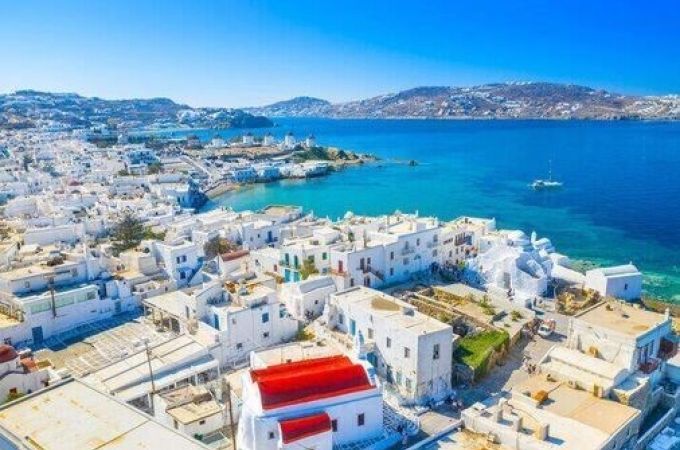
Mykonos Town, also known as Chora, gives travelers something beach resorts cannot reproduce: spontaneity.
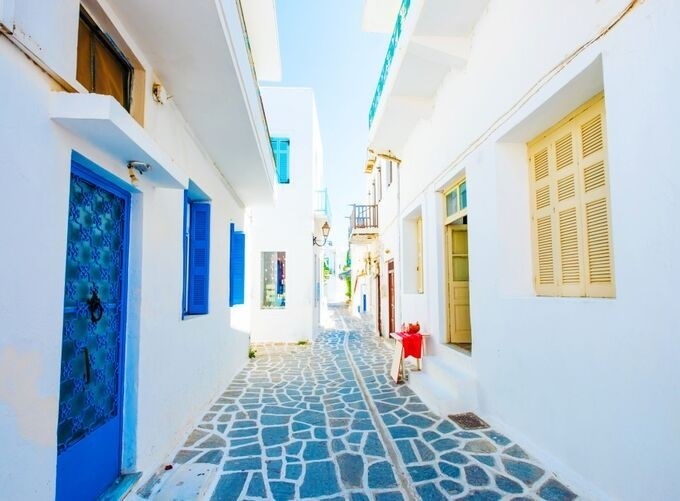
You can leave the hotel without deciding where the evening will end. Walk through narrow whitewashed lanes, stop for coffee, browse shops, change restaurants at the last minute, continue toward Little Venice or simply remain somewhere because the atmosphere feels right.
That freedom is especially valuable after sunset.
A beach hotel can offer a beautiful environment, but travelers who repeatedly return to town for dinner and evening life create a transportation dependency that becomes more noticeable over several nights.
Town-based accommodation does not mean sacrificing beaches. It means beach visits become the deliberate excursions while restaurants, shopping and evening walks remain the default environment.
For first-time visitors who want to experience several sides of Mykonos and are unsure which will matter most, that flexibility can be extremely useful.
A Beach Hotel Reverses the Logic of the Day
Stay beside a beach and the island begins differently.
There is no need to organize the morning around getting somewhere to swim because you are already there. Breakfast can stretch longer, returning to the room is easy, and a beach afternoon can evolve without transportation deadlines.
For travelers who came primarily for the Aegean, this can feel far more like a holiday than sleeping in town.
The compromise arrives later.
Dinner elsewhere may require transportation. Shopping in Chora becomes an outing rather than something encountered casually. If nightlife is important, the return journey must be considered before the evening begins.
Neither arrangement is superior.
The important question is which part of the day should require effort.
Town-based travelers usually organize their beach movement.
Beach-based travelers organize their town movement.
Once framed this way, accommodation becomes much easier to choose.
Do Not Choose a Mykonos Beach by Reputation Alone
Beach names carry strong identities on Mykonos, and those identities can influence hotel choices more than they should.
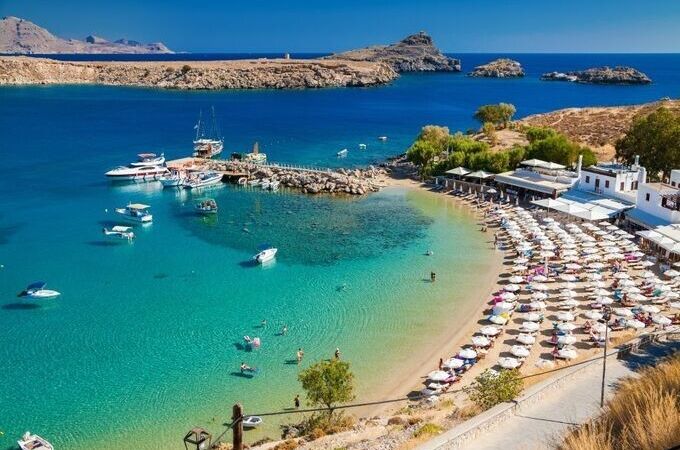
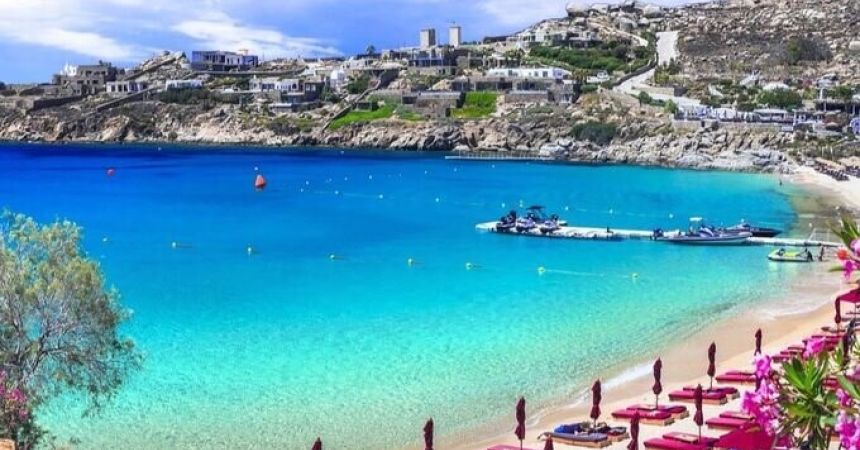
Some coastal areas are associated with sophisticated beach clubs and social energy. Others offer a more relaxed atmosphere. Certain beaches work naturally for travelers who want facilities close at hand, while quieter coastal settings appeal to visitors deliberately distancing themselves from the island's most active zones.
The right choice depends less on which beach appears most frequently online and more on what you want to hear, see and do after you put down your towel.
A couple looking for long lunches and an energetic afternoon may make one decision.
Parents wanting easy swimming and a less complicated day may make another.
Someone planning to rent a car and explore several areas may not need to pay a substantial premium to sleep beside the beach they intend to use only twice.
This article therefore will not rank Mykonos beaches from first to tenth. That belongs to another search intent.
The planning value here is recognizing that beach character can become hotel character when you stay there.
Mykonos Has a Transportation Problem Only When Your Itinerary Creates One
Visitors sometimes describe transportation on Mykonos as difficult, while others travel for several days with very few problems.
Both experiences can be genuine.
The difference often comes from planning.
A traveler who stays in town, walks most evenings and organizes one beach transfer each day has relatively simple requirements. Someone staying remotely while dining in town every night, changing beaches daily and adding late-night venues may need several separate movements within the same twenty-four hours.
During busy periods, demand for transportation can intensify, and roads around popular areas naturally become more congested.
Instead of asking whether you “need a car in Mykonos,” ask how many times per day your accommodation choice forces you to move.
That number tells you far more.
The Real Cost of a Hotel Is Not Displayed on the Booking Screen
Mykonos is one of the destinations where comparing room rates without comparing daily logistics can be misleading.
Imagine two hotels.
Hotel A costs more but allows you to walk to the environment where you expect to spend every evening.
Hotel B costs less but requires paid transportation twice every night, plus additional beach movements during the day.
After four nights, the difference between the properties is no longer merely the room price.
There is also waiting time, planning effort and the loss of spontaneity.
For that reason, use a friction calculation rather than a simple price comparison:
| Booking Question | Low-Friction Choice | Potential Hidden Cost |
|---|---|---|
| Where will we eat most evenings? | Stay within easy reach | Repeated evening transfers |
| Will we swim almost every day? | Beach-oriented base | Daily beach transport |
| Do we want nightlife? | Match location to evenings | Difficult late returns |
| Will we rent a car? | Property with practical access | Parking and road dependence |
| Do we value privacy? | Remote hotel may win | Every outing needs planning |
| Will we return to the room midday? | Stay near daily activity | Cross-island backtracking |
This is not a hotel-ranking table.
It is a way of exposing the part of the room rate that does not appear on the invoice.
Little Venice Is Better When It Is Not Your Appointment at Sunset
Little Venice and the nearby windmills form one of the most recognizable parts of Mykonos Town, and sunset naturally draws visitors toward the waterfront.
There is nothing wrong with wanting to see it.
The mistake is organizing the entire evening around arriving at one precise location at the same moment as everyone else.
If you are staying near town, you gain the luxury of repetition. Walk through the area earlier. Return another evening. See it in morning light when the atmosphere is completely different.
That changes a famous sight from an appointment into part of the neighborhood.
It also illustrates one of the strongest advantages of matching accommodation with interests: proximity allows famous places to become casual rather than compulsory.
Morning Mykonos and Midnight Mykonos Are Almost Different Destinations
Travelers who only enter Mykonos Town in the evening encounter its most animated version.
Morning tells another story.
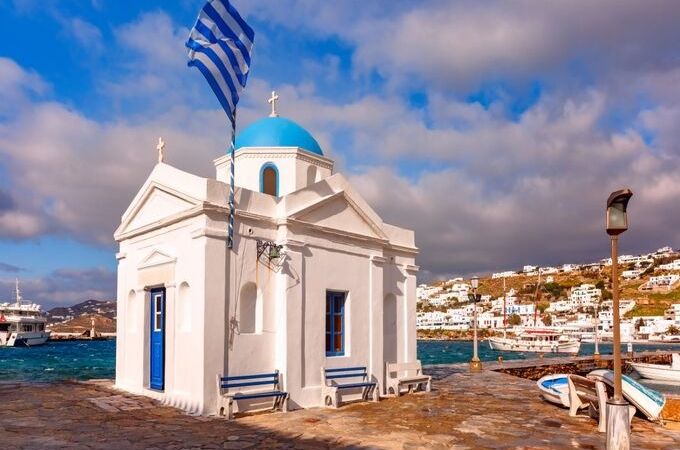
Before the busiest pedestrian flow develops, Chora's maze of lanes becomes easier to read. Whitewashed buildings, small churches and stairways have room around them, deliveries and local routines are more visible, and the architectural character that can disappear behind evening crowds becomes much clearer.
This is particularly valuable for photographers and travelers interested in the Cycladic setting beyond its social reputation.
The contrast also provides an argument for resisting over-scheduling.
You do not need to leave the hotel every morning for another formal activity. Sometimes seeing the same place at another hour provides more information than adding another destination.
Delos Should Be a Deliberate Choice, Not a Mykonos Obligation
The archaeological island of Delos lies close enough to Mykonos that it frequently appears as an automatic component of first-time itineraries.
Historically, it is enormously significant.
That does not mean every Mykonos traveler must visit.
A person fascinated by ancient Greece may consider Delos one of the most meaningful parts of the entire stay. Someone spending only two nights on Mykonos primarily for beaches and relaxation may experience the excursion as an interruption to the reason they chose the island.
This page intentionally does not become a Delos guide because the archaeological site's history, monuments and visit planning deserve separate ownership.
The useful Mykonos decision is simpler:
Would several hours devoted to archaeology enrich the holiday you are actually taking?
If yes, protect the time properly.
If no, skipping it is not a failure to complete Mykonos.
Two Nights Can Work, but They Leave Little Room for a Wrong Decision
Mykonos often appears within wider Greece itineraries, making two-night stays common.
Two nights can provide a good introduction when arrival and departure times cooperate. Travelers can experience Chora, spend meaningful time by the sea and enjoy the island's evening atmosphere.
The problem is fragility.
A late arrival, inconvenient ferry timing or badly positioned hotel can consume a disproportionate amount of such a short stay.
Three nights changes the equation considerably because one complete day can belong to the beach while another period remains available for town, Delos or another priority.
Four nights suits travelers who want both active and deliberately slow days without feeling that every afternoon must justify the accommodation cost.
Beyond that, Mykonos becomes less about “seeing enough” and more about whether its particular style of island life matches the traveler.
Expensive Mykonos Is Often a Planning Problem Before It Is a Price Problem
Mykonos has a justified reputation as one of Greece's more expensive destinations, especially when premium accommodation, restaurants and beach clubs enter the itinerary.
There is no useful reason to pretend otherwise.
However, travelers sometimes increase the cost without increasing the experience because they purchase the same convenience twice.
They book an expensive remote hotel for privacy, then spend heavily on transportation because they actually want town life every night.
Or they choose premium town accommodation, then spend every day paying for a beach environment they rarely leave.
The answer is not necessarily to spend less.
It is to make sure the expensive element corresponds to what you will use most.
If the hotel terrace is the reason you booked Mykonos, leave time to sit on it.
If beach clubs are the priority, place them at the center of the plan rather than pretending the trip is primarily cultural.
Value improves when the itinerary admits what the traveler actually wants.
Families Can Enjoy Mykonos Without Participating in Its Famous Nightlife
Mykonos' party reputation sometimes causes families to eliminate the island immediately.
That can be unnecessary.
Nightlife is geographically and behaviorally specific; it does not define every beach, hotel or hour of the day. Families choosing appropriate accommodation can build a holiday around swimming, early dinners, town walks and relatively simple island exploration.
What matters is avoiding a mismatch.
A hotel chosen because it is famous for an energetic social scene will not become quiet merely because a family booked it. Likewise, staying remotely for peace may create inconvenient transportation if parents want to visit town every evening with children.
Mykonos can work for families, but it rewards precise hotel selection more than generic “family-friendly island” labels.
Couples Should Decide Whether Privacy or Participation Matters More
Romantic travel on Mykonos comes in at least two very different forms.
One couple wants privacy: a beautiful hotel, sea views, long breakfasts and evenings that occasionally venture beyond the property.
Another wants participation: dinner in town, cocktails, people-watching, beach clubs and enough energy around them that the holiday feels socially alive.
Both can describe themselves as wanting a romantic island.
Their hotel choices should be almost opposite.
This is why destination planning based only on traveler labels—couple, honeymooner, family, luxury traveler—can be surprisingly weak.
Behavior predicts the correct Mykonos base more accurately than category.
A Four-Night Mykonos Stay Should Not Contain Four Full-Day Excursions
Mykonos becomes strangely easy to over-plan because there are enough optional activities to fill every blank space.
Delos. Sailing. Beach hopping. Private touring. Nearby islands. Sunset cruises.
Each can be worthwhile, but stacking them creates an expensive itinerary in which travelers barely experience the hotel, town or beach they crossed the Aegean to enjoy.
For guests incorporating Mykonos within Cyclades journeys with private island services, we generally find the most useful question is not what else can be added but what should remain unscheduled.
That reflects operational experience developed since Magnificent Travel began arranging regional journeys in 1997: island itineraries are frequently improved by removing a transfer or excursion rather than adding another one.
Mykonos particularly rewards that restraint.
The Island Changes Again When You Combine It With Santorini
Mykonos and Santorini are frequently paired, but similarity is not the reason the combination works.
Their strongest experiences are different.
Mykonos offers a highly social relationship between town, beaches, dining and resort life. Santorini's experience is shaped much more strongly by caldera geography, cliff settlements and the relationship between accommodation and views.
This page should not decide which island is “better”; that belongs to a separate comparison intent.
Operationally, however, travelers taking Athens, Mykonos and Santorini journeys should avoid booking equivalent experiences on both islands. If Mykonos accommodation is chosen for beach access and social energy, Santorini can play another role in the journey.
A multi-stop trip improves when each destination has a job.
The Most Useful Mykonos Itinerary Starts With Three Blank Spaces
Before adding attractions, divide the stay into three types of time:
Time you want beside the sea.
Time you want around Mykonos Town.
Time you want to commit to an excursion or organized experience.
Now look at the hotel again.
If the largest block is beach time, does the accommodation support that without daily effort?
If evenings in town matter most, will returning there repeatedly be straightforward?
If Delos or sailing is a major priority, have you protected enough unscheduled time around it that the entire stay does not become transportation?
This is a more reliable way to build tailor-made Mykonos travel arrangements than beginning with a generic list of ten attractions and trying to fit them into available days.
Mykonos is not difficult because there is too little to do.
It becomes difficult when travelers refuse to decide which version of it they want.
Frequently Asked Questions About Planning Mykonos
1. What should I check before booking a hotel with a Mykonos sea view?
Look beyond the photograph and check exact access, gradient, walking practicality, distance from your preferred evening area and transportation requirements. A spectacular view can justify isolation, but only when you genuinely intend to spend enough time at the property to enjoy it.
2. Is it inconvenient to stay at a beach hotel if I want dinner in Mykonos Town every night?
It can become inconvenient if every evening depends on separate transportation. The arrangement works when travelers accept that routine, but visitors who value spontaneous town evenings may prefer making the beach their daytime journey rather than making town their nightly journey.
3. Should I pre-plan every beach day on Mykonos?
Usually not. Decide which beach experiences genuinely require advance arrangements and leave some flexibility for weather, energy and changing preferences. Treating every beach as a reservation can remove one of the main pleasures of spending several days on an island.
4. What happens if my Mykonos hotel is far from restaurants?
The property may still be excellent, particularly if it has strong dining facilities, but you should calculate evening transportation before booking. Remote accommodation works best when privacy is intentional rather than something discovered after realizing that every meal requires another journey.
5. Is Mykonos Town still enjoyable if I dislike shopping and nightlife?
Yes. Chora's architectural character, waterfront setting, morning atmosphere, churches and pedestrian lanes exist independently of shopping and nightlife. Travelers uninterested in its commercial energy may simply find early mornings and quieter periods more rewarding than peak evening hours.
6. Does staying beside the beach mean I can avoid transportation entirely?
Not necessarily. It can substantially reduce daytime movement, but restaurants, Mykonos Town, excursions or other beaches may still require transportation. The better objective is minimizing movements that add little value rather than trying to eliminate transportation completely.
7. Should I choose Mykonos for only one night between ferry connections?
It is possible, but one night leaves very little margin for ferry timings and provides only a narrow impression of the island. If Mykonos genuinely matters to the trip, two nights should normally be considered a more meaningful minimum.
8. Is a private pool worth paying for in Mykonos?
It can be when hotel time is an important part of the holiday. Travelers planning full sightseeing and beach days followed by late evenings may barely use it, making location or room quality a more valuable upgrade than an expensive amenity.
9. How should I plan Mykonos if I do not want to rent a car?
Choose accommodation strategically and organize your main movements through available buses, transfers or taxis according to the season and itinerary. A well-positioned hotel can make a car unnecessary, while an isolated property can make transportation planning considerably more important.
10. Can I experience Mykonos nightlife without staying out until morning?
Absolutely. Mykonos' evening atmosphere begins well before late-night club hours, with dining, bars and busy streets providing plenty of social energy. Travelers can experience that side of the island while maintaining an entirely different daily rhythm from dedicated club visitors.
11. What should I do if my ferry arrives before hotel check-in?
Confirm luggage arrangements with the hotel or transfer provider beforehand rather than designing a sightseeing plan around suitcases. Early arrival can become useful beach or town time when baggage logistics are solved before reaching the island.
12. Which Mykonos booking mistake is hardest to fix after arrival?
Choosing accommodation that conflicts with how you actually want to spend each day is difficult to correct because it creates repeated transportation rather than one isolated inconvenience. Location should therefore be evaluated against daily behavior before comparing decorative hotel features.

A travel professional specializing in tailor-made travel planning, guest experience management, and multi-destination tourism operations.
With over 23 years of experience in the travel industry, he designs and manages private and cultural tours for international travelers across Türkiye, Greece, Egypt, Jordan, Morocco, and other destinations.
He has strong expertise in both online and face-to-face guest communication, sales processes, and end-to-end travel operations.
Working closely with hotels, travel agencies, and local partners, he ensures smooth coordination and high-quality travel experiences at every stage of the journey.
His focus is on delivering personalized, reliable, and seamless travel experiences for international guests worldwide.