Mykonos Weather in April: When the Island Reopens
Last Updated: August 2026
In April, Mykonos begins putting the furniture back outside.
A restaurant that was dark through winter may suddenly have tables along the street again. Hotel staff prepare terraces, seasonal properties reopen, boats and visitor services gradually return, while Chora begins acquiring a little more evening energy.
The important word is gradually.
Mykonos does not reopen on a single morning. There is no island-wide switch that turns winter off and summer on. Individual hotels, restaurants, beach venues and tourism businesses follow their own schedules, influenced by Easter, expected visitor demand and the approaching travel season.
Weather is undergoing its own transition at the same time.
Days become milder and longer, rainfall generally becomes less dominant than in winter, and outdoor sightseeing grows easier. Yet April is still spring. The sea remains cool for most casual swimmers, evenings can require a jacket and unsettled periods remain possible.
This overlap between improving weather and returning tourism infrastructure gives April its own identity.
March showed the island before the visitor season had properly awakened. May will begin shifting attention toward beaches and the approaching summer.
April is the month of reopening.
The First Sign of Spring May Be a Restaurant Table
Temperature averages do not fully explain why April feels different from March.
Typical daytime temperatures often reach around 16–20°C, while evenings may fall toward approximately 11–14°C. Warm spells can produce very pleasant afternoons, particularly later in the month, although wind and cloud can still make individual days feel considerably cooler.
What visitors often notice first, however, is activity.
More places begin operating.
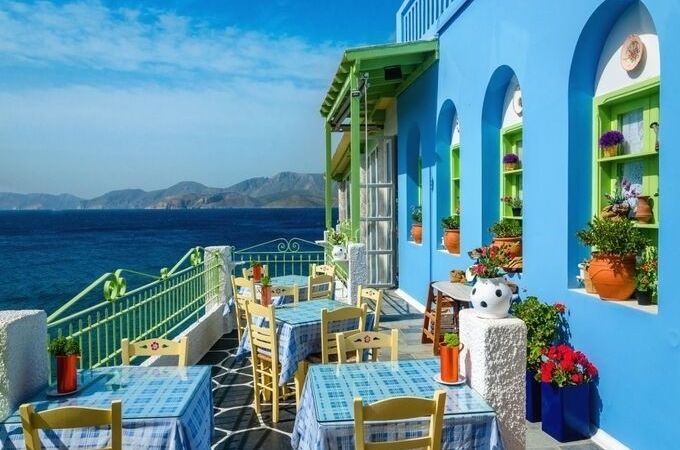
Outdoor tables return when conditions allow. Hotels prepare for guests. Tourism-dependent areas start looking less dormant, particularly as the month advances.
April Changes Two Things at Once
| Weather Transition | Tourism Transition |
|---|---|
| Longer daylight | More accommodation reopening |
| Milder afternoons | Restaurant choice begins expanding |
| Fewer deep-winter conditions | Organized services start returning |
| Outdoor dining becomes easier | Chora gains evening activity |
| Walking remains comfortable | Visitor infrastructure strengthens |
| Sea still relatively cool | Beach season not fully established |
That second column is what separates April from a generic spring-weather article.
The island itself is changing operationally.
Reopening Is Uneven — and That Matters
Suppose your hotel has reopened.
That does not mean the restaurant next door has.
A beach venue may be preparing for summer while another several hundred meters away is already operating. Chora can feel increasingly active while a highly seasonal coastal area remains much quieter.
This unevenness is normal.
Travelers sometimes interpret an open hotel as evidence that the surrounding area has returned to full seasonal operation, which can lead to unnecessary disappointment.
Check the things that genuinely matter.
If you are choosing accommodation outside Chora, ask whether nearby restaurants are operating during your dates. If a specific beach venue or excursion is important, verify it individually.
April offers considerably more than winter, but it should not be treated as July with lower room rates.
Easter Can Change the Character of the Month
Greek Orthodox Easter is one of the most important religious and family occasions in Greece, and its date varies from year to year.
When Easter falls in April, it can influence the rhythm of Mykonos considerably.
Church services, family gatherings and traditional celebrations become part of island life, while domestic travel can increase around the holiday period. Businesses may also adjust their opening schedules as the tourism season begins gathering momentum.
For international visitors, this creates an opportunity to encounter Mykonos through something other than its famous summer social scene.
A spring and Easter journey through Mykonos can incorporate churches, Ano Mera and local traditions rather than treating Easter simply as a convenient long weekend.
The important point is to respect the distinction between experiencing a cultural tradition and expecting it to function as a visitor attraction.
Ano Mera Has a Stronger April Story Than the Beaches
The coast will eventually dominate Mykonos tourism.
April does not need to rush there.
Ano Mera becomes particularly relevant around the spring and Easter period because the village offers a clearer connection with year-round island life and religious heritage. Panagia Tourliani Monastery provides cultural context, while the surrounding countryside can still retain some of the seasonal freshness associated with early spring.
Temperatures also suit inland exploration well.
A warm summer afternoon may make visitors eager to reach the coast; an April day encourages a slower route through the island's interior without feeling that you are sacrificing swimming time.
This gives the month a useful geographic balance.
Chora provides the returning visitor energy.
Ano Mera provides continuity.
Chora Begins Sounding Different After Dark
Winter Mykonos Town can become quiet remarkably early.
April gradually changes the soundtrack.
More restaurants are operating, visitors begin returning and the lanes acquire increasing evening movement. It is nowhere near peak-season intensity, nor should it be.
That middle ground can be particularly attractive.
You can wander through Chora without the density of July or August, yet the town no longer feels as though you have arrived after most of the tourism economy has gone to sleep.
Little Venice also begins functioning more naturally as somewhere to spend part of the evening rather than simply a winter coastal viewpoint.
A Mykonos Town and island highlights tour can use the daytime for broader exploration while leaving Chora for the period when its returning seasonal atmosphere becomes most noticeable.
April is one of the few months when you can watch Mykonos Town become social again without seeing it at full volume.
The Weather Is Finally Comfortable Enough to Forget for a While
Winter weather demands attention.
You check the wind before heading toward an exposed coastline, watch for rain and think about how early darkness arrives.
April begins loosening that relationship.
On a good spring day, you may spend several hours outside without thinking about the weather at all. Temperatures are mild enough for walking, the sun is increasingly strong and daylight provides enough room for unhurried sightseeing.
That does not mean forecasts become irrelevant.
Rain remains possible. Wind can still change how exposed areas feel, and evenings cool quickly compared with summer.
The difference is psychological.
Weather starts becoming background again.
How April Conditions Affect the Day
| Conditions | Where April Works Best |
| Warm and sunny | Chora + countryside + outdoor lunch |
| Mild and overcast | Long island exploration |
| Breezy but clear | Inland villages + sheltered coastal stops |
| Brief showers | Flexible Chora/heritage day |
| Calm late afternoon | Coast + sunset |
| Cool evening | Chora dining with an extra layer |
You still adjust.
You simply adjust less often.
Should You Come for the Beaches in April?
Come to see them.
Do not choose April because you expect a conventional Mykonos beach holiday.
The sea is still cool for most leisure swimmers, even when warm sunshine makes the sand look inviting. Individual beach businesses may reopen during the month, but operations vary and the full summer atmosphere has not yet developed.
That makes April beaches interesting for a different reason.
You can spend time at Ornos or Platis Gialos without feeling that swimming must justify the visit. Walk the coast, have lunch where seasonal businesses are operating and see how familiar beach areas look before summer reaches full scale.
May will own the cluster's transition toward genuine beach travel.
April is still watching the coast prepare.
The Difference Between “Open” and “Fully Open”
These phrases are often used interchangeably in travel advice, but they should not be.
Open means you can find accommodation, restaurants, transportation and experiences.
Fully open suggests the broad range and frequency associated with the main visitor season.
April belongs firmly to the first category.
| Experience | April Expectation |
| Hotels | Increasing selection |
| Chora restaurants | Growing choice |
| Beach venues | Mixed reopening |
| Nightlife | Returning, not peak |
| Public transport | Improving but verify schedules |
| Boat activities | Increasing availability |
| Shopping | More seasonal stores reopening |
| Beaches | Scenic, swimming still secondary |
This distinction is especially important when comparing prices.
A less expensive April stay may offer excellent value, but it is not necessarily providing the identical tourism product sold in August.
It is providing April Mykonos.
The Best April Days Need Almost No Itinerary
Imagine waking to clear skies and a forecast around 19°C with manageable wind.
That is not the day to overcomplicate.
Walk through Chora in the morning, drive inland toward Ano Mera, stop somewhere because the countryside looks interesting, have lunch outside and continue toward the coast later.
There is enough daylight to let the route breathe.
This is where April benefits from Mykonos's compact geography. Distances are short enough that you do not need military precision, while the absence of peak-season congestion makes spontaneous changes easier.
If a place looks inviting, stay longer.
The island will not punish you for being twenty minutes behind schedule.
Packing Gets Lighter but Not Yet Summery
April packing is easier than March but still requires layers.
Bring lightweight daytime clothing together with a sweater or similar layer and a wind-resistant jacket for evenings or exposed conditions. A compact waterproof layer remains sensible because spring showers are still possible.
Comfortable walking shoes matter more than sandals if you intend to explore Chora and the countryside extensively.
Sunglasses and sunscreen become increasingly important as daylight strengthens, even when temperatures remain moderate.
Swimwear can go into the suitcase if you enjoy cool-water swimming or your hotel has a suitable pool, but it should not occupy the same planning importance it will later in the season.
The jacket is still more useful.
April or May Is Really a Question About the Sea
For many travelers, this is the most useful comparison.
Both months offer spring conditions, increasingly active tourism infrastructure and considerably less peak-season pressure than July or August.
The main distinction is where you want the holiday to lean.
| Choose April | Choose May |
| Cultural spring atmosphere matters | Beach time matters more |
| You enjoy mild sightseeing | You want warmer conditions |
| Easter may interest you | Swimming becomes more realistic |
| You don't need full beach operations | More beach venues are active |
| Spring countryside appeals | Early-summer coast appeals |
| Lower seasonal intensity preferred | Stronger resort atmosphere preferred |
April does not lose this comparison because May is warmer.
They serve different intentions.
You Can See the Season Being Built
There is something unusual about visiting a famous tourism destination while it is preparing to become itself again.
Terraces are cleaned. Hotels reopen. Tables return outside. Seasonal workers arrive, businesses begin extending their hours and Chora gradually changes from winter town to international destination.
The transformation is incomplete, which is precisely what makes April distinctive.
You are not looking at abandoned winter infrastructure, nor have you arrived once everything is operating at summer intensity.
You are somewhere in between.
For travelers who need every beach club open and every evening busy, that incompleteness will feel like a disadvantage.
For those curious about how a seasonal island moves from one identity into another, April has a story that temperature averages alone cannot tell.

A travel professional specializing in tailor-made travel planning, guest experience management, and multi-destination tourism operations.
With over 23 years of experience in the travel industry, he designs and manages private and cultural tours for international travelers across Türkiye, Greece, Egypt, Jordan, Morocco, and other destinations.
He has strong expertise in both online and face-to-face guest communication, sales processes, and end-to-end travel operations.
Working closely with hotels, travel agencies, and local partners, he ensures smooth coordination and high-quality travel experiences at every stage of the journey.
His focus is on delivering personalized, reliable, and seamless travel experiences for international guests worldwide.