Rhodes Greece: How to Experience the Island Beyond the Old Town
Updated: August 2026
Rhodes creates an unusual first impression because it can appear to be several Greek destinations occupying the same island.
Arrive in Rhodes Town and the experience is dominated by medieval walls, stone lanes, harbors and layers of history that feel considerably different from the whitewashed Cycladic image many travelers associate with Greece. Travel south along the eastern coast and the landscape gradually becomes about coves, beaches and resort communities before Lindos introduces another historic settlement dramatically positioned above the sea. Continue farther away from the principal visitor areas and Rhodes becomes quieter, more spacious and increasingly rural.
That diversity is the island's greatest strength, but it also explains why Rhodes deserves more planning than its reputation as a straightforward beach destination suggests.
The question is not simply what to see.
You need to decide which version of Rhodes you want to wake up in each morning, because staying beside the medieval city produces a very different holiday from basing yourself near Lindos or choosing a coastal resort farther south.
Rhodes Works Best When You Stop Treating It Like a Small Island
One of the easiest planning mistakes is looking at Rhodes on a map and assuming that everything will feel close enough to approach casually.
Rhodes is one of Greece's larger islands, stretching roughly north to south with major visitor areas distributed along its coastline. Rhodes Town occupies the northern tip, while Lindos lies considerably farther south on the eastern side. Resorts, beaches, archaeological locations and villages continue between and beyond them.
That scale matters.
A couple staying in Rhodes Town can enjoy the medieval center in the evening without transportation concerns, but reaching southern beaches becomes an excursion. Someone staying near Lindos gains easier access to a completely different section of the coast but loses the ability to walk spontaneously through Rhodes Old Town after dinner.
Neither location is superior.
They simply produce different holidays.
This is why accommodation should be chosen after understanding the island rather than before it.
Rhodes Town Is More Than the Convenient Place to Arrive
Rhodes Town deserves to be considered a destination rather than merely an airport-and-port gateway.
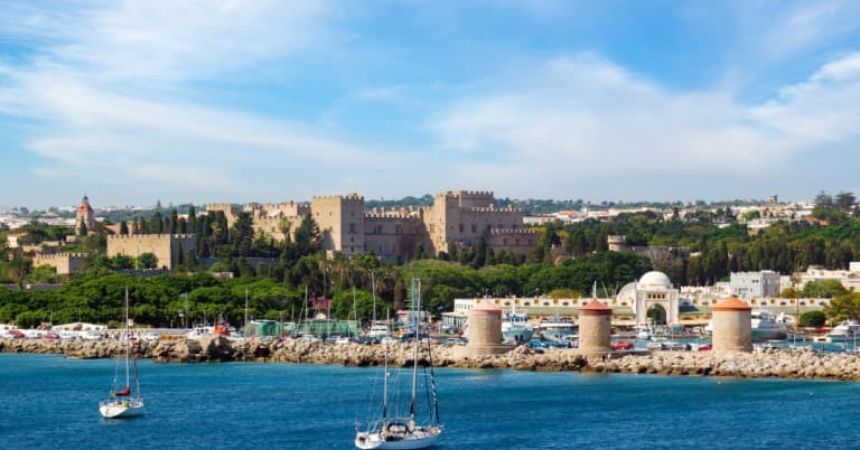
The UNESCO-listed Medieval City is the obvious reason. Walking through its fortified entrances changes the atmosphere almost immediately, with defensive walls, narrow lanes and monumental architecture preserving the character of a place shaped by centuries of Mediterranean history.
The Palace of the Grand Master provides one of the most visible reminders of the Knights of St. John, while the Street of the Knights gives the historic quarter an architectural identity unlike almost anywhere else in the Greek islands.
Yet staying in Rhodes Town offers another advantage that becomes obvious only after arrival: you can experience the medieval city at different times of day.
A day visitor sees one version.
Someone staying nearby can walk through in the morning before the streets become busier, return after sightseeing elsewhere and experience the walls and lanes again in the evening.
For history-oriented travelers, that repetition is not redundant. It is part of the reason to stay.
Choosing Your Rhodes Base Changes More Than Your Hotel View
Rhodes is easier to understand when accommodation areas are compared according to the holiday they create rather than simply their hotel inventory.
| Base | What Your Days Naturally Become | Main Advantage | What You Give Up |
|---|---|---|---|
| Rhodes Town | History, dining, walking and excursions | Old Town available morning and evening | Longer journeys to southern areas |
| Faliraki area | Beach-oriented with easy movement north/south | Practical coastal positioning | Less historical atmosphere |
| Lindos area | Scenic, romantic and southern-focused | Exceptional setting and eastern coast access | Rhodes Town becomes a planned excursion |
| Ixia/Ialyssos side | Resort stay with access to town | Convenient for northern Rhodes | Different sea conditions from east coast |
| Farther south | Slower resort and beach holiday | Space and distance from busiest areas | Less practical for repeated Old Town visits |
This table is deliberately not a hotel ranking.
Rhodes accommodation decisions are fundamentally geographical decisions.
Choose the base that supports the days you actually want.
The East and West Coasts Should Not Be Treated as Identical
Rhodes has a useful geographical distinction that first-time visitors sometimes overlook.
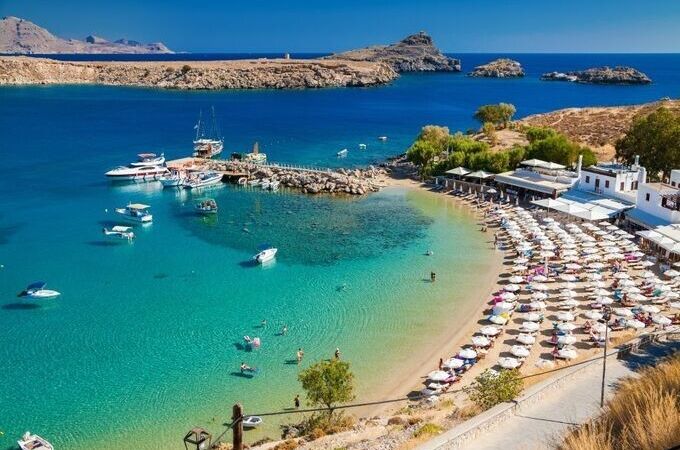
The eastern side contains many of the island's best-known swimming areas and resort communities, with locations such as Faliraki, Anthony Quinn Bay and the wider Lindos region forming a natural coastal progression south from Rhodes Town.
The western side has its own character and tends to be more exposed to prevailing winds, which can appeal to travelers interested in wind-related water sports and a different coastal environment.
This is not a matter of declaring one side “better.”
For a traveler imagining calm swimming coves and beach days combined with Lindos, the east coast usually aligns more naturally with that expectation. Someone prioritizing a particular resort, water-sport environment or western Rhodes exploration may reach a different conclusion.
Understanding that distinction before choosing accommodation prevents the common mistake of booking purely according to price and discovering later that the island experience you wanted was concentrated elsewhere.
Lindos Deserves Time, Not Just the Photograph From Above
Lindos is often reduced to three visual elements: white houses, blue water and the Acropolis rising above the settlement.
The actual experience is more layered.
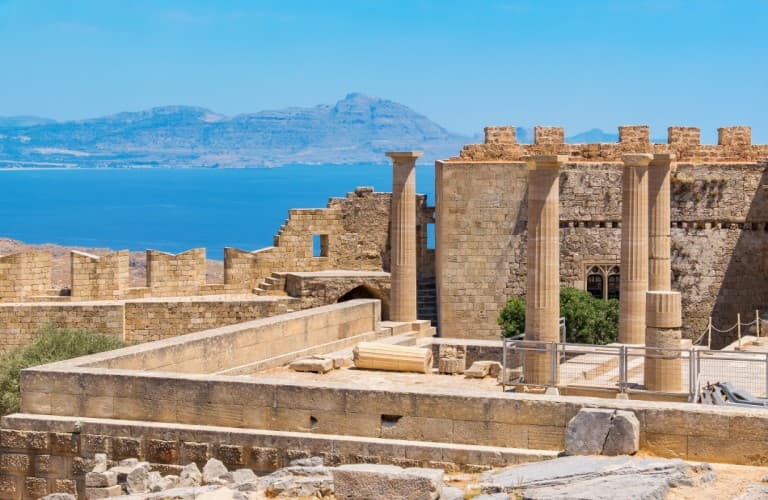
Its pedestrian lanes create an intimate village environment beneath the archaeological site, while the climb toward the Acropolis changes the perspective continuously until the coastline opens dramatically around you. The combination of ancient remains and natural setting is what gives Lindos its impact.
Timing matters, particularly during warmer periods.
Visiting an exposed archaeological site at the hottest part of the day can change how much time travelers want to spend there. A thoughtful Rhodes itinerary therefore considers not simply whether Lindos appears on the schedule, but when the visit happens and what else is combined with it.
Couples staying nearby gain another advantage: once day visitors leave, Lindos develops a different evening rhythm.
This is one of the clearest examples of how overnight location can change the experience of a famous place.
The Medieval City and Lindos Should Not Compete for Your Attention
Rhodes has two powerful historical anchors, but they tell completely different stories.
The ancient and medieval layers around Rhodes Town belong to the northern urban history of the island, with the Knights' legacy particularly visible inside the fortified city.
Lindos reaches into another historical and geographical environment, where its Acropolis rises above a settlement and coastline that feel entirely separate from the capital.
Trying to decide which one is “better” misses the point.
They are valuable precisely because they do not duplicate one another.
For travelers interested in Rhodes cultural and island tours, combining both creates a much stronger understanding of the island than spending the entire visit around a single resort area.
The distance between them is not wasted travel.
It reveals how Rhodes changes as you move south.
Beach Selection Should Follow the Day Rather Than a Ranking
Searching for “the best beach in Rhodes” produces an apparently useful list and an often unhelpful planning method.
The best beach depends on where you are staying, what else you are doing that day, whether you want facilities, how far you want to travel and what type of coastal setting you prefer.
Anthony Quinn Bay attracts attention for its rocky setting and clear water, while other eastern beaches provide different combinations of sand, pebbles, organized facilities and resort access. Areas around Lindos make sense when already exploring the southern-east coast, while northern beaches can be far more practical for travelers based in Rhodes Town.
Instead of crossing the island because a particular beach ranked number three on somebody's list, use the coastline geographically.
Combine nearby experiences.
That reduces unnecessary driving and creates more time beside the water—which was presumably the reason you wanted the beach in the first place.
Inland Rhodes Is Where the Island Stops Performing for Visitors
The coast naturally dominates tourism, but remaining entirely beside the sea gives an incomplete impression of Rhodes.
Moving inland reveals villages, agricultural landscapes, wooded areas and a quieter relationship with the island. Places such as Embonas introduce a different side of local life, while routes through the interior can connect landscapes that bear little resemblance to the busy northern and eastern resort zones.
This is particularly worthwhile for repeat visitors or travelers staying long enough that another beach day would add less value than seeing a different environment.
The interior also provides an important reminder:
Rhodes is not a resort strip wrapped around an archaeological site.
It is an inhabited island with communities and landscapes that continue beyond the visitor-facing coastline.
That distinction is increasingly important for travelers who want their Greece holiday to feel connected to place rather than exclusively to tourism infrastructure.
A Rental Car Is Useful, but Not Automatically Necessary
Whether you need a car depends on your base and ambitions.
Travelers staying in Rhodes Town for a short visit focused on the medieval city, perhaps with one organized excursion to Lindos, may have little reason to rent one for the entire stay.
The calculation changes for travelers who want several beaches, inland villages, more remote areas or freedom to alter the day spontaneously.
A car becomes particularly useful when exploration itself is part of the holiday.
The wrong approach is renting one automatically because “you need a car on Greek islands,” or refusing one automatically because organized transportation exists.
Ask what the vehicle will enable.
If it gives you access to places you genuinely want to experience and removes inefficient backtracking, it has value. If it remains parked while you explore Rhodes Town on foot, it does not.
Three Nights and Seven Nights Produce Almost Different Destinations
Rhodes scales unusually well according to available time.
With a short stay, the island becomes primarily about its strongest contrasts: Rhodes Town, Lindos and perhaps one coastal experience.
Add several more nights and the interior, additional beaches, villages and slower mornings begin to make sense.
| Time Available | What Rhodes Can Realistically Become | Planning Priority |
|---|---|---|
| 2 nights | Focused historical stop | Rhodes Town with selective sightseeing |
| 3 nights | History plus Lindos | Avoid trying to cover entire island |
| 4–5 nights | Balanced island experience | Add beaches and broader exploration |
| 6–7 nights | Genuine island holiday | Include coast, history and interior |
| 8+ nights | Slow regional exploration | Consider changing base if useful |
This is why asking “How many days do I need in Rhodes?” has no universal numerical answer.
The island expands according to the time you give it.
Rhodes Is Particularly Strong for Couples Who Want More Than One Holiday Mood
Some Greek islands excel because they provide one very specific atmosphere.
Rhodes succeeds differently.
A couple can spend a morning discussing medieval history with a licensed guide, swim in the afternoon and eat dinner inside an old walled city. Another day can revolve around Lindos and the coast, while the next can move inland.
That variety is useful for couples whose interests are not identical.
One person does not have to choose between a cultural trip and the other's beach holiday. Rhodes can accommodate both without making either feel like an afterthought.
For honeymooners, however, the island should still be compared against the emotional experience they want. Santorini may provide a more concentrated romantic setting, while Rhodes offers greater day-to-day variety.
Those are different advantages rather than competing claims.
Families Benefit From Rhodes When They Resist Over-Scheduling
Rhodes can work exceptionally well for families because history, swimming and outdoor exploration can be alternated rather than stacked into consecutive museum-heavy days.
The mistake is using the island's variety as an excuse to schedule every hour.
A morning in the Old Town followed by a relaxed afternoon can work better than attempting the medieval city, another archaeological site and a distant beach on the same day.
Private transportation can become particularly useful for larger families because the day can be structured around their pace. This is where private Greece family journeys including Rhodes can offer practical value beyond luxury, especially when several generations or younger children are traveling together.
Flexibility is valuable because Rhodes gives families many choices.
It does not mean they need to use all of them.
Rhodes Can Be Combined With Other Islands, but It Does Not Need Them
Travelers sometimes assume that a Greece holiday becomes more authentic as the number of islands increases.
Rhodes challenges that assumption because it contains enough variety for a substantial standalone island stay.
Its Dodecanese location can support combinations with other islands when transportation schedules and travel dates align, but adding another island should create a genuinely different experience rather than merely increasing the count.
Rhodes already provides history, beaches, resort areas, traditional communities and substantial geographical variation.
If you have four nights, adding another island may simply divide limited time.
If you have ten or twelve nights dedicated to the region, the argument becomes much stronger.
Island hopping should be an experience.
Not an accounting exercise.
What Rhodes Gives You That the Cyclades Do Not
Rhodes should not be evaluated according to how closely it resembles Mykonos, Santorini, Paros or Naxos.
It belongs to the Dodecanese and carries a different architectural and historical identity.
The medieval city alone changes the character of the destination. The island's scale adds another distinction, while Lindos, inland villages and the long coastline create a journey that can feel more geographically expansive than a stay on a smaller Cycladic island.
This is particularly important for first-time Greece travelers who assume every famous island will provide variations of the same whitewashed aesthetic.
They do not.
Choosing Rhodes is partly choosing a different Greece.
That difference should be preserved rather than edited out of the itinerary.
How We Would Build Rhodes Into a Wider Greece Journey
Since 1997, Magnificent Travel has worked with travelers whose Greece trips range from focused island stays to longer combinations involving Athens, the mainland and several islands.
Rhodes requires a slightly different approach from the classic Athens–Mykonos–Santorini sequence because its southeastern position changes transportation logic.
We therefore look first at international arrival and departure points, available air or ferry connections for the actual travel dates, the number of nights and whether Rhodes is meant to be the cultural center of the journey or its slower final section.
For travelers considering customized Greece island itineraries, this is important because adding Rhodes should improve the journey rather than create a complicated detour simply because the island is famous.
Transportation is part of itinerary design.
It should never be treated as something to solve after the destinations have already been selected.
Rhodes Is Best for Travelers Who Want an Island With Substance
Rhodes is not the Greek island we would recommend to every traveler, and that is precisely why understanding its character matters.
Choose it when you want historical depth without sacrificing beaches, when spending an entire week on one island sounds more appealing than changing hotels every two nights, or when you want enough geographical variety that several days can feel genuinely different from one another.
Stay around Rhodes Town if history, walking and evening atmosphere matter most. Move toward Lindos or the eastern coast if beaches and a more resort-oriented rhythm are central to the holiday. Give the interior time if you want to understand the island beyond its most photographed places.
Most importantly, do not reduce Rhodes to a checklist containing Old Town, Lindos and a beach.
The island becomes much more interesting once you allow its different regions to influence the rhythm of the trip.
Frequently Asked Questions About Rhodes
1. Is it worth staying inside Rhodes Old Town itself?
It can be highly atmospheric, particularly for couples and history-focused travelers who value walking through the medieval streets early or late in the day. However, vehicle access and luggage arrangements should be checked carefully because staying within a historic pedestrian environment creates different logistics from a conventional hotel.
2. Can I visit Lindos comfortably without staying there?
Yes. Lindos can be visited from Rhodes Town or other parts of the island, although travel time and summer heat should influence the day's timing. Staying nearby becomes more attractive when couples want to experience the village after daytime visitor traffic decreases.
3. Which coast of Rhodes is better for swimming?
Many of the island's popular swimming coves and beaches are found along the eastern side, which is one reason that coast attracts numerous resort stays. The western side has different wind and sea characteristics, making the correct choice dependent on preferred activities.
4. Does Rhodes feel too large for travelers who dislike driving?
Not necessarily. Travelers can stay in Rhodes Town and use organized excursions or arranged transportation for selected locations rather than exploring independently every day. The island's size becomes more relevant when you want spontaneous access to numerous beaches and inland communities.
5. Is Rhodes a sensible Greek island for history-focused travelers?
Very much so. The fortified Medieval City, legacy of the Knights of St. John, ancient history and Lindos give Rhodes substantially more historical depth than travelers expecting a conventional resort island may anticipate, allowing culture to remain central throughout the stay.
6. Can Rhodes work as the only island on a first trip to Greece?
Yes. Its scale and variety mean travelers can combine historical sightseeing, beaches, villages and resort time without changing islands. This can be particularly valuable for visitors who want a Greek island experience but prefer avoiding repeated ferry journeys and hotel changes.
7. Is Lindos suitable for travelers who have difficulty with steep walking?
Its setting includes slopes, pedestrian areas and the climb toward the Acropolis, so mobility requirements should be considered before planning the visit. Travelers do not necessarily need to abandon Lindos completely, but the day's structure should reflect realistic individual capabilities.
8. Why would I stay near Faliraki instead of Rhodes Town?
Faliraki can provide easier access to a beach-oriented holiday while maintaining a relatively practical position for exploring both northern Rhodes and areas farther south. Travelers whose evenings revolve around the medieval city, however, may still prefer Rhodes Town as their base.
9. Is one day enough for Rhodes on a cruise stop?
A day can provide an introduction, particularly to Rhodes Town and its medieval heritage, but it cannot reproduce the experience of exploring the island. Lindos, beaches, interior villages and different coastal regions require additional time and deliberate transportation planning.
10. Should I split my hotel stay between Rhodes Town and Lindos?
For longer visits, splitting the stay can make sense when both northern history and southern/eastern coastal time are important. For shorter holidays, another hotel change may create more inconvenience than benefit, making one strategically chosen base the better option.
11. What makes Rhodes different from Santorini or Mykonos?
Rhodes combines a large, geographically varied island with substantial medieval and ancient heritage. Santorini is dominated by its volcanic caldera landscape, while Mykonos has a different Cycladic and social character. Rhodes should therefore be chosen for its own identity rather than as an alternative version of either.
12. What is the most common planning mistake people make in Rhodes?
Treating every attraction as though it were clustered around Rhodes Town can lead to inefficient days and unnecessary driving. Understanding the island's north–south scale before choosing accommodation allows beaches, Lindos, historical areas and inland exploration to be grouped far more naturally.

A travel professional specializing in tailor-made travel planning, guest experience management, and multi-destination tourism operations.
With over 23 years of experience in the travel industry, he designs and manages private and cultural tours for international travelers across Türkiye, Greece, Egypt, Jordan, Morocco, and other destinations.
He has strong expertise in both online and face-to-face guest communication, sales processes, and end-to-end travel operations.
Working closely with hotels, travel agencies, and local partners, he ensures smooth coordination and high-quality travel experiences at every stage of the journey.
His focus is on delivering personalized, reliable, and seamless travel experiences for international guests worldwide.