What Is the Best Way to Travel Around Greece? It Depends on the Route
Updated: August 2026
Traveling around Greece becomes much easier once you abandon the idea that one form of transportation should carry you through the entire country.
Greece is unusually resistant to that kind of planning. Athens has an extensive urban transport network, the Cyclades depend heavily on ferries, Crete is large enough for road travel to become important, and mainland journeys through the Peloponnese or toward destinations such as Delphi and Meteora introduce completely different geographical considerations. Domestic flights can connect distant regions efficiently, while private transfers become valuable in situations where saving logistical effort matters more than simply buying the cheapest available seat.
For most travelers, the best way to travel around Greece is therefore a carefully chosen combination of transportation methods rather than one method used everywhere.
The practical skill is knowing when to switch.
A ferry should be used because the sea route makes geographical sense, not simply because you are in Greece. A car should be rented because it opens places that would otherwise be difficult to explore, not because driving sounds independent. A domestic flight earns its place when the distance it removes is greater than the airport procedures it creates.
Once transportation is treated as part of the experience rather than a separate booking exercise, Greece begins to feel considerably more connected.
Think Door to Door, Not Departure to Arrival
The most misleading number in transportation planning is often the published journey time.
A 50-minute flight does not necessarily move you between hotels in 50 minutes, because you first need to reach the airport, arrive with sufficient time for check-in and security, collect luggage after landing and continue from the destination airport to your accommodation.
The same principle applies to ferries. A two-hour crossing includes more than two hours of your day once hotel checkout, port transfer, embarkation and arrival transfer are considered.
This means transportation options should be compared using door-to-door time.
Imagine that one route offers a four-hour ferry while another option involves a 45-minute flight. The flight appears dramatically faster until airport access and procedures are added. On another route, however, a flight may eliminate most of a travel day and become the obvious choice.
Ticket duration is therefore only the middle of the journey.
Travelers should compare the entire movement from the hotel they are leaving to the hotel where they will sleep that evening.
Ferries Are Part of Greek Island Travel, but They Are Not an Automatic Choice
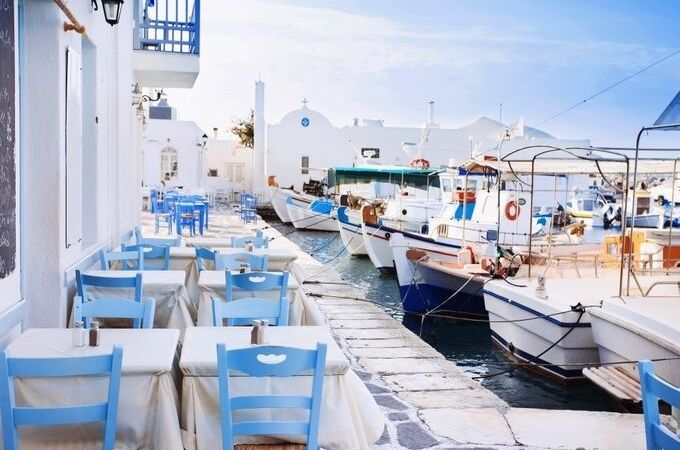
Ferries provide one of the most distinctive elements of traveling through Greece.
Leaving one island by sea, watching another appear on the horizon and arriving directly into a port can feel much more connected to the geography than moving through airports. Within well-served island groups, ferry travel can also be operationally straightforward because the route naturally follows the shape of the archipelago.
The Cyclades provide the obvious example. Connections between islands such as Mykonos, Paros, Naxos and Santorini can make ferry travel an integral part of a multi-island journey when appropriate services operate for the required dates.
However, the presence of water between two destinations does not guarantee a convenient direct ferry.
Greek ferry networks follow commercial routes, seasonal demand and operational schedules. Two islands that appear reasonably close on a map may have an indirect or inconvenient connection, while destinations farther apart may be well linked because they sit on an established route.
This is why ferry schedules should be checked before treating an island sequence as confirmed.
A Fast Ferry Is Not Automatically Better Than a Conventional Ferry
Travelers naturally gravitate toward the shortest published crossing, particularly when the itinerary contains several islands.
Yet speed is only one variable.
Different ferry types can provide different onboard environments, luggage arrangements and sensitivity to sea conditions, while departure time can matter more than the theoretical journey duration. A slightly slower ferry leaving at a convenient hour may preserve the day better than a faster service requiring a very early departure or awkward hotel transfer.
Travelers prone to motion sickness may also want to consider vessel characteristics rather than simply selecting the shortest crossing.
The correct ferry decision therefore considers the whole journey: departure time, arrival time, vessel type, seating preference, luggage, port logistics and what you intend to do after reaching the next island.
Saving forty minutes at sea means little if the schedule costs three hours elsewhere.
Domestic Flights Become Powerful When Greece Stops Being Geographically Compact
Flying becomes more attractive when a journey moves between regions rather than neighboring destinations.
A traveler combining Athens with Crete, Rhodes or another distant island may find that flying preserves substantially more usable time than forcing the journey into an unnecessarily complicated surface route.
The same logic can apply when connecting geographically separated parts of a longer Greece vacation.
The mistake is assuming that domestic flights are either always efficient or somehow less authentic than ferry travel.
Transportation is not a cultural loyalty test.
If flying prevents an entire day from being consumed by an awkward connection, it may improve the trip substantially. Conversely, when a ferry moves naturally between neighboring islands and avoids airport procedures, flying can solve a problem that did not exist.
Use air travel where Greece is genuinely large.
Use ferries where the sea network already does the job elegantly.
Athens Airport Should Be Viewed as a Transportation Hub, Not Merely an Entry Point
Athens International Airport naturally handles the arrival and departure of many international visitors, but its domestic role can also influence the wider journey.
This becomes especially useful when travelers combine regions that do not belong to one straightforward ferry network.
A trip might begin with several days in Athens before flying to a more distant island, or return from an island by air before continuing internationally. In other cases, arriving internationally and immediately connecting onward may seem efficient but create unnecessary risk or fatigue depending on ticket structure and connection time.
The airport should therefore be considered part of the route architecture.
That does not mean every regional change should pass through Athens. Repeatedly returning to the capital can introduce exactly the backtracking a good transport plan should remove.
The objective is to use Athens when it functions as a genuine hub, rather than treating it as the compulsory answer to every connection.
Rental Cars Make the Most Sense Where Geography Rewards Detours
A rental car is at its best when independence changes what you can experience.
The Peloponnese is a strong example because archaeological sites, coastal towns, villages and landscapes can be spread across routes where independent road travel provides considerable flexibility. Travelers can control departure times, stop spontaneously and combine places that would be cumbersome to reach through multiple scheduled services.
Crete can create similar logic. Its scale is substantial, and travelers planning to explore beyond one resort or city may find independent transportation extremely useful.
A rental car becomes less compelling when it spends most of the holiday parked.
Several nights in central Athens rarely require a vehicle for ordinary sightseeing, and parking or city navigation can introduce responsibilities without producing meaningful freedom.
The right question is therefore not whether you enjoy driving.
Ask whether having a car materially changes the destinations you can reach or the way you can experience them.
Driving in Greece Requires a Different Calculation From Driving Distance
A map may show 100 kilometers and encourage a traveler to estimate the journey using familiar highway speeds.
That assumption can fail quickly.
Motorways make some mainland routes efficient, while mountain roads, village approaches, island roads and coastal sections can produce a completely different driving rhythm. Parking at popular destinations can add another variable.
This is especially important on larger islands.
A destination may appear close geographically while the actual road follows terrain that requires considerably more time and attention than expected.
For road-based travel, the useful unit is not kilometers.
It is realistic driving time plus the energy required to drive it.
A three-hour scenic road journey can be perfectly enjoyable. A supposedly short drive that unexpectedly becomes demanding can disrupt the entire day.
A Car Ferry Is Not Always a Reason to Keep the Same Rental Vehicle
Travelers sometimes assume that renting a car in Athens and taking it through several islands will create maximum independence.
That needs careful evaluation.
Rental agreements can contain restrictions regarding ferry transport, insurance conditions may differ, and transporting the same vehicle between islands can create additional costs and operational complications. Parking can also become unnecessary in destinations where most daily movement occurs on foot or through local transport.
In many itineraries, renting locally only where a car is genuinely useful can be more practical.
For example, a traveler may explore Athens without a vehicle, travel to an island by ferry and rent locally for one or two days of exploration.
The principle is simple: do not transport a car merely because you already rented it.
The vehicle should continue only when its usefulness continues.
Private Transfers Solve a Different Problem From Public Transportation
Private transportation is often compared with buses or taxis purely through price, but its strongest advantage is not necessarily speed.
It is continuity.
A driver meeting travelers at an airport, ferry port or hotel removes several small decisions at a moment when luggage, unfamiliar surroundings and timing already demand attention. For families, larger groups, older travelers or guests with significant luggage, this can provide practical value well beyond the distance traveled.
Private transfers can also make complex mainland movements easier when a route does not align naturally with public transportation.
That does not mean every journey should be private.
A private car is poor value when an efficient scheduled connection already performs exactly the required movement.
Within privately arranged Greece transportation services, the best use of private transport is usually where it removes friction rather than where it merely replaces an easy public option.
Buses Can Be Excellent, but They Require Route-Specific Thinking
Greece has intercity bus networks that can provide practical connections across the mainland and on larger islands.
For independent travelers with flexible schedules, buses can be an economical and perfectly reasonable way to reach many destinations.
The limitation appears when the desired journey involves several intermediate places, significant luggage, a tightly scheduled sightseeing day or destinations that do not connect conveniently in the sequence the traveler wants.
A bus works exceptionally well when its route and timetable already match your plan.
It becomes less attractive when the entire itinerary must be redesigned around several separate connections.
Public transportation should therefore be evaluated on a route-by-route basis, rather than promoted or dismissed as a category.
Trains Have a More Limited Role Than Many European Travelers Expect
Visitors accustomed to traveling around Italy, France, Spain or central Europe sometimes arrive expecting Greece to support a similarly comprehensive rail-based holiday.
That assumption can create planning problems.
Rail does not provide the universal intercity solution that travelers may expect from other European countries, and many important tourism routes are better served by road, bus, ferry or air.
This matters particularly during the early planning stage because European travel habits can unconsciously shape expectations.
A traveler who normally builds holidays around railway stations may need to approach Greece differently.
The absence of a train on a route is not a logistical failure.
It simply means that Greece's transportation geography is organized differently.
Transportation Inside Athens Should Not Be Planned Like Transportation Across Greece
Once travelers are in central Athens, the transport question changes completely.
Walking becomes important because many historic neighborhoods and archaeological areas are geographically connected. Metro services can handle longer urban movements, while taxis provide flexibility when required.
This means a rental car that was extremely useful on a mainland road trip can become unnecessary once the traveler reaches Athens.
A sophisticated Greece transport plan is comfortable changing modes when the environment changes.
There is no prize for using the same vehicle from beginning to end.
Returning a rental car before several nights in Athens can be more sensible than paying to keep it while relying on walking and urban transportation anyway.
Ports Need More Planning Than Their Names Suggest
“Athens to the islands by ferry” sounds straightforward until the departure port is considered.
Athens is served by multiple ports used for different routes, including Piraeus and other departure points such as Rafina or Lavrio depending on destination and schedule.
Those ports are not interchangeable dots beside the city.
Where you are staying, which airport you are using and what time the ferry departs can all affect which route is genuinely convenient.
An early ferry from a distant port can require a departure from the hotel long before the crossing begins. A slightly different ferry option from a more convenient port may produce a better overall journey even if the sea portion is longer.
Port access is part of the ferry journey.
Ignoring it is equivalent to comparing flights without considering which airport they use.
Luggage Changes the Best Transportation Choice
Travel advice frequently assumes one healthy adult carrying a small suitcase.
Real travelers are more varied.
A family with several large bags experiences ferry boarding differently from a couple traveling with cabin luggage. Older travelers may reasonably place greater value on prearranged transfers. Someone traveling for three weeks may carry luggage that makes repeated public-transport connections considerably less attractive.
This does not mean travelers with luggage cannot use ferries or buses.
It means the transportation choice should reflect the actual people taking the journey, rather than an abstract efficiency calculation.
A route that looks beautifully simple on paper can feel very different when six travelers and twelve pieces of luggage need to execute it.
Transportation Days Should Be Designed Around the Weakest Connection
Imagine a day containing a ferry, a private transfer and a domestic flight.
The itinerary may look efficient if every component runs exactly on schedule.
The problem is that the second and third services depend on the first.
A good transport plan therefore asks which component is least under your control and builds appropriate margin around it.
Ferries can be affected by operational or weather conditions. Road journeys encounter traffic. Separately ticketed flights introduce their own check-in requirements.
The objective is not eliminating all risk, which is impossible.
It is preventing one ordinary delay from becoming an expensive chain reaction.
The Final International Flight Deserves Its Own Transport Strategy
One of the most consequential decisions in a Greece trip occurs at the end.
Suppose the international flight leaves Athens in the afternoon while the traveler is staying on an island the previous night.
A same-day domestic flight or ferry may appear to maximize island time.
It also creates dependency.
If that connection is disrupted, the consequence is no longer missing dinner or arriving late at the hotel; it may be missing a long-haul flight.
For this reason, many travelers benefit from treating the final international departure differently from ordinary internal connections.
The appropriate margin depends on the actual transport arrangement and ticket structure, but the underlying principle remains consistent:
the more expensive the consequence of delay, the less aggressively the connection should be optimized.

Use Different Transport Modes for Different Parts of the Same Trip
A well-designed Greece journey might reasonably use:
Airport transfer → walking/metro → rental car → ferry → local transfer → domestic flight.
That is not complicated simply because several modes appear.
It can actually be simpler than forcing one transport method into environments where it does not belong.
Consider a traveler visiting Athens, the Peloponnese, Santorini and Crete. Urban transportation can handle Athens. A vehicle can support mainland exploration. Ferry or air can manage the island transition depending on the route, while local transfers or another rental can handle destination-specific movement.
The question is never whether the trip uses too many transportation types.
The question is whether each transition is intuitive for the traveler executing it.
Compare Transport by Friction, Not Just Time and Price
Traditional comparisons use two variables: cost and duration.
Travelers need a third.
Friction.
| Transport Mode | Strongest Use | Hidden Friction | When It Becomes Valuable |
|---|---|---|---|
| Ferry | Logical island connections | Ports, embarkation, sea conditions | Islands share a useful route |
| Domestic flight | Larger regional jumps | Airports, security, transfers | Distance removed is substantial |
| Rental car | Mainland/large-island exploration | Parking, navigation, driving fatigue | Independence changes the day |
| Intercity bus | Established point-to-point routes | Timetable dependence | Route already matches the plan |
| Private transfer | Door-to-door movements | Higher direct cost | Convenience solves real logistics |
| Urban transport | Athens movement | Luggage/peak periods | Staying within the city |
The best option is the one that creates an acceptable combination of time + cost + friction.
Ignoring any one of those variables can produce the wrong answer.
A More Expensive Transfer Can Make the Whole Journey Cheaper in Effort
Not every transport decision should be optimized financially.
After an overnight international flight, navigating several public connections with luggage may save money but consume patience at the exact moment travelers have the least of it.
On another day, using public transportation after a relaxed breakfast may be completely straightforward.
This is why door-to-door Greece travel planning should consider energy as well as geography.
Convenience has diminishing returns. Paying privately for every ten-minute journey makes little sense for many travelers.
But convenience also has strategic value.
Use it at the points where the trip is naturally difficult: arrivals, luggage-heavy transfers, unfamiliar ports, early departures or complex mainland connections.
The Best Way to Travel Around Greece Is Usually the One You Barely Notice
Good transportation should disappear into the holiday.
You remember Santorini, not the luggage transfer.
You remember Delphi, not where the car was parked.
You remember the ferry arriving through the Aegean because that movement itself became part of the experience, rather than because you spent the entire morning worrying about the connection.
That is the standard worth aiming for.
The fastest method is not always best. The cheapest is not automatically smartest, and the most private is not necessarily the most comfortable once the entire route is considered.
For travelers building Greece tours with ferries, flights and private transfers, the strongest transportation plan normally changes methods several times because Greece itself changes several times.
Use ferries where islands naturally connect.
Fly when geography becomes too large.
Drive where independence unlocks the landscape.
Use buses when scheduled routes already solve the journey efficiently.
Pay for private transportation when removing friction genuinely improves the day.
Once each method is given the job it performs best, getting around Greece stops feeling like a logistical problem and becomes part of how the country is experienced.
Frequently Asked Questions About Getting Around Greece
1. Should I collect a rental car immediately after landing in Athens?
Usually only if you are leaving Athens and beginning a road journey relatively quickly. Travelers spending several days sightseeing in central Athens may find walking, metro services and taxis more practical before collecting a vehicle when the mainland portion actually begins.
2. What should I check before choosing between two ferry departures?
Look beyond sailing duration and compare departure port, hotel pickup time, vessel type, arrival hour, seating requirements and what you plan to do afterward. A slightly longer crossing can create a much easier overall travel day.
3. Is flying between Greek islands normal?
Flights can be useful for certain island combinations, particularly when distances are substantial or ferry connections are inconvenient, although not every island pair has a practical direct air connection. The decision should be based on the actual route rather than a general rule.
4. How early should I arrive at a Greek ferry port?
Required and sensible arrival times vary according to the port, operator, route, ticketing situation and whether a vehicle is involved. Travelers should follow the current instructions provided for their specific sailing rather than applying one fixed arrival rule to every ferry.
5. Can I take large suitcases on Greek ferries?
Ferries commonly accommodate passenger luggage, but handling arrangements differ by vessel and service. Travelers with substantial baggage should check their specific operator and consider how comfortably they can move luggage through ports, transfers and hotel changes throughout the wider journey.
6. When is a private transfer most useful in Greece?
Private transfers provide particularly strong value for airport and port arrivals with luggage, families or larger groups, early departures and movements where public transportation requires several connections. They are less necessary when an easy direct transport option already exists.
7. Should I rent a car for Santorini or use transfers?
That depends on where you stay and how independently you intend to explore. Travelers spending significant time around their hotel and joining organized activities may need little driving, while independent exploration can make a vehicle useful for selected periods.
8. Is a rental car necessary for exploring Crete properly?
Not universally, but Crete's size means independent road transport can become valuable when the itinerary includes dispersed beaches, villages or inland areas. Travelers remaining primarily in one city or resort and using organized excursions may not need a vehicle throughout.
9. What happens if bad weather affects my ferry?
Operational decisions depend on conditions and the ferry company, so travelers should avoid building fragile onward connections around sea transport. When an important flight or other fixed service follows, sufficient margin can prevent one schedule disruption from affecting the rest of the trip.
10. Can I travel around mainland Greece entirely by public transportation?
Many destinations can be reached through scheduled services, but whether public transportation suits the complete route depends on the exact sequence. Multi-stop archaeological or rural itineraries may become considerably easier with a car or arranged transportation than with several separate connections.
11. Is it better to fly or take a ferry from Athens to an island?
Neither is universally better. Compare the specific island, departure point, total door-to-door time, ferry duration, airport access and your preferred travel experience. Short, logical sea connections and longer regional movements often produce very different answers.
12. What transport mistake causes the most problems on a Greece trip?
Treating published journey duration as the entire transfer. Travelers need to include hotel departure, airport or port access, check-in or embarkation, luggage handling and onward transportation, particularly when another fixed service depends on arriving on time.

A travel professional specializing in tailor-made travel planning, guest experience management, and multi-destination tourism operations.
With over 23 years of experience in the travel industry, he designs and manages private and cultural tours for international travelers across Türkiye, Greece, Egypt, Jordan, Morocco, and other destinations.
He has strong expertise in both online and face-to-face guest communication, sales processes, and end-to-end travel operations.
Working closely with hotels, travel agencies, and local partners, he ensures smooth coordination and high-quality travel experiences at every stage of the journey.
His focus is on delivering personalized, reliable, and seamless travel experiences for international guests worldwide.