Why Jordan and Egypt Are Better Together Than You Might Expect
Updated: August 2026
Jordan and Egypt are often placed together because they are neighbors within the wider Middle East and both possess extraordinary ancient sites. That explanation is accurate, but it misses the more interesting reason the combination works.
The two countries do not feel particularly similar once you are traveling through them.
Jordan can feel intimate and geographically manageable, with journeys moving relatively quickly between Amman, archaeological landscapes, desert environments and the Dead Sea. Egypt changes the scale. Cairo is immense, the Nile shapes both geography and travel, archaeological sites span thousands of years, and distances between major regions become a much more visible part of the journey.
Even their most famous ancient places create different reactions. Petra draws you gradually through a landscape where architecture and sandstone seem inseparable, while Giza confronts you with monuments whose scale is difficult to understand until you are standing beside them.
This difference is precisely why combining the countries works.
You are not spending two weeks repeating variations of the same ancient-world holiday. If the journey is designed intelligently, Jordan changes the rhythm of Egypt and Egypt expands the historical scale established in Jordan.
Rather than asking whether the countries are similar enough to combine, it is more useful to ask whether their differences make the overall journey stronger.
For many travelers, they do.
Petra and Giza Belong to Completely Different Ancient Worlds
Petra and the Pyramids of Giza are inevitably mentioned in the same conversation because both can become defining moments of a Jordan and Egypt journey.
Yet placing them together reveals how little they actually have in common.
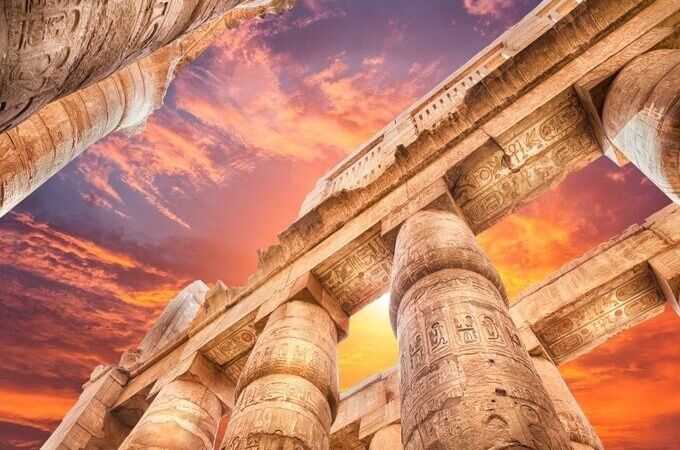
The monuments at Giza take travelers deep into ancient Egyptian history and a civilization whose monumental architecture developed on an extraordinary scale. Petra belongs to a much later historical world, where Nabataean culture, trade, engineering and architecture became closely connected with the surrounding sandstone landscape.
The emotional experience is different as well.
At Giza, the monuments are already visible across the landscape, yet their proportions remain surprisingly difficult to appreciate until you approach them. Petra works more theatrically because the route through the Siq delays one of its most famous views, allowing the landscape to control how the archaeological city reveals itself.
Neither experience makes the other redundant.
Quite the opposite.
Seeing both within one journey prevents the broad label of “ancient history” from flattening civilizations that developed under very different conditions and left behind radically different forms of architecture.
That historical contrast is one of the strongest arguments for combining the two countries.
Jordan Gives the Journey Space Before Egypt Changes the Scale
There is a physical quality to traveling through Jordan that becomes particularly noticeable once Egypt follows.
Outside Amman and other urban areas, landscapes can open rapidly. The journey toward southern Jordan passes through changing terrain before Petra encloses the traveler again among sandstone formations. Wadi Rum then reverses that sensation entirely, replacing narrow passages and carved architecture with immense visual space.
Egypt alters the relationship between traveler and landscape.
Cairo introduces a density that Jordan rarely prepares you for, while journeys farther south become connected with the Nile, cultivated riverbanks and archaeological sites distributed across a much larger geographical canvas.
These changes help prevent travel fatigue.
One of the problems with combining historically rich countries is that travelers can reach a point where another temple, column or archaeological explanation begins competing with everything they have already seen.
Jordan and Egypt reduce that risk because landscape repeatedly interrupts history.
The journey does not simply move from monument to monument.
Its entire visual language keeps changing.
Wadi Rum Is an Unexpectedly Good Companion to the Nile
Wadi Rum and the Nile have almost nothing obvious in common, which is why experiencing both can give a Jordan and Egypt journey such a strong internal rhythm.
In Wadi Rum, the landscape encourages you to look outward. The sense of distance, changing desert light and monumental rock formations often matter more than individual named sights, particularly once the organized part of the desert experience ends and the evening becomes quieter.
The Nile introduces movement differently.
Instead of crossing an open desert landscape, you travel through a narrow geographical corridor that has supported communities and agriculture for millennia. On a cruise, the spaces between archaeological visits become part of the experience as villages, vegetation and river life pass by.
Both environments slow the traveler down, but they do so in completely different ways.
This becomes particularly valuable in an itinerary containing several archaeology-heavy days because neither landscape requires the same concentration as a guided historical site.
You can simply look.
That change of attention is not wasted time between attractions; it is part of what makes the combination sustainable over a longer journey.
Amman and Cairo Should Never Be Treated as Interchangeable Gateways
International itineraries sometimes reduce capitals to arrival and departure logistics, particularly when world-famous archaeological sites are waiting elsewhere.
That would be unfortunate in both Jordan and Egypt.
Amman provides an introduction to contemporary Jordan on a scale that many travelers find relatively approachable. Historical layers remain visible, but restaurants, neighborhoods, cafés and everyday urban life prevent the city from becoming merely another heritage stop.
Cairo operates on another level of intensity.
Its population, traffic, architecture, museums, neighborhoods and relationship with the Nile produce a capital experience that feels substantially larger and more demanding. That intensity is part of its character rather than an inconvenience that needs to be edited out of the journey.
Experiencing both capitals helps correct another misconception about combining Jordan and Egypt: that the trip is primarily about ancient civilizations.
It is not.
The modern countries surrounding those civilizations are part of the experience, and their capitals provide two very different introductions to contemporary Arab urban life.
Jordan's Compact Geography Changes the Way You Travel
One reason Jordan works particularly well in a two-country journey is the relative efficiency with which very different experiences can be connected.
The north, Amman, central Jordan, Petra, Wadi Rum and the Dead Sea can be organized into a logical overland route without requiring domestic flights between every major stage.
Egypt asks for a different planning mindset.
Distances are larger, and travelers combining Cairo with Luxor, Aswan or other regions need to think more deliberately about flights, rail or river travel according to the itinerary. A Nile cruise can turn part of that movement into an experience in itself, while domestic flights may be valuable where overland transportation would consume too much usable holiday time.
This contrast actually helps the combined journey.
Jordan provides continuity through overland travel, whereas Egypt introduces larger geographical transitions and different modes of transportation.
The trip feels as though it has entered another chapter rather than simply crossed a border.
A Nile Cruise Adds Something Jordan Cannot Replicate
A Nile cruise should not be viewed simply as accommodation that happens to move between archaeological sites.
Its value within a Jordan and Egypt combination is partly structural.
Jordan's strongest first-time routes are usually land based. You move between cities, archaeological areas, desert landscapes and hotels, with the road linking each stage.
On the Nile, the transportation itself becomes part of the destination.
There is a different rhythm to waking beside the river, visiting historical sites and returning to a vessel that continues through the landscape rather than checking into another hotel every evening.
That difference can be particularly welcome after an active Jordan itinerary.
It does not mean the Egyptian portion suddenly becomes passive; sightseeing around Upper Egypt can still be substantial and physically demanding. The cruise simply creates a different pattern between those visits.
Travelers researching a professionally coordinated combination can naturally continue toward Jordan and Egypt Combined Tours, where flights, hotels, transfers and the transition between the two countries can be considered as one journey rather than two unrelated holidays.
The Dead Sea Works Best as a Change of Pace, Not Another Major Sightseeing Day
A combined Jordan and Egypt journey can contain an extraordinary concentration of history.
That makes the Dead Sea valuable for a reason that has little to do with adding another archaeological attraction.
It interrupts the pattern.
Floating in the distinctive water, spending time at a resort or simply allowing an afternoon to contain less structured sightseeing can create useful breathing room before or after more demanding portions of the journey.
This is particularly important when Egypt follows Jordan because Cairo, the Pyramids and the archaeological sites farther south can restore the intensity very quickly.
The Dead Sea therefore works well as punctuation.
It does not need to compete with Petra for importance or occupy several days merely to justify its place in the itinerary.
Sometimes a destination improves a journey precisely because it asks less of the traveler.
The Historical Timeline Becomes Almost Absurdly Large
One of the pleasures of combining Jordan and Egypt is realizing that “ancient” stops being a particularly useful description.
The civilizations, kingdoms and empires represented across the two countries belong to very different periods.
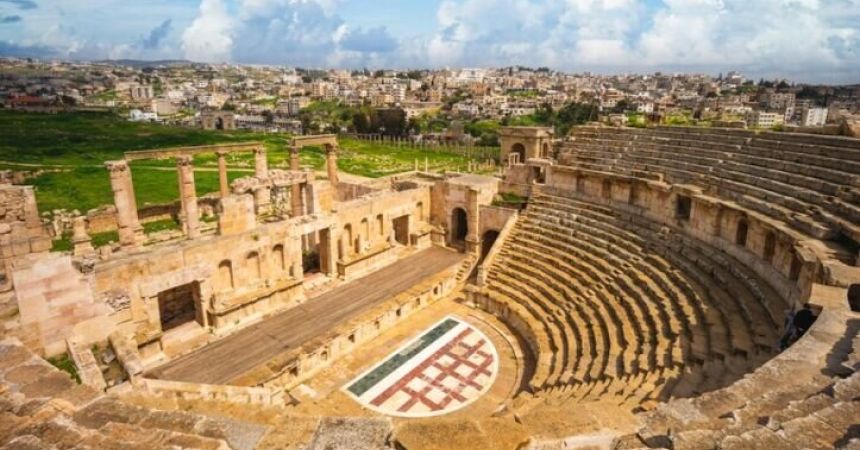
Egypt can take travelers deep into Pharaonic history before moving through later Greek, Roman, Coptic and Islamic layers. Jordan introduces its own succession of peoples and periods, including Nabataean, Roman, Byzantine and Islamic history among others.
Once the countries are combined, the timeline becomes too broad to treat everything as one ancient civilization.
That is useful.
It encourages travelers to notice historical succession rather than collecting monuments.
A Roman site in Jordan and an ancient Egyptian temple may both contain columns, but that superficial visual similarity tells you very little about why they were created, who used them or the societies surrounding them.
Good guiding becomes especially valuable here because historical context prevents a long multi-country journey from becoming a collection of impressive structures whose chronology has gradually blurred together.
The Countries Also Tell Different Stories About Water
Water may not be the first theme travelers associate with Jordan and Egypt, yet it creates another fascinating contrast.
Egypt's relationship with the Nile is fundamental. The river shaped settlement, agriculture, transportation and the development of ancient civilization in ways that remain visible to travelers today.
Jordan presents water differently.
The Dead Sea occupies one extreme, while ancient water management becomes particularly interesting at Petra, where surviving evidence helps explain how the Nabataeans supported life and activity within an arid environment.
Wadi Rum then reinforces the visual power of scarcity.
Looking at the two countries through this lens creates a more interesting journey than simply comparing famous monuments.
Egypt demonstrates what a great river made possible.
Jordan repeatedly reminds you what people achieved where water could not be taken for granted.
Which Country Should Come First?
There is no universal rule, although the order can influence the emotional shape of the journey.
Starting in Jordan can create a gradual expansion of scale. Amman introduces the region relatively gently, Petra provides the first major archaeological climax, Wadi Rum opens the landscape, and Egypt then increases the intensity through Cairo, Giza and the Nile Valley.
Beginning in Egypt creates another experience entirely.
The journey opens at high volume, with the scale of Cairo and ancient Egyptian monuments establishing an immediate sense of magnitude. Jordan can then provide a geographically more compact conclusion in which Petra and Wadi Rum remain spectacular without trying to imitate Egypt.
Both can work.
Flight schedules, cruise dates, international connections and hotel availability may ultimately be more important than attempting to create a theoretically perfect direction.
The strongest order is the one that works operationally while preserving a sensible emotional rhythm.
The Border on the Map Is Not the Main Transportation Question
Jordan and Egypt appear close enough that travelers sometimes assume movement between them will resemble an ordinary road transfer.
For many itineraries, flying is considerably more practical.
The correct connection depends on the cities involved, airline schedules and the wider route. This is why the international transition should be planned at the same time as the land itinerary rather than being treated as a detail to solve after every hotel has been selected.
A poorly timed flight can consume much of a day.
A sensible connection can allow breakfast in one country and a comfortable arrival in the next without damaging either itinerary.
This operational detail matters more on a two-country trip because every unnecessary transit hour is being taken from a finite pool of usable days.
Travelers considering Private Egypt and Jordan Journeys should therefore compare the sequencing and transportation logic as carefully as the hotel list.
A combined trip succeeds partly in the spaces between its famous places.
You Do Not Need the Same Style of Guiding in Both Countries
The idea of having one guide accompany you continuously through Jordan and Egypt sounds convenient, but tourism operations, licensing and local expertise do not necessarily work that way.
More importantly, the knowledge required across the journey is enormous.
Petra benefits from interpretation rooted in Nabataean history and the archaeological landscape. Cairo and Giza demand different historical expertise, while Upper Egypt introduces another concentration of temples, dynasties and religious concepts.
Using appropriately qualified local professionals allows each country to be interpreted within its own historical context rather than forcing the entire journey through one generalized narrative.
Continuity should instead come from the itinerary itself.
Transfers should connect properly, documents should be clear, flights should fit the route and the traveler should know who is responsible at each stage.
A seamless journey does not require pretending the two countries are one destination.
Jordan and Egypt Should Not Receive Equal Time Automatically
Symmetry looks attractive on paper.
Six nights Jordan. Six nights Egypt.
Why not?
Because the countries do not necessarily require time in the same way.
Jordan's compact geography allows major experiences to be connected relatively efficiently. Egypt's distances and the structure of a Cairo plus Nile Valley journey can require more nights even before optional destinations are considered.
The correct division therefore depends on what is included.
A Jordan-focused traveler may deliberately allocate more time to Petra, hiking or the desert. Someone whose primary interest is ancient Egypt may give the Egyptian portion substantially more nights while still retaining a strong Jordan experience.
Equal importance does not require equal duration.
This is another reason generic two-country itineraries can be misleading: they sometimes prioritize visual balance in the itinerary document rather than the actual time each experience needs.
The Combination Works Particularly Well for Travelers Who Like Contrast
Not every traveler needs to combine countries.
Some people would rather spend the same amount of time exploring Egypt in greater depth, adding Alexandria, more time in Cairo or a longer Nile experience. Others may prefer slowing Jordan down through hiking, additional Petra exploration, Aqaba or less-visited regions.
Those are excellent alternatives.
Combining Jordan and Egypt becomes particularly rewarding for travelers who enjoy the feeling of a journey changing character every few days.
The archaeology changes.
The landscapes change.
The scale changes.
The cities change.
The transportation changes.
Even the rhythm of the evenings can change when a desert camp gives way several days later to a Nile cruise.
If variety energizes you rather than making you feel hurried, the pairing has an unusually strong logic.
Families Need to Think About Energy Before They Think About Country Count
Jordan and Egypt can work extremely well for families, particularly when children or teenagers respond positively to visually dramatic places such as Petra, Wadi Rum and the Pyramids.
The challenge is cumulative intensity.
Several consecutive early starts, long archaeological visits and repeated hotel changes can become tiring regardless of how impressive each individual destination is. The solution is not necessarily removing one country; it is designing enough variation into the journey.
Wadi Rum can break up archaeology.
A Dead Sea stay can reduce the pace.
A Nile cruise changes the accommodation pattern and allows transportation to happen while travelers are already settled.
Families should also be realistic about walking expectations and heat, especially when younger children are involved.
The best family itinerary is rarely the one with the largest number of famous sites.
It is the one where everybody still wants to see the final one.


A travel professional specializing in tailor-made travel planning, guest experience management, and multi-destination tourism operations.
With over 23 years of experience in the travel industry, he designs and manages private and cultural tours for international travelers across Türkiye, Greece, Egypt, Jordan, Morocco, and other destinations.
He has strong expertise in both online and face-to-face guest communication, sales processes, and end-to-end travel operations.
Working closely with hotels, travel agencies, and local partners, he ensures smooth coordination and high-quality travel experiences at every stage of the journey.
His focus is on delivering personalized, reliable, and seamless travel experiences for international guests worldwide.