
Turkey vs Greece: Which One Matches Your Travel Style?
Updated: August 2026
Turkey and Greece are often compared because they share the Aegean, centuries of intertwined history, Mediterranean food traditions and some of the most recognizable archaeological landscapes in the world.
That is where the similarity ends.
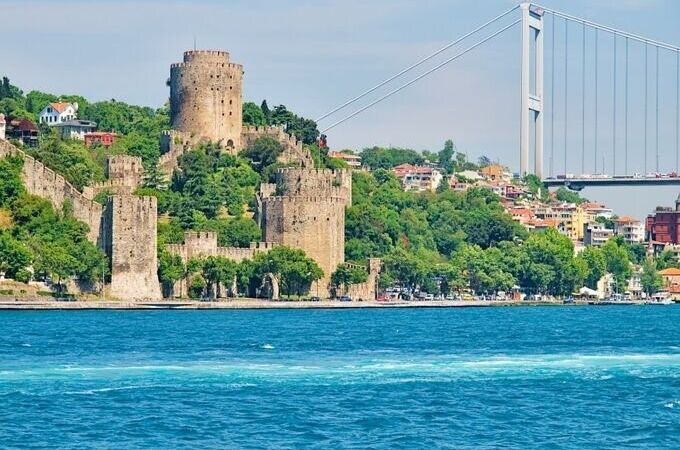
A trip through Turkey can move from Istanbul's imperial layers to Cappadocia's volcanic landscape, then continue toward Ephesus, Pamukkale or the Mediterranean coast. Greece often feels more maritime, with Athens acting as a powerful historical gateway before the journey spreads toward the islands or mainland archaeological regions.
Neither country is simply “better.”
They create different travel rhythms.
Turkey tends to reward travelers who enjoy contrast, movement and dramatic changes of setting. Greece often suits people who value island atmosphere, slower transitions and a stronger relationship with the sea.
That does not mean Turkey lacks relaxed coastal travel or Greece lacks complex historical routes. It means the two countries tend to organize a first holiday differently.
The useful question is therefore not:
“Which country has more to see?”
It is:
“Which country feels more like the kind of trip I actually enjoy taking?”
If You Like Contrast, Turkey Usually Changes Faster
One of Turkey's greatest strengths is how dramatically the experience can change within a single itinerary.
Istanbul feels dense, layered and urban.
Cappadocia replaces the Bosphorus with valleys, cave architecture and Central Anatolian landscapes.
Ephesus introduces a major archaeological world in western Turkey.
Pamukkale adds a natural-geological element.
Antalya or the southwest coast can then slow the trip down.
A traveler can therefore experience several visually and culturally distinct versions of the country without crossing a border.
Greece offers variety too, but the transition often feels different. Athens, Delphi, Meteora, the Peloponnese and the islands all have strong identities, yet the Aegean and maritime character remains more consistently present once you move toward island travel.
If you love a holiday where every three days feels almost like a different trip, Turkey may suit you more naturally.
If Islands Are the Heart of the Holiday, Greece Has the Stronger Identity
Greece is difficult to separate from its islands.
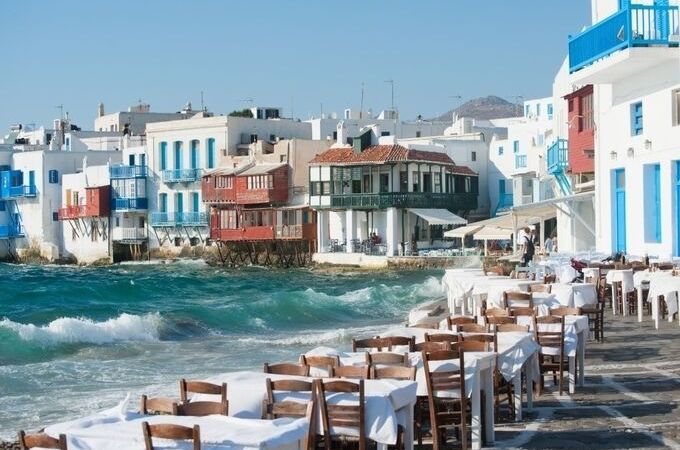
Santorini, Mykonos, Crete, Rhodes, Naxos, Paros, Corfu and dozens of lesser-known options create a level of island choice that shapes how travelers imagine the country before they arrive.
The island experience is not only about beaches.
It influences architecture, food, ferry movement, sunset culture, village life and the pace of the trip.
Turkey has beautiful coastal destinations and excellent sailing routes, but the holiday identity is different. A Turkish coastal trip may revolve around Bodrum, Fethiye, Marmaris, Antalya or a gulet journey, whereas Greece naturally encourages travelers to think in island sequences.
If you say, “I want to wake up in a different island environment every few days,” Greece is usually the more intuitive fit.
If you say, “I want ancient cities, big cultural contrast and perhaps a few coastal days at the end,” Turkey becomes extremely compelling.
The Historical Experience Feels Different
Both countries are outstanding for archaeology, but they do not deliver history in exactly the same way.
In Greece, travelers often enter the classical world through entities such as the Acropolis, Delphi, Epidaurus, Mycenae and Olympia. The cultural narrative can feel strongly anchored in Ancient Greece, even though Byzantine and later history are equally important in many places.
Turkey's historical layers are broader in a different direction.
Istanbul alone contains Byzantine and Ottoman history within the same urban geography. Western Turkey preserves major Greco-Roman cities such as Ephesus and Pergamon, while Central Anatolia introduces Hittite history, Cappadocia's rock-cut religious heritage and later Seljuk influences.
The result is not a competition in historical importance.
It is a difference in historical texture.
| If you are most drawn to... | Turkey may suit you | Greece may suit you |
|---|---|---|
| Byzantine + Ottoman layers | ✓ | |
| Classical Greek identity | ✓ | |
| Major Greco-Roman cities | ✓ | ✓ |
| Ancient island civilizations | ✓ | |
| Hittite / Anatolian civilizations | ✓ | |
| Imperial city history | ✓ | ✓ |
| Archaeology combined with islands | ✓ | |
| Archaeology combined with varied landscapes | ✓ |
This is why a history lover can easily enjoy both countries for completely different reasons.
Istanbul and Athens Set Different Tones for the Entire Journey
For many first-time travelers, the choice between Turkey and Greece begins with their two most famous cities.
Istanbul is expansive, busy, layered and physically divided by water. Its major landmarks are only part of the experience. Ferries, bazaars, neighborhoods, food and the relationship between Europe and Asia create a city that can easily absorb several days without feeling finished.
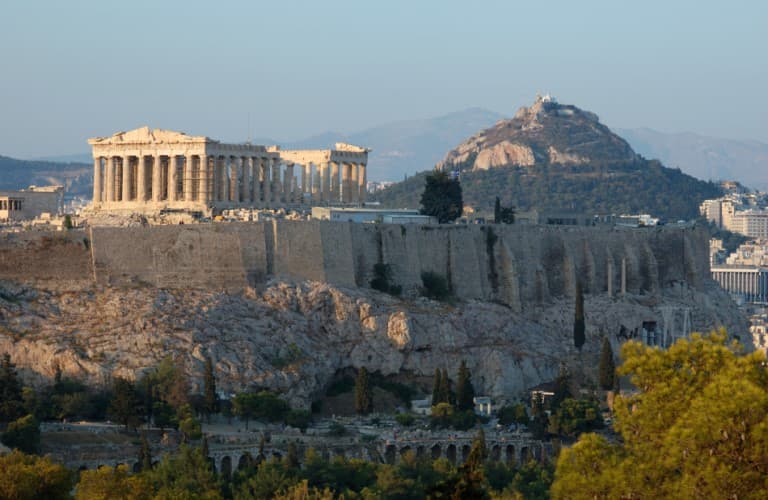
Athens is more concentrated around its ancient core, although the modern city extends well beyond the Acropolis. Its historical identity feels immediately legible: the Parthenon dominates the cultural imagination, and the city's archaeological narrative is highly visible.
Travelers who love large, complex cities with several historical identities often fall quickly for Istanbul.
Those who want a strong archaeological focus before moving onward to islands or the mainland may find Athens a more efficient opening chapter.
Neither city should be judged only by monument count.
They establish the emotional rhythm of the country that follows.
Greece Often Feels Slower Once You Reach the Islands
Island travel changes behavior.
People stay longer over lunch.
The ferry becomes part of the journey rather than an interruption.
A day that contains a beach, a village, dinner and sunset can feel complete without a long sightseeing checklist.
This is why Greece often suits travelers who are comfortable allowing the destination to slow them down.
Turkey can absolutely provide the same feeling on the coast, especially in Bodrum, Fethiye, Antalya or aboard a gulet, but a classic Turkey itinerary usually contains more movement between culturally different regions.
The difference can be summarized simply:
Greece often asks you to settle into a place.
Turkey often encourages you to keep moving.
That distinction alone can determine the right destination for certain travelers.
Turkey Can Feel More Rewarding for a Multi-Region First Trip
A first Turkey itinerary has unusually strong internal contrast.
You might begin in Istanbul, fly to Cappadocia, continue toward western archaeological regions and finish on the Mediterranean.
Every move adds a noticeably different chapter.
For travelers who enjoy the feeling of covering a lot of cultural ground, this is enormously satisfying.
It also means the trip requires more logistics.
Domestic flights become useful, transfers matter, and hotel changes can accumulate if the itinerary is too ambitious.
Greece can also require significant movement, especially with multiple islands, but the travel structure often feels more obvious: Athens, ferry or flight, island stay, another island, return.
Turkey rewards stronger route design.
Greece rewards stronger island selection.
Food Will Not Make the Decision Easier
Anyone hoping cuisine will provide an easy winner will probably be disappointed.
Both countries offer food cultures capable of becoming central to the holiday.
Greece is strongly associated with olive oil, grilled fish, vegetables, meze-style dishes, feta, yogurt, seafood, pastries and regional island cooking.
Turkey's cuisine is broader than the kebab stereotype suggests. Istanbul alone brings together influences from across Anatolia, while different regions introduce meze, seafood, olive-oil dishes, breads, grilled meats, pastries, regional specialties and an enormous breakfast culture.
The difference is partly geographical.
Greek food often feels closely tied to the Mediterranean and Aegean table.
Turkish food can feel more varied across regions because the country stretches between several culinary worlds.
If food exploration is one of your main travel motivations, Turkey may offer greater regional contrast.
If long island meals and seafood-centered coastal dining are part of the holiday fantasy, Greece may feel more naturally aligned.
Beaches: Greece Has the Island Advantage, Turkey Has the Coastal-Variety Advantage
Greece's beaches are inseparable from its island geography.
Many travelers choose islands partly according to beach character: sandy, pebbled, dramatic, calm, family-friendly or surrounded by cliffs.
Turkey's coastline is continuous rather than island-dominated, which creates a different pattern.
The Turquoise Coast around Fethiye, Marmaris and Bodrum offers bays, coves and sailing routes, while Antalya combines resort beaches with major archaeological sites inland.
This distinction matters.
Choose Greece if you want the island itself to define the beach holiday.
Choose Turkey if you want the beach to exist alongside a broader land itinerary.
Travelers specifically attracted to the Aegean comparison can consider Turkey and Greece coastal tours, where the two coastlines can be understood as complementary rather than competing versions of the same experience.
Greece Usually Requires More Ferry Thinking
Island-hopping introduces freedom, but also dependency.
Ferry routes, departure times, seasonal operations and wind conditions can influence a Greece itinerary, particularly when several islands are involved.
This is not a problem.
It is simply part of the architecture of Greek travel.
Turkey's most common first-time route relies more heavily on domestic flights and road transfers. That can make long geographical jumps quicker, but also means airports become part of the trip.
Neither transportation style is inherently easier.
Ask yourself which process you prefer.
Some travelers find ferries romantic.
Others dislike carrying luggage through ports.
Some find domestic flights efficient.
Others resent airport procedures during a holiday.
The right answer is highly personal.
Greece Can Be Easier for Travelers Who Want Fewer Moving Parts
A traveler staying in Athens plus one or two islands can create a relatively simple holiday.
Turkey becomes equally straightforward if you limit the number of regions, yet many first-time visitors are tempted to include too much because Istanbul, Cappadocia, Ephesus and Pamukkale all feel essential.
That is where trip personality matters.
If you enjoy carefully designed travel days and are happy to move frequently, Turkey's variety rewards the effort.
If you prefer checking into an island hotel and staying several nights before the next transfer, Greece can feel more natural.
The number of days matters less than how often you want to repack your suitcase.
Couples May Reach Different Conclusions Than Families
Couples often gravitate toward Greece because island atmosphere, dining and slower evenings fit the rhythm of a romantic holiday naturally.
That does not make Turkey less romantic. Cappadocia cave hotels, Bosphorus evenings and the southwestern coast can be exceptional for couples.
Families have a different decision.
Turkey's large range of cultural and natural experiences can keep varied age groups interested, while private transfers and domestic flights can simplify multi-region travel when organized well.
Greece can be excellent for families who want beach time and fewer sightseeing obligations, especially on islands with good accommodation and accessible beaches.
The best family destination depends on whether the parents want the trip to be educationally active or primarily restorative.
Budget Should Be Judged by Travel Structure, Not Reputation
Travelers frequently arrive with the assumption that Turkey is inexpensive and Greece is expensive.
That simplification is not useful enough to plan around.
Hotels, room categories, destination popularity, season, transportation and tour style can create enormous variation in both countries.
A high-end Cappadocia cave hotel can cost more than a modest Greek island property.
A prime Santorini room can dramatically exceed accommodation costs elsewhere in Greece.
Private guiding in Turkey adds cost, while several Greek ferry tickets and island transfers can also accumulate.
The better comparison is not average daily spending.
It is:
How expensive is the version of the trip I actually want?
A Turkey itinerary with multiple flights and private touring should not be compared with a simple Greece beach stay.
Compare like with like.
Greece Is Stronger When the Sea Is Part of the Daily Identity
This is more subtle than choosing a beach.
In Greece, the sea frequently remains present even when you are not swimming.
Ferries, waterfront restaurants, harbors, island architecture and sunset views all keep it in the background of the holiday.
Turkey's coastal regions can do the same, but a classic multi-region Turkey trip may spend several days far inland, particularly in Cappadocia.
If being near water is emotionally important to your holiday, Greece often maintains that relationship more consistently.
If you are happy to leave the sea completely behind for several days in exchange for inland landscapes, Turkey opens more variety.
Turkey Is Stronger for Travelers Who Want a Bigger Cultural Shift
For many visitors, especially those coming from western Europe, Greece can feel culturally familiar in certain ways even when its language, traditions and history are distinct.
Turkey often feels like a larger cultural transition.
Istanbul's mosques, bazaars, tea culture, call to prayer, Ottoman heritage and Anatolian regional differences create a travel experience that can feel more unfamiliar to first-time visitors.
Some people love that.
Others prefer a Mediterranean destination that feels easier to decode immediately.
Travel style matters here more than experience level.
Curious travelers who enjoy learning local norms and moving through visibly different cultural environments may find Turkey more stimulating.
Travelers prioritizing ease, islands and a relaxed Mediterranean rhythm may lean toward Greece.
If Archaeology Is the Main Reason for Traveling, Ask What Kind
This is where the comparison becomes more interesting.
If Ancient Greece itself is the emotional center of your interest, Athens, Delphi, Mycenae, Epidaurus and Olympia naturally make Greece difficult to beat.
If you want to move through multiple civilizations, Turkey becomes extraordinarily rich.
Istanbul introduces Byzantine and Ottoman history. Pergamon and Ephesus deepen the Greco-Roman story. Hattusa pushes far back into Bronze Age Anatolia, while Cappadocia adds another religious and cultural landscape entirely.
Turkey is therefore particularly strong for travelers who think historically in layers rather than one era.
Greece is particularly powerful for those who want the cultural origins and landscapes of the ancient Greek world to remain central throughout the trip.
One Country May Be Better for Your First Trip — and the Other for Your Next
This comparison does not need a permanent winner.
A traveler who chooses Turkey first may later appreciate Greece even more because the shared Aegean history becomes visible from another perspective.
The reverse is equally true.
Greek archaeological and cultural knowledge can make western Turkey feel more connected, while Turkey's Ottoman and Byzantine layers can deepen later understanding of the eastern Mediterranean.
For travelers with enough time, Turkey Greece combined journeys can eventually solve the comparison by refusing to choose at all.
But on a single-country trip, clarity is useful.
Choose the destination whose rhythm matches you, not the one whose attraction list appears longer.
A Simple Travel-Style Test
Choose Turkey if you want dramatic regional contrast, imperial cities, inland landscapes, multiple ancient civilizations and a trip that evolves constantly.
Choose Greece if island culture, slower coastal days, Ancient Greek heritage and a strong relationship with the sea define your ideal holiday.
Choose Turkey if you enjoy complex itineraries and want several travel styles in one journey.
Choose Greece if you want fewer transitions and longer stays in places that feel immediately different from one another without changing the overall Mediterranean mood.
Choose Turkey if the idea of Istanbul followed by Cappadocia sounds irresistible.
Choose Greece if Athens followed by two islands already sounds complete.
Neither answer is more sophisticated.
It is simply more accurate for you.
Travelers still undecided can review Turkey and Greece tour options to compare how each country structures a real multi-day journey rather than relying only on destination stereotypes.
Frequently Asked Questions About Turkey vs Greece
1. Is Turkey or Greece better for a first Mediterranean trip?
Greece may suit travelers wanting islands, slower pacing and an immediately recognizable Mediterranean holiday, while Turkey is especially rewarding for those wanting dramatic cultural and landscape contrast. The better first choice depends more on travel personality than destination importance.
2. Is Turkey better than Greece for history?
Turkey offers unusually broad historical layering, from Hittite and Greco-Roman sites to Byzantine and Ottoman heritage. Greece provides exceptional access to the ancient Greek world alongside Byzantine and later history. The better choice depends on which civilizations most interest you.
3. Which country is better for island hopping?
Greece has the stronger island-hopping identity because numerous islands are connected through established ferry and flight networks. Turkey offers excellent coastal destinations and sailing experiences, but its classic travel structure is less dependent on moving between islands.
4. Is Greece more relaxing than Turkey?
It can be, particularly when the itinerary uses Athens followed by one or two islands with longer stays. Turkey can be equally relaxing on the coast, but many classic Turkey journeys involve more regional movement and stronger changes in daily travel rhythm.
5. Is Turkey or Greece better for food lovers?
Both are outstanding, but the experience differs. Greece delivers a strong Aegean and Mediterranean food identity, while Turkey offers wider regional variation across Anatolia. Travelers who enjoy exploring markedly different food traditions between regions may find Turkey especially rewarding.
6. Which country has better beaches?
Greece offers exceptional island beach diversity, while Turkey has an extensive Aegean and Mediterranean coastline with beaches, coves and sailing routes. Rather than ranking them generally, decide whether island atmosphere or a beach integrated into a broader land itinerary matters more.
7. Is Turkey cheaper to travel than Greece?
Not always. Costs vary according to hotels, season, transportation and travel style in both countries. A multi-region Turkey trip with domestic flights and private touring may cost more than a simple Greek island stay, making direct trip-by-trip comparison more useful than stereotypes.
8. Which is better for couples, Turkey or Greece?
Greece naturally suits couples seeking island atmosphere, long dinners and slower coastal days, while Turkey offers romantic experiences ranging from Cappadocia cave hotels to Istanbul and the Turquoise Coast. The preferred travel pace usually determines the stronger fit.
9. Is Turkey or Greece better for families?
Turkey can suit families wanting varied cultural experiences and organized multi-region touring, while Greece often works especially well for families prioritizing beaches and fewer hotel changes. Children's ages, activity level and tolerance for transfers should influence the choice.
10. Which country is easier to travel around?
Neither is universally easier. Greece often involves ferries between islands, while Turkey relies more heavily on domestic flights and road transportation across longer distances. Travelers should decide which form of movement they personally find less disruptive during a holiday.
11. Can I visit both Turkey and Greece in one trip?
Yes, particularly on longer itineraries where each country receives enough time to retain its identity. Short trips can become dominated by airports or ferry logistics, so combining both works best when the second country adds meaningful depth rather than another rushed stop.
12. What is the biggest mistake when choosing between Turkey and Greece?
The biggest mistake is comparing attraction counts instead of travel style. Both countries contain extraordinary history, food and coastlines, but they organize the holiday differently. Decide how you like to move, relax and experience places before deciding which destination fits better.

A travel professional specializing in tailor-made travel planning, guest experience management, and multi-destination tourism operations.
With over 23 years of experience in the travel industry, he designs and manages private and cultural tours for international travelers across Türkiye, Greece, Egypt, Jordan, Morocco, and other destinations.
He has strong expertise in both online and face-to-face guest communication, sales processes, and end-to-end travel operations.
Working closely with hotels, travel agencies, and local partners, he ensures smooth coordination and high-quality travel experiences at every stage of the journey.
His focus is on delivering personalized, reliable, and seamless travel experiences for international guests worldwide.