Abu Simbel Egypt: Is the Journey Really Worth It?
Updated: August 2026
Abu Simbel creates an unusual problem for travelers in Egypt. Almost nobody questions whether the temples are important; the uncertainty begins when you look at where they are.
Far south of Aswan, close to Egypt's border with Sudan, the temples do not conveniently fall between Cairo, Luxor and the familiar Nile Valley stops. Visiting requires a deliberate journey into Nubia, usually an early start and a meaningful block of travel time. On an already ambitious Egypt holiday, that naturally raises the question: is Abu Simbel genuinely worth the effort, or does its reputation make travelers feel they have to go?
For most first-time visitors with a serious interest in Ancient Egypt, the answer is yes. Abu Simbel is not merely another temple added to a long sequence of archaeological sites. Its monumental scale, isolated setting, association with Ramesses II and extraordinary twentieth-century relocation give the visit a character that is difficult to reproduce elsewhere.
That does not mean everybody should automatically include it.
Abu Simbel makes most sense when you understand what the journey costs in time, where it fits around Aswan and Nile travel, and what you are giving up elsewhere to make room for it.
Abu Simbel Is Not Simply Another Sight Near Aswan
One of the easiest planning mistakes is seeing Abu Simbel listed under “things to do from Aswan” and mentally treating it like another local attraction.
Geographically, it is a much bigger commitment.
The temples stand on the western shore of Lake Nasser, roughly 280 kilometers south of Aswan by road. A road excursion therefore involves several hours of travel in each direction, which is why departures commonly begin very early.
That changes the character of the day.
You are not stepping out of your Aswan hotel after breakfast, visiting a monument for two hours and returning for lunch. Abu Simbel effectively becomes the central purpose of that part of the day.
For some travelers, this sounds inconvenient. For others, the remoteness contributes to the experience. After the intensity of Cairo and the busier archaeological corridor around Luxor, traveling through southern Egypt toward two enormous rock-cut temples beside Lake Nasser can feel like reaching the geographical edge of the conventional Egypt journey.
The distance is therefore both Abu Simbel's weakness and part of its appeal.
What Makes the Temples Different After You Have Already Seen So Much Ancient Egypt?
Temple fatigue is real.
A first-time Egypt itinerary may include the Pyramids of Giza, Saqqara, Karnak, Luxor Temple, Valley of the Kings, Philae and several additional archaeological sites. By the time travelers reach Aswan, another temple can sound less essential than it did while planning from home.
Abu Simbel tends to resist that problem because its first impression is so different.
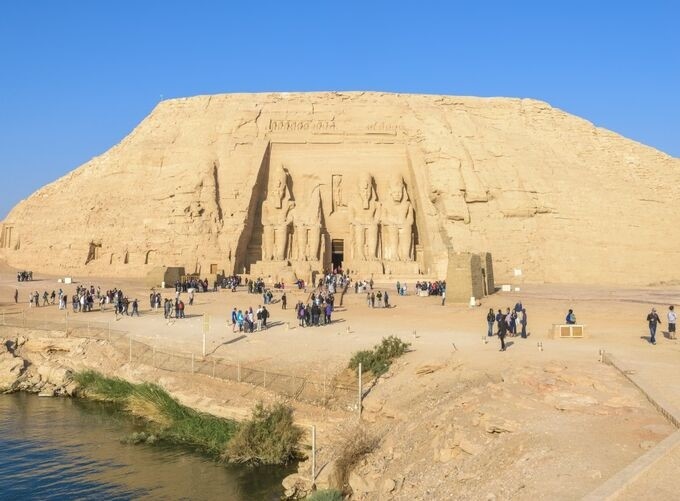
The Great Temple of Ramesses II is dominated by four colossal seated statues carved into the façade, creating a scale that feels almost theatrical even by pharaonic standards. Nearby, the smaller temple dedicated to Hathor and Queen Nefertari provides a different architectural experience and gives Nefertari unusually prominent representation.
The temples were created during the reign of Ramesses II in the 13th century BCE, but their modern story has become almost inseparable from their ancient one.
When construction of the Aswan High Dam threatened numerous Nubian monuments with inundation, an international UNESCO-led campaign dismantled the Abu Simbel temples into massive sections and reconstructed them on higher ground during the 1960s.
The result is unusual: you are simultaneously looking at one of Ancient Egypt's great expressions of royal power and one of modern archaeology and engineering's most remarkable preservation projects.
That double identity is one reason Abu Simbel still feels distinctive after several days of Egyptian monuments.
The Real Question Is Not “Is Abu Simbel Beautiful?” but “What Does It Cost Your Itinerary?”
This is where travel planning becomes more useful than another list of historical facts.
Abu Simbel has an opportunity cost.
A traveler with plenty of time in Aswan can accommodate the excursion without much difficulty. Someone trying to combine Cairo, Luxor, Aswan, a Nile cruise and perhaps the Red Sea within a short holiday has much less flexibility.
The right question is therefore:
What would I do with this time if I did not visit Abu Simbel?
If the answer is “another relaxed afternoon in Aswan,” Abu Simbel may easily win.
If removing Abu Simbel gives you the extra night that prevents Luxor from becoming rushed, the decision becomes more complicated.
If you are already feeling exhausted after several early starts and transfers, another pre-dawn departure may have a larger impact than the itinerary spreadsheet suggests.
The monument does not change.
Its value relative to your available time does.
Road or Air Is Really a Time-versus-Cost Decision
Abu Simbel can generally be approached from Aswan by road or by air, subject to operating schedules and arrangements for the travel date.
The road option is common because it integrates relatively simply with an Aswan stay, although the distance means a substantial amount of the day is spent traveling. Early departures are normal, and travelers should be comfortable with that before placing Abu Simbel immediately after another demanding day.
Flying can reduce road time, but it introduces another set of considerations: flight schedules, airport procedures, transfer timing and usually a higher cost. A short flight should not automatically be interpreted as a dramatically shorter total excursion once the entire airport process is considered.
This is why there is no universally “best” method.
| Your Main Concern | Road Excursion | Flight Option |
|---|---|---|
| Keeping costs more controlled | Usually stronger | Usually less attractive |
| Avoiding a long road journey | Weaker | Stronger |
| Simple inclusion from Aswan | Common approach | Schedule-dependent |
| Very tight surrounding schedule | Requires careful timing | May help, but connections matter |
| Dislike of early starts | Often challenging | Still dependent on flight schedule |
| Experience of traveling through Nubia | Part of the journey | Much less prominent |
The correct choice depends less on prestige than on what your surrounding days already demand.
Why Aswan Is the Natural Decision Point
Travelers sometimes begin researching Abu Simbel as though it were an independent stop requiring its own miniature Egypt itinerary.
For most conventional journeys, it is more useful to think of Aswan as the logistical anchor.
Aswan already occupies a natural position in many Upper Egypt trips, whether travelers arrive by air, connect with a Nile cruise or approach from Luxor. Abu Simbel can then be evaluated as an extension from that base rather than another destination that requires restructuring the entire country.
This distinction matters.
The question becomes:
“While I am in Aswan, do I want to commit part of my available time to Abu Simbel?”
rather than:
“How do I add another Egyptian city to my itinerary?”
Travelers considering Egypt journeys combining Cairo and Upper Egypt should make the Abu Simbel decision before locking the Aswan portion too tightly. Trying to insert it afterward is where awkward timings and unnecessarily exhausting days often appear.
Abu Simbel Before or After a Nile Cruise?
This is one of the practical questions that deserves attention, although it should not turn this article into a Nile cruise itinerary.
Both arrangements can work.
What matters is the exact embarkation or disembarkation schedule, where you are staying, how much buffer exists around transfers and whether the excursion creates an uncomfortable sequence of early mornings.
A traveler arriving in Aswan late one evening, leaving for Abu Simbel before dawn and immediately beginning another structured travel program after returning may technically have a workable itinerary.
That does not necessarily make it a pleasant one.
Where possible, Abu Simbel benefits from being placed beside breathing room, particularly if the surrounding Egypt journey is already fast-paced.
This is one of those cases where operationally possible and experientially sensible are not always the same thing.
The Early Start Is Not a Minor Detail
Travel itineraries often hide fatigue behind departure times.
“Early morning departure for Abu Simbel” sounds harmless until it follows a late flight, several days of touring or another early start.
For travelers accustomed to active itineraries, this may not matter much. For families, older travelers or anyone who values leisurely mornings, it can materially affect the experience.
That is why Abu Simbel should not be judged solely by the hours spent at the archaeological site.
The experience begins when you wake up.
If the excursion requires sacrificing sleep, spending hours traveling, visiting the temples and then immediately continuing into another tightly scheduled activity, the monument may still be magnificent while the day itself becomes unnecessarily demanding.
Good itinerary design does not merely ask whether everything fits.
It asks whether you will still enjoy it once it does.
Who Gets the Most Value From Abu Simbel?
Abu Simbel is particularly rewarding for travelers whose interest in Egypt extends beyond simply seeing the Pyramids.
If Ramesses II, temple architecture, Nubian Egypt, monumental sculpture or archaeological preservation genuinely interests you, the journey is easy to defend. The same is true for travelers who value places partly because of their setting; Abu Simbel's isolation beside Lake Nasser contributes considerably to its impact.
First-time visitors undertaking a substantial Upper Egypt journey are also unlikely to regard it as redundant.
The decision becomes less obvious for travelers with extremely limited time, people primarily interested in contemporary Egyptian culture, or those whose itineraries already contain more archaeological sightseeing than they realistically enjoy.
Skipping Abu Simbel does not mean you have “failed” to see Egypt.
Including it should be a choice, not an obligation generated by a checklist.
What Travelers Commonly Underestimate
The biggest misconception is not the distance itself. Most people discover that quickly.
It is how the Abu Simbel day interacts with the days immediately before and after it.
Consider the difference:
| Situation | Likely Effect |
|---|---|
| Abu Simbel after a relaxed Aswan day | Early departure is easier to absorb |
| Abu Simbel after a late arrival | Sleep and energy become part of the cost |
| Free afternoon after returning | Day retains some breathing room |
| Major transfer immediately afterward | Excursion feels substantially heavier |
| Several archaeological days already completed | Interest level matters more |
| Abu Simbel is a personal priority | Travel effort feels easier to justify |
This is why copying somebody else's itinerary rarely answers whether Abu Simbel belongs in yours.
The surrounding 48 hours matter almost as much as the excursion itself.
What If You Have to Choose Between Abu Simbel and More Time in Aswan?
This is a genuine trade-off rather than a question with a universally correct answer.
Aswan deserves more than being treated as the departure point for somewhere else. The Nile landscape, Nubian character and archaeological sites around the city create a considerably different atmosphere from Cairo and Luxor.
A traveler with only one usable day in the area therefore needs to think carefully before spending much of it traveling to Abu Simbel.
With more time, the conflict largely disappears.
This is another reason the Abu Simbel decision should happen while allocating time to Upper Egypt, rather than being added after every other component has already been fixed.
For private Egypt travel with time in Aswan, the greatest advantage is often not simply having a vehicle or guide; it is the ability to position the excursion around the rest of the journey instead of forcing every traveler into an identical sequence.
Abu Simbel Is More Than the Photograph of Four Colossi
The famous façade creates expectations, but the visit becomes more interesting when travelers understand what they are actually seeing.
Ramesses II used architecture on a monumental scale to project royal power in Egypt's Nubian territories. The Great Temple incorporates deities and the pharaoh himself into an architectural statement designed to impress long before modern tourism existed.
The neighboring temple associated with Nefertari adds another dimension, while the temples' relocation after the construction of the High Dam means the modern landscape itself contains a preservation story.
You do not need to become an Egyptologist before arriving.
However, Abu Simbel rewards context.
A knowledgeable guide or some preparation beforehand can turn enormous statues into a much richer discussion of kingship, Nubia, religion, political messaging and the modern struggle to preserve heritage threatened by development.
That interpretive depth is where the long journey begins to pay back more than photographs.
When Abu Simbel Probably Does Not Belong in Your Trip
There are circumstances where removing Abu Simbel improves the itinerary.
If adding it means turning Aswan into little more than a hotel bed between transfers, reconsider.
If your Egypt trip is extremely short and including Abu Simbel forces you to reduce a major destination to an impractical stay, reconsider.
If archaeological sightseeing is already becoming repetitive for you personally, do not assume one more famous temple will automatically reverse that feeling.
And if the only reason you are going is because every itinerary online seems to include it, that is worth questioning too.
Travel planning improves when important places are allowed to compete for time rather than being treated as compulsory.
So, Is Abu Simbel Worth Visiting?
For most culturally curious travelers who already intend to reach Aswan, yes — Abu Simbel is worth the journey.
The answer comes with a condition.
Give the excursion enough space to remain an experience rather than turning it into another logistical achievement. Recognize that the road journey is substantial, avoid surrounding it unnecessarily with other demanding transfers, and understand why the temples matter beyond their monumental façades.
Travelers exploring Egypt tours with Nile and archaeological experiences should also judge Abu Simbel according to the rest of the route. A longer itinerary can absorb the excursion naturally; a shorter one may require a genuine sacrifice elsewhere.
Abu Simbel's remoteness is not an inconvenience that planning can completely remove.
In some ways, that remoteness is precisely the point.
You travel far south of Egypt's most familiar visitor route and arrive beside Lake Nasser at a monument that survived not only thousands of years of history but the extraordinary modern operation required to save it.
The journey asks something from you.
For the right traveler, that is part of why arriving feels worthwhile.
Frequently Asked Questions About Visiting Abu Simbel
1. Is Abu Simbel really worth traveling several hours from Aswan?
For travelers interested in Ancient Egypt, monumental architecture or archaeological preservation, usually yes. The temples offer a scale and setting unlike most other sites, although visitors with very limited time should weigh the excursion against what they would sacrifice elsewhere in Upper Egypt.
2. Should I skip Abu Simbel if I have already seen many temples in Egypt?
Not necessarily. Abu Simbel feels different because of its monumental façades, Nubian location and extraordinary relocation history. However, travelers already experiencing archaeological fatigue should decide according to personal interest rather than treating the temples as an obligatory box to tick.
3. Is Abu Simbel actually in Aswan?
No. Abu Simbel lies much farther south, near Lake Nasser and close to the Sudanese border. Aswan functions as the usual logistical base for many visitors, which is why Abu Simbel is frequently described as an excursion from Aswan rather than an independent stay.
4. Is the road journey to Abu Simbel exhausting?
It can be tiring because several hours of road travel are involved and departures are commonly early. How demanding it feels depends greatly on the previous evening, the activities planned afterward and the traveler's tolerance for early starts and long vehicle journeys.
5. Is flying to Abu Simbel automatically much easier?
Flying reduces the long road component, but total travel time also includes airport transfers, check-in procedures and schedule constraints. It can be attractive for some travelers, although the best option should be assessed using the complete door-to-door journey rather than flight duration alone.
6. Do I need to stay overnight at Abu Simbel?
Most visitors based in Aswan experience Abu Simbel as an excursion rather than an overnight destination. An overnight can create a different pace, but whether it provides enough additional value depends on the wider route and the traveler's particular interest in the site.
7. Can Abu Simbel fit naturally around a Nile cruise?
Yes, and it is frequently incorporated around the Aswan portion of an Upper Egypt journey. Exact timing should be coordinated with embarkation, disembarkation, flights and transfers rather than assuming the excursion can simply be inserted into any available calendar space.
8. Should families with children visit Abu Simbel?
It can be rewarding for families, particularly when children are interested in Ancient Egypt, but the early departure and long travel time deserve serious consideration. For younger children, the logistics of the day may matter more than the archaeological importance of the destination.
9. Is Abu Simbel more impressive than the temples in Luxor?
They offer very different experiences, so ranking them is not particularly useful. Luxor provides extraordinary archaeological concentration, while Abu Simbel combines monumental scale, an isolated Nubian setting and a remarkable modern preservation story that gives the visit its own identity.
10. Should I choose Abu Simbel or spend another day in Aswan?
If you have adequate time in Aswan, the choice may not be necessary. With a very short stay, travelers who value slower exploration may prefer Aswan itself, while those particularly interested in Ramesses II and monumental archaeology are more likely to prioritize Abu Simbel.
11. Why was Abu Simbel moved from its original location?
Construction of the Aswan High Dam and creation of Lake Nasser threatened the temples with inundation. An international UNESCO-led preservation campaign dismantled and reconstructed them on higher ground, creating one of the twentieth century's most extraordinary archaeological rescue operations.
12. What is the biggest mistake travelers make when adding Abu Simbel?
The biggest mistake is considering only the visit itself while ignoring the surrounding 48 hours. A late arrival before an early departure or another demanding transfer immediately afterward can make an otherwise excellent excursion feel unnecessarily exhausting.

A travel professional specializing in tailor-made travel planning, guest experience management, and multi-destination tourism operations.
With over 23 years of experience in the travel industry, he designs and manages private and cultural tours for international travelers across Türkiye, Greece, Egypt, Jordan, Morocco, and other destinations.
He has strong expertise in both online and face-to-face guest communication, sales processes, and end-to-end travel operations.
Working closely with hotels, travel agencies, and local partners, he ensures smooth coordination and high-quality travel experiences at every stage of the journey.
His focus is on delivering personalized, reliable, and seamless travel experiences for international guests worldwide.