An Egypt Trip Can Cross 2,500 Years Before Lunch
Updated: August 2026
There is a peculiar moment that happens on many first journeys through Egypt.
One morning you are standing beside a pyramid built during the Old Kingdom. The following day you fly south and begin visiting temples and royal tombs associated primarily with the New Kingdom, roughly a thousand years later. A few days after that, you arrive at a temple whose surviving architecture belongs largely to the Ptolemaic and Roman periods.
Your suitcase has aged perhaps four days.
Historically, you have traveled through more than two millennia.
This is one reason ancient Egypt can become confusing even when the itinerary itself is perfectly straightforward. Travelers naturally remember geography: Cairo first, Luxor next, Aswan farther south. Ancient Egyptian history does not arrange itself so conveniently around a modern route.
The Pyramids of Giza were already ancient monuments by the time Tutankhamun was buried. Ramesses II came later still. Cleopatra VII belongs near the opposite end of the ancient Egyptian story, despite being one of its most recognizable names.
Once those relationships begin making sense, Egypt changes.
The monuments stop looking like one enormous collection of things built by “the ancient Egyptians” and begin revealing a civilization that repeatedly changed its rulers, capitals, religious landscapes, architecture and relationship with neighboring regions over an extraordinary span of time.
You do not need to memorize thirty dynasties to appreciate that.
You only need a better map of time.
Your Itinerary Is Probably Traveling Backwards, Forwards and Sideways Through History
A normal Egypt itinerary is designed around geography and transportation rather than chronology.
That is sensible.
Nobody should drive around the country attempting to visit every monument in the exact order in which it was constructed.
The consequence is that historical time jumps around constantly.
You might begin at Giza, continue to the Egyptian Museum or another museum collection containing objects from completely different periods, fly to Luxor, travel south toward Aswan, make an excursion to Abu Simbel and eventually visit Philae.
On paper, that looks like a clean southbound journey.
Historically, it is anything but linear.
The easiest solution is not to memorize every reign. Instead, attach several broad periods to places you are likely to visit.
The Timeline Hidden Inside a Typical Egypt Journey
| What You Encounter | Broad Historical Context | What Has Changed |
|---|---|---|
| Saqqara | Early Dynastic and Old Kingdom, with many later layers | Monumental stone architecture and pyramid development become visible |
| Giza | Mainly Old Kingdom | Royal pyramid building reaches an extraordinary scale |
| Luxor / Ancient Thebes | Especially Middle and New Kingdom, with extensive later additions | Southern royal power, monumental temple complexes and hidden royal tombs become central |
| Abu Simbel | New Kingdom, reign of Ramesses II | Royal power and monumental messaging extend deep into Nubian geography |
| Philae | Primarily Ptolemaic and Roman monumental phases | Traditional Egyptian religion continues under Greek and Roman political rule |
| Roman Egypt | From 30 BCE onward | Egypt becomes part of the Roman world while many older religious traditions continue |
This is deliberately not a complete chronology of Egypt.
It is the amount of chronology that helps a traveler understand what is happening around them.
Before Giza Became Giza, There Was Saqqara
If the Great Pyramid feels like the obvious beginning of ancient Egypt, Saqqara complicates the story in a useful way.
The Step Pyramid complex of Djoser, dating to the Third Dynasty, predates the great pyramids at Giza and represents a crucial stage in the development of monumental stone architecture and royal pyramid construction.
For a traveler, this changes how Giza is understood.
The pyramids did not simply appear one morning because somebody in the Fourth Dynasty had an unusually ambitious architectural idea. Earlier royal tomb traditions and experiments preceded them, and pyramid design developed over time.
Saqqara allows you to see part of that evolution.
This is why chronology can add more value than another list of attractions. Without historical context, Saqqara and Giza become two places containing pyramids. With context, one helps explain how the other became possible.
The relationship is more interesting than the checklist.
Giza Takes You Deep Into the Old Kingdom
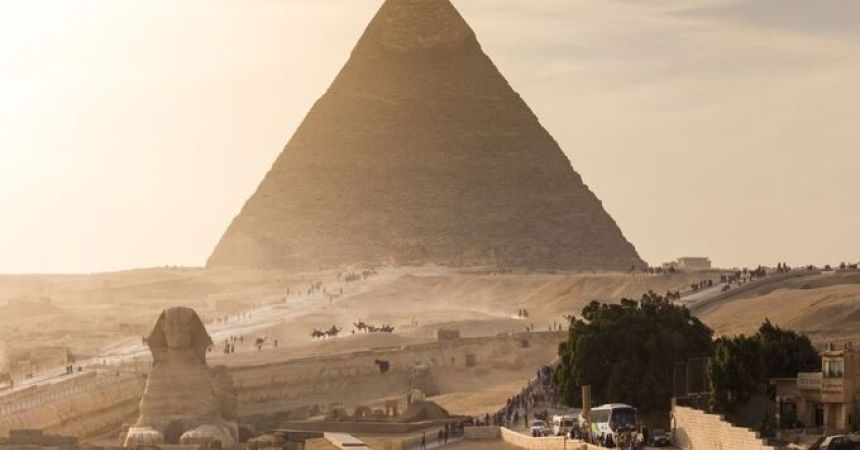
The pyramids associated with Khufu, Khafre and Menkaure belong to Egypt's Fourth Dynasty and the period historians call the Old Kingdom.
This is early in the long story travelers casually describe as Ancient Egypt.
The Great Pyramid was constructed in the third millennium BCE, more than two thousand years before Cleopatra VII. Even Tutankhamun, who feels extremely ancient from our perspective, lived roughly a millennium after the great pyramid-building age at Giza.
That scale of time is difficult to absorb because tourism compresses it.
You can see an Old Kingdom monument in the morning and a New Kingdom object in a museum that afternoon. Both are behind glass, both belong to ancient Egypt and both may be explained within minutes of each other.
The physical distance is tiny.
The historical distance is enormous.
Understanding this makes Giza more impressive rather than less mysterious. The pyramids survived long enough to become ancient monuments within ancient history itself.
Your Flight to Luxor Can Move You Forward Roughly a Millennium
A domestic flight from Cairo to Luxor may take little more than an hour.
Historically, your itinerary has just performed something far more dramatic.
Much of what first-time visitors associate with Luxor belongs particularly to the New Kingdom, beginning in the sixteenth century BCE, although the history of ancient Thebes is considerably broader and many monuments contain additions from different reigns and later periods.
This means you have moved from the great pyramid age into a world separated from it by many centuries.
Kingship still matters.
Religion still matters.
Monumental building certainly has not disappeared.
But the political geography and royal funerary landscape have changed substantially.
The pharaohs you encounter around Luxor are not the rulers who built Giza.
That sounds obvious when written down.
During a fast-moving tour, it is remarkably easy to forget.
Luxor Is Where the New Kingdom Becomes Difficult to Ignore
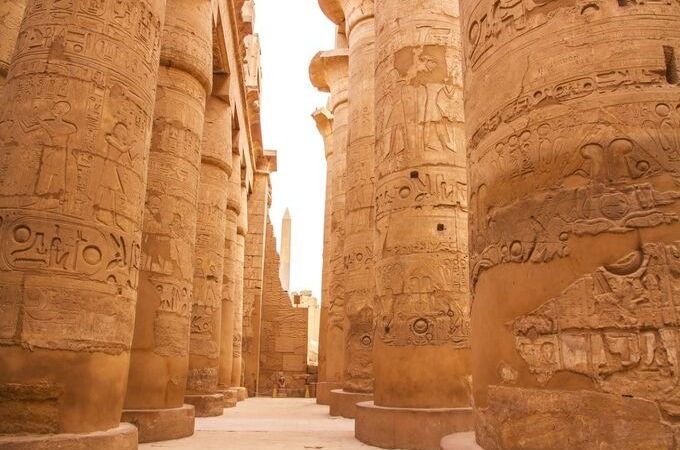
Ancient Thebes rose to extraordinary importance, and the landscape around modern Luxor preserves monuments associated with some of the names travelers recognize most readily: Hatshepsut, Tutankhamun, Seti I and Ramesses II among them.
This is also where the relationship between the living city, temples and the royal burial landscape on the west bank becomes particularly important.
The scale remains monumental, but it is monumental in a different way from Giza.
Instead of approaching three enormous royal pyramids dominating a desert plateau, travelers encounter vast temple complexes, decorated tombs cut into the landscape and monuments altered or expanded by successive rulers.
That last detail matters.
An Egyptian temple should not always be imagined as something one pharaoh commissioned, completed and left untouched forever. Major religious sites could develop over long periods, with rulers adding gateways, courts, pylons, chapels, inscriptions or other architectural elements.
Consequently, asking “When was Karnak built?” sounds like a simple question but requires a much more complicated answer.
Ancient Egypt rarely cooperates with one-date captions.
Why Did Pharaohs Stop Building Great Pyramids for Their Tombs?
After Giza, visitors sometimes arrive in the Valley of the Kings and wonder why New Kingdom rulers were being buried in rock-cut tombs rather than enormous pyramids.
The transition was not simply a matter of somebody deciding that pyramids had gone out of fashion.
Royal burial practices changed over centuries, and by the New Kingdom, kings were buried in concealed tombs in the Theban landscape while mortuary temples were physically separated from the burial chambers.
Security was one factor in the broader development, but religion, landscape and changing funerary traditions also matter.
For travelers, the useful insight is not a single explanation.
It is recognizing that the Valley of the Kings represents a different solution to royal death from the monumental pyramid complexes of the Old Kingdom.
When you travel from Giza to Luxor, you are therefore not visiting two versions of the same royal cemetery.
You are seeing how royal burial itself changed.
Tutankhamun Arrived Very Late to the Pyramid Party
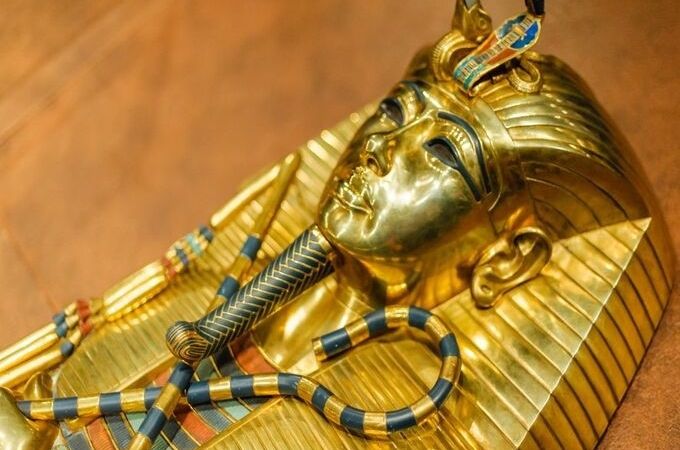
Tutankhamun is perhaps the most famous Egyptian pharaoh among modern travelers, largely because of the extraordinary survival and discovery of his tomb and burial objects.
Chronologically, however, he belongs to the Eighteenth Dynasty of the New Kingdom.
The Great Pyramid was already roughly a thousand years old by Tutankhamun's lifetime.
That single relationship is more useful than memorizing a long sequence of dynasty numbers because it immediately stretches the traveler's mental timeline.
Imagine Tutankhamun visiting Giza.
He would not have been looking at a contemporary royal construction site.
He would have been looking back at monuments from a distant Egyptian past.
Ancient Egyptians themselves lived among antiquities.
This is one of the most useful corrections to the idea that ancient Egypt was one static civilization in which pyramids, Tutankhamun, Ramesses II and Cleopatra somehow occupied the same historical neighborhood.
They did not.
Hatshepsut and Tutankhamun Were Much Closer Neighbors in Time
Once the Old Kingdom/New Kingdom gap becomes clear, the relationships within Luxor become easier to understand.
Hatshepsut ruled during the Eighteenth Dynasty, earlier in the same broad dynasty that later included Tutankhamun.
This does not mean their monuments or historical circumstances were identical, but they belong to a much closer chronological world than either does to the builders of the Giza pyramids.
That context helps when visiting the Theban landscape.
Instead of encountering Hatshepsut's temple, Tutankhamun's tomb and other New Kingdom monuments as unrelated famous attractions, you begin seeing overlapping generations of royal ambition, religious practice and political change.
This is where Ancient Egypt Tours become much more rewarding when guiding includes historical relationships rather than simply dates.
A date tells you when something happened.
A relationship tells you why you should remember it.
Ramesses II Came After Tutankhamun, but Not Centuries Later
Ramesses II belonged to the Nineteenth Dynasty and ruled after the Eighteenth Dynasty world of Tutankhamun.
His exceptionally long reign and enormous building legacy mean his name appears repeatedly during an Egypt journey.
This can create the impression that he was everywhere.
To be fair, he did his best.
Existing monuments could carry his inscriptions, while major new construction projects reinforced royal presence on an extraordinary scale.
His monuments also help travelers connect Luxor with the journey farther south.
By the time you encounter Ramesses II at Abu Simbel, the geography has changed dramatically, but the chronological thread remains within the New Kingdom.
This is where an itinerary stops being a collection of isolated destinations and starts revealing relationships across Egypt.
Aswan Changes the Geography Before It Changes the Century
Travel south from Luxor toward Aswan and the Nile environment changes noticeably.
Granite becomes important to the physical story of Egyptian monument building, while the relationship between Egypt and Nubia becomes increasingly difficult to treat as a footnote.
Aswan's importance cannot be reduced to one historical period. The region mattered across long stretches of Egyptian history as a southern frontier zone, a center connected with trade and movement, and a source of stone used in monumental construction.
This makes Aswan useful in a chronological journey precisely because it resists being assigned to one dynasty.
At Giza, the Old Kingdom can dominate your attention.
At Luxor, the New Kingdom can easily take over.
Aswan reminds you that geography itself remained important while political periods came and went.
Our dedicated Aswan guide deals with whether the destination deserves one, two or three nights. Here, its role is different: Aswan helps explain why southern Egypt mattered long before your itinerary needed a hotel there.
Abu Simbel Is Ramesses II Making a Statement in Stone
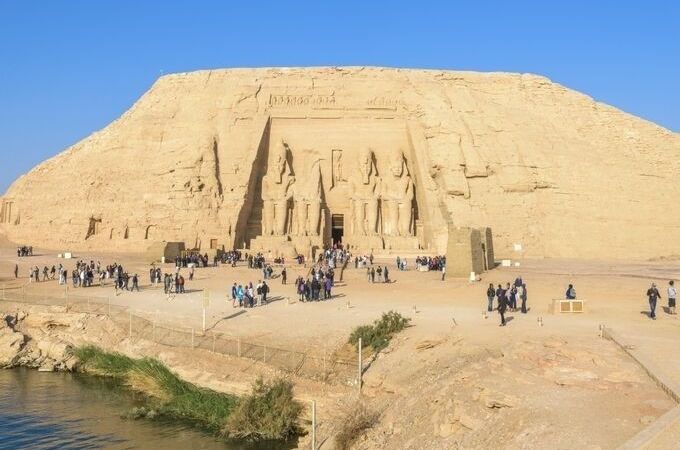
Abu Simbel is often introduced through dimensions.
How tall are the colossal seated figures?
How large is the temple?
How far is it from Aswan?
Those numbers are useful, but historical context makes the site much more interesting.
The great temple was created during the reign of Ramesses II in the thirteenth century BCE, within a Nubian landscape where monumental architecture also communicated royal authority.
This means Abu Simbel should not be mentally detached from the New Kingdom world you encountered around Luxor.
Geographically, you have traveled much farther south.
Chronologically, the relationship is much closer.
That is an important reversal from the Cairo-to-Luxor experience.
A short flight or journey can sometimes cross a thousand years of history, while a much longer geographical journey may keep you within the same broad historical period.
Maps and timelines measure completely different kinds of distance.
Egypt makes you use both.
Philae Is Much Later Than Many Travelers Expect
Philae produces another chronological surprise.
The site looks unmistakably “ancient Egyptian” to modern eyes, which encourages travelers to mentally place it beside much earlier temples and monuments.
Yet much of the temple complex visitors encounter today developed during the Ptolemaic period, with additions continuing under Roman rule.
That places it extremely late in the ancient Egyptian timeline compared with Giza.
The visual continuity is fascinating.
Egyptian religious traditions, iconography and temple forms did not simply vanish when political control changed. Greek-speaking Ptolemaic rulers governed Egypt after Alexander the Great's conquest, yet traditional Egyptian religious architecture and practices continued.
Later, Roman rule added another political layer.
If you visited Giza earlier in the same week, you have now encountered monuments separated by more than two thousand years.
Your itinerary may call both days “Ancient Egypt sightseeing.”
History is entitled to object.
Cleopatra Appears Near the End, Not Somewhere in the Middle
Cleopatra VII is so deeply associated with ancient Egypt in popular culture that it is easy to imagine her occupying the same general historical world as the great pharaohs.
Chronologically, she arrives astonishingly late.
Cleopatra VII lived from 69 to 30 BCE and was the final active ruler of the Ptolemaic Kingdom. Her lifetime was much closer to the beginning of Roman imperial Egypt than to the construction of the Great Pyramid.
By Cleopatra's time, Giza's great pyramids had already stood for more than two and a half millennia.
Think about that before calling anything from the 1700s “really old.”
This enormous chronological distance is one of the reasons the phrase Ancient Egypt can be misleading when used too casually.
It describes a civilization whose history was long enough to contain its own ancient history.
Cleopatra could look backward toward the pyramid builders across a span of time vastly greater than the entire history of many modern nations.
Greek Rule Did Not Make Egyptian Culture Disappear
Alexander the Great conquered Egypt in 332 BCE, and after his death the country eventually came under the Ptolemaic dynasty.
It would be tempting to draw a hard line:
Egyptian period ends. Greek period begins.
History is rarely that tidy.
Ptolemaic rulers operated within a Greek-speaking political world while also adopting and supporting important aspects of Egyptian kingship and religion. Egyptian temples continued to be built and decorated, which is one reason places such as Philae can look visually consistent with much older traditions despite belonging to a very different political era.
For travelers, this is more useful than arguing about where “real ancient Egypt” ends.
Cultures do not change costumes at midnight because historians have reached the next chapter.
Political power can change quickly.
Religious practice, artistic traditions and cultural identity often move at a different speed.
Roman Egypt Did Not Switch the Lights Off Either
After Cleopatra's defeat and death in 30 BCE, Egypt became part of the Roman world.
Again, the transition did not erase everything that preceded it.
Traditional Egyptian religious life continued in various forms, and Roman emperors could be represented within Egyptian temple contexts using established visual conventions.
This is especially interesting at sites whose histories extend into Roman rule.
A traveler standing before such reliefs is not necessarily looking at a monument from the age of pyramid construction simply because the figures appear “Egyptian.”
Style can outlive political systems.
That is one of the most valuable lessons of a chronological journey through Egypt.
What looks older is not always older.
What looks culturally continuous may have survived enormous political change.
Museums Put the Pieces Back Into an Order Your Route Never Had
Travel creates historical disorder because you encounter monuments according to geography.
Museums can help repair it.
Objects gathered from different locations and periods allow travelers to compare artistic styles, burial practices, royal representations and everyday material culture without traveling hundreds of kilometers between them.
This is particularly useful after visiting archaeological sites.
A statue that seemed like another beautiful ancient object before Luxor may become more meaningful once you recognize the ruler, period or religious context behind it.
Likewise, museum collections can reveal aspects of Egyptian life that monumental sites naturally underrepresent.
Temples and royal tombs tell us a great deal, but ancient Egypt consisted of rather more people than kings and priests.
Our Egypt Cultural Tours therefore benefit when museums and archaeological sites are treated as complementary rather than competing experiences.
One gives objects context.
The other gives context objects.
You Do Not Need to Memorize Thirty-One Dynasties
Travelers occasionally approach Egypt as though an examination will be held at Cairo Airport before departure.
There will not be one.
You do not need to remember every dynasty, pharaoh or regnal date to understand what you are seeing.
For most first-time visitors, a handful of chronological anchors does most of the work:
Saqqara and Giza help establish the Old Kingdom and pyramid age.
Luxor brings the New Kingdom particularly strongly into focus.
Tutankhamun and Hatshepsut belong to the Eighteenth Dynasty.
Ramesses II follows in the Nineteenth Dynasty.
Ptolemaic Egypt and Cleopatra arrive much later.
Roman Egypt follows Cleopatra's defeat.
Once these relationships are clear, guides can add detail without every new name floating independently in your memory.
History becomes a structure rather than a collection.
A Good Guide Should Connect Tuesday to Thursday
One of the practical differences between sightseeing and interpretation becomes obvious on a multi-city Egypt journey.
On Tuesday, a guide explains the Old Kingdom at Giza.
On Thursday, another guide introduces New Kingdom rulers in Luxor.
Both explanations may be accurate.
What travelers sometimes lack is the bridge between them.
This is where experienced guiding matters on Egypt History Tours. The best explanation is not necessarily the one containing the largest number of facts. It is the one that connects today's site with something you already saw and gives tomorrow's site somewhere to attach.
“You are now roughly a thousand years later than Giza” can occasionally be more useful than another ten royal names.
Human memory likes relationships.
Fortunately, Egyptian history contains plenty of them.
Once You See the Timeline, the Monuments Stop Looking Contemporary
This is the point of the entire exercise.
Not memorization.
Perspective.
The Great Pyramid, Tutankhamun's tomb, Abu Simbel and Philae all belong to what we casually call ancient Egypt, but they do not belong to one historical moment.
Their builders lived under different political circumstances, faced different problems and inherited traditions that had already been developing for centuries or millennia.
A modern journey compresses those differences because airplanes and roads make geographic movement fast.
History refuses to compress so easily.
Once you recognize that, a temple becomes more than an ancient building and a pyramid becomes more than an extremely old tomb. Each monument starts occupying a particular position within a civilization that repeatedly transformed itself while maintaining remarkable continuities.
That is when an Egypt itinerary becomes much more interesting.
You are no longer traveling only from Cairo to Luxor, then Aswan and farther south.
You are moving between different versions of ancient Egypt.
And sometimes, remarkably, the distance between two of them is only tomorrow morning's flight.
Questions That Make the Timeline Fall Into Place
1. Were the Pyramids of Giza already ancient during Tutankhamun's lifetime?
Yes. The great pyramids at Giza were built during the Old Kingdom, roughly a millennium before Tutankhamun lived during the Eighteenth Dynasty of the New Kingdom. Tutankhamun therefore belonged to a civilization that already possessed its own very ancient monumental past.
2. Did Hatshepsut live before or after Tutankhamun?
Hatshepsut lived before Tutankhamun, although both belonged to Egypt's Eighteenth Dynasty. This makes their historical worlds considerably closer to each other than either was to the Old Kingdom rulers responsible for the great pyramid complexes at Giza centuries earlier.
3. Was Ramesses II alive at the same time as Tutankhamun?
No. Tutankhamun belonged to the Eighteenth Dynasty, while Ramesses II ruled during the following Nineteenth Dynasty. They were relatively close when compared with the enormous span of ancient Egyptian history, but they were not contemporaries.
4. Why were New Kingdom pharaohs buried in the Valley of the Kings rather than pyramids?
Royal funerary traditions had changed substantially since the Old Kingdom. New Kingdom rulers used rock-cut tombs in the Theban landscape, with mortuary temples separated from the burial chambers. Security contributed to the development, alongside changing religious, architectural and geographical traditions.
5. Is Karnak older than Abu Simbel?
Parts of Karnak's history extend much earlier than Abu Simbel, although Karnak developed over a very long period rather than belonging to one construction date. Abu Simbel is closely associated with Ramesses II of the Nineteenth Dynasty, while Karnak contains work from numerous earlier and later rulers.
6. Is Philae Temple from the same period as Luxor's New Kingdom monuments?
Much of the surviving monumental complex at Philae is considerably later, particularly Ptolemaic, with additions under Roman rule. This is why Philae is so valuable chronologically: its Egyptian religious character continued despite major changes in who politically controlled the country.
7. Where does Cleopatra fit into the ancient Egyptian timeline?
Cleopatra VII belongs near the end of ancient Egypt's pharaonic political history. She ruled during the first century BCE as the final active monarch of the Ptolemaic Kingdom, more than two and a half millennia after the construction of the Great Pyramid.
8. Did Cleopatra build the Pyramids of Giza?
No. The major Giza pyramids were constructed during the Fourth Dynasty of the Old Kingdom, thousands of years before Cleopatra VII. By her lifetime, the pyramids were already monuments from an extremely distant Egyptian past rather than contemporary royal buildings.
9. Why do Ptolemaic temples still look Egyptian if the rulers were Greek?
Political rule and cultural tradition do not necessarily change at the same speed. Ptolemaic rulers participated in established Egyptian forms of kingship and supported traditional religious institutions, allowing Egyptian temple architecture, iconography and ritual traditions to continue under a new ruling dynasty.
10. Which destination gives the clearest introduction to Egypt's Old Kingdom?
Giza and Saqqara together provide particularly strong context. Saqqara helps travelers understand earlier stages in royal pyramid development, while Giza demonstrates the extraordinary scale reached during the Fourth Dynasty through the pyramid complexes associated with Khufu, Khafre and Menkaure.
11. Which destination is most strongly associated with Egypt's New Kingdom?
Modern Luxor and the surrounding ancient Theban landscape provide the strongest concentration of New Kingdom associations for most travelers. Major temples and the royal burial areas connect visitors with rulers including Hatshepsut, Tutankhamun, Seti I and Ramesses II.
12. Can I travel through ancient Egyptian history in chronological order?
Technically you could design parts of a journey around chronology, but there is little practical reason to force the entire itinerary into historical order. Geography, flights and travel efficiency matter more. Understanding the timeline allows you to travel logically while still knowing when history has jumped centuries.

A travel professional specializing in tailor-made travel planning, guest experience management, and multi-destination tourism operations.
With over 23 years of experience in the travel industry, he designs and manages private and cultural tours for international travelers across Türkiye, Greece, Egypt, Jordan, Morocco, and other destinations.
He has strong expertise in both online and face-to-face guest communication, sales processes, and end-to-end travel operations.
Working closely with hotels, travel agencies, and local partners, he ensures smooth coordination and high-quality travel experiences at every stage of the journey.
His focus is on delivering personalized, reliable, and seamless travel experiences for international guests worldwide.