Sinai Egypt: Which Side of the Peninsula Fits Your Trip?
Updated: August 2026
Sinai is easy to misunderstand because travelers often encounter its destinations before they encounter the peninsula itself.
Someone discovers Sharm el-Sheikh while searching for a Red Sea holiday. Another finds Dahab through diving. A third becomes interested in Mount Sinai or St. Catherine because of religious history. Desert landscapes appear in photographs, while maps reveal an enormous triangular peninsula positioned between mainland Egypt, the Mediterranean and two arms of the Red Sea.
All of these are Sinai, yet they do not describe the same journey.
That is precisely why asking “Should I visit Sinai?” is almost too broad to be useful. A traveler who wants several days beside the Gulf of Aqaba is making a fundamentally different decision from someone drawn to the high mountains around St. Catherine, even though both may eventually say they visited Sinai.
The useful starting point is therefore not a list of places.
It is understanding which version of Sinai you actually want.
Sinai Makes More Sense as a Landscape System Than a Destination
Look at Egypt through the conventional first-time tourism route and the geography feels relatively linear.
Cairo and Giza dominate the north. Luxor and Aswan pull travelers south along the Nile. The Red Sea creates another branch to the east.
Sinai breaks that pattern.
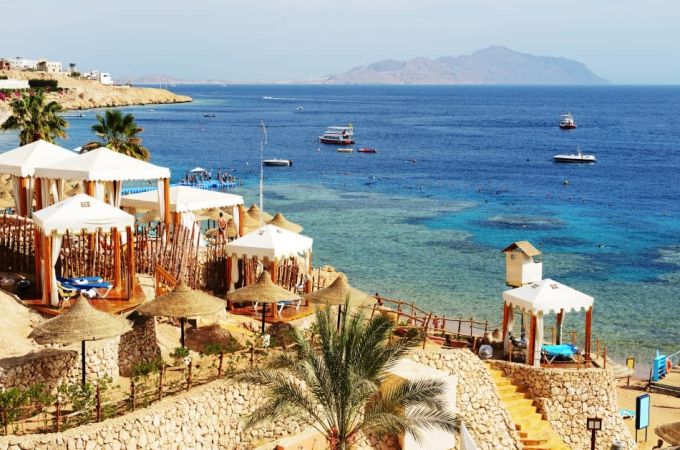
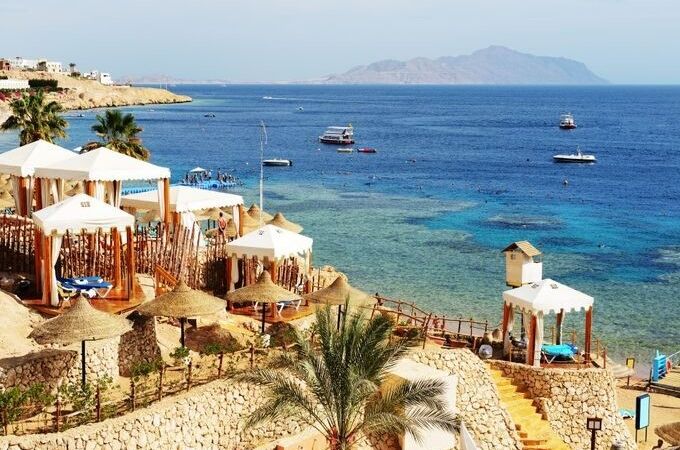
The peninsula sits beyond the Suez Canal and Gulf of Suez, extending toward the Gulf of Aqaba. Its southern section contains dramatic mountains, desert environments and Red Sea coastline, while established tourism centers occupy parts of the coast.
That geography matters because the experiences are not interchangeable.
The sea may be the reason one traveler arrives. Religious and historical associations may motivate another. A third may be interested primarily in the relationship between Bedouin culture, mountain landscapes and desert travel.
Calling all of this “a Sinai holiday” hides the decision that actually needs to be made.
What do you want Sinai to contribute that the rest of Egypt will not?
Until that is answered, choosing a destination within the peninsula is premature.
Start With the Experience, Not the Famous Name
Travel planning often works backwards.
People hear a destination name repeatedly, assume it must belong in their trip and only later investigate why they would go.
Sinai rewards the opposite approach.
Begin with the experience you want.
Do you want the Red Sea to dominate your days?
Do you want a comfortable resort environment where the coastal stay operates as a substantial holiday component?
Are you attracted to a more independent seaside rhythm?
Are mountains and desert landscapes more important than resort facilities?
Does the religious and historical significance of the St. Catherine area genuinely matter to you?
These questions immediately separate journeys that initially looked identical.
A famous destination should be the answer to a travel need, not the starting assumption.
There Are Several Siniais Hiding Inside the Same Peninsula
Rather than ranking destinations, it is more useful to divide the traveler decision by environment.
| The Experience You Want | The Part of Sinai to Investigate | What Should Drive the Decision |
|---|---|---|
| Full Red Sea resort stay | Established southern coastal resorts | Resort style, marine access and desired level of structure |
| Informal coastal rhythm | Gulf of Aqaba communities such as Dahab | Independence, sea access and town character |
| Mountain environment | St. Catherine region | Landscape, physical demands and historical interest |
| Desert experience | Interior South Sinai | Quality of arrangement and purpose of the experience |
| Religious/historical context | St. Catherine / Mount Sinai area | Genuine interest rather than checklist tourism |
| Sea plus another landscape | Coastal base with carefully selected inland experience | Whether the transition adds value rather than another rushed excursion |
This is the job of a regional article.
It points you toward the correct question without attempting to answer every destination-specific query itself.
If You Want the Sea, Decide What You Want Around the Sea
Two travelers can both say:
“I want to spend time on the Red Sea.”
and mean completely different things.
One imagines a comfortable hotel, extensive facilities, organized marine activities and a coastal section that requires very little decision-making.
Another imagines walking out of smaller-scale accommodation, eating in different places and allowing the sea to exist alongside a more independent town experience.
Those preferences can lead to different parts of Sinai.
This is exactly why the previous Dahab Egypt page owns Dahab's specific lower-key coastal character. Repeating that material here would weaken both URLs.
For Sinai, the information gain lies one level higher:
The Red Sea does not determine your destination by itself. Your preferred relationship with the destination surrounding the Red Sea does.
That distinction prevents a great deal of disappointing resort selection.
If the Mountains Attract You, You Are Choosing a Different Sinai
Move inland and the emotional character of the peninsula changes dramatically.
The high mountains of southern Sinai create an environment far removed from the familiar imagery of beach resorts. The area around St. Catherine carries profound religious and historical associations alongside its geographical importance.
Mount Sinai is traditionally associated with the biblical account of Moses receiving the Ten Commandments, while Saint Catherine's Monastery has centuries of religious history and remains one of the world's most significant Christian monastic sites.
These entities naturally deserve mention because they explain why travelers consider the region.
But this article should not turn into:
How to climb Mount Sinai
or
Complete St. Catherine's Monastery Guide.
Those are separate search decisions.
Here, the question is simpler and more personal:
Does this mountain and spiritual dimension belong in the Egypt experience you want?
If the answer is yes, Sinai has suddenly become much more than a Red Sea extension.
Mount Sinai Is a Poor Addition When It Exists Only to Fill a Checklist
There are destinations travelers visit because they are personally meaningful, and others they visit because the itinerary tells them they are important.
The distinction matters enormously around Mount Sinai.
For someone interested in biblical history, religious heritage, sacred landscapes or mountain environments, the experience can carry substantial meaning.
For someone with little interest in any of those subjects, inserting it merely because the name is famous can create a demanding excursion with limited personal reward.
Physical effort and timing also matter.
This is not an archaeological monument where a vehicle can simply deliver you to the entrance, after which everyone experiences approximately the same visit. Travelers need to understand the nature of the experience they are considering and assess it according to their own abilities and interests.
Sinai is one of the places where personal relevance should outweigh itinerary prestige.
The Desert Should Not Become Entertainment Scenery
Sinai's desert landscape is another area where generic travel content tends to flatten complexity.
It is easy to write about “desert adventures,” camel rides and Bedouin experiences as interchangeable tourism products.
They are not.
Bedouin communities have longstanding connections with Sinai, and the relationship between local communities, tourism and the landscape deserves more respect than reducing culture to an evening activity added between a beach day and dinner.
For the traveler, this means evaluating desert experiences by more than how photogenic they appear.
What is the purpose of the experience? How much time is actually spent in the landscape? Who is organizing it? Is cultural interpretation meaningful or merely decorative? Does the activity genuinely add a new dimension to the trip?
These questions produce better decisions than a list of “must-do Sinai activities.”
Sinai Can Feel Like a Separate Journey Inside Egypt
This is one of the peninsula's greatest strengths and one of its biggest planning risks.
After Cairo and the Nile Valley, Sinai can feel geographically and visually detached from the Egypt travelers have already experienced. The mountains are different, the coastal orientation changes the daily rhythm, and the desert environment introduces another physical language entirely.
That can make the journey richer.
It can also make an already fragmented itinerary even more fragmented.
Imagine a trip that attempts Cairo, Luxor, Aswan, Abu Simbel, a Nile cruise, Sinai and perhaps another Red Sea destination within limited time. Every place may be individually worthwhile, yet the combined trip can become a sequence of arrivals and departures.
The problem is no longer destination quality.
It is transition density.
Travelers considering Egypt Multi Tours should therefore evaluate Sinai as a distinct geographical chapter rather than another attraction that can simply be inserted between existing days.
A Map Can Mislead You About Travel Effort
Sinai is part of Egypt, but national borders do not tell you how naturally a destination fits with your existing route.
Travelers sometimes look at the country as a single geographical unit and underestimate how much movement is involved in combining distant regions.
A trip that includes the Nile Valley and Sinai requires actual transition planning. The relevant question is not simply the distance in kilometers; it is the door-to-door effect of the movement, including departure timing, transport options, check-in, waiting and the usable time lost on either side.
This matters especially when Sinai is supposed to provide relaxation.
If reaching your chosen part of the peninsula consumes a substantial amount of energy, staying only briefly may defeat the purpose.
The farther a destination sits from the core route, the more strongly it should justify the transition.
Sinai Is Strongest When It Changes the Story of the Trip
Adding destinations is easy.
Adding dimensions is harder.
Sinai earns its place when it changes how you understand Egypt.
Perhaps the trip has been dominated by ancient civilization along the Nile and Sinai introduces a stark mountain environment.
Perhaps Cairo has supplied urban intensity and the peninsula introduces days structured around the sea.
Perhaps the St. Catherine region brings religious history into a journey previously focused almost entirely on pharaonic Egypt.
Perhaps a carefully planned desert experience shifts attention from monuments toward landscape and communities.
These are meaningful additions because they create contrast.
By comparison, adding another coastal stop that performs exactly the same function as one already included elsewhere may produce far less information gain despite increasing the number of destinations.
A good itinerary does not ask:
How many places can we include?
It asks:
How many genuinely different experiences does this trip need?
First-Time Visitors Should Be Especially Selective
Sinai can absolutely belong in a first journey to Egypt.
It simply should not be automatic.
First-time visitors already face unusually strong competition for their available days. Cairo, Giza and the Nile Valley contain enough historical significance to occupy an entire journey, while the Red Sea creates another obvious attraction.
Adding Sinai works best when the traveler has either enough time or a strong personal reason for choosing the peninsula.
Someone who has dreamed for years about diving in the Gulf of Aqaba has that reason.
Someone whose interest in biblical landscapes is central to the trip has that reason.
Someone who simply sees an empty two-day space and wonders whether Sinai can fill it should think more carefully.
For Customized Egypt Tours, the value of customization is precisely the ability to reject destinations that do not serve the traveler's priorities rather than treating every famous name as compulsory.
Repeat Visitors Can Use Sinai Very Differently
The calculation changes considerably once Cairo, Luxor and Aswan are no longer first-time obligations.
Repeat visitors can give Sinai more room.
Instead of treating the peninsula as a short extension, they can allow one part of it to become the principal destination. The sea can dominate without guilt about missing another temple. Mountain and desert experiences can receive more attention because they are no longer competing with the Pyramids for the first available day.
This is an important distinction because search results often assume everybody is planning the same “once-in-a-lifetime Egypt trip.”
They are not.
A destination that feels difficult to justify on a seven- or eight-day first visit can become extremely compelling on a return journey.
Sinai's breadth particularly rewards that freedom.
Do Not Try to Experience Every Version of Sinai at Once
Once travelers understand that Sinai contains several different experiences, a new temptation appears:
include all of them.
That can recreate the same problem at regional scale.
Coast, diving, mountains, desert, religious heritage and resort relaxation can technically coexist within one peninsula, but they do not all need to appear in the same trip.
Choose a dominant reason for coming.
Then add another dimension only when it complements that reason naturally.
If the trip is primarily coastal, perhaps one inland experience provides useful contrast.
If the St. Catherine region is the central motivation, the coast can provide recovery afterward.
What matters is hierarchy.
When everything becomes equally important, travel days begin competing with the experiences themselves.
Who Probably Does Not Need Sinai on This Trip?
Travelers with very limited time and no specific interest in the peninsula may be better served by concentrating elsewhere.
The same applies to someone already including a Red Sea stay that fully satisfies the coastal purpose of the journey. Sinai does not become compulsory simply because another part of the Red Sea lies there.
Travelers who dislike additional internal transitions should also calculate the real cost carefully.
And someone hoping to “see Sinai” in a very brief stop may need to reconsider the premise. The region is too varied for a superficial visit to represent it meaningfully.
Leaving Sinai for another trip can be an intelligent decision rather than a missed opportunity.
Who Should Give Sinai Serious Space?
The peninsula becomes far more persuasive when the traveler's motivation is specific.
Divers and snorkelers may have clear reasons to investigate particular coastal areas. Travelers interested in sacred geography may be drawn toward Mount Sinai and St. Catherine. Those who respond strongly to desert and mountain landscapes may find a side of Egypt here that the Nile corridor cannot provide.
There is also another type of traveler who tends to appreciate Sinai: someone who wants Egypt to become less monument-centered after several culturally intensive days.
For travelers using Egypt Private Tours to connect different regions, Sinai can provide enormous contrast when it is treated as a genuine destination rather than a hurried appendix.
The common thread is intentionality.
You should know why you are crossing into Sinai.
The Best Sinai Choice Is Usually the One That Leaves Something Out
This sounds counterintuitive, but it is the central planning principle for the peninsula.
You do not need the complete Sinai experience.
You need the right Sinai experience.
If the Red Sea is the priority, allow it to be the priority without feeling obligated to add every inland landmark.
If the mountains and religious history are why you came, do not dilute them simply because a resort appears nearby on the map.
If a slower coastal environment is the goal, choose the destination whose daily rhythm supports it rather than the one with the longest activity list.
Sinai becomes easier to plan once you stop treating it as a bucket of attractions.
It is a region containing several competing versions of a holiday.
The traveler who chooses between them usually has a better experience than the traveler who tries to collect them all.
Frequently Asked Questions About Choosing a Sinai Experience
1. Is saying “I want to visit Sinai” specific enough to start planning?
Not really. Sinai contains coastal resorts, independent seaside communities, high mountains, desert environments and important religious sites. Identifying which of those experiences actually motivates you should come before choosing accommodation or trying to determine how long to allocate.
2. Should I include Sinai simply because I already want Red Sea time?
No. Egypt offers several ways to experience the Red Sea, and choosing Sinai should depend on the particular coastal environment or additional regional experience you want. The sea alone does not automatically make the peninsula your best logistical choice.
3. Can Sinai add something meaningful after I have already visited Egypt's major ancient sites?
Very much so. Its value may actually increase because the peninsula can change the visual and thematic character of the journey, replacing archaeological concentration with coast, mountains, desert landscapes or religious history rather than offering more of the same.
4. Is Mount Sinai essential if I travel to the peninsula?
No. Its importance does not make it compulsory for every visitor. Travelers with strong religious, historical or landscape interest may consider it central, while someone visiting primarily for the Red Sea can have a completely valid Sinai experience without making it the focus.
5. Does visiting a coastal resort mean I have experienced Sinai?
You have experienced one part of Sinai, which is perfectly legitimate. The problem arises only when a single resort stay is treated as representative of the entire peninsula, whose mountain, desert, cultural and religious environments can be substantially different.
6. Should desert time be added automatically to a Sinai beach stay?
Only when the desert genuinely interests you and the experience has enough substance to justify the time. Adding a short activity simply because “desert” appears on a checklist may provide less value than leaving more space around the coastal experience you actually came for.
7. Is Sinai better suited to repeat visitors than first-time Egypt travelers?
Not necessarily, but repeat visitors often have greater freedom to give the peninsula sufficient attention. First-time travelers can include Sinai successfully when they have enough time or a specific motivation rather than forcing it into an already crowded classic Egypt route.
8. Can I combine the mountain and coastal sides of Sinai without making the trip too busy?
Potentially, provided one remains the primary experience and enough time is allowed for transitions. Problems arise when every regional possibility is treated as equally essential, turning a destination chosen for contrast into another tightly scheduled sightseeing sequence.
9. How should travelers interested in Bedouin culture approach Sinai experiences?
Avoid treating Bedouin identity as tourism decoration. Look for experiences where local knowledge and cultural context have genuine substance, and remember that communities are contemporary societies rather than attractions created for visitors. Quality matters more than simply ticking a “Bedouin experience” box.
10. Why can Sinai feel so different from a Nile Valley journey?
Geography changes dramatically. The Nile corridor is shaped by river landscapes, cities and concentrated archaeological heritage, while South Sinai introduces rugged mountains, desert terrain and extensive Red Sea coastline. The shift can make the peninsula feel like a separate chapter of Egypt.
11. Is it a mistake to include only one part of Sinai?
Usually the opposite. Choosing one area according to your strongest interest can produce a more coherent experience than trying to sample coastline, mountains, desert and religious sites within limited time simply to claim that you have “covered” the peninsula.
12. What should ultimately decide whether Sinai belongs in my Egypt trip?
Ask what Sinai contributes that your existing route does not. If the answer is a specific marine, mountain, desert or religious experience you genuinely value, it has a clear purpose. If the answer is merely “another famous region,” your time may be stronger elsewhere.

A travel professional specializing in tailor-made travel planning, guest experience management, and multi-destination tourism operations.
With over 23 years of experience in the travel industry, he designs and manages private and cultural tours for international travelers across Türkiye, Greece, Egypt, Jordan, Morocco, and other destinations.
He has strong expertise in both online and face-to-face guest communication, sales processes, and end-to-end travel operations.
Working closely with hotels, travel agencies, and local partners, he ensures smooth coordination and high-quality travel experiences at every stage of the journey.
His focus is on delivering personalized, reliable, and seamless travel experiences for international guests worldwide.