Nazareth, Israel: Beyond the Pilgrimage Route
Updated: August 2026
Nazareth is one of those places many travelers feel they already understand before arriving.
The name is immediately familiar from Christian tradition, and the city is strongly associated with the childhood of Jesus and the Annunciation. For pilgrims, those connections alone can make Nazareth one of the most meaningful destinations in Israel.
Yet arriving with only that expectation creates a surprisingly narrow visit.
Nazareth is also a living Arab city with homes, schools, shops, cafés, markets and neighborhoods that continue independently of tourism. Christian heritage is present everywhere, but it is woven into a contemporary urban environment rather than preserved inside an isolated pilgrimage complex.
That combination is what gives Nazareth its character.
You can spend the morning inside one of Christianity’s most significant churches, walk several minutes through the Old City, stop for coffee or sweets, pass businesses serving local residents and then encounter another religious site embedded directly into the city fabric.
The meaningful question is therefore not simply, “Which biblical sites should I see?”
It is:
How does a city carrying extraordinary religious significance continue functioning as an ordinary home for people today?
The Basilica of the Annunciation Deserves More Than a Quick Photograph
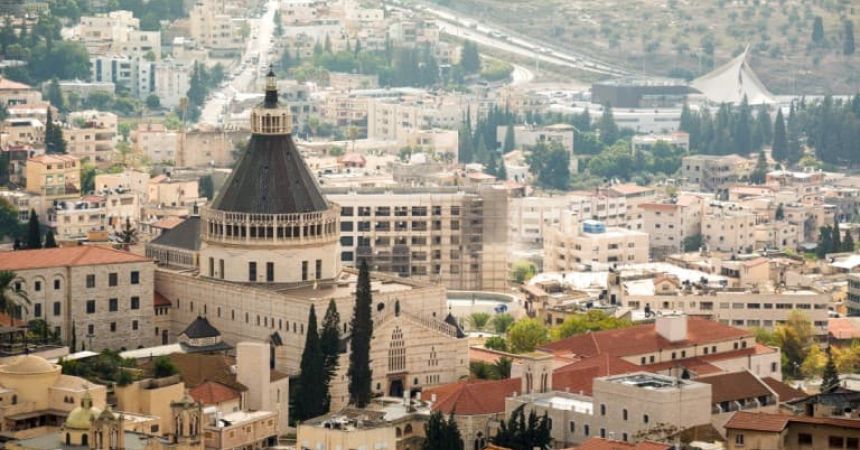
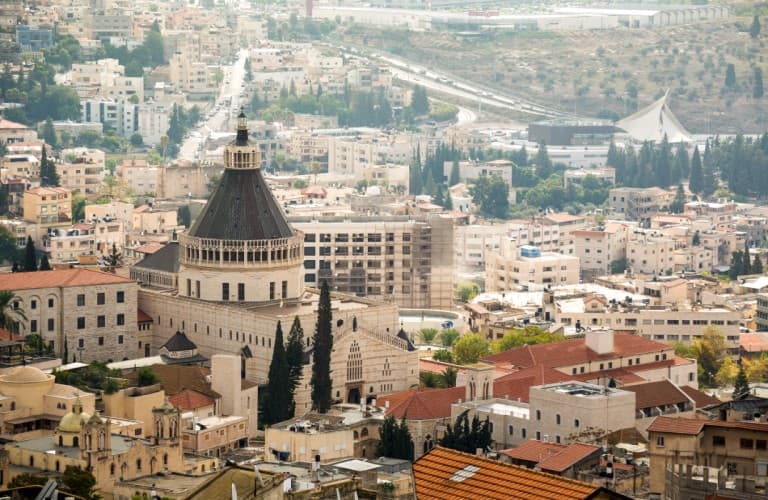
For many Christian visitors, the Basilica of the Annunciation is the central reason for coming to Nazareth.
Christian tradition associates the location with the Annunciation, when the angel Gabriel announced to Mary that she would give birth to Jesus. The modern basilica stands over earlier religious remains, making the site itself part of a long history of Christian worship and pilgrimage.
The building is striking, but rushing through it solely to photograph the exterior or central interior misses much of its significance.
Different levels of the basilica contribute different experiences. The lower area draws attention toward the traditional site associated with the Annunciation, while the upper church opens into a much larger worship space.
One of the most interesting elements is the international character of the Marian artwork associated with the complex.
Representations of Mary from different cultures remind visitors that Nazareth’s religious significance extends far beyond the local community.
This is not merely a church important to one region.
It is a pilgrimage destination interpreted globally.
The Basilica Works Better When You Allow Silence Into the Visit
Large pilgrimage destinations can become strangely busy.
Groups arrive, guides explain, cameras appear, people move toward the next point and conversations continue even inside spaces intended for prayer.
Nazareth benefits from resisting that rhythm.
Whether or not you are religious, allowing several quiet minutes inside the Basilica of the Annunciation gives the site a different character. Religious buildings are not only historical objects, and treating them entirely as museum pieces can flatten the very reason they continue to matter.
For practicing Christians, that pause may naturally become prayer.
For other travelers, it can simply be time to observe the architecture, worshippers and atmosphere without trying to document everything immediately.
Good cultural travel sometimes requires fewer explanations rather than more.
St. Joseph's Church Adds a Different Kind of Christian Context
Near the Basilica of the Annunciation, St. Joseph's Church introduces another tradition associated with the Holy Family and Joseph.
Because it sits so close to the larger basilica, travelers can easily treat it as a minor addition to be completed quickly before lunch.
Its value is more subtle.
The church contributes to Nazareth’s identity as a place where Christian tradition connects religious narrative with domestic and everyday life. The story of the Holy Family is not expressed only through major theological events; it is also connected with ideas of home, work and family life.
This can make St. Joseph's Church particularly meaningful for pilgrims even though it lacks the monumental scale of the Annunciation basilica.
Not every important religious site needs to compete architecturally with the most famous one.
The Old City Changes the Pace Completely
Walk away from the major churches and Nazareth begins telling a different story.
The Old City contains narrow streets, traditional buildings, small businesses, religious institutions and market areas that make it possible to experience the city beyond pilgrimage architecture.
This is where Nazareth becomes much more interesting for travelers without a purely religious focus.
You begin noticing how historic urban fabric continues to be used rather than functioning simply as a preserved setting. Homes sit near shops, religious sites appear within ordinary streets and local food becomes part of the experience almost without planning it.
The Old City is not enormous, and it should not be oversold as another Jerusalem Old City.
Its scale is part of the appeal.
It can be explored slowly without every corner carrying the pressure of another internationally famous monument.
The Market Is More Useful as a Transition Than an Attraction
Travel writing loves turning markets into numbered attractions.
Nazareth’s market is more useful when approached as part of the movement through the city rather than as something you “complete.”
Depending on the day, timing and current local activity, visitors may encounter food shops, spices, sweets, household businesses and other ordinary commercial life.
The atmosphere can vary considerably.
This is precisely why the market should not be described as though it performs identically for every visitor.
Its value lies in moving from the religious core into an environment that belongs more clearly to everyday city life.
If you are traveling with a guide, ask what people are actually buying and how the commercial area has changed rather than simply asking where to purchase souvenirs.
The answer will generally tell you more about Nazareth.
Arab Food Culture Belongs in the Nazareth Story
Nazareth is one of the places where food can expand a traveler’s understanding of the city without requiring a formal culinary tour.
Arab culinary traditions are part of everyday life here, and restaurants, bakeries, sweet shops and cafés can provide an important counterbalance to a day otherwise dominated by religious heritage.
The point is not to produce another “foods you must try” checklist.
Instead, use meals to slow the visit down.
Try local dishes that interest you, notice how desserts and coffee fit into social life and allow enough time for lunch that it does not become merely a gap between churches.
This matters especially for travelers following a Christian heritage itinerary.
A pilgrimage should still feel like travel through a living country, not movement between sacred buildings while everything in between becomes invisible.
Mary's Well Introduces a Different Nazareth Tradition
Nazareth contains more than one traditional location associated with events surrounding Mary and the Annunciation, reflecting the way different Christian traditions developed around the city.
Mary's Well is associated particularly with traditions placing an encounter involving Mary near the city’s water source.
For travelers unfamiliar with the diversity of Christian traditions, this can initially seem confusing.
Which site is “correct”?
That question is often less useful than understanding how traditions developed.
Religious landscapes accumulate memory in different ways. Communities preserve stories, churches are built, pilgrimage practices evolve and multiple traditions can coexist around the same broader sacred narrative.
Nazareth is particularly good at exposing visitors to this complexity because different Christian communities have interpreted the city's religious geography in distinct ways.
The Greek Orthodox Church of the Annunciation Adds Another Voice
The Greek Orthodox Church of the Annunciation offers a valuable complement to the Catholic Basilica of the Annunciation.
It reflects a different Christian tradition and another interpretation of the Annunciation's location.
Travelers interested in Christianity as a living collection of traditions rather than one uniform institution may find the comparison especially rewarding.
Architectural style, worship environment and devotional atmosphere differ, while the underlying biblical association remains connected to the same city.
This is where Nazareth begins to provide something more interesting than a list of churches.
It becomes a place where travelers can see how different Christian communities hold and express religious memory.
That is a richer question than simply deciding which building is more impressive.
Nazareth Should Not Be Explained as a Christian Theme Park
Because the city's international identity is so strongly connected to Jesus and Mary, tourism can unintentionally flatten Nazareth into a pilgrimage stage set.
The contemporary city resists that interpretation.
Nazareth has a predominantly Arab population with Christian and Muslim communities, and daily life extends well beyond religious tourism. People are commuting, studying, working, shopping and living in neighborhoods that travelers may pass through without noticing if the itinerary never leaves the major pilgrimage axis.
This contemporary context matters.
It reminds visitors that religious heritage exists within societies that continue evolving.
Understanding Nazareth only through first-century narratives is rather like understanding Rome only through the Roman Empire.
History matters enormously.
It simply does not own the present.
Christian and Muslim Nazareth Share the Same Urban Space
Travelers interested in contemporary religious life should pay attention to how churches, mosques, shops and residential areas coexist within the city.
This does not require turning Nazareth into a simplified story of perfect interfaith harmony.
Real communities are more complicated than tourism slogans.
What visitors can observe is a city whose Arab identity includes both Christian and Muslim life, creating a contemporary context very different from the Christian-only image visitors might form before arrival.
This also changes the atmosphere outside pilgrimage sites.
The call to prayer, church bells, local businesses and everyday street life belong to the same urban soundscape.
For travelers interested in religion beyond monuments, this coexistence is often one of Nazareth's most revealing experiences.
A Guide Can Help Separate Tradition, Scripture and History
Nazareth presents a particular challenge for interpretation because biblical narrative, later Christian tradition, archaeology and modern pilgrimage practice frequently overlap.
Travelers may hear statements presented as historical certainty when they are better understood as religious tradition, while other details are supported by archaeological or textual evidence.
A good guide should not make the experience less meaningful by turning every statement into an academic debate.
Neither should the guide erase distinctions.
On Private Nazareth Christian Heritage Tours, interpretation becomes strongest when travelers understand what scripture says, what particular Christian traditions hold, what archaeology contributes and where uncertainty remains.
Faith and historical care do not have to compete.
For many visitors, distinguishing them actually makes the experience more interesting.
Pilgrims and Cultural Travelers Often Need Different Nazareth Days
Rather than ranking attractions, Nazareth benefits from a visit-purpose map because different travelers arrive with fundamentally different expectations.
| Main reason for visiting | What should receive more time | What can remain secondary |
|---|---|---|
| Christian pilgrimage | Annunciation traditions, prayer time, major churches | Extensive market wandering |
| Biblical-history interest | Religious geography and historical context | Long devotional stops |
| Arab culture interest | Old City, food, neighborhoods, daily life | Visiting every minor church |
| Architecture interest | Basilica, Orthodox church, historic urban fabric | Detailed theological interpretation |
| Family travel | Strong stories, selected churches, food breaks | Long sequences of similar religious sites |
| Photography | Old City texture, religious architecture, street life | Attempting to photograph every interior |
| Repeat Israel visitor | Contemporary Nazareth and lesser-known layers | Repeating standard pilgrimage circuit |
| Short northern itinerary | Core Christian sites + one city-life experience | Trying to cover everything |
The difference is important.
The same city should not produce the same itinerary for everybody.
Half a Day and a Full Day Create Different Nazareths
A half-day visit can cover the central Christian heritage efficiently.
Travelers can experience the Basilica of the Annunciation, nearby religious sites and some of the Old City before continuing elsewhere in northern Israel.
A full day changes the balance.
Now there is room for a slower meal, additional Christian traditions, more Old City exploration and enough time for Nazareth to feel like a city rather than a pilgrimage complex.
That distinction should influence combined touring days.
If Nazareth is paired with several Sea of Galilee sites, the city will naturally receive a more concentrated visit. If Nazareth itself is particularly important because of the traveler’s faith or cultural interests, reducing it to ninety minutes so that five other sites fit on the same day makes little sense.
The itinerary should reflect emotional importance as well as geography.
Nazareth and the Sea of Galilee Belong Together Geographically, Not Editorially
Christian travelers often experience Nazareth and the Sea of Galilee within the same northern Israel journey.
The connection is obvious.
Nazareth relates strongly to the early life of Jesus, while the Sea of Galilee region contains places associated with his ministry, including Capernaum, Tabgha and the Mount of Beatitudes.
That creates a natural narrative progression.
However, the travel experiences are different enough that they should not be collapsed into one generic biblical-tour blog.
Nazareth is an urban experience centered on a living city and several major religious traditions.
The Galilee is regional.
It involves movement between sites distributed around a landscape and lake.
Future Nazareth and Galilee Pilgrimage Journeys can combine them operationally while still respecting those differences.
Staying Overnight Changes the City More Than It Changes the Sightseeing
Many visitors encounter Nazareth during a day tour and leave before evening.
That approach is entirely valid.
An overnight becomes interesting for another reason: once the main pilgrimage traffic declines, Nazareth begins feeling less like a touring stop and more like the city its residents know.
Dinner becomes part of the experience, streets change character and there is less pressure to move from church to church.
Travelers following a slow northern itinerary may appreciate this.
Others may prefer using Tiberias, Haifa or another destination as their overnight base according to the wider route.
The decision should therefore not be made according to whether Nazareth has “enough attractions for two days.”
Accommodation choices are about itinerary rhythm as much as attraction count.
Religious Holidays Can Transform the Experience
Nazareth's importance as a Christian city means religious holidays can affect the atmosphere substantially.
Christmas and other major Christian observances can bring special services, pilgrimage activity and changes to the way religious spaces are experienced.
For believers, this may be exactly why they want to visit.
For travelers primarily interested in architecture and relatively quiet sightseeing, large religious gatherings can create a different experience from what they expected.
Church access, services and local arrangements should therefore be checked close to travel when dates coincide with major religious observances.
The same principle applies to Sunday worship.
A working church is not simply an attraction whose schedule exists around visitors.
Sometimes worship should take priority.
Modest Behavior Matters More Than a Complicated Dress Formula
Visitors entering churches should dress and behave appropriately for active religious spaces.
That normally means avoiding excessively revealing clothing, maintaining respectful volume and following instructions concerning photography or restricted areas.
The larger principle is more useful than memorizing a clothing formula.
Look at what kind of place you are entering.
A basilica containing worshippers is different from an archaeological museum. A church service is different from an empty architectural visit.
Travelers usually handle these situations well when they approach them with common sense rather than treating etiquette as a list of exotic rules.
Photography Works Better When Worship Is Not Treated as Scenery
Nazareth offers extraordinary religious architecture and intimate devotional spaces.
Photography naturally becomes part of many visits.
However, a person praying is not automatically a useful foreground element for your photograph.
Neither is a religious service a performance arranged to improve the atmosphere of the building.
Before photographing inside churches, check current rules and pay attention to whether your camera use interferes with worshippers. Flash restrictions and photography limitations should be respected without argument.
Some moments are better remembered than documented.
This is particularly true in places where visitors and pilgrims share the same space for very different reasons.
Food Can Prevent Pilgrimage Fatigue
A northern Christian heritage day can easily become a sequence of churches, biblical associations and historical explanations.
By the third or fourth religious site, even highly motivated travelers can begin processing information less effectively.
A well-timed lunch in Nazareth solves more than hunger.
It separates experiences.
A meal gives travelers time to discuss what they have seen, notice contemporary city life and return to the afternoon with more attention.
This is why Customized Nazareth Cultural Journeys should not treat food and free time as gaps between religious attractions.
They are part of how the day remains human.
The Most Useful Nazareth Visit Has Two Perspectives
Spend part of the visit looking backward.
Understand the biblical traditions, Christian pilgrimage history and religious sites that made Nazareth globally significant.
Then spend part of the visit looking around.
Notice Arabic spoken in the streets, contemporary businesses, churches and mosques, cafés, young people, families and the ordinary rhythms of a city that did not stop developing because its name became famous two thousand years ago.
Nazareth becomes much more rewarding when both perspectives remain visible.
One without the other is incomplete.
A purely biblical visit removes the contemporary city.
A purely contemporary visit ignores why millions of people know its name.
The tension between those two realities is precisely what makes Nazareth distinctive.
Before Leaving Nazareth, Ask a Better Question
Many visitors leave asking whether they saw all the important churches.
A more useful question is whether the city became more complicated than it seemed before arrival.
Did the Annunciation become more than a famous biblical sentence?
Did the differences between Christian traditions become visible?
Did you notice that Nazareth is an Arab city rather than merely a Christian pilgrimage destination?
Did food, markets or neighborhoods provide any understanding of the people living there today?
If the answer is yes, you probably experienced Nazareth rather than simply completing it.
That is a much stronger result.
Questions Travelers Ask Once Nazareth Becomes More Than a Church Stop
Why are there different places associated with the Annunciation in Nazareth?
Different Christian traditions developed around the location and circumstances of the Annunciation. Rather than treating this as a contradiction to solve quickly, travelers can use the different sites to understand how Catholic and Orthodox traditions preserve religious memory differently.
Can non-Christians visit the Basilica of the Annunciation?
Visitors of different faiths can generally experience major Christian heritage sites when access is open, provided they behave respectfully and follow current site rules. Active worship and special services may affect access at particular times.
Does Nazareth still feel religious outside the main churches?
Yes, although the city’s religious identity is broader than Christianity alone. Christian and Muslim communities form part of contemporary Nazareth, and religious buildings exist alongside shops, homes, restaurants and ordinary Arab urban life.
Why do some travelers stay only a few hours in Nazareth?
Nazareth is frequently combined with a wider northern Christian itinerary, especially the Sea of Galilee region. A concentrated visit can cover major pilgrimage sites, while travelers wanting Arab culture, food and deeper city context benefit from additional time.
Is the Old City worth exploring if pilgrimage is my main priority?
Yes. Even a short walk beyond the principal churches helps place sacred sites inside the city where they developed. The Old City also gives pilgrims a better sense of Nazareth as a living community rather than an isolated religious complex.
What is the significance of St. Joseph's Church?
The church is associated by tradition with Joseph and the Holy Family, adding a domestic dimension to Nazareth's Christian heritage. Its significance is often more devotional and contextual than architectural, particularly when compared with the much larger Annunciation basilica.
Why does Arab food matter to understanding Nazareth?
Food connects visitors with the contemporary Arab city surrounding the pilgrimage sites. Restaurants, bakeries, sweets and cafés provide a social and cultural layer that religious sightseeing alone cannot reveal, while also giving the day a more natural rhythm.
Can Nazareth feel disappointing if I expect an ancient biblical village?
Yes, because modern Nazareth is a substantial contemporary city. Travelers expecting a preserved first-century settlement can misunderstand what they encounter. Its value comes from seeing how ancient religious memory survives inside a living modern urban environment.
Are the Christian sites in Nazareth all from the same denomination?
No. Catholic, Orthodox and other Christian traditions contribute to Nazareth's religious landscape. Their churches, devotional practices and interpretations give travelers an opportunity to see Christianity expressed through several communities rather than one uniform tradition.
Does Sunday affect a sightseeing visit?
It can, particularly at active churches where worship takes priority over tourism. Visitors should check current service and access arrangements when Sunday sightseeing is important, while also respecting areas where congregations are actively worshipping.
Should families explain the biblical story before arriving?
A simple introduction can help children understand why Nazareth matters, but lengthy preparation is unnecessary. Questions about Mary, Joseph, family life and the different churches often work better for younger travelers than attempting to teach complex theological or historical detail.
What would make me choose an overnight stay instead of a day visit?
Stay when you want time for the contemporary city, relaxed dining and a less hurried Old City experience rather than only the major pilgrimage sites. An overnight also works when it improves the geography of a broader northern Israel itinerary.

A travel professional specializing in tailor-made travel planning, guest experience management, and multi-destination tourism operations.
With over 23 years of experience in the travel industry, he designs and manages private and cultural tours for international travelers across Türkiye, Greece, Egypt, Jordan, Morocco, and other destinations.
He has strong expertise in both online and face-to-face guest communication, sales processes, and end-to-end travel operations.
Working closely with hotels, travel agencies, and local partners, he ensures smooth coordination and high-quality travel experiences at every stage of the journey.
His focus is on delivering personalized, reliable, and seamless travel experiences for international guests worldwide.