Tel Aviv: How to Experience Israel’s Modern Side
Updated: August 2026
Tel Aviv can confuse travelers who arrive after several days in Jerusalem.
In Jerusalem, the sightseeing logic is obvious. Major sacred sites and historical layers provide natural anchors for the day, and a guide can explain why one location matters before moving to another.
Tel Aviv works differently.
The city is experienced through streets, neighborhoods, cafés, architecture, beaches, markets, restaurants and the way people use public space. Jaffa supplies historical depth, but modern Tel Aviv itself is not a destination where every rewarding hour needs to end at a famous monument.
This changes how you should plan it.
A tightly scheduled city tour can introduce important areas, yet leaving no time to walk independently, stop for coffee, spend an hour beside the Mediterranean or stay longer over dinner removes much of what makes Tel Aviv distinctive.
The city rewards participation more than completion.
You understand Tel Aviv gradually by moving through it at different times of day.
Morning Tel Aviv Belongs to the Streets Before It Belongs to Sightseeing
There is something useful about beginning Tel Aviv without immediately entering a museum or boarding a touring vehicle.
Walk.
Morning provides a natural introduction to the city's physical character: relatively flat streets, bicycle traffic, cafés beginning their day, residential neighborhoods, Mediterranean light and the mixture of architectural styles that developed as Tel Aviv expanded.
This is particularly effective for travelers arriving from Jerusalem because the contrast becomes visible without anyone needing to explain it.
The streets feel different.
The city faces outward toward the sea rather than inward toward a dense sacred core. Its historical identity is younger, and much of its appeal comes from twentieth- and twenty-first-century urban life rather than ancient archaeology.
That younger character does not mean Tel Aviv lacks history.
It means history functions differently here.
Jaffa Gives Tel Aviv the Historical Weight It Does Not Need to Pretend to Have
Trying to turn central Tel Aviv into an ancient city makes little sense when Jaffa sits immediately beside it.
Jaffa has a much longer history and provides a powerful contrast with the modern city that grew to its north. Ancient associations, Ottoman-era urban fabric, port history, religious traditions and later changes have all contributed to the area visitors experience today.
The value of Jaffa is therefore not merely that it gives travelers “something old” to see.
It makes the relationship between old and new visible within the same metropolitan experience.
You can walk through historic lanes, look toward the Mediterranean and later continue into districts where the architecture, street pattern and cultural atmosphere feel completely different.
This proximity helps explain Tel Aviv more effectively than an isolated history lecture.
Modernity becomes easier to recognize when it stands beside an older urban world.
Jaffa Should Be Walked Slowly Enough to Notice the Transitions
A rushed Jaffa visit often becomes a familiar sequence: viewpoint, narrow lane, church exterior, port, photograph, leave.
The area deserves a looser approach.
Notice where tourist-oriented lanes transition into ordinary urban spaces. Look at architectural details without assuming every old building belongs to the same period. Spend time around the port rather than simply using it as the end point of a walking route.
If religious heritage matters to you, Jaffa contains traditions that add another dimension, particularly within Christian history.
If it does not, the district remains worthwhile through urban history, architecture, art spaces and its relationship with the sea.
This flexibility is what makes Jaffa so useful.
It can absorb different traveler interests without requiring the entire Tel Aviv stay to become historical sightseeing.
The Beach Is Not a Side Attraction
Travelers coming to Israel primarily for heritage sometimes treat Tel Aviv's beach as something to visit only if sightseeing finishes early.
That underestimates its role in the city.
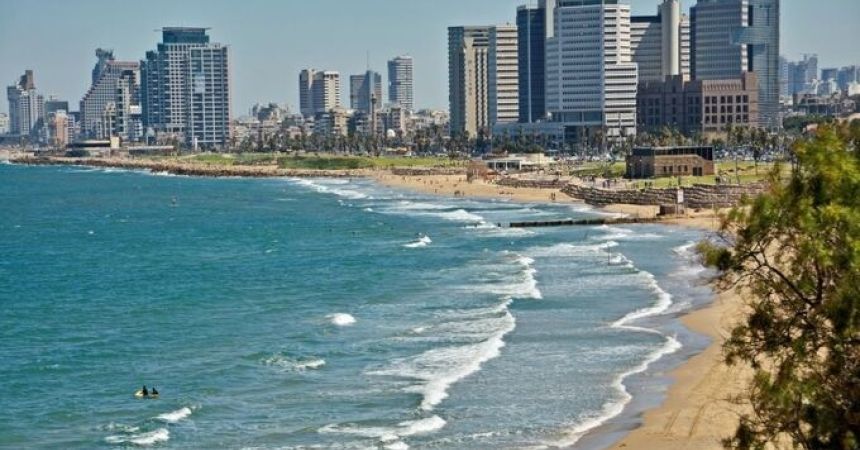
The Mediterranean coastline influences how Tel Aviv moves, exercises, socializes and spends leisure time. Walking along the promenade reveals the city in a way that entering another attraction cannot.
You may see runners, cyclists, families, swimmers, tourists and local residents all using the same public space differently.
For travelers who do not care about lying on the beach, the coastline still matters.
You can walk it.
Sit beside it.
Use it to connect neighborhoods.
Watch the city transition into evening.
The beach is not separate from Tel Aviv's urban identity.
It is one of the places where that identity becomes easiest to observe.
Tel Aviv Makes More Sense in Neighborhoods Than in “Top Attractions”
Different parts of the city create noticeably different experiences, which is why one continuous downtown walk rarely explains Tel Aviv properly.
Neve Tzedek, for example, carries a different atmosphere from the more commercial parts of the city and works particularly well for travelers interested in architecture, cafés and slower walking.
Florentin introduces another character through street art, nightlife and a more informal urban environment.
Areas surrounding major boulevards reveal the modern planning history and architectural identity associated with Tel Aviv's twentieth-century development.
Markets create their own rhythms, while the seafront provides another layer altogether.
The point is not to visit every named neighborhood.
Choose several that reveal different versions of the city.
Depth through contrast works better than neighborhood collection.
The White City Is More Interesting Than a Photograph of One Bauhaus Building
Tel Aviv is internationally associated with a large concentration of buildings influenced by the International Style, often discussed through the term “White City.”
Travelers expecting a single spectacular architectural landmark may initially find the experience subtle.
That is because the architecture works collectively.
Buildings, balconies, shaded openings, proportions and street relationships begin to make more sense once you understand the environmental and urban context in which these modernist forms were adapted.
This is an excellent subject for guided walking if architecture genuinely interests you.
A knowledgeable explanation can turn buildings that seemed visually modest five minutes earlier into evidence of how the city developed.
The mistake is expecting every architectural story to produce a dramatic monument.
Tel Aviv's modern heritage often hides in repetition.
Rothschild Boulevard Explains Why Urban Space Matters Here
Rothschild Boulevard is useful not because it must be declared the single most important street in Tel Aviv, but because it illustrates how public urban space functions.
Walking along it can reveal architecture, cafés, cycling, shade, residential and commercial life and the relationship between the city's built environment and everyday movement.
This is also where travelers interested in Tel Aviv's modern history can begin connecting architecture with the story of the city's expansion.
Do not rush it solely because there is no ticketed attraction demanding a fixed arrival time.
Some cities are best understood in places where nothing formally begins.
Tel Aviv is one of them.
Carmel Market Should Be Experienced Through Appetite, Not Obligation
Markets are often treated as mandatory travel experiences, which can turn them into another chore.
Carmel Market works better when you arrive hungry or curious rather than because a checklist said you should.
Food stalls, produce, prepared foods and the surrounding streets can provide an energetic introduction to the city's culinary side. The exact experience changes according to time and day, which is another reason not to promise one fixed atmosphere in an evergreen blog.
Rather than attempting to sample everything, use the market as a transition between sightseeing and eating.
Choose something because it appeals to you.
Observe what local shoppers are buying.
Notice how food businesses around the market extend the experience beyond the central lanes.
The value lies in participation, not coverage.
Tel Aviv Food Is Contemporary Israel in Edible Form
Jerusalem often encourages travelers to think historically.
Tel Aviv food culture pulls attention toward the present.
The city's restaurants reflect Mediterranean ingredients, Jewish culinary traditions from different backgrounds, Arab influences, global techniques and the experimentation expected from a large contemporary city.
That makes dinner particularly important to the Tel Aviv experience.
You do not need a formal food tour every evening.
What matters is allowing enough variety that the city does not become represented by hotel breakfast and one rushed lunch between attractions.
Casual meals, markets, cafés and more ambitious restaurants all reveal different aspects of the city.
Travelers on Private Tel Aviv Cultural Tours should therefore treat food as part of city interpretation rather than simply arranging whatever restaurant is closest to the hotel.
Lunch and Dinner Belong to Different Tel Aviv Moods
A daytime café meal and an evening restaurant experience can make the same neighborhood feel surprisingly different.
During the day, Tel Aviv can appear informal, practical and sunlit.
By evening, streets, restaurants and bars change the urban rhythm.
This is why I would hesitate to schedule a major departure immediately after a full day of sightseeing if the traveler has only one night in the city.
Tel Aviv is a destination where evening contributes meaningfully to the experience.
That does not automatically mean nightlife until 03:00.
It might mean a long dinner, a walk, drinks, live music or simply observing the city after temperatures drop and workday routines change.
The city should be experienced after dark at least once.
Nightlife Matters Even If You Do Not Go Clubbing
Tel Aviv's reputation for nightlife can make older travelers or those uninterested in clubs assume this part of the city's identity has little relevance to them.
The broader point is evening culture.
Restaurants operate late, bars and public spaces remain active, and neighborhoods can develop a second life after the formal sightseeing day ends.
You can participate without adopting somebody else's version of nightlife.
A rooftop drink, neighborhood bar, extended dinner or evening promenade can provide enough context.
The mistake is reducing nightlife to clubs and then concluding it has nothing to offer you.
Urban energy exists on several levels.
Choose the one that matches your pace.
Shabbat Reveals a Different Tel Aviv From Jerusalem
Shabbat is one of the clearest examples of how Tel Aviv and Jerusalem can feel different despite being part of the same country.
Jewish religious practice affects both cities, but the urban rhythms and degree of observance vary considerably between communities and neighborhoods.
Travelers should not rely on simplistic formulas about what will definitely be open or closed. Transportation and business operations can change, and current arrangements for specific services should be checked when planning the trip.
What matters culturally is noticing the contrast.
Experiencing Shabbat in Tel Aviv after Jerusalem can reveal how differently religious practice intersects with public life within Israel.
That comparison is more interesting than treating Shabbat purely as an inconvenience affecting restaurant reservations.
A Museum Day Can Rescue Tel Aviv From Being Oversimplified as “Beach and Food”
Tel Aviv's outdoor lifestyle is prominent enough that visitors can mistakenly assume serious cultural content belongs elsewhere in Israel.
Museums, galleries and cultural institutions provide a different perspective.
Art, design, contemporary culture and Jewish or Israeli history can all be explored according to individual interests, making Tel Aviv useful on days when travelers want something more structured than neighborhood wandering.
The important principle is selectivity.
Do not visit a museum merely because every city guide needs a museum section.
Choose one when its subject genuinely interests you.
A contemporary art enthusiast and a traveler focused on Jewish cultural history should not automatically receive the same indoor itinerary.
You Can Feel Tel Aviv's Character Without Trying to “See Everything”
This city becomes less satisfying when approached with completion anxiety.
You do not need every market, boulevard, museum, beach section and neighborhood.
A stronger visit might include Jaffa, one architecture-focused walk, a market or food experience, meaningful beach or promenade time, two contrasting neighborhoods and an evening left partly unscheduled.
That can easily provide a fuller sense of Tel Aviv than twelve stops completed quickly.
The reason is simple.
Tel Aviv's identity appears in relationships between activities.
Coffee before Jaffa.
Walking beside the sea afterward.
A neighborhood in late afternoon.
Dinner somewhere you had not planned to visit when the day began.
The city needs room to connect itself.
Tel Aviv Has a Daily Rhythm You Can Use Instead of Fighting
Rather than another attraction comparison, this table shows how different parts of the day naturally support different Tel Aviv experiences.
| Time of day | Tel Aviv feels strongest for | Why |
|---|---|---|
| Early morning | Beach walk, promenade, cafés | Cooler air and quieter public space |
| Late morning | Jaffa, architecture, neighborhoods | Good walking period before lunch |
| Midday | Market, museum, long lunch | Natural transition away from continuous walking |
| Afternoon | Neve Tzedek, galleries, beach time | Flexible pace and neighborhood exploration |
| Sunset | Mediterranean waterfront | The city gathers around the coast |
| Evening | Restaurants, bars, streets | Tel Aviv's social identity becomes more visible |
| Late night | Nightlife for those who want it | The city remains active well beyond dinner |
The purpose is not creating a timetable.
It is showing why scheduling Tel Aviv like Jerusalem often produces the wrong city experience.
Tel Aviv and Jerusalem Need Different Amounts of Guiding
Jerusalem often benefits from substantial interpretation because sacred geography and history can become difficult to understand independently.
Tel Aviv works better with selective guiding.
A focused Jaffa tour, architecture walk or neighborhood introduction can provide valuable context, after which travelers usually benefit from independent time.
This is one reason Tel Aviv and Jaffa City Tours should not become eight-hour lectures delivered while walking.
Guide where knowledge changes what the traveler sees.
Then leave space where the city itself can do the explaining.
That balance is especially effective for couples and repeat visitors who are comfortable exploring on their own once they understand the basics.
The City Is Particularly Good at Recovering Travelers From History Fatigue
History fatigue is real.
After several days of religious sites, archaeological ruins and dense interpretation, travelers can reach a point where another extraordinary historical place produces less emotional response than it deserves.
Tel Aviv provides relief without requiring a resort detour.
The beach, restaurants, contemporary neighborhoods and nightlife allow travelers to remain inside Israeli culture while changing the intellectual demands of the trip.
This makes Tel Aviv especially valuable near Jerusalem in an itinerary.
The contrast is immediate enough that even two cities relatively close geographically can feel like different travel genres.
For a Customized Tel Aviv and Jaffa Journey, the goal should be protecting that contrast rather than filling Tel Aviv with historical touring because the rest of the itinerary happens to be history-focused.
Two Nights Give Tel Aviv a Chance to Change Mood
A single night can provide a taste of the city, particularly when flight logistics require arrival or departure through the area.
Two nights are more interesting because Tel Aviv now has time to show more than one rhythm.
You can experience Jaffa without sacrificing the central city.
You can see the Mediterranean during the day and again at sunset.
Dinner no longer needs to compete with packing for tomorrow's departure.
Three nights can work extremely well for travelers interested in architecture, food, beach time, contemporary culture or simply a less intensive stage of the journey.
The useful measure is not attraction count.
It is whether you have experienced the city in more than one mood.
Tel Aviv Works Differently for First-Time and Repeat Israel Travelers
First-time visitors often appreciate Tel Aviv primarily as a contrast with Jerusalem.
Repeat visitors may discover the city more deeply because they are no longer under pressure to complete Israel's headline historical itinerary.
That second type of stay can become neighborhood-focused, food-oriented, architectural or almost entirely social.
This is a good reminder that destination value can change with familiarity.
Tel Aviv does not necessarily reveal everything valuable during a single standard city tour.
It may become more interesting precisely after travelers stop treating it as somewhere they need to “understand” quickly.
What Should You Take Away From Tel Aviv?
Not a list.
You should leave understanding that contemporary Israel cannot be represented only through ancient sites, religious history or political narratives.
Tel Aviv shows another part of the country: highly urban, Mediterranean, food-focused, architecturally modern, socially active and often informal.
Jaffa complicates that modern identity by placing a much older city directly beside it.
The beach connects daily life with geography.
Neighborhoods provide texture.
Food and evening culture show how the city lives now.
If Jerusalem asks travelers to look backward repeatedly, Tel Aviv constantly pulls attention toward the present.
A balanced Israel journey benefits from having both perspectives.
Questions Travelers Ask Once They Stop Treating Tel Aviv as a Beach Stop
Why does Tel Aviv feel so different from Jerusalem despite the short distance?
The cities developed through very different historical, religious and urban contexts. Jerusalem's identity is heavily shaped by sacred history and ancient layers, while Tel Aviv is a much younger Mediterranean metropolis where contemporary culture and daily urban life dominate the visitor experience.
Should Jaffa be visited separately from central Tel Aviv?
It deserves enough time to feel distinct, although it does not need an entirely separate day for most travelers. Moving between Jaffa and modern Tel Aviv is actually valuable because the contrast helps explain the metropolitan area's historical development.
Is the White City immediately impressive if I know little about architecture?
Not always. Its significance becomes clearer when travelers understand International Style principles and how architecture was adapted to local conditions. An architecture-focused guide can reveal patterns that are easy to overlook during an ordinary street walk.
Can Tel Aviv still be worthwhile in poor beach weather?
Yes. Neighborhoods, food, markets, architecture, museums, galleries and Jaffa provide plenty of urban experience independent of swimming or sunbathing. The beach contributes strongly to the city's identity without needing to dominate every day.
Why do people recommend walking so much in Tel Aviv?
The relatively flat layout and neighborhood character make walking one of the easiest ways to notice transitions between architecture, cafés, commercial streets and residential areas. Short independent walks often reveal more city personality than repeated vehicle transfers.
Is Carmel Market mainly for tourists?
No. Tourism forms part of its activity, but the market and surrounding food businesses also operate within everyday urban commerce. Its atmosphere varies according to timing, making observation and eating more useful than approaching it as a fixed sightseeing performance.
Does Tel Aviv have enough history for travelers who dislike modern cities?
Jaffa supplies substantial historical depth, while Tel Aviv itself offers twentieth-century architecture and modern urban history. Travelers seeking primarily ancient or biblical sites may still prefer Jerusalem, Caesarea or other destinations, but Tel Aviv is not historically empty.
What does Shabbat feel like in Tel Aviv compared with Jerusalem?
The experience can differ because levels of religious observance and urban activity vary between the cities and among neighborhoods. Specific transport and business arrangements should be checked for travel dates rather than assuming Jerusalem and Tel Aviv behave identically.
Is Tel Aviv a good place to finish an Israel tour?
It can be excellent because restaurants, beach time and a more relaxed urban rhythm provide contrast after intensive historical touring. Airport logistics may also make the city convenient, although exact routing should depend on the overall travel plan.
Should I book a food tour or simply choose restaurants independently?
Both approaches can work. A good food tour adds cultural and neighborhood context, while independent dining gives greater flexibility. Travelers especially interested in cuisine may combine one guided introduction with several meals chosen spontaneously afterward.
What part of Tel Aviv tends to surprise first-time visitors most?
Many are surprised by how little the city feels like the Israel they imagined through Jerusalem imagery. Beach culture, modern architecture, bicycles, cafés, nightlife and contemporary neighborhoods can create a dramatically different impression within the same journey.
How do I know whether I have given Tel Aviv enough time?
If you have experienced Jaffa, spent time in at least a few contrasting neighborhoods, interacted with the Mediterranean coastline and seen the city after dark without rushing between them, you probably understand Tel Aviv better than another half-day of attractions would achieve.

A travel professional specializing in tailor-made travel planning, guest experience management, and multi-destination tourism operations.
With over 23 years of experience in the travel industry, he designs and manages private and cultural tours for international travelers across Türkiye, Greece, Egypt, Jordan, Morocco, and other destinations.
He has strong expertise in both online and face-to-face guest communication, sales processes, and end-to-end travel operations.
Working closely with hotels, travel agencies, and local partners, he ensures smooth coordination and high-quality travel experiences at every stage of the journey.
His focus is on delivering personalized, reliable, and seamless travel experiences for international guests worldwide.