
Casablanca in June: Don't Judge the Day at Breakfast
Updated: August 2026
Open the curtains on a June morning in Casablanca and the view may not resemble the Moroccan summer you imagined.
The sky can appear pale or grey, the Atlantic horizon may lack definition, and the sunlight that dominates travel photographs seems to have disappeared somewhere beyond the cloud. If you have only one full day in the city, there is an understandable temptation to reorganize everything immediately.
Perhaps the waterfront should be cancelled. Maybe photography should wait. Perhaps this is the moment to move indoor attractions forward.
Not necessarily.
Casablanca's Atlantic setting can produce low cloud, haze or muted morning conditions that do not always describe what the rest of the day will look like. The useful June skill is therefore learning not to confuse a visually dull morning with a ruined summer day.
Sometimes the sky simply needs time.
Grey Does Not Automatically Mean Rain
This distinction is fundamental in June.
A grey-looking sky can result from low cloud or marine influence without necessarily indicating an approaching wet day. Travelers accustomed to climates where heavy cloud often signals imminent rainfall can easily misinterpret what they see outside.
Check the forecast rather than reading the sky emotionally.
If significant rain is not expected, there may be no reason to replace your outdoor plans simply because breakfast lacks blue sky.
For someone on a Casablanca June holiday, this prevents unnecessary itinerary changes and creates a more realistic understanding of Atlantic summer weather.
Morning Cloud Can Actually Help the First Few Hours
Not every sightseeing experience improves when the sun is intense.
Muted morning conditions can make urban walking comfortable, reduce harsh visual contrast and create a softer atmosphere around Casablanca's streets and architecture. Instead of waiting impatiently for the sky to clear, use those conditions for activities that do not require dramatic blue-sky scenery.
The important shift is psychological.
You stop treating cloud as weather that must disappear before the day can begin.
June becomes easier when you understand that different light can support different experiences.
Photography Has More Than One Version of “Good Weather”
Travel photography frequently equates success with blue sky, but Casablanca does not always benefit from that narrow standard.
Softer morning light can reduce severe shadows across façades and reveal architectural details differently. If the cloud begins breaking later, stronger sunlight creates another visual language entirely, particularly around open spaces and the Atlantic.
That means a June photography day can contain two useful phases rather than one good period and one bad period.
How June Light Changes the Same City
| Sky / Light | Visual Effect | Works Well For |
|---|---|---|
| Low morning cloud | Softer contrast | Façades and architectural details |
| Marine haze | Muted distance | Atmospheric urban scenes |
| Cloud beginning to break | Mixed light and shadow | Street photography and wider compositions |
| Clearer midday sky | Stronger contrast | Open squares and broad city views |
| Bright afternoon | More intense reflections | Atlantic-facing architecture and coastline |
This table has a deliberately different function from previous months: it explains visual conditions, not itinerary timing or thermal comfort.
Hassan II Mosque Doesn't Need Blue Sky to Be Impressive
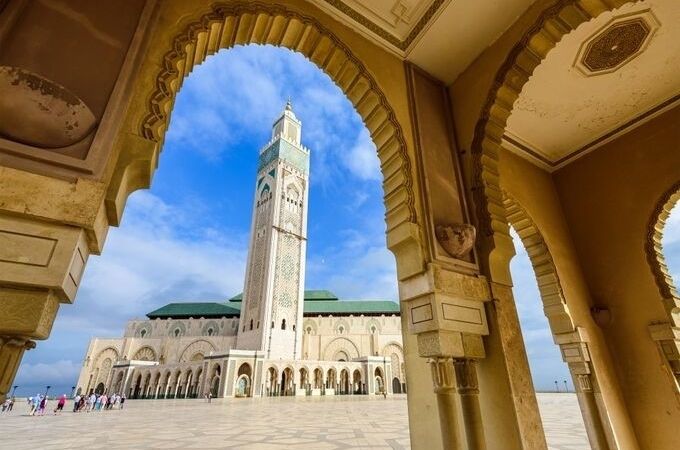
Few buildings in Casablanca are photographed as frequently as Hassan II Mosque, which makes it easy to arrive with a predetermined image in mind: blue Atlantic, bright sky, strong sunlight.
June may give you that.
It may also give you a softer morning when the ocean and sky seem to merge more subtly behind the mosque.
Neither version is inherently inferior.
The architecture remains extraordinary, while changing light can alter details, reflections and the relationship between the building and its Atlantic setting. If photography matters to you, consider the conditions creatively instead of waiting for Casablanca to reproduce a postcard.
A Morocco summer discovery becomes more interesting when weather changes how you see a place rather than merely determining whether you visit it.
The Sun Can Become Relevant Before It Becomes Obvious
A cloudy-looking morning can encourage travelers to neglect sun protection.
That can be a mistake.
Cloud cover does not eliminate ultraviolet exposure, and conditions may brighten while you remain outside. Sun protection should therefore be considered according to UV conditions and the amount of outdoor time planned, not solely according to whether direct sunshine is obvious when you leave the hotel.
This is particularly important on longer sightseeing days when the sky may change before you have considered reapplying protection or finding your sunglasses.
The simplest rule is useful: do not use visible blue sky as your only signal for sun awareness.
Don't Dress for the Colour of the Sky
A muted morning can also look cooler than it actually is.
Before reaching automatically for heavier clothing, check the temperature, wind and forecast. The visual appearance of the sky and the thermal conditions you experience at street level are related, but they are not identical.
June clothing should remain light and practical for increasingly summery conditions while accommodating whatever coastal breeze is expected for your dates.
This is not a packing article, so there is no need for an exhaustive checklist.
The important point is simply that grey weather can create misleading visual expectations in both directions.
Let Casablanca Reveal the Afternoon
One of the pleasures of June is watching the city change if morning cloud begins thinning.
Streets that looked subdued become brighter, building surfaces change character, shadows sharpen and the Atlantic becomes more visually distinct. Because you were already sightseeing rather than waiting for “good weather,” the transition becomes part of the experience.
This is where June separates decisively from February.
February focused on changeable winter weather windows, including showers and decisions about when to prioritize outdoor activities.
June is not about chasing temporary good weather.
It is about understanding that Atlantic summer mornings can look less promising than the day they eventually become.
A Late Start Can Waste the Most Interesting Transition
Travelers sometimes see a grey June morning and decide to delay sightseeing until conditions look more summery.
That can be unnecessary.
By starting normally, you experience Casablanca under softer light and may later watch the atmosphere transform around you. Waiting in the hotel for a blue sky removes that transition entirely and assumes that sunshine is the only weather worth experiencing.
For a Casablanca coastal adventure, the Atlantic influence should be part of the destination rather than something you wait to disappear.
June Owns the Misleading Morning
May asked where you wanted to spend the afternoon as Casablanca's central and Atlantic environments began feeling increasingly distinct.
June asks a completely different question:
What should you do when the morning does not look like summer?
Usually, the answer is simpler than expected.
Check the actual forecast, prepare for the conditions indicated rather than the colour of the sky, and begin the day. Cloud, haze and softer light can have their own advantages, while brighter conditions may develop later.
July will move into a different summer problem entirely.
June belongs to the mornings when Casablanca looks grey through the hotel window, yet gives you no good reason to stay inside.

The Best Response to a Grey Morning May Be No Response at All
Weather advice often encourages action: move this activity, delay that one, carry something different. June Casablanca sometimes rewards the opposite approach.
If the forecast remains generally suitable and the morning sky is simply overcast or hazy, continue with the day you intended to have.
Visit the places that interest you. Walk when you planned to walk. Have lunch where you wanted to eat. If the cloud later breaks, the city changes around you without requiring an itinerary change.
This is an important distinction because travelers can lose valuable time trying to optimize weather that did not actually create a problem.
Use the Morning for Details You Might Miss in Stronger Light
Casablanca's architectural character benefits from attention at street level. Decorative façades, balconies, geometric details and the relationship between older buildings and modern commercial life can become easier to observe when harsh sunlight is absent.
A subdued morning therefore has its own visual advantage.
Rather than spending those hours waiting for a more conventionally photogenic sky, look more closely at the city itself. If stronger sunlight develops later, you can shift naturally toward broader compositions, open spaces and Atlantic views.
The two conditions complement one another.
Sun Protection Should Follow Exposure, Not Appearance
A cloudy sky can create false confidence.
UV radiation can still reach you through cloud, while several hours outdoors accumulate more exposure than a short walk between attractions. Conditions can also brighten rapidly enough that the protection you dismissed at breakfast becomes relevant before lunch.
For practical planning, separate visible sunshine from sun exposure.
| What You See | What You Should Consider |
|---|---|
| Grey morning sky | Check UV and forecast rather than assuming low exposure |
| Thin cloud | Sun protection can still be relevant |
| Cloud beginning to break | Expect exposure to increase |
| Bright afternoon | Shade, water and sun protection become more important |
| Several outdoor hours planned | Prepare from the start rather than reacting later |
This table answers a specific June question and avoids turning the article into another generic temperature guide.
Don't Schedule Photography Around One Imaginary Sky
If photography matters to you, flexibility is useful, but repeatedly returning to the same landmark in pursuit of perfect blue sky can consume too much of a short Casablanca visit.
Work with what the city gives you.
A softer Hassan II Mosque photograph against Atlantic haze tells a different story from the bright afternoon version. Streets photographed beneath thin cloud reveal different textures from those captured under stronger sunlight.
Travel photography becomes more personal when weather is allowed into the frame rather than treated as an imperfection that must be removed.
Afternoon Brightness Can Change Your Pace
If cloud thins and stronger sunshine develops, the city may begin feeling more summery than it did earlier.
At that point, adjust naturally. Perhaps you spend longer over lunch, choose a less exposed route for a while or move toward an activity that benefits from the brighter conditions.
There is no need for a rigid midday strategy.
June's central lesson is precisely that the visual and practical character of the day can evolve, so an itinerary with some breathing room works better than one that assigns every hour months in advance.
Haze Is Part of Casablanca's Coastal Personality
Visitors sometimes interpret atmospheric haze as evidence that something is wrong with the weather.
In an Atlantic city, softer horizons and marine-influenced conditions can simply be part of the experience.
They may reduce distant visibility or make the coastline less sharply defined, but they can also create a distinctive sense of place. Casablanca does not need to resemble an intensely clear inland destination to provide satisfying summer sightseeing.
Understanding that difference also protects this cluster from broader Morocco weather content. June is not comparing Moroccan regions; it is explaining how Casablanca's Atlantic atmosphere can shape what summer looks like from the street.
Don't Let the Forecast Become the Attraction
Checking conditions before leaving is sensible. Rechecking when you have a meaningful decision to make can also help.
Beyond that, put the phone away.
If the morning is comfortable and your plans are working, there is little value in repeatedly checking exactly when cloud cover might decrease. You will notice when the city becomes brighter.
Casablanca should remain the reason you are outside.
The weather is simply helping you understand why the same street can look entirely different three hours later.
June Is the Month That Challenges the Summer Postcard
The useful surprise of June is that summer does not always announce itself with uninterrupted blue sky from breakfast onward.
A pale morning can become brighter. Marine haze can soften the Atlantic horizon. Cloud can make architecture easier to photograph before stronger sunlight changes the scene later.
None of this makes June less summery.
It simply makes Casablanca's version of early summer distinctly Atlantic.
12 Questions About Casablanca in June
1. What is the weather like in Casablanca in June?
June generally brings increasingly warm, dry early-summer conditions, although Atlantic influence can produce cloud, haze and muted mornings. Travelers should avoid judging the entire day from the sky at breakfast because brighter conditions may develop as the day progresses.
2. Why can Casablanca be cloudy in June?
Casablanca's Atlantic location can contribute to low cloud and marine-influenced conditions, particularly around the earlier part of the day. A grey appearance does not necessarily indicate significant rain, so checking the actual forecast provides better guidance than relying on appearance alone.
3. Does it rain in Casablanca in June?
Rain becomes less characteristic as Casablanca moves toward its drier summer period, although unusual precipitation remains possible. Travelers should check forecasts for their exact dates rather than assuming either completely dry weather or that morning cloud automatically signals rainfall.
4. Is Casablanca hot in June?
June can bring warm conditions, although Casablanca's Atlantic influence distinguishes it from hotter inland Moroccan destinations. Individual temperatures vary, and sunshine, cloud, wind and location all affect how the day feels while sightseeing.
5. Does a cloudy June morning mean bad weather all day?
No. Low cloud or haze can produce a grey-looking morning without determining the entire day's conditions. If the forecast remains suitable, there is generally no reason to delay sightseeing solely because the sky does not look conventionally summery.
6. Do I need sunscreen when Casablanca is cloudy?
Sun protection can still be relevant under cloud because visible sunshine is not the same as UV exposure. Check UV conditions and consider how many hours you will spend outside rather than deciding entirely from whether the sky appears blue.
7. What should I wear in Casablanca in June?
Light, comfortable clothing generally suits increasingly summery conditions, with choices adjusted for the day's wind and forecast. Sun protection is useful for extended outdoor periods, while a light additional layer may occasionally help around breezier Atlantic-facing areas.
8. Is June good for photography in Casablanca?
Yes, particularly if you are willing to work with changing light. Softer morning conditions can suit architectural details, while brighter periods later may create stronger contrast around open spaces, Hassan II Mosque and Atlantic-facing scenes.
9. Should I delay sightseeing if June starts cloudy?
Usually not solely because of cloud. If temperature, rain and wind forecasts remain suitable, beginning normally allows you to experience Casablanca under softer morning conditions and potentially watch the city's light change naturally as the day develops.
10. Is the Atlantic visible through June haze?
Visibility varies according to actual atmospheric conditions. Haze can soften distant views and reduce definition along the horizon, but it also creates a distinctly coastal atmosphere rather than preventing you from experiencing Casablanca's relationship with the Atlantic.
11. Is June the best time to visit Casablanca?
That comparison belongs to a Best Time to Visit Casablanca guide. This article has a deliberately narrower purpose: explaining June's cloud-filtered mornings, changing light and why apparently grey conditions should not automatically alter a sightseeing day.
12. How is June different from May in Casablanca?
May focuses on the contrast between central Casablanca and Atlantic-facing environments, particularly as the day develops. June abandons that spatial approach and examines morning cloud, marine haze, changing light and the misleading difference between how summer weather looks and how it actually behaves.

A travel professional specializing in tailor-made travel planning, guest experience management, and multi-destination tourism operations.
With over 23 years of experience in the travel industry, he designs and manages private and cultural tours for international travelers across Türkiye, Greece, Egypt, Jordan, Morocco, and other destinations.
He has strong expertise in both online and face-to-face guest communication, sales processes, and end-to-end travel operations.
Working closely with hotels, travel agencies, and local partners, he ensures smooth coordination and high-quality travel experiences at every stage of the journey.
His focus is on delivering personalized, reliable, and seamless travel experiences for international guests worldwide.