Morocco’s Sahara Is Not One Place, and That Changes Everything
Updated: August 2026
Travelers often speak about “going to the Sahara” as though Morocco contains one giant desert entrance followed by the same dunes, camps and sunsets for everyone.
It does not work that way.
The Morocco Sahara experience depends heavily on where you go, how far you travel, what type of camp you book, what season you visit and whether your expectations come from geography or Instagram. Merzouga and the Erg Chebbi dunes are the most internationally recognizable desert setting for many first-time visitors, while the Zagora region and other southern routes offer different landscapes, distances and travel patterns. Not every desert area provides the same height of dunes, the same camp style or the same sense of isolation.
This matters because the phrase “Sahara tour” can describe experiences that are visually and operationally very different.
For one traveler, the highlight is walking barefoot over a dune before sunrise. For another, it is the road journey through southern Morocco. Someone else cares primarily about the camp, dinner and night sky, while another traveler may discover that the long drive is the part they remember most clearly.
The desert becomes much easier to plan once you stop asking whether the Sahara is worth visiting and start asking which Sahara experience you are actually buying.
The First Surprise Is Usually How Long the Journey Takes
Many first-time travelers underestimate the road time because Morocco’s Sahara is often presented as a visual destination rather than a logistical one.
You see dunes.
The photograph does not show the hours spent reaching them.
From Marrakech or other major northern cities, desert-bound journeys require substantial overland travel, often broken across regions such as the High Atlas, Ouarzazate, Dades, Tinghir or other southern stops depending on the route. This is one reason well-designed desert journeys usually make the road part of the experience rather than pretending the dunes are just outside the city.
The mistake is not taking a long road journey.
The mistake is planning as though the road does not count.
If you dislike long drives, frequent hotel changes or early departures, that should influence whether you choose a full Saharan route, a shorter southern desert experience or a completely different Morocco itinerary.
The Sahara deserves honesty before enthusiasm.
Merzouga and Erg Chebbi Are Not Synonyms for the Entire Sahara
Merzouga is strongly associated with Morocco’s best-known dune experience because of its position beside Erg Chebbi.
This is where travelers encounter large orange-gold dunes, desert camps and the visual landscape most closely matching the classic Sahara imagery used in tourism marketing.
That does not mean every desert experience in Morocco happens there.
The country contains different arid landscapes, rocky plains, valleys and dune systems, each with a different atmosphere and access pattern. Treating all of them as interchangeable creates disappointment, especially when a traveler expects enormous dunes and arrives somewhere where the landscape is flatter or more stony.
This is one of the most important pieces of operational information in the entire blog:
Ask which desert region you are actually visiting before comparing prices.
A cheaper “Sahara experience” may not be the same product at all.
Erg Chebbi Is About Scale More Than Silence
The dunes create a powerful visual impression because they rise sharply from the surrounding landscape.
For first-time visitors, that transition can feel almost unreal. One moment the road is moving through an arid region; later, a wall of sand appears with enough height and color to dominate the horizon.
This is where expectations around silence should be handled carefully.
Popular desert areas host multiple camps, vehicles, camel activities and visitors, particularly during high-demand periods. The environment can still feel expansive and atmospheric, but travelers seeking absolute isolation should understand that famous dunes attract other people for the same reasons they attracted them.
The goal should not be proving that nobody else exists.
It should be allowing enough time and distance from activity centers that the scale of the dunes becomes the focus rather than the logistics around them.
Camp Quality Changes the Desert More Than Most Travelers Expect
The phrase “desert camp” covers a surprisingly wide range of comfort.
Some camps focus on simple accommodation, basic facilities and a more stripped-back atmosphere. Others provide private bathrooms, larger tents, proper beds, heating or cooling arrangements where available, more elaborate dining and significantly higher service levels.
This difference matters because the desert night is not a short activity.
It is where you sleep.
A traveler happy with simple facilities may value atmosphere over comfort, while someone who struggles with poor sleep can find that a “rustic” night undermines the following day.
Neither preference is more authentic.
Comfort level should be selected according to the traveler rather than according to an idea that suffering somehow makes the desert more real.
Travelers considering Private Morocco Sahara Tours should therefore ask about the camp itself, not merely whether “desert accommodation” is included.
A Luxury Camp Is Still in the Desert
Luxury wording can create expectations that conflict with geography.
A high-end desert camp may provide excellent bedding, private facilities, strong dining and carefully designed tents, but it still operates in an environment shaped by sand, wind, temperature changes and remote logistics.
That means service can feel different from a five-star urban hotel.
The setting is part of the product.
Travelers expecting complete environmental control may be surprised by dust, cooler nights, insects in some periods or the practical limitations of operating far from normal urban infrastructure.
Luxury improves comfort.
It does not remove the desert.
That distinction is what allows the experience to remain interesting.
Do Not Choose a Camp From Photographs Alone
Camp photography is especially persuasive.
Beds look perfect, lanterns glow, carpets appear untouched by sand and nobody in the photograph is carrying luggage awkwardly through a dune.
Before booking, ask questions photographs cannot answer.
How are guests transferred to the camp? Is a private bathroom included or shared? What kind of bedding is provided? How does the camp handle colder nights? Is dinner included? How far is the camp from the main dune areas? Are there many neighboring camps?
These details determine how the experience feels far more than whether the tent photographs beautifully.
A strong desert booking begins with operational questions.
The aesthetic comes afterward.
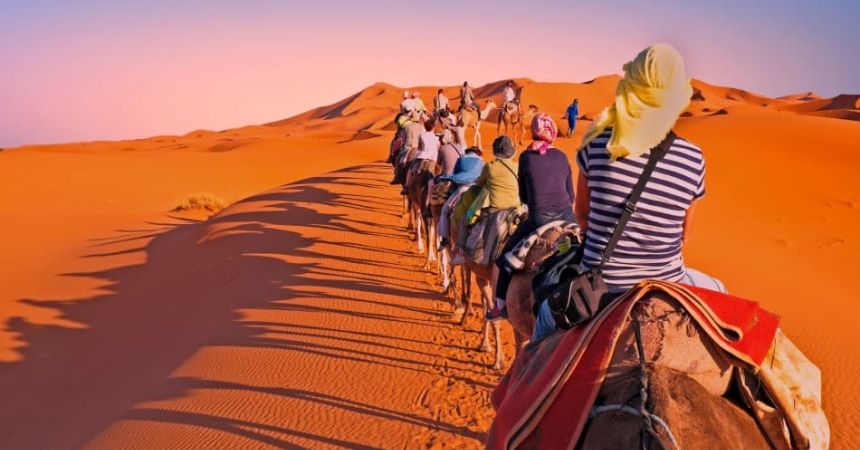
Camel Riding Is Part of the Image, Not a Requirement
The silhouette of a camel caravan against sunset has become one of the most recognizable images of Moroccan desert travel.
That does not mean every visitor must ride.
Some travelers enjoy the experience and find that the slow movement across sand creates a memorable transition toward camp. Others find camel riding physically uncomfortable, particularly after a short period in the saddle.
Travelers with back, hip or mobility concerns should discuss suitability before assuming that a camel transfer is compulsory.
Alternative vehicle arrangements may be possible depending on camp and route.
The useful principle is simple:
Choose the transport experience you will enjoy, not the one that produces the most familiar photograph.
The Sahara remains the Sahara whether you arrive on a camel or in a 4x4.
Sunset Can Be Wonderful Without Being Perfect
Desert marketing often treats sunset as a guaranteed performance.
It is not.
Cloud cover, haze, wind and seasonal conditions can change the light completely. Some evenings produce spectacular color; others are subtle, muted or almost uneventful.
The mistake is spending the entire sunset evaluating whether it matches the photograph that convinced you to book.
Sand changes gradually with light, and the broader atmosphere can remain beautiful even without dramatic skies.
If photography matters, arrive early enough that you are not rushing up a dune during the final five minutes.
If photography does not matter, sit down.
The desert is one of the few places where not doing anything can still feel like the main activity.
Sunrise Is Often Quieter Than Sunset
Sunset gathers people naturally because everyone is awake and already part of the evening program.
Sunrise asks more commitment.
You need to get out of a warm bed, dress according to the morning temperature and walk into the sand before breakfast. This means the atmosphere can feel calmer, particularly around camps where not every guest is enthusiastic about dawn.
For travelers who value quiet, sunrise can become more memorable than sunset.
The light also behaves differently, gradually revealing dunes rather than closing the day.
The operational advice is simple: prepare clothes the night before.
Searching for socks inside a dark tent while everyone else is already outside is a particularly inefficient way to greet the Sahara.
Desert Nights Can Be Colder Than Travelers Expect
The word “desert” encourages assumptions about heat.
Days can indeed become extremely hot during warmer periods, but nighttime temperatures may drop substantially, particularly in cooler seasons.
This catches travelers who packed for a warm Morocco holiday and assumed the camp would remain comfortable in the same clothing used at lunch.
Layers matter.
Ask about typical conditions for your specific travel dates and what the camp provides for cold nights. Do not rely on generic annual averages when deciding what to pack.
A thick blanket can solve the sleeping problem.
It does not help much if you want to sit outside under the stars after dinner and brought only a light shirt.
Summer Heat Changes the Entire Desert Logic
Summer desert travel deserves particular caution because daytime heat can become severe.
This affects activity timing, road travel, walking on dunes and how much physical effort feels comfortable. Midday dune exploration can be far more demanding than the same activity during cooler periods, while the sand itself can become extremely hot.
A well-designed summer desert experience therefore uses early morning and later afternoon more intelligently rather than insisting that the same program works year-round.
Travelers should also be realistic about personal heat tolerance.
The Sahara is not improved by proving that you can tolerate discomfort longer than everyone else.
Winter Is Comfortable in the Day and Surprisingly Serious at Night
Cooler-season desert travel can produce beautiful daytime conditions, particularly for travelers who dislike extreme heat.
The trade-off often appears after sunset.
Evenings and early mornings can become genuinely cold, especially when wind is involved, and camps vary in how they manage that cold.
Warm layers, socks and appropriate sleep expectations matter.
A traveler wearing a jacket at breakfast in the Sahara is not evidence that the desert experience failed.
It is evidence that deserts have large temperature ranges.
Understanding this before arrival makes winter considerably easier to enjoy.
Wind Can Change the Experience Without Cancelling It
Sand and wind have an obvious relationship.
A windy day can reduce visibility, make walking less comfortable and create conditions very different from the polished images associated with calm desert evenings.
This does not automatically mean the Sahara trip is ruined.
It means activities may need adjustment.
Current local advice should guide decisions, particularly when visibility, road conditions or comfort become concerns.
Travelers should avoid building the entire desert experience around one photographic objective that requires perfectly calm weather.
Nature has not read the itinerary.
One Night and Two Nights Do Not Buy the Same Thing
A one-night desert stay can be deeply memorable, particularly for travelers on a broader Morocco route.
You arrive, experience late afternoon, dinner, the night, sunrise and continue onward.
Two nights change the structure.
The second day allows the desert to exist without immediate arrival or departure logistics. Activities can happen more slowly, nearby communities or additional landscapes can be explored, and the camp stops feeling like one elaborate overnight stop.
The useful comparison is not “more sights,” but how much of the desert day belongs to the desert itself:
| Experience factor | One camp night | Two camp nights | What actually changes |
|---|---|---|---|
| Arrival | Often timed around afternoon/sunset | First arrival becomes less pressured | No need to maximize every hour |
| Sunrise | One opportunity | Two possible mornings | Weather and fatigue matter less |
| Camp atmosphere | Evening-focused | Full daytime rhythm becomes visible | Camp feels less transitional |
| Activities | Selected and time-sensitive | More flexible | You can choose according to conditions |
| Rest | Limited by onward journey | Much easier | The desert becomes restorative |
| Road fatigue | Still prominent in wider route | Better separated from camp time | Experience feels less transport-heavy |
This table measures experience depth, not package value.
One night is enough for many people.
Two nights are better for travelers who want the Sahara to become a destination rather than a spectacular hotel stop.
The Road Should Be Broken for a Reason
Long desert journeys are often divided by overnight stops.
That is sensible.
What matters is whether those stops add something to the route or merely reduce driving hours.
Places such as Ouarzazate, Dades or Tinghir can provide landscape, architecture and regional context, depending on the chosen route. The strongest journeys use those regions intentionally rather than treating them as compulsory boxes inserted because nobody wants to drive for ten hours continuously.
This is an important cluster boundary.
The Sahara blog should explain why the journey needs structure, but it should not absorb complete guides to those destinations.
Each stop needs its own reason.
The Dades and Todra Landscapes Make the Desert Arrival Better
Travelers often focus so strongly on reaching the dunes that they undervalue the geological landscapes encountered beforehand.
The Dades Valley and Todra Gorge region can provide dramatic changes in terrain, with rock formations, canyon environments and cultivated areas creating a gradual transition toward increasingly arid landscapes.
This progression makes the eventual dunes feel earned.
If you flew directly into the middle of Erg Chebbi, the dunes would still be extraordinary.
Traveling overland gives them narrative.
The Sahara arrives after Morocco has already changed several times.
Desert Camps Are Not Automatically “Authentic Bedouin Experiences”
Travel marketing occasionally uses cultural language too casually.
Morocco's desert regions are home to communities with their own histories, identities and contemporary lives. Camp entertainment, music and hospitality can draw from local traditions, but travelers should be cautious about interpreting every tourism camp as a complete representation of nomadic or desert culture.
A hotel in Fes is not the entirety of Moroccan urban culture.
A camp is not the entirety of Saharan life.
Respectful curiosity works better than expecting people to perform an imagined desert identity for visitors.
Ask questions.
Listen to local guides.
Allow culture to remain more complex than the marketing description.
Dinner in the Desert Is About Context More Than Cuisine
A meal that might feel ordinary in a city can become memorable when eaten after sunset in a remote camp.
That does not mean every desert dinner is a culinary masterpiece.
The atmosphere contributes heavily: darker skies, colder air, sand outside the dining tent and the knowledge that the nearest urban restaurant is not a short walk away.
Travelers with dietary requirements should communicate them before reaching camp rather than waiting until dinner appears.
Remote hospitality requires planning.
A vegetarian preference mentioned at booking is much easier to manage than an allergy disclosed after the kitchen has already prepared the meal.
This is basic operational etiquette.
It also improves the evening considerably.
The Stars Are Real, but the Sky Is Not Always Perfect
The Sahara has excellent potential for night-sky viewing because of low artificial light in remote areas.
That does not guarantee visible stars every night.
Moon phase, clouds, dust and atmospheric conditions all affect the sky.
Travelers planning astrophotography should pay particular attention to moonlight because a bright moon can dramatically change the appearance of the stars while also creating beautiful illumination across the dunes.
This is another example of why desert experiences improve when visitors stop requiring one specific version of nature.
A moonlit desert can be just as memorable as a dark-sky night.
It is simply different.
Luggage Should Become Smaller Before the Camp Transfer
One of the most practical desert decisions happens before leaving the road.
Large suitcases are often unnecessary and awkward for a single camp night, especially when the final transfer involves sand, camels or smaller vehicles.
Many itineraries work better when travelers prepare a small overnight bag containing the clothes, toiletries, medication, electronics and warm layers actually needed at camp, while larger luggage remains safely stored according to the operator's arrangements.
Ask in advance how luggage is handled.
Do not discover at the dune edge that your hard-shell suitcase was not designed for this stage of the journey.
A small bag makes everything easier.

A travel professional specializing in tailor-made travel planning, guest experience management, and multi-destination tourism operations.
With over 23 years of experience in the travel industry, he designs and manages private and cultural tours for international travelers across Türkiye, Greece, Egypt, Jordan, Morocco, and other destinations.
He has strong expertise in both online and face-to-face guest communication, sales processes, and end-to-end travel operations.
Working closely with hotels, travel agencies, and local partners, he ensures smooth coordination and high-quality travel experiences at every stage of the journey.
His focus is on delivering personalized, reliable, and seamless travel experiences for international guests worldwide.