Ouarzazate, Morocco: The Place Between the Places Everyone Recognizes
Updated: August 2026
Ouarzazate is easy to misunderstand because many travelers first encounter it as a name written between two more immediately exciting destinations.
Marrakech on one side. The Sahara somewhere farther southeast. Ait Ben Haddou nearby. Atlas roads behind you. Desert landscapes beginning to appear ahead.
That makes Ouarzazate look like a logistical comma in a larger sentence.
It is more useful than that.
The city sits at an important geographical and cultural transition where Morocco begins changing from the greener, higher landscapes associated with the Atlas into the drier valleys, kasbah country and desert-edge environments of the south. Its film studios have given it an international identity, while Taourirt Kasbah and the wider architecture of the surrounding region connect the modern city with a much older southern building tradition.
Ouarzazate is therefore not strongest when treated as another city where travelers need fifteen attractions before dinner.
Its value lies in context.
Spend a little time here and the journey south becomes easier to understand: why film productions were drawn to this region, why fortified earthen architecture fits the landscape so naturally, why road distances begin feeling different and why the transition toward Morocco’s desert regions deserves more than a sleeping driver and a quick lunch stop.
The Road Into Ouarzazate Is Part of the Explanation
Travelers arriving from Marrakech usually remember the journey.
Mountain roads, changing elevations, dramatic views and increasingly dry terrain make the transfer feel much longer culturally than it looks geographically. By the time Ouarzazate appears, Marrakech already feels like a different Morocco.
That change is important.
Ouarzazate should not be understood independently of the road that reaches it, because the city’s role is partly geographical. It sits where north-south and east-west travel routes through southern Morocco meet a landscape that historically depended on trade, fortified settlements, irrigated valleys and connections between mountain and desert regions.
For travelers using Private Ouarzazate Morocco Tours, the strongest arrival is therefore rarely one where every minute of the mountain journey has been treated as wasted transfer time.
The road prepares you for the place.
Once the vegetation thins and the colors of the landscape become more earthen, Ouarzazate makes considerably more sense.
Ouarzazate Is Not the Sahara, and It Should Not Pretend to Be
This distinction matters because tourism language regularly blurs southern Morocco into one enormous desert.
Ouarzazate is not a dune destination.
You do not step outside your hotel and suddenly find the vast sand seas associated with Morocco’s better-known Sahara experiences. The environment is arid and cinematic, certainly, but the city belongs to a different geographical setting.
That is not a weakness.
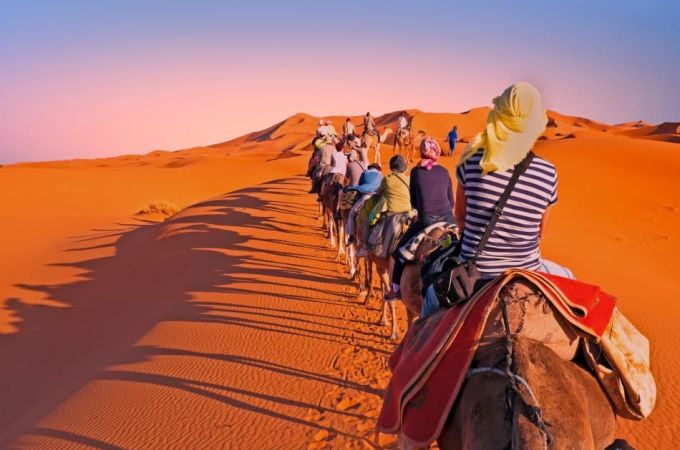
The journey from Ouarzazate toward desert regions becomes more meaningful precisely because the landscape continues changing. Rocky terrain, valleys, palm-filled areas, kasbah settlements and eventually more recognizably Saharan environments create a progression rather than one abrupt switch.
Travelers who expect Ouarzazate itself to provide a classic dune-camp experience are asking the wrong destination to perform the wrong job.
Ouarzazate is where the desert journey begins to feel plausible.
The Sahara is where it becomes something else entirely.
Taourirt Kasbah Gives the Modern City Its Historical Anchor
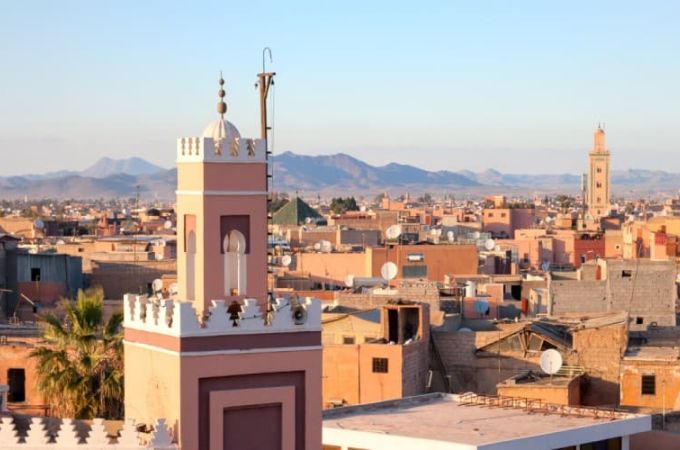
Modern Ouarzazate can initially feel spacious and low-key compared with Morocco’s more intense historic centers.
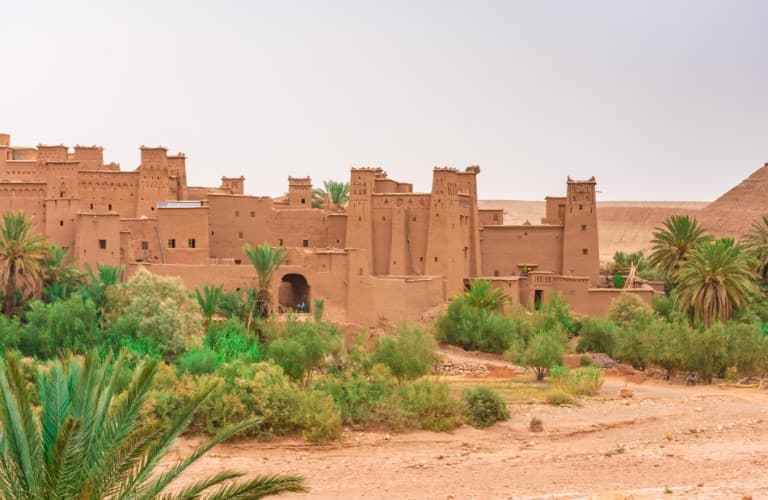
Taourirt Kasbah changes the visual language immediately.
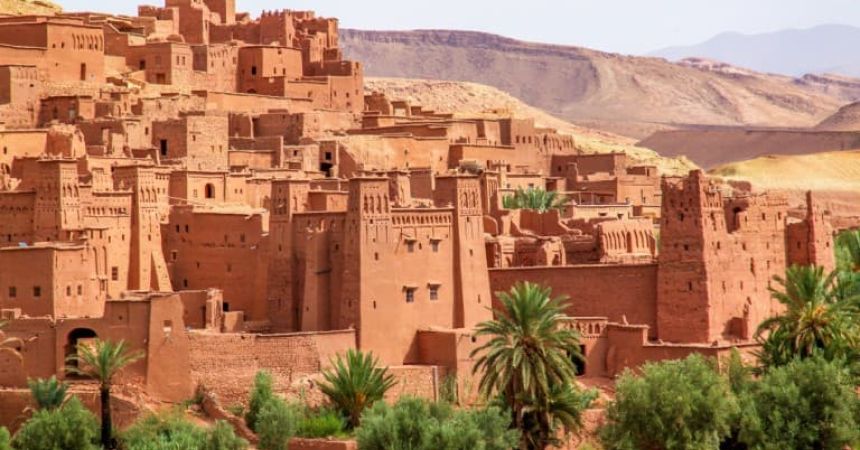
The fortified earthen architecture, towers and interior spaces connect the city to the building traditions that shaped southern Morocco, particularly in regions where clay, earth and local materials were used to create structures adapted to climate and security.
What matters here is not simply photographing the exterior.
Kasbah architecture becomes more interesting when travelers understand how defensive form, family life, storage, status and environmental adaptation could coexist within the same complex.
Ouarzazate’s modern streets then become easier to contextualize.
The city is not an ancient settlement preserved intact around one monument.
It is a contemporary regional center where older architectural traditions remain visible within a much broader twentieth- and twenty-first-century urban environment.
“Kasbah” Should Not Become a Decorative Word
Morocco tourism uses the term so frequently that travelers can begin hearing it as a synonym for “old beautiful building.”
That strips away useful meaning.
Kasbahs were fortified structures connected with political authority, elite families, local control and protection, although their exact roles differed according to place and period. In southern Morocco, their earthen construction also reflects local materials and environmental conditions.
Understanding this helps when traveling beyond Ouarzazate because the region contains numerous fortified structures and settlements that might otherwise blur together visually.
The aim is not memorizing architectural terminology.
It is recognizing that these buildings belong to a social landscape rather than being picturesque props built conveniently beside modern roads.
Once you see that distinction, the entire region becomes easier to read.
Film Studios Make Sense Here Because the Landscape Already Looks Invented
Ouarzazate’s film industry is not simply a strange modern addition to an old Moroccan town.
The surrounding landscape explains why filmmakers arrived.
Dry valleys, open horizons, mountains, earthen settlements and a relative absence of dense modern construction in selected areas made the region extraordinarily adaptable for productions requiring biblical, historical, desert or imagined settings.
Major international films and television productions have used Ouarzazate and the surrounding region for decades, giving the city a nickname often translated loosely as Morocco’s Hollywood.
Visitors can explore studio environments and sets depending on current access arrangements, although expectations should be realistic.
Film sets are designed for cameras.
From one angle, a structure can look monumental. Walk behind it and the illusion may end immediately.
That contrast is arguably the most interesting part.
Cinema turns surfaces into worlds.
Seeing how that happens can be more entertaining than expecting every studio building to behave like permanent architecture.
Do Not Visit a Film Studio Because You Feel Obliged To
Film heritage is one of Ouarzazate’s strongest identities, yet it will not interest everyone equally.
A traveler fascinated by production design, movies or television locations may happily spend substantial time examining sets and hearing which productions used them. Someone with very little interest in cinema may find the same experience far less compelling.
That is perfectly acceptable.
Ouarzazate should not become a compulsory studio visit merely because the city is famous for filmmaking.
A strong itinerary uses interests honestly.
If film is part of what attracted you here, give it time.
If not, focus on kasbah architecture, the wider landscape and the role Ouarzazate plays within southern Morocco.
Destination reputation should inform the itinerary.
It should not control it.
Atlas Studios and CLA Studios Are Not One Generic “Movie Attraction”
Visitors researching Ouarzazate may encounter different studio names and assume they describe interchangeable versions of the same experience.
They do not necessarily.
Studios have been involved in different productions, sets and operating arrangements, and visitor access can vary over time. Travelers should therefore check current opening conditions and what can actually be visited rather than relying on a decade-old film blog that describes a set no longer available in the same form.
This is one of those places where current local information matters far more than an evergreen list of movie titles.
The films remain historical facts.
The visitor experience changes.
That distinction should guide planning.
Ait Ben Haddou and Ouarzazate Should Not Be Collapsed Into One Destination
The two are frequently linked because of geographical proximity and their shared connection with film productions, but they provide different experiences.
Ouarzazate is a functioning regional city with studios, hotels, contemporary neighborhoods and Taourirt Kasbah.
Ait Ben Haddou is a historic fortified settlement whose architecture, setting and preservation create a completely different atmosphere.
Travelers often sleep in Ouarzazate and visit Ait Ben Haddou as part of the surrounding journey, which makes logistical sense. What does not make sense is describing them interchangeably.
For content-cluster purposes, this distinction is essential.
Ouarzazate owns the regional gateway and cinema-city experience.
Ait Ben Haddou deserves its own architectural and heritage context rather than becoming a paragraph stretched until it consumes the Ouarzazate blog.
The City Is More Valuable at Sunset Than Many Itineraries Allow
A rushed southern Morocco itinerary often reaches Ouarzazate late, checks into the hotel, eats dinner and leaves early the following morning.
That solves accommodation.
It does not necessarily experience the city.
The late afternoon can be one of the most satisfying times to slow down because lower light emphasizes the warm colors of the surrounding landscape and earthen architecture. The heat can also become more manageable during warmer periods, making a walk or viewpoint considerably more comfortable than it would have been earlier.
This does not mean Ouarzazate requires a formal sunset activity.
The useful point is that arriving before dark adds more value than simply arriving before dinner.
Sometimes an extra two hours changes a hotel stop into an actual destination.
A Pool Can Be More Valuable Here Than Another Museum
Travelers planning culture-heavy Morocco itineraries can become suspicious of hotel leisure.
Surely the afternoon should contain another kasbah, another village or another film location.
Southern road journeys have a way of correcting that attitude.
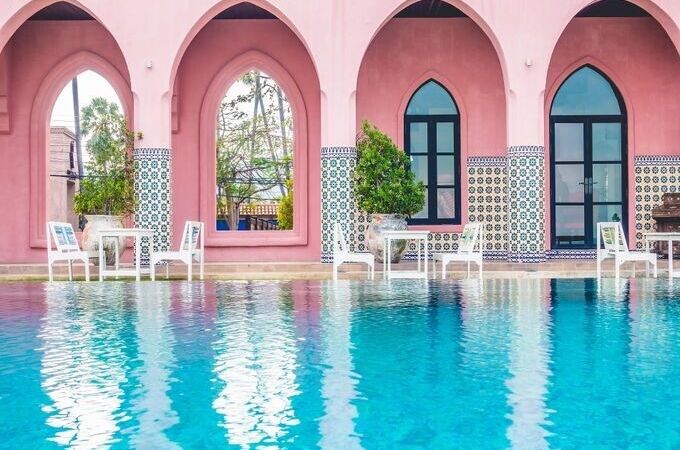
After several hours crossing mountain roads or continuing through dry landscapes, a hotel pool can provide exactly the change of pace the trip needs, particularly in warm weather.
This is not an argument for spending the entire Ouarzazate stay inside a resort.
It is an argument for acknowledging the physical reality of southern Morocco travel.
A relaxed afternoon followed by evening sightseeing may produce a better day than forcing every daylight hour into another excursion.
Good itineraries manage energy.
They do not merely distribute attractions.
Ouarzazate Is a Place Where Hotel Choice Should Follow Tomorrow’s Road
Accommodation decisions here are unusually connected to onward travel.
If the next morning begins with a long drive toward the Dades Valley, Zagora or farther southeast, vehicle access, breakfast timing and easy departure can matter more than staying inside the most atmospheric possible location.
If the purpose of the stay is primarily leisure, pool and hotel facilities gain value.
If film studios or city sightseeing are important, location can influence how efficiently those visits fit.
This makes Ouarzazate a poor place to choose accommodation purely from photographs.
The hotel’s job depends on what comes next.
A beautiful property that complicates tomorrow’s departure may be less useful than a simpler one positioned perfectly for the route.
Southern Morocco Road Days Need a Different Definition of “Full Day”
City itineraries can often describe a full day through hours spent sightseeing.
Southern Morocco behaves differently.
A substantial road journey can already be a full day because the landscape itself is part of the experience. Stops, photography, lunch, winding roads and changing terrain make the journey more than transportation even when relatively few formal attractions are included.
Ouarzazate sits naturally inside this travel style.
Trying to force a city-style sightseeing schedule onto a road-heavy day often creates unrealistic expectations.
This is why operational planning matters more here than attraction count.
The relevant question is not how many stops fit.
It is how many stops still leave the journey enjoyable.
How Ouarzazate Changes According to the Journey Around It
Rather than comparing Ouarzazate with another destination, the more useful table is to look at how its role changes according to where it sits in your trip:
| Ouarzazate’s position | What the city mainly provides | Main planning risk | Better use of time |
|---|---|---|---|
| After Marrakech | Transition from city to southern landscapes | Overloading the Atlas crossing | Arrive with enough daylight to settle in |
| Before Sahara regions | Operational break before longer road travel | Treating it as only a sleep stop | Use the evening for kasbah or film heritage |
| After desert touring | Comfortable return to urban facilities | Scheduling another exhausting excursion | Allow hotel or pool recovery |
| Film-focused trip | Studios and production history | Expecting every old set to remain accessible | Verify current studio visits |
| Kasbah-focused journey | Context for southern architecture | Collapsing every fortified site into one story | Use Ouarzazate as orientation for the region |
| Short Morocco trip | One additional stop competing for scarce time | Including it merely because it is “on the way” | Stay only if southern Morocco is a real priority |
This is Ouarzazate’s real planning value: its role changes according to what happened yesterday and what you are doing tomorrow.
One Night Can Work When the Timing Is Good
Ouarzazate is one of those places where one night can be perfectly sensible, provided the arrival and departure times allow the stay to contain something beyond sleep.
An afternoon arrival can leave enough time for one focused experience, dinner and a relaxed morning departure. In that structure, the city functions naturally as part of a wider southern route.
A very late arrival followed by an early departure is different.
Technically, you stayed in Ouarzazate.
Experientially, you stayed in a hotel that happened to be located there.
That distinction matters when evaluating an itinerary.
Hotel nights are not destination experiences automatically.
Two Nights Make Sense for a Specific Kind of Traveler
A second night becomes more valuable when film studios are a genuine interest, regional kasbah exploration matters, or travelers want to slow the road journey instead of continuing immediately toward the next valley or desert destination.
It can also work well for families and people who become fatigued by repeated one-night stays.
What two nights should not do is automatically create another day of long excursions.
Travelers considering Ouarzazate and Kasbah Tours may gain more from one focused touring day and one lighter period than from using both days to reach farther and farther from the hotel.
The reason for staying longer should be reducing pressure.
Not simply expanding the radius of the vehicle.
Families Often Appreciate Ouarzazate for Reasons Adults Do Not Predict
Children who have already spent several days seeing historical buildings may respond enthusiastically to film sets because the experience requires less abstract historical imagination.
A wall can become ancient Rome, a palace or a fictional city simply because the camera framed it that way.
That idea is immediately understandable.
Pools and spacious hotels can also make Ouarzazate an effective pause within a road-heavy family itinerary, while the city’s broader streets and less intense medina environment may feel easier after denser destinations.
Parents should still pay attention to heat, driving time and how many stops are being added between hotels.
A child who enjoyed one movie studio does not necessarily want four more hours in the car to see another location.
Film Fans Should Separate Production History From Celebrity Hunting
Ouarzazate has hosted numerous major productions, which can make travelers arrive expecting a permanent archive of everything filmed there.
Cinema does not work that way.
Sets are reused, adapted, dismantled or left to weather, while productions move in and out. A location associated with a famous film may look dramatically different years later.
This can disappoint visitors who expect preservation.
For film enthusiasts, the more interesting approach is understanding how the landscape and infrastructure made production possible rather than treating the city as a museum of intact movie scenes.
Ouarzazate’s cinematic importance lies in repeated transformation.
The fact that one place can convincingly become several imaginary worlds is the story.
Do Not Let Movie Trivia Replace Morocco
There is another danger for film fans.
A guide points out that a famous production used a location, and suddenly everything becomes more interesting because an actor once stood there.
That can be fun.
It should not erase the real historical and cultural significance of the place.
Ait Ben Haddou was not built for cinema. Kasbah architecture did not develop because future productions needed dramatic backgrounds. The landscape existed long before a film crew arrived.
Cinema adds a fascinating modern layer.
It should remain a layer.
Travel becomes considerably richer when Morocco is not reduced to locations that happened to appear in somebody else’s story.
Ouarzazate Is One of the Best Places to Understand Why the Sahara Should Not Be Rushed
Once travelers reach Ouarzazate, there can be a strong desire to continue immediately toward the dunes.
The Sahara feels close because the landscape has already become dry and dramatic.
In practical terms, significant desert destinations still require substantial road travel, and the journey itself passes through places that deserve attention.
This is why Ouarzazate can be useful psychologically.
It breaks the long transition south into understandable sections.
Instead of thinking “Marrakech to Sahara” as one enormous transfer, the route becomes a sequence of changing environments.
That makes both the road and the eventual desert arrival more meaningful.
Summer Changes the Value of the Middle of the Day
Ouarzazate can become very hot during warmer months, which changes what feels sensible between late morning and afternoon.
This is where hotel facilities, shaded lunch stops and flexible scheduling become operationally important.
A physically undemanding studio visit can still feel tiring under strong heat, while exploring exposed outdoor architecture is rarely improved by insisting that the itinerary must continue at full pace through the hottest period.
Move some activity toward morning or later afternoon where practical, keep water available and use midday intelligently.
Travelers do not receive extra credit for being uncomfortable in southern Morocco.
Winter Can Make the Road More Important Than the Forecast in Ouarzazate
Ouarzazate itself may experience relatively mild daytime conditions compared with higher mountain areas, but road journeys to and from the city can pass through very different elevations and weather.
This matters particularly when traveling across the High Atlas.
A pleasant forecast in Ouarzazate does not necessarily describe conditions on the mountain route earlier that morning.
Travel planning should therefore consider the entire journey rather than only the destination weather.
Current road and local conditions deserve more authority than a generic seasonal statement.
The hotel may be sunny.
The road still gets a separate forecast.
The Best Ouarzazate Experience Usually Involves Knowing Why You Stopped
Travelers rarely regret Ouarzazate because the city is inherently disappointing.
They regret it when nobody explained what role it was supposed to play.
If you expected a dramatic medina, you may find the modern city understated. If you expected Saharan dunes outside the hotel, the geography will disappoint you. If you expected a giant movie theme park, the studios may feel more industrial than imagined.
But if you arrive understanding that Ouarzazate is a southern Moroccan crossroads where film production, earthen architecture and desert-bound travel overlap, the destination becomes much clearer.
That clarity should determine the stay.
Come for film heritage if cinema matters.
Stay for kasbah context if southern architecture interests you.
Use the city as a comfortable road break if the Sahara is the larger objective.
Spend another night if slowing down would improve the route.
Ouarzazate does not need to be the star of every Morocco itinerary.
It is remarkably good at making the rest of the southern journey make sense.
12 Ouarzazate Questions Travelers Usually Ask Too Late
1. Is Ouarzazate actually in the Sahara Desert?
No. Ouarzazate sits in an arid southern Moroccan landscape but is not itself a classic Saharan dune destination. It is better understood as a gateway toward desert regions and kasbah country rather than the place where travelers experience Morocco’s major sand dunes.
2. Is it worth staying in Ouarzazate if I am not interested in movies?
Yes, particularly when southern architecture, kasbahs and the overland journey toward Morocco’s valleys or desert regions interest you. Film heritage is important, but the city’s geographical role and Taourirt Kasbah give it value beyond studio visits.
3. How different are Ouarzazate and Ait Ben Haddou?
Very different in character. Ouarzazate is a modern regional city with film studios, hotels and Taourirt Kasbah, whereas Ait Ben Haddou is a historic fortified settlement nearby. They combine easily geographically but should not be treated as one interchangeable destination.
4. Are Ouarzazate film studios interesting if I do not recognize the films?
They can still be interesting because visitors see how sets create architectural illusion and how southern Morocco became useful for international productions. Film enthusiasts naturally gain more from specific production history, but technical curiosity can make the experience enjoyable without extensive movie knowledge.
5. Should I stay one or two nights in Ouarzazate?
One night works well when Ouarzazate forms part of a wider southern road journey and arrival occurs early enough to experience the city. Two nights become more useful for film fans, slower travelers or visitors exploring surrounding kasbah landscapes in greater depth.
6. Is Ouarzazate a good place for families?
It can be, especially when film studios, hotel pools and a less intense urban environment provide a change from heavy historical sightseeing. Families should focus particularly on road hours and heat, since the journey around Ouarzazate can be more tiring than the city itself.
7. Does Ouarzazate have an old medina like Marrakech or Fes?
Not in the same destination-defining sense. Travelers should not visit expecting a vast historic medina experience. Taourirt Kasbah and regional earthen architecture provide the main historical character, while modern Ouarzazate developed as a functioning contemporary city.
8. Should I visit the film studios before or after Ait Ben Haddou?
The order depends on road direction, opening arrangements and where you are sleeping rather than a universal sightseeing rule. When both matter, design the day around realistic driving and visiting time instead of assuming their geographical proximity makes the schedule effortless.
9. Is Ouarzazate worth visiting during summer heat?
Yes, but daily timing becomes more important. Morning and later-afternoon activities can be more comfortable, while midday may suit lunch, hotel time or less exposed experiences. Build the schedule around actual conditions rather than forcing continuous outdoor sightseeing.
10. Can I use Ouarzazate as a base for the Sahara?
It can function as one stage of a desert-bound journey, but major dune destinations remain considerably farther away by road. Travelers should avoid interpreting “gateway to the Sahara” as meaning the Sahara itself begins immediately outside Ouarzazate.
11. What makes Ouarzazate useful on a Morocco road trip?
It provides accommodation, services and sightseeing at a natural transition between the High Atlas and southern Moroccan landscapes. That makes it valuable not simply as a destination but as a place where a long road journey can be divided without becoming an empty overnight.
12. What is the biggest mistake first-time visitors make in Ouarzazate?
Expecting the city to deliver the Sahara, a huge historic medina and a permanent collection of intact movie sets simultaneously. Ouarzazate becomes much more rewarding when visitors understand its actual strengths: southern geography, kasbah heritage, cinema infrastructure and road-trip context.

A travel professional specializing in tailor-made travel planning, guest experience management, and multi-destination tourism operations.
With over 23 years of experience in the travel industry, he designs and manages private and cultural tours for international travelers across Türkiye, Greece, Egypt, Jordan, Morocco, and other destinations.
He has strong expertise in both online and face-to-face guest communication, sales processes, and end-to-end travel operations.
Working closely with hotels, travel agencies, and local partners, he ensures smooth coordination and high-quality travel experiences at every stage of the journey.
His focus is on delivering personalized, reliable, and seamless travel experiences for international guests worldwide.