Göbeklitepe Turkey: How to Understand the Site Before You Visit
Updated: August 2026
Göbeklitepe is much easier to appreciate when you arrive knowing that its importance is not simply a matter of age.
Yes, the site is extraordinarily old. Its monumental structures belong to the Pre-Pottery Neolithic period, with UNESCO dating the principal archaeological sequence represented by the inscribed property broadly between 9600 and 8200 BCE. The builders lived during one of the most consequential transitions in human history, when communities in Upper Mesopotamia were moving through profound changes in subsistence, settlement and social organization.
Yet standing beneath the protective roof and looking toward a group of limestone pillars can initially be underwhelming if you have arrived expecting something visually comparable with Ephesus, Petra or an Egyptian temple. Göbeklitepe does not impress through surviving columns stretching across a city or immense walls towering over the visitor. Its significance lies in what those structures required people to organize, carve, move and build at a time when the familiar assumptions of later settled civilization had not yet developed.
That difference is exactly why the site needs interpretation.
Göbeklitepe becomes fascinating when you stop asking, “How old is this?” and begin asking a much more difficult question:
What kind of society was capable of creating something like this so early?
Forget the Civilization Timeline You Normally Carry Through Turkey
Most archaeological tourism in Turkey encourages visitors to think in relatively familiar historical layers.
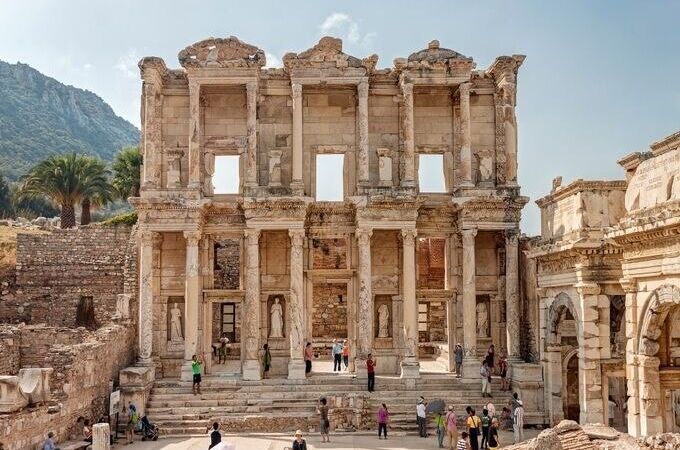
Ephesus brings Greek and Roman urbanism into view. Pergamon opens another Hellenistic and Roman chapter. Hattusa belongs to the Bronze Age Hittite world, while Istanbul allows Byzantine and Ottoman periods to overlap within a living metropolis.
Göbeklitepe stands much farther back.
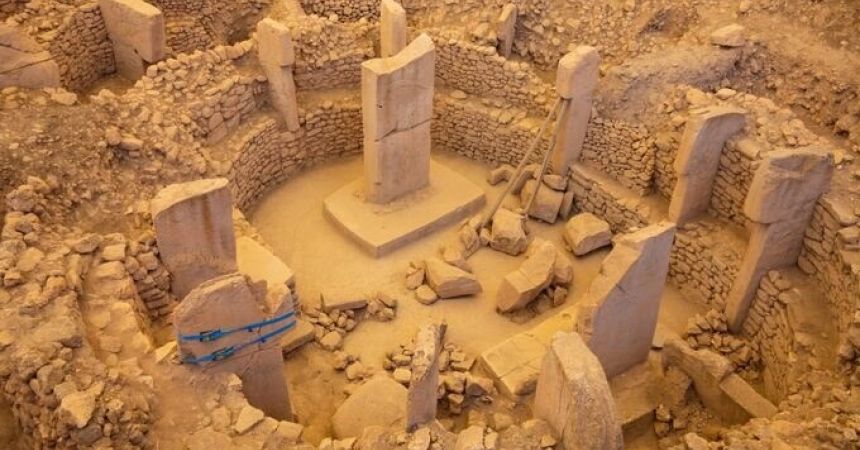
Its major monumental structures were created thousands of years before classical cities, Roman roads or Ottoman mosques, during the Pre-Pottery Neolithic. UNESCO describes monumental round-oval and rectangular structures with distinctive T-shaped limestone pillars, some reaching about 5.5 metres, associated with hunter-gatherer communities of Upper Mesopotamia.
That chronological distance matters because the site forces archaeologists and visitors alike to think about social complexity without reaching automatically for the institutions of later urban societies.
The builders did not need marble façades, written inscriptions or royal statues to create monumentality.
They had limestone, coordinated labour, sophisticated symbolic traditions and reasons strong enough to bring people together.
The T-Shaped Pillars Are the Site’s Main Visual Language
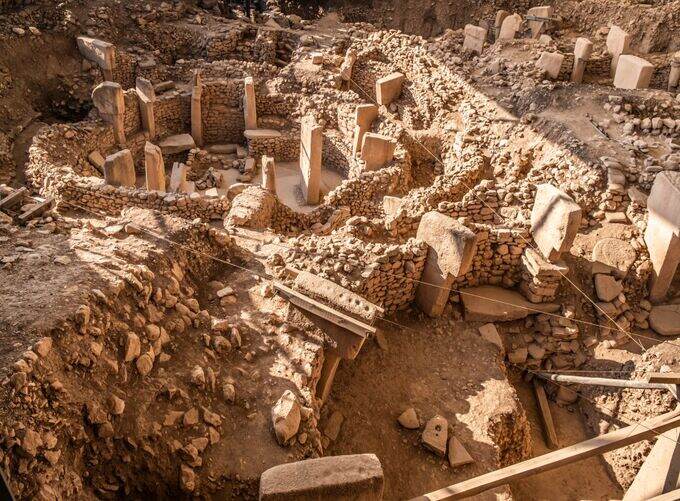
The most recognizable features at Göbeklitepe are the large T-shaped pillars.
At first glance, they may appear abstract, particularly from a distance. Look more carefully and some begin to suggest stylized human forms, with details interpreted as arms, hands, belts or garments appearing on certain examples.
Other surfaces contain carved animals, including wild species that belonged to the surrounding world of these Neolithic communities. UNESCO specifically highlights the rich animal imagery on the pillars as an important source for understanding beliefs and ways of life in prehistoric Upper Mesopotamia.
The interesting question is not simply identifying each creature correctly.
Ask why animals were being represented here at all.
These carvings were produced deliberately on monumental stones placed within carefully arranged structures. Whatever meanings they carried would have been intelligible to people who shared the symbolic world in which Göbeklitepe was created, even though much of that meaning is now inaccessible to us.
That gap between what we can see and what we can confidently explain is part of responsible archaeology.
“World’s Oldest Temple” Is Memorable but Too Simple
Göbeklitepe is frequently described in tourism language as the world's oldest temple.
That phrase is easy to remember and difficult to use responsibly.
The archaeological evidence clearly demonstrates monumental construction and strongly supports communal or ritual significance, but interpretations have developed as excavations and research have continued. UNESCO describes the structures as monumental communal buildings or enclosures and states that they were probably associated with social events and rituals, rather than presenting one rigid definition of their function.
This distinction does not make Göbeklitepe less important.
It makes it more interesting.
Archaeological sites rarely reveal themselves through one perfect label. Different structures may have served different purposes, while activities that modern societies separate into categories such as religious, social and communal may not have been divided in the same way by Neolithic people.
A strong visitor guide should therefore explain what is known without pretending that every unanswered question has already been resolved.
The Real Surprise Is the Scale of Cooperation
One of the most compelling things about Göbeklitepe is the human effort implied by its architecture.
Large limestone pillars had to be quarried, shaped, transported and positioned. Structures had to be planned, and groups of people had to coordinate the work. Some pillars were substantial enough that their creation clearly required more than one individual working casually whenever convenient.
That observation opens the site beyond the usual discussion of ritual.
Who organized labour?
How were participants supported while they worked?
What social relationships brought groups together?
How regularly were these places used?
Those questions take Göbeklitepe away from the simplistic image of isolated hunter-gatherers moving endlessly across an empty landscape and toward a more sophisticated understanding of Neolithic social networks.
Visitors interested in this deeper archaeological context can explore Göbeklitepe and Sanliurfa tours, where the site makes considerably more sense when interpreted alongside the wider prehistoric landscape and museum collections.
What You See at Göbeklitepe Is Only Part of the Archaeological Story
A visitor naturally experiences Göbeklitepe through the excavated areas visible today, but archaeology is always a partial window.
The UNESCO property covers a wider archaeological landscape than the few enclosures that dominate popular photography, while excavation and research have continued over time. The site was inscribed on the UNESCO World Heritage List in 2018, recognizing both the monumental architecture and its exceptional significance for understanding an early stage of human social development.
This is why travelers should resist imagining that they are viewing a complete Neolithic settlement laid open like Pompeii.
You are seeing archaeological evidence selected by preservation, excavation history and continuing research.
Some questions remain open because only archaeology can answer them, and archaeology takes time.
That incompleteness is not a weakness in the experience; it is part of what makes visiting an active archaeological landscape different from visiting a reconstructed historical attraction.
Read the Site in Layers Rather Than Searching for One Masterpiece
Göbeklitepe becomes more rewarding when the visitor stops searching for the equivalent of Ephesus's Library of Celsus.
Instead, look for relationships.
Notice the scale difference between central pillars and surrounding elements. Observe the circular or oval organization of several structures and how later architectural forms differ. Look for relief carving and consider which surfaces would have been visible to people occupying the enclosure.
Then step back and look at the landscape.
The site occupies elevated terrain in southeastern Anatolia rather than hiding in an enclosed valley. Geography therefore belongs to the archaeological experience because people deliberately chose this place, worked stone here and created monuments within a wider Upper Mesopotamian world.
The most important object is not necessarily one pillar.
It is the relationship between architecture, people and landscape.
Göbeklitepe, Hattusa and Ephesus Should Never Be Compared as “Better Ruins”
These three sites illustrate why ranking archaeological destinations is usually pointless.
| Site | Historical world | What the visitor is really reading | Best reason to include it |
|---|---|---|---|
| Göbeklitepe | Pre-Pottery Neolithic | Early monumentality, symbolism and communal organization | Deep prehistory |
| Hattusa | Bronze Age Hittite Empire | Fortified capital, state organization and written civilization | Ancient Anatolian state power |
| Ephesus | Greek/Roman world | Monumental urban life and classical city planning | Greco-Roman archaeology |
| Pergamon | Hellenistic/Roman | Royal capital, acropolis and intellectual culture | Hellenistic history |
Göbeklitepe may be older, but age does not make it “better” than Ephesus.
The sites answer different questions.
A traveler who understands that distinction is far less likely to suffer archaeological fatigue because each stop retains its own intellectual purpose.
Şanlıurfa Museum Can Make the Site Far Easier to Understand
Göbeklitepe should ideally not be experienced in isolation from Şanlıurfa.
The Şanlıurfa Archaeology Museum provides regional archaeological context that a short walk around the open-air site cannot reproduce. Material from the wider Neolithic landscape helps visitors understand that Göbeklitepe was not an inexplicable monument floating alone in prehistory.
This context matters increasingly as archaeological research across southeastern Turkey reveals a much broader Neolithic cultural landscape.
For a serious cultural traveler, I would therefore think of the journey as:
Şanlıurfa + museum + Göbeklitepe, rather than simply driving to the archaeological site, photographing several pillars and returning immediately.
The museum gives vocabulary to the site.
The site then gives physical scale to what you saw in the museum.
That relationship produces far more value than either experience rushed independently.
Do Not Turn Karahantepe Into a Footnote to Göbeklitepe
The wider region contains other Neolithic sites, including Karahantepe, which has attracted substantial attention through continuing archaeological work.
It should not simply be described as “another Göbeklitepe.”
That kind of comparison repeats the same problem found throughout tourism writing: one famous entity becomes the standard against which everything nearby is measured.
Göbeklitepe's owner intent is its own archaeology and significance. Karahantepe should retain separate semantic ownership, while broader regional initiatives such as Taş Tepeler belong to another level of archaeological interpretation.
For travelers, the useful lesson is that Göbeklitepe did not emerge within an archaeological vacuum.
Southeastern Anatolia was part of a far richer Neolithic landscape than one famous hill alone can represent.
A Half-Day Visit Works; a Full Cultural Day Works Better
The archaeological site itself does not require an entire day for most travelers.
The mistake is assuming that this means Göbeklitepe deserves only an hour.
Transportation from Şanlıurfa, the visitor facilities, walking the viewing route and allowing time to understand the enclosures all need to be considered. Rushing past every pillar because there are relatively few “attractions” misses the entire point.
A half-day framework can work comfortably for the archaeological site.
A stronger cultural day connects it with Şanlıurfa's museum or other city experiences without stacking several distant archaeological sites into one exhausting schedule.
Travelers following a southeastern Turkey heritage journey should also protect time for Şanlıurfa itself rather than sleeping there simply because it happens to be the nearest practical base.
Guided Interpretation Has Unusually High Value Here
Some archaeological sites remain visually legible without much explanation.
A Roman theatre looks like a theatre.
A city gate looks like an entrance.
Göbeklitepe is different because the extraordinary part of the site lies partly in ideas the stones do not communicate automatically.
Chronology matters.
The nature of Pre-Pottery Neolithic societies matters.
The distinction between evidence and interpretation matters.
A knowledgeable guide can therefore add considerable value, particularly when the explanation avoids the sensational claims that have accumulated around Göbeklitepe in popular culture.
What you want from interpretation is not more superlatives.
You want someone who can separate:
what archaeologists found, what researchers infer and what remains unknown.
That is real EEAT at an archaeological site.
Photography Is Easier Than Understanding, So Spend Time Without the Camera
The T-shaped pillars photograph well, particularly when animal reliefs are visible.
However, photography can reduce a visit to a hunt for whichever carving appeared in the article you read beforehand.
Spend some time simply looking across an enclosure.
Try to imagine the scale of quarrying and construction without modern machinery. Notice that these were deliberately organized spaces, then remember how far back in time you have traveled.
Göbeklitepe's strongest impact often arrives slowly.
It does not necessarily provide the immediate theatrical grandeur of walking through Ephesus or approaching a massive classical temple.
Its power lies in intellectual distance.
You are trying to understand people whose symbolic world is remote enough that the stones can only partially translate it for us.
Şanlıurfa Deserves to Be More Than Your Hotel Base
A common mistake is flying into the region, visiting Göbeklitepe and leaving almost immediately.
Şanlıurfa adds cultural depth to the journey through its archaeology, religious associations, markets and southeastern culinary identity. The city also provides a modern human context around a prehistoric site that might otherwise feel isolated from the region in which it exists.
This is particularly important for travelers who have already visited Istanbul, Cappadocia and western Turkey.
Southeastern Turkey changes the journey considerably.
The food, architecture, urban atmosphere and historical narratives shift, which means Göbeklitepe can function as the archaeological anchor for a much broader regional experience.
Travelers building that kind of route can consider Mesopotamian archaeology tour routes rather than treating the archaeological site as a standalone checklist excursion.
What Makes Göbeklitepe Important Is Not That It “Proved Everything Wrong”
Statements that Göbeklitepe “rewrote all of human history” are irresistible headlines and poor archaeological explanation.
The site is genuinely transformative because it provides exceptional evidence of monumental construction, symbolic expression and communal activity among early Neolithic communities at a remarkably early date. UNESCO's assessment places that achievement within one of humanity's major transitions from hunter-gatherer subsistence toward the emergence of farming societies.
That is already extraordinary.
It does not need exaggeration.
Archaeology advances because new evidence modifies, complicates or sometimes overturns earlier models. Göbeklitepe has played an enormously important role in that process, particularly by demonstrating that sophisticated communal monumentality cannot simply be positioned at the end of a neat sequence beginning with agriculture and permanent villages.
The site becomes more impressive when its complexity is respected rather than reduced to a slogan.
The Best Way to Leave Göbeklitepe Is With Better Questions
You are unlikely to leave knowing exactly what every enclosure meant.
Archaeologists do not possess that certainty either.
A good visit instead changes the quality of your questions.
Why did these communities invest so much labour here?
What did the animals mean?
How often did people gather?
How did building these structures affect social organization?
What relationship existed between communal architecture, subsistence and the wider transition toward settled life?
Those questions are why Göbeklitepe deserves a place on a serious Turkey itinerary.
Its greatest attraction is not a single carved pillar.
It is the realization that nearly twelve thousand years ago, people whose lives can appear extremely distant from our own were already creating architecture dense with planning, labour and symbolic meaning.
The stones survived.
Much of their language did not.
Understanding that difference is where the real Göbeklitepe experience begins.
Frequently Asked Questions About Göbeklitepe
1. How old is Göbeklitepe?
The monumental structures represented at Göbeklitepe date broadly to the Pre-Pottery Neolithic between about 9600 and 8200 BCE, placing important phases of the site more than eleven thousand years in the past.
2. Is Göbeklitepe really the world's oldest temple?
It is frequently described that way in tourism language, but archaeologists use more careful terminology. UNESCO refers to monumental communal structures probably connected with social and ritual activities, reflecting ongoing discussion about precisely how the enclosures functioned.
3. Who built Göbeklitepe?
The monumental structures were created by communities living in Upper Mesopotamia during the Pre-Pottery Neolithic. UNESCO characterizes the builders as hunter-gatherer groups living during the wider transition that eventually saw farming communities emerge across the region.
4. What are the T-shaped pillars at Göbeklitepe?
They are monumental limestone pillars that form one of the site's defining architectural features. Several contain reliefs of wild animals, while details on certain pillars have contributed to interpretations that some represented highly stylized anthropomorphic figures.
5. Why are animal carvings important at Göbeklitepe?
The carvings provide evidence of a sophisticated symbolic world rather than functioning merely as decoration. Wild animals appear prominently on several pillars, although the precise meanings those images carried for Neolithic communities remain open to archaeological interpretation.
6. Is Göbeklitepe older than Stonehenge?
Yes, by several millennia. The important point, however, is not using age as a competition between monuments; Göbeklitepe belongs to a very different prehistoric social and cultural context and should be understood on those terms.
7. How much time should I allow for Göbeklitepe?
Most travelers can experience the archaeological site within a half-day framework from Şanlıurfa, although rushing through it is counterproductive. Combining the site with strong museum interpretation usually provides considerably more archaeological understanding than treating it as a brief photographic stop.
8. Should I visit Şanlıurfa Archaeology Museum before Göbeklitepe?
It can be extremely useful because the museum provides wider prehistoric and regional context that makes the archaeological site easier to interpret. Travelers with enough time may gain more from treating the museum and Göbeklitepe as complementary parts of one archaeological experience.
9. Is Göbeklitepe a good destination for children?
It can be, particularly for children interested in archaeology, animals or ancient mysteries, but interpretation matters because much of the site's importance is conceptual rather than immediately visual. Explaining the extraordinary age and construction challenge can make the experience significantly more engaging.
10. Is Karahantepe the same as Göbeklitepe?
No. Karahantepe is another important Neolithic archaeological site in southeastern Turkey and should be understood through its own evidence rather than described simply as another version of Göbeklitepe. Both belong to a much wider prehistoric landscape under continuing research.
11. When did Göbeklitepe become a UNESCO World Heritage Site?
Göbeklitepe was inscribed on the UNESCO World Heritage List in 2018 under criteria recognizing its exceptional monumental architecture and importance for understanding a transformative period in early human history.
12. What is the biggest mistake when visiting Göbeklitepe?
The biggest mistake is arriving only to see something “old.” Göbeklitepe becomes far more meaningful when visitors understand the archaeological questions surrounding its monumental construction, symbolic carvings, communal organization and place within the profound social changes of the Neolithic period.

A travel professional specializing in tailor-made travel planning, guest experience management, and multi-destination tourism operations.
With over 23 years of experience in the travel industry, he designs and manages private and cultural tours for international travelers across Türkiye, Greece, Egypt, Jordan, Morocco, and other destinations.
He has strong expertise in both online and face-to-face guest communication, sales processes, and end-to-end travel operations.
Working closely with hotels, travel agencies, and local partners, he ensures smooth coordination and high-quality travel experiences at every stage of the journey.
His focus is on delivering personalized, reliable, and seamless travel experiences for international guests worldwide.