Can I Do Turkey and Greece Together? A Realistic Trip Planning Guide
Updated: August 2026
Turkey and Greece look like obvious travel partners on a map, and in many ways they are. Istanbul and Athens provide two very different introductions to the eastern Mediterranean, the Aegean connects rather than separates the countries culturally, and a journey can move from Cappadocia's volcanic landscape or Ephesus's ancient streets into the island world of Santorini, Mykonos or Crete without feeling as though two unrelated holidays have been stitched together.
The difficult part is not whether Turkey and Greece can be combined.
They can.
The real question is how much of each country should be included before the trip becomes a sequence of airports, ferry ports and hotel check-ins.
For most first-time travelers, around 12 to 14 days creates the most useful starting point. Ten days can work when the destination list is disciplined, while 16 to 18 days gives both countries enough space to develop their own character. An eight-day trip is possible, but only when you accept that you are seeing a carefully chosen introduction rather than the major highlights of both countries.
That distinction matters because Turkey and Greece both tempt travelers into the same planning mistake: once the famous names appear on a screen, everything begins to look essential.
It isn't.
A good combined trip is built as much around what you leave out as what you include.
The First Decision Is Not Turkey or Greece — It Is Depth or Variety
Before deciding whether to start in Istanbul or Athens, decide what you expect the journey to feel like.
Some travelers want contrast. They are happy moving from Istanbul's mosques and bazaars to Cappadocia's valleys, then crossing into Greece for Athens and Santorini. The appeal comes from changing landscapes, architecture, food and atmosphere several times during one holiday.
Others want immersion. They would rather spend four nights in Istanbul, explore Cappadocia properly, give Athens more than a passing visit and settle into one Greek island long enough to experience an evening after the day-trip crowds disappear.
Both approaches work, but they require different destination counts.
The most useful planning principle is surprisingly simple:
The shorter your trip, the more important it becomes to choose experiences rather than famous names.
If Santorini is essential, Mykonos may not need to be. If Cappadocia is non-negotiable, adding Pamukkale simply because it is famous may weaken the route. If ancient history is the central interest, Ephesus may deserve the days that would otherwise go to another island.
The two-country concept should determine the itinerary, not become an excuse to collect destinations.
How Many Days Do You Actually Need?
Instead of treating every duration as a smaller or larger version of the same trip, it is more realistic to ask what each additional block of time actually buys you.
| Total Time | Realistic Scope | What the Extra Time Buys | What I Would Avoid |
|---|---|---|---|
| 8 days | Istanbul + Athens, with limited expansion | Two strong capital experiences | Cappadocia plus multiple islands |
| 10 days | 2 Turkey bases + Athens, or Istanbul + Athens + one island | One major contrast beyond the cities | Trying to cover both countries comprehensively |
| 12 days | Istanbul + Cappadocia + Athens + one Greek island | Strong first combined journey | Multiple one-night stays |
| 14 days | 2–3 Turkey regions + Athens + one island | Better cultural/coastal balance | Adding islands simply because ferries exist |
| 16–18 days | Deeper Turkey + Athens + 1–2 Greek regions | Slower pace and more meaningful coast time | Treating extra days as permission to add everything |
This is not a fixed itinerary template. International flight times, domestic connections and personal travel pace can move the balance by a day or two.
What matters is the pattern: eight days demands selection; fourteen days permits balance; eighteen days allows depth.
Eight to Ten Days Works Only When You Stop Trying to “See Both Countries”
A short Turkey-and-Greece journey can be excellent, but the language used to plan it matters.
You are not “doing Turkey and Greece” in eight days.
You are selecting a few experiences from two very large countries.
Istanbul and Athens form the cleanest foundation because both are major international gateways and each can support several days without additional internal transportation. The combination also has enough contrast to justify crossing the border: Istanbul introduces Ottoman, Byzantine and contemporary Turkish layers, while Athens brings the classical Greek world into a modern Mediterranean capital.
With ten days, one additional destination becomes more realistic.
That could mean Cappadocia on the Turkish side or one Greek island after Athens. Trying to add both immediately creates a very different holiday because two internal travel segments have now entered an already short schedule.
This is the point where discipline produces a better trip than ambition.
Twelve to Fourteen Days Changes the Journey Completely
Around two weeks is where a combined Turkey and Greece trip starts feeling naturally proportioned rather than compressed.
Istanbul can receive the time it deserves. Cappadocia can be given multiple nights rather than being reduced to one balloon morning. Athens can become a destination rather than a transfer point, and one Greek island can provide a genuine change of pace.
Western Turkey can also enter the discussion, particularly for travelers interested in Ephesus and the Aegean.
The important word is or.
Cappadocia or a deeper western Turkey section may make more sense than automatically including both. Santorini or Mykonos may create a better island experience than moving through both simply because their names appear together in so many itineraries.
Travelers who prefer an organized framework can explore Turkey Greece combination tours, where the value should come from coordinating the cross-border logistics rather than simply increasing the number of stops.
Istanbul and Athens Make the Strongest Two-Country Backbone
If there are two destinations that naturally belong in most first combined journeys, they are Istanbul and Athens.
Not because they are capitals — Istanbul is not Turkey's capital — but because both function as cultural anchors.
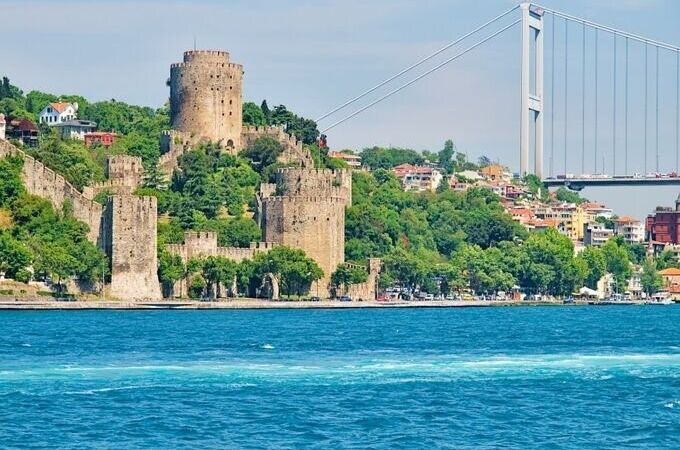
Istanbul contains Roman, Byzantine and Ottoman history within a city still shaped by the Bosphorus and contemporary Turkish life. Athens operates differently: the Acropolis dominates its historical identity, but neighborhoods, food, museums and the modern city become increasingly important once visitors move beyond the archaeological core.
They also solve a logistical problem.
Direct air travel between the two cities makes the international transition far simpler than many travelers initially assume.
This allows the itinerary to be designed as two coherent national chapters instead of an elaborate attempt to cross the Aegean one island at a time.
Cappadocia Is Worth Adding Only if You Give It Enough Space
Cappadocia is one of the strongest reasons to include Turkey in a combined trip because Greece offers nothing quite comparable.
That uniqueness is precisely why it deserves proper time.
Adding Cappadocia means another domestic flight or significant overland movement, airport transfers and at least several nights if the visit is to be resilient. Travelers who care strongly about hot-air ballooning should remember that flights depend on suitable weather conditions; arriving for one night and building the entire Cappadocia experience around one morning creates unnecessary risk.
The region also contains valleys, underground cities, rock-cut churches and distinctive accommodation, none of which should become background scenery for the balloon.
In a 12–14 day combined trip, Cappadocia can make excellent sense.
In an eight-day trip already containing Istanbul, Athens and an island, it usually represents a harder trade-off.
Ephesus Changes the Logic Because It Pulls You Toward the Aegean
Ephesus creates an entirely different Turkey-to-Greece route logic.
Travelers interested primarily in ancient history may find western Turkey particularly rewarding because Ephesus belongs naturally within the broader Aegean historical world. The experience also creates an interesting intellectual transition into Greece without requiring the two countries to be treated as interchangeable.
However, geographic closeness can be deceptive.
Travelers sometimes assume that reaching the Greek islands from Turkey must always be simpler than flying between major cities. In practice, ferry routes are seasonal, port-specific and dependent on the islands involved.
The itinerary should therefore be built around actual transport connections, not around the visual distance between two places on a map.
That single rule prevents many badly designed combined trips.
Flying Between Turkey and Greece Is Often Simpler Than Forcing a Ferry
The Aegean Sea makes ferries feel like the obvious romantic connection between Turkey and Greece.
Sometimes they are.
Sometimes they are the wrong tool.
Direct flights between Istanbul and Athens provide one of the cleanest ways to divide the trip. Regional flights can also support more complex itineraries, depending on the season and current schedules.
Ferries make more sense when the specific Turkish coastal base and Greek island have a practical operating connection and when that crossing supports the route you already wanted.
They should not be added simply to make the journey look more adventurous.
A ferry can be a beautiful part of a trip, but ports require check-in time, transfers and schedule awareness just as airports do. Seasonal routes can also change.
Good logistics are almost invisible when traveling.
Bad logistics become the holiday.
Do Not Plan a Bodrum-to-Athens Ferry That Does Not Exist
This is exactly where operational knowledge matters more than generic travel writing.
Travelers looking at the map may assume they can simply travel from Bodrum directly to Athens by ferry. That is not how the route works.
Bodrum has seasonal ferry relationships with nearby Greek islands, but there is no direct Bodrum–Athens ferry. A traveler determined to move through the islands would need a more complicated sequence, while flying or restructuring the route may be considerably more sensible.
The same principle applies elsewhere along the coast.
Never build a Turkey-and-Greece itinerary around an assumed ferry connection before checking whether that specific route operates during your travel period.
Geography suggests possibilities.
Schedules decide whether they are useful.
Santorini and Mykonos Should Not Automatically Travel as a Pair
Another planning habit worth breaking is the assumption that a first Greece trip must contain both Santorini and Mykonos.
They solve different travel desires.
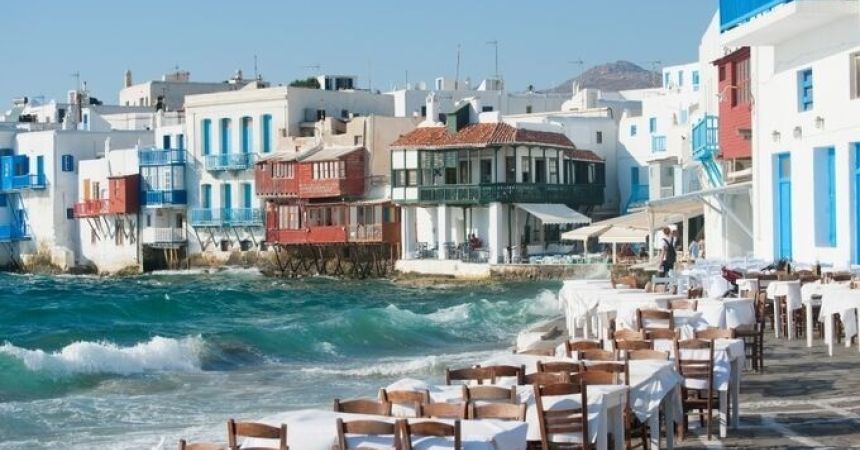
Santorini's caldera landscape, volcanic geography and villages create a highly distinctive visual experience. Mykonos offers another Cycladic environment with beaches, whitewashed settlements and a stronger association with nightlife and social energy.
A traveler with enough time may enjoy both.
A traveler combining two countries may gain more from choosing one and protecting several days elsewhere.
If the purpose of Greece is to introduce island life after an intensive Turkey section, one well-chosen island can provide stronger contrast than two islands experienced quickly.
This is especially true when every additional island requires another ferry, port transfer and hotel change.
Which Country Should Come First?
There is no universal Turkey-first rule, but the sequence can influence how the trip feels.
Starting in Turkey often works beautifully when the journey begins with Istanbul and perhaps Cappadocia or Ephesus, then shifts into Athens and finishes on a Greek island. The overall rhythm moves from intensive cultural exploration toward slower coastal time.
For many travelers, that feels naturally satisfying.
The reverse sequence can be equally logical when international flights, cruise schedules or personal plans favor Greece first. Someone beginning with the islands may enjoy moving toward the greater urban intensity of Istanbul at the end.
The sequence should therefore be determined by three things:
international flight efficiency, internal transport logic and the emotional pace you want at the end of the holiday.
Do not add an unnecessary flight merely to follow somebody else's preferred direction.
Build the Trip Around Transfer Cost, Not Just Hotel Nights
A four-night destination does not always consume four days.
A three-night destination does not necessarily provide three full days.
This distinction becomes particularly important on a two-country trip.
Consider a day that begins with checking out of a Cappadocia hotel, driving to the airport, flying via a suitable connection, collecting baggage, reaching another airport or port and finally checking into accommodation in Greece.
That calendar date belongs largely to transportation even if both hotels appear on the itinerary.
The practical planning unit should therefore be usable experience time.
If a destination receives two nights but only one usable day, ask whether it deserves the transfer required to reach it.
This simple calculation removes many unnecessary stops.

A travel professional specializing in tailor-made travel planning, guest experience management, and multi-destination tourism operations.
With over 23 years of experience in the travel industry, he designs and manages private and cultural tours for international travelers across Türkiye, Greece, Egypt, Jordan, Morocco, and other destinations.
He has strong expertise in both online and face-to-face guest communication, sales processes, and end-to-end travel operations.
Working closely with hotels, travel agencies, and local partners, he ensures smooth coordination and high-quality travel experiences at every stage of the journey.
His focus is on delivering personalized, reliable, and seamless travel experiences for international guests worldwide.