
How Many Days Do You Need for Turkey and Greece? 10, 14 or 18 Days
If you are planning Turkey and Greece in the same trip, 14 days is a very good starting point for most first-time visitors. If you want to include Istanbul, Cappadocia, Ephesus or Pamukkale, Athens and two Greek islands, 17–18 days is a much better fit.
Ten days can work too. But at ten days, the secret is not finding a clever way to squeeze everything in. It is knowing what to leave out.
That is where many Turkey and Greece itineraries go wrong.
On a map, the two countries look remarkably easy to combine. They share the Aegean Sea, Istanbul and Athens are well connected, and several Greek islands lie just off Turkey’s western coast.
But a good trip is not measured by the distance between two points on a map.
Every additional stop means packing, checking out, getting to an airport or port, waiting, traveling, collecting luggage, transferring again and checking into another hotel. A one-hour flight rarely takes only one hour out of your day.
After organizing trips in Turkey and the surrounding region since 1997, we have seen the same pattern many times: travelers usually enjoy Turkey and Greece far more when the itinerary is built around usable time, rather than around the maximum number of destinations that can technically fit into the calendar.
So, before deciding where to go, decide how much time you really have.
Turkey and Greece Trip Length at a Glance
| Time Available | What Realistically Fits | Overall Pace |
|---|---|---|
| 7–9 days | A very selective introduction to both countries | Very fast |
| 10 days | Istanbul + Cappadocia + Athens + one island | Fast but workable |
| 12 days | Similar route with more breathing room | Moderate |
| 14 days | Major highlights of both countries | Best balance |
| 17–18 days | Turkey highlights + Athens + two Greek islands | Comfortable |
| 21+ days | More regions or longer stays | Relaxed |
For most first-time visitors, 14 days offers the best balance.
But if your wish list reads something like Istanbul, Cappadocia, Ephesus, Pamukkale, Athens, Mykonos and Santorini, we would much rather have 17 or 18 days.
Here is why.
Is One Week Enough for Turkey and Greece?
A week is enough to say you have visited both Turkey and Greece. It is not really enough to experience the classic highlights of both.
With seven days, we would normally recommend either concentrating on one country or keeping the combination extremely simple.
Istanbul and Athens, for example, can make a fascinating one-week trip. Both cities deserve time, particularly if history, architecture and food are important to you.
The problem starts when the wish list grows.
Add Cappadocia and you introduce another flight and hotel. Add Santorini and there is another travel sector. Suddenly, a large percentage of your seven days is being spent moving between the places you came to experience.
If a week is all you have and visiting both countries matters to you, there is nothing wrong with keeping it simple.
Two memorable destinations are better than five hotel reservations.
Is 10 Days Enough for Turkey and Greece?
Yes. Ten days is enough for a focused Turkey and Greece trip, provided you treat it as a highlights journey rather than a complete tour of both countries.
For a first visit, something like this makes sense:
Istanbul → Cappadocia → Athens → one Greek island
Those four stops already give you four completely different experiences.
In Istanbul, you have the Byzantine and Ottoman heritage of the historic peninsula, with landmarks such as Hagia Sophia, the Blue Mosque and Topkapi Palace, alongside the Bosphorus, bazaars and everyday life of a city spread across Europe and Asia.
Then comes Cappadocia, where the landscape changes completely. The valleys, rock formations, underground cities and cave settlements make it unlike anywhere else on the trip. Many visitors also hope to take a hot-air balloon flight, although balloon operations always depend on weather conditions.
Crossing into Greece brings another change of atmosphere.
Athens gives you the Acropolis, Parthenon, Acropolis Museum, Ancient Agora and neighborhoods such as Plaka and Monastiraki.
Then, rather than trying to collect several islands, give yourself time for one.
For many first-time visitors that will be Santorini. For others, Mykonos will be the better match.
What we would not do is take those same ten days and try to turn them into:
Istanbul → Cappadocia → Ephesus → Pamukkale → Athens → Mykonos → Santorini
It can be made to fit on a spreadsheet.
That does not mean it will feel good on holiday.
A realistic 10-day balance
Think approximately:
5–6 days in Turkey
4–5 days in Greece
At this length, adding something usually means giving something else up.
If you add Ephesus, perhaps you choose not to visit a Greek island. If two Greek islands are essential, Cappadocia may have to wait for another trip.
That is not a compromise caused by poor planning.
It is often what good planning looks like.
What Can You Do With 12 Days?
Twelve days is an interesting middle ground.
Those extra two days make the journey noticeably easier, but you still need to make choices.
You could comfortably combine Istanbul, Cappadocia, Athens and one island, giving each destination a little more room.
Or, depending on your dates and connections, you may decide to introduce Ephesus.
The temptation, of course, is to use every extra day to add another destination.
We would resist that.
An additional night in Cappadocia can be more valuable than another hotel somewhere else. Three nights on Santorini feel very different from two. A proper day in Athens is worth more than arriving late and leaving the following morning.
One of the most useful lessons in multi-country travel is this:
More days do not always need to mean more places.
Sometimes they simply make the places already on your itinerary much more enjoyable.
Are 14 Days Enough for Turkey and Greece?
Yes. For many first-time travelers, 14 days is the sweet spot for a combined Turkey and Greece trip.
Two weeks gives you enough time to begin experiencing the countries rather than simply passing through them.
A strong 14-day framework might be:
Istanbul → Cappadocia → Ephesus → Athens → Santorini
There are plenty of variations. Depending on your interests, travel dates and connections, Pamukkale or Mykonos may enter the itinerary.
But this is also where we start watching the number of nights carefully.
A 14-day trip normally means only 13 hotel nights.
Imagine allocating them like this:
3 nights Istanbul
2 nights Cappadocia
2 nights around Ephesus
2 nights Athens
3 nights Santorini
That is already twelve nights.
There is only one night left.
And we still have not considered whether your international flight arrives in Istanbul early enough for the first day to be useful, or whether your departure from Greece removes most of the final day.
This is why fourteen days works so well when the itinerary remains disciplined.
You can see a great deal, but there is still a point where adding one more destination begins taking time away from everything else.
Why 17–18 Days Feels So Different
This is probably the most important distinction in the whole article.
Three or four additional days may not sound like much.
On the ground, they can transform the trip.
With 17–18 days, an itinerary such as:
Istanbul → Cappadocia → Ephesus/Pamukkale → Athens → Mykonos → Santorini
becomes much more comfortable.
Cappadocia no longer needs to feel like a quick stop between flights. Ephesus can be visited without immediately rushing onward. Athens gets the time it deserves. And adding a second Greek island does not automatically reduce both islands to short stays.
There is also room for something that disappears very quickly from over-planned itineraries:
time to do nothing.
You may want an afternoon in Istanbul without another museum reservation.
You may want to sit on a terrace in Cappadocia after touring the valleys.
You may discover a restaurant in Athens and decide to stay for another glass of wine.
And when you reach the islands, you may simply want to spend an afternoon by the sea rather than checking the departure time of tomorrow’s ferry.
Those moments rarely appear in an itinerary.
They are often the moments people remember.
That is why, when someone tells us they want the major Turkey highlights, Athens, Mykonos and Santorini, we are much more comfortable recommending 17–18 days than trying to squeeze the same list into two weeks.
The extra days do not simply buy more sightseeing.
They buy a better pace.
How Many Days Should You Spend in Turkey?
On a combined journey, around 6–9 days in Turkey works well for many first-time visitors.
The right number depends heavily on geography.
Turkey is much larger than it may appear when looking at a typical vacation itinerary.
Istanbul is in the northwest.
Cappadocia is in central Anatolia.
Ephesus lies near the Aegean coast.
Pamukkale is farther inland in southwestern Turkey.
These are separate regions, not neighboring attractions.
If you have only 4–5 days in Turkey, we would normally choose Istanbul plus one other major destination.
With 6–7 days, Istanbul, Cappadocia and Ephesus become more realistic.
With 8–9 days, you can begin considering Pamukkale as well, or simply stop shortening every stay in order to fit the next place.
For most first-time combined trips, we would protect enough time for Istanbul and Cappadocia first.
Ephesus is then a particularly strong addition for travelers interested in archaeology, Roman history and the ancient Mediterranean.
How Many Days Should You Spend in Greece?
Within a combined trip, 5–8 days in Greece is a useful starting range.
With around five days, we would generally recommend Athens plus one island.
With seven or eight days, Athens, Mykonos and Santorini become much more realistic, assuming the seasonal connections work for your dates.
One mistake we often see is treating Athens purely as a gateway to the islands.
It deserves more than that.
The Acropolis and Parthenon are obvious highlights, but Athens also has the Acropolis Museum, Ancient Agora, Plaka, Monastiraki and a modern city that feels very different once the day-trip crowds have gone.
The islands need time for a different reason.
If you stay two nights on an island, you usually have only one full day there.
You arrive on Day 1.
You have Day 2.
You leave on Day 3.
Three nights changes the experience because you suddenly have two full days.
That extra day can be the difference between feeling that you visited an island and feeling that you actually stayed there.
Should You Divide Your Time Equally Between Turkey and Greece?
No.
A combined Turkey and Greece holiday does not need to be divided mathematically.
Seven days Turkey + seven days Greece sounds neat on paper, but there is no reason it has to work that way.
If you want Istanbul, Cappadocia and Ephesus, but only Athens and Santorini in Greece, Turkey will naturally need more time.
If your priority is a shorter cultural tour in Turkey followed by Athens, Mykonos and Santorini, Greece may deserve the larger share.
For a 14-day trip, something around:
7–8 days Turkey + 6–7 days Greece
is a useful starting point.
For 17–18 days:
9–10 days Turkey + 7–8 days Greece
often works well.
But these are not rules.
A honeymoon should not necessarily have the same balance as an archaeology-focused trip. A family with children may value fewer hotel changes. A traveler who has already visited Istanbul may want to spend those days somewhere else entirely.
The itinerary should follow the traveler, not a formula.
Count Nights, Not Just Days
This is one of the simplest ways to tell whether an itinerary is realistic.
A 14-day trip usually means 13 nights.
If your flight lands in Istanbul at 6:30 PM, the first day is effectively an arrival day.
If your flight home leaves Athens at 10:00 AM on Day 14, the final day is effectively a departure day.
Your “14-day vacation” may therefore contain only 12 genuinely usable days.
Then subtract the days that include flights, ferries or longer road transfers.
Suddenly, the itinerary looks very different.
When comparing Turkey and Greece itineraries, do not look only at the number in the tour title.
Look at:
- how many nights you have;
- how many times you change hotels;
- how many full sightseeing days remain;
- how many days involve transportation.
Those numbers tell you much more about the real pace of the trip.
Every Extra Destination Costs More Than a Night
Suppose you decide to add Mykonos.
You are not simply adding “two nights in Mykonos.”
You are also adding the journey there.
That means checking out, reaching an airport or ferry port, waiting, traveling, arriving, transferring to the hotel and eventually repeating the process when you leave.
The same principle applies when adding Cappadocia, Ephesus, Pamukkale or Santorini.
This is why removing a single destination from an overloaded itinerary can improve far more than one day.
Suddenly, the destination before it gets another night.
The destination after it gets another night.
And one entire travel transition disappears.
That can improve three different parts of the holiday.
The best itinerary is rarely the one with the longest list of famous places.
It is the one where the places you chose were given enough time to become experiences rather than photographs.
Does Your Travel Style Change How Many Days You Need?
Absolutely.
Two people can both have fourteen days and need completely different trips.
If history and archaeology are your priorities
Give more time to Istanbul, Ephesus and Athens. You may enjoy one Greek island properly more than trying to visit two.
If landscapes and photography matter most
Cappadocia and Santorini deserve time. A longer stay also gives you more than one sunrise or sunset rather than a single chance dictated by your schedule.
If this is your honeymoon
Do less.
Seven hotels in fourteen days may look impressive before departure. By the fifth suitcase repack, it may feel less romantic.
If you are traveling as a family
Fewer hotel changes often matter more than adding another attraction. Three-night stays can make mornings and evenings noticeably easier, especially with younger travelers.
If you simply dislike rushing
Listen to that instinct.
If your ideal morning begins with breakfast rather than luggage outside the room, 17–21 days may suit you much better than ten or fourteen.
The real question is not only:
How many days do Turkey and Greece require?
It is also:
How many days do you need to enjoy Turkey and Greece in the way you like to travel?
Does the Time of Year Affect the Ideal Trip Length?
The season does not necessarily change the number of days you need, but it can change how those days should be used.
Spring and autumn are particularly attractive for cultural sightseeing in places such as Istanbul, Cappadocia, Ephesus and Athens, when conditions can be more comfortable for long days outdoors.
Summer naturally gives the Greek islands a larger role, but it also brings stronger demand and busier ports, airports and resorts.
Outside the main island season, transportation deserves more attention because ferry routes and frequencies can change.
This is one reason we would never build an October itinerary simply by copying a route that worked perfectly in July.
Cappadocia adds another consideration.
Hot-air balloon flights are weather-dependent. Staying longer in the region does not guarantee a flight, but a very short Cappadocia stay gives you less flexibility if weather affects your plans.
Your actual travel dates therefore matter almost as much as the number of days available.
For the separate question of route order, gateways and how to make the two-country journey flow efficiently, see our guide to How to Plan a Turkey and Greece Trip That Actually Flows.
Should You Visit Both Mykonos and Santorini?
If you have enough time, certainly.
But they should not automatically appear together on every itinerary.
For a 10-day Turkey and Greece trip, we would normally choose one island.
For 14 days, both may work if the Turkey side of the itinerary remains focused.
With 17–18 days, including both Mykonos and Santorini becomes much easier to justify.
The important point is not simply whether they can fit.
It is whether there is enough time to enjoy them once they do.
If adding a second island means reducing Istanbul, Cappadocia and Athens to a series of rushed overnight stays, we would question whether the trade is worthwhile.
Sometimes one island with three nights is far more rewarding than two islands with hurried stays.
What If You Want Both Ephesus and Pamukkale?
This is where we begin leaning toward 17–18 days.
Ephesus and Pamukkale are often grouped together when people plan western Turkey, but they are separate destinations and require real travel time.
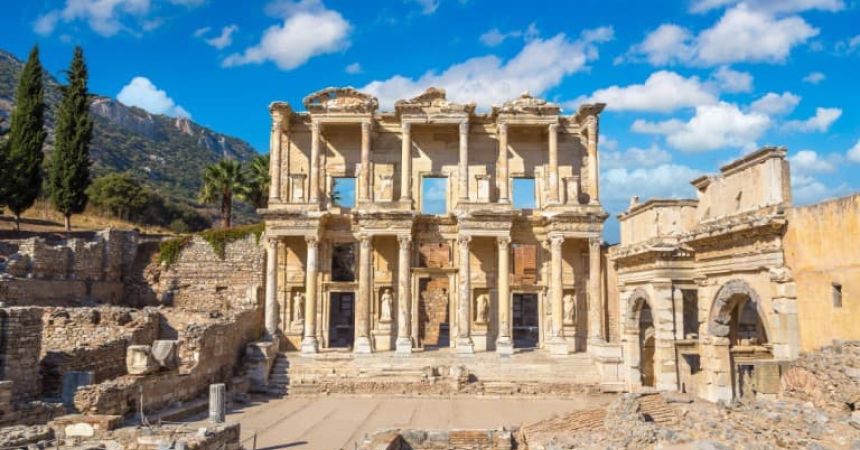
Ephesus is one of the great archaeological sites of the Mediterranean world, with the Library of Celsus, Great Theatre, Curetes Street and Terrace Houses among its highlights.
Pamukkale combines its famous white travertine terraces with Hierapolis, an important ancient city in its own right.
Both deserve to be experienced properly.
If your list already includes Istanbul, Cappadocia, Athens, Mykonos and Santorini, adding both Ephesus and Pamukkale is the point where a two-week itinerary begins to feel crowded.
Instead of asking which visit can be shortened, we would first ask a different question:
Can the trip be extended by three or four days?
Quite often, that is the better solution.
10, 14 or 18 Days: Which One Should You Choose?
If you want the shortest possible answer, it is this:
Choose 10 days if...
You have limited vacation time and are willing to focus on the essentials.
A sensible framework is:
Istanbul + Cappadocia + Athens + one Greek island
It will be an active trip, but it can work well.
Choose 14 days if...
This is your first trip and you want the best overall balance.
A possible framework is:
Istanbul + Cappadocia + Ephesus + Athens + Santorini
There is room for adjustment, but you still need to be selective.
Choose 17–18 days if...
Your wish list is longer and you do not want the entire trip dictated by the next departure.
Think:
Istanbul + Cappadocia + Ephesus/Pamukkale + Athens + Mykonos + Santorini
This is the range we prefer when travelers want the classic highlights of both countries.
Choose 21 days or more if...
You have the luxury of time.
You can add another region, spend longer on the islands, explore more of mainland Greece or Turkey, or simply slow the existing itinerary down.
And that final option is worth remembering.
More time does not have to mean more destinations.

So, What Is the Ideal Length for a First Turkey and Greece Trip?
For most first-time travelers, 14–18 days is the ideal range for a combined Turkey and Greece journey.
Fourteen days is enough for a well-designed highlights itinerary.
Seventeen or eighteen days is better if your priorities include several regions of Turkey plus Athens and two Greek islands.
If you have only ten days, do not abandon the idea. Just reduce the number of places.
If you have three weeks, resist the temptation to fill every extra day with another destination.
A useful way to think about it is:
10 days — choose carefully.
14 days — see the highlights.
17–18 days — see more without constantly rushing.
21+ days — slow down and go deeper.
And if you already have a list of places you absolutely want to see, work backward from that list.
For example:
Istanbul + Cappadocia + Athens + one island
→ 10–12 days
Istanbul + Cappadocia + Ephesus + Athens + Santorini
→ around 14 days
Istanbul + Cappadocia + Ephesus + Pamukkale + Athens + Mykonos + Santorini
→ 17–18 days
Could some of these trips be done faster?
Yes.
Would we recommend doing them faster?
Usually not.
Planning Your Turkey and Greece Journey
At Magnificent Travel, we have been organizing journeys in Turkey and the surrounding region since 1997.
That experience has taught us that combining Turkey and Greece successfully is not about putting the greatest number of destinations into the shortest possible itinerary.
It is about making the whole journey work.
The number of nights in each destination matters. So do arrival and departure times, domestic connections, hotel changes and the amount of time left when you actually reach the places you came to see.
That is why we prefer to begin with three things:
your travel dates, the places that genuinely matter to you, and the pace at which you like to travel.
From there, the right number of days usually becomes much easier to see.
If you already know how long you have, explore our Turkey & Greece Tours to compare shorter highlight trips with more comprehensive itineraries.
If you are still deciding whether the two countries make sense together, read Can I Do Turkey and Greece Together? A Realistic Trip Planning Guide.
And if your dates and duration are already fixed but you are unsure about the order of the journey, How to Plan a Turkey and Greece Trip That Actually Flows is the better next read.
The goal is not to return home saying you managed to fit everything in.
It is to return home feeling that you actually had time to be there.
Frequently Asked Questions
1. How many days do you need for Turkey and Greece?
For most first-time travelers, 14 days is a good starting point, while 17–18 days gives you a noticeably more comfortable Turkey and Greece trip. Ten days can still work if you focus on Istanbul, Cappadocia, Athens and one Greek island rather than trying to include every major destination in both countries.
2. Is 10 days enough for Turkey and Greece?
Yes. Ten days is enough for a focused highlights trip, but you need to keep the destination list under control. Istanbul, Cappadocia, Athens and one Greek island can work well. Adding Ephesus, Pamukkale, Mykonos and Santorini to the same ten days would create too many transfers and very little time to settle into each destination.
3. Are 14 days enough for Turkey and Greece?
Yes. Fourteen days is one of the best trip lengths for first-time visitors to Turkey and Greece. It gives you enough time to combine major cultural destinations with a Greek island stay without making every second day a transfer. Istanbul, Cappadocia, Ephesus, Athens and Santorini form one realistic two-week framework.
4. Is 18 days enough for Turkey and Greece?
Yes. Seventeen to eighteen days is an excellent duration for a more complete first journey. It creates enough room for Istanbul, Cappadocia, Ephesus or Pamukkale, Athens and two Greek islands such as Mykonos and Santorini, while allowing longer stays and fewer rushed arrivals and departures.
5. Can I visit Turkey and Greece in one week?
You can, but one week is too short for an extensive tour of both countries. If seven days is your limit, consider a simple combination such as Istanbul and Athens rather than attempting several regions and islands. Keeping the route focused will give you substantially more actual sightseeing time and fewer hours in transit.
6. How should I split two weeks between Turkey and Greece?
A useful starting point is around seven to eight days in Turkey and six to seven days in Greece, but an equal split is not necessary. Your interests should decide the balance. Istanbul, Cappadocia and Ephesus require more Turkey time, while Athens combined with Mykonos and Santorini may justify allocating more nights to Greece.
7. How many days should I spend in Turkey on a combined Turkey and Greece trip?
For most first-time visitors, six to nine days in Turkey is a useful range. Around six days can cover Istanbul and Cappadocia with careful planning. Seven to nine days gives you more freedom to include Ephesus or Pamukkale, or simply spend longer in the main destinations without feeling that you are constantly moving.
8. How many days should I spend in Greece when combining it with Turkey?
Allow approximately five to eight days in Greece within a combined journey. Five days is suitable for Athens and one island. Seven or eight days makes Athens plus two islands much more comfortable. Remember that changing islands also uses travel time, so the number of hotel nights matters as much as the number of destinations.
9. Can I see Istanbul, Cappadocia, Athens and Santorini in 10 days?
Yes. Istanbul, Cappadocia, Athens and Santorini can form a realistic 10-day Turkey and Greece itinerary if the connections work well for your dates. The pace will still be active, but the route gives you history, culture, landscapes and island time without trying to fit too many geographically separate destinations into a short holiday.
10. Can I visit Istanbul, Cappadocia, Ephesus, Athens, Mykonos and Santorini in 14 days?
It is possible, but six major destinations in fourteen days creates a fairly active itinerary with several hotel changes and travel sectors. Travelers who enjoy a fast pace may be comfortable with it. If you prefer free afternoons, longer stays and less packing, 17–18 days—or removing one destination—would normally produce a better journey.
11. How many days do I need if I want to visit both Mykonos and Santorini?
If your journey also includes major Turkey destinations, around 14 days is the minimum range where both islands begin to make sense, while 17–18 days is more comfortable. With only ten days in total, choosing either Mykonos or Santorini generally gives you a better island experience than trying to include both.
12. Is it better to spend more days in Turkey or Greece?
There is no universal answer. The balance should reflect the places you actually want to experience. Turkey may require more days if your route includes Istanbul, Cappadocia, Ephesus and Pamukkale. Greece may need a larger share if you want Athens plus several islands. A combined trip does not need to be divided equally.
13. How many nights should I stay in Cappadocia?
For most combined Turkey and Greece trips, two to three nights in Cappadocia works well. Two nights can be sufficient when time is limited, while three provides a more relaxed stay and additional flexibility. If a hot-air balloon flight is important to you, remember that balloon operations remain weather-dependent and cannot be guaranteed.
14. How many nights should I spend on a Greek island?
Three nights is often a much better island stay than two. With two nights, arrival and departure leave you with only one complete day. Three nights gives you two full days for beaches, villages, sightseeing, restaurants or simply relaxing. This becomes particularly important on a trip that already includes several busy cultural destinations.
15. Do travel days count when planning a Turkey and Greece itinerary?
Yes, and failing to count travel days is one of the easiest ways to create an unrealistic itinerary. A short flight or ferry still involves hotel checkout, transfers, waiting, boarding, the journey itself, arrival and another hotel transfer. Always evaluate how many full destination days remain after those movements are included.
16. Should I visit Ephesus and Pamukkale on the same Turkey and Greece trip?
Yes, both can be included, particularly on a longer itinerary. If you also want Istanbul, Cappadocia, Athens, Mykonos and Santorini, however, 17–18 days is much more comfortable than 14. Ephesus and Pamukkale are separate destinations, and each deserves enough time rather than being treated simply as stops between other places.
17. Is 14 days or 18 days better for Turkey and Greece?
Fourteen days is enough; 17–18 days is better if your schedule allows it. Two weeks works very well when the itinerary is selective. The extra three or four days become valuable when you want Ephesus or Pamukkale as well as Athens and two Greek islands, because they reduce short stays and repeated travel days.
18. What is the ideal length for a first Turkey and Greece trip?
For most first-time visitors, 14–18 days is the ideal range. Fourteen days provides a strong introduction to both countries, while 17–18 days allows a fuller itinerary at a more comfortable pace. Travelers with only ten days can still combine the countries successfully by limiting themselves to fewer, carefully chosen destinations.

A travel professional specializing in tailor-made travel planning, guest experience management, and multi-destination tourism operations.
With over 23 years of experience in the travel industry, he designs and manages private and cultural tours for international travelers across Türkiye, Greece, Egypt, Jordan, Morocco, and other destinations.
He has strong expertise in both online and face-to-face guest communication, sales processes, and end-to-end travel operations.
Working closely with hotels, travel agencies, and local partners, he ensures smooth coordination and high-quality travel experiences at every stage of the journey.
His focus is on delivering personalized, reliable, and seamless travel experiences for international guests worldwide.
