Aswan Deserves More Than the Time Left Over After Luxor
Updated: August 2026
Aswan has a problem that Luxor rarely encounters.
It does not look sufficiently busy on paper.
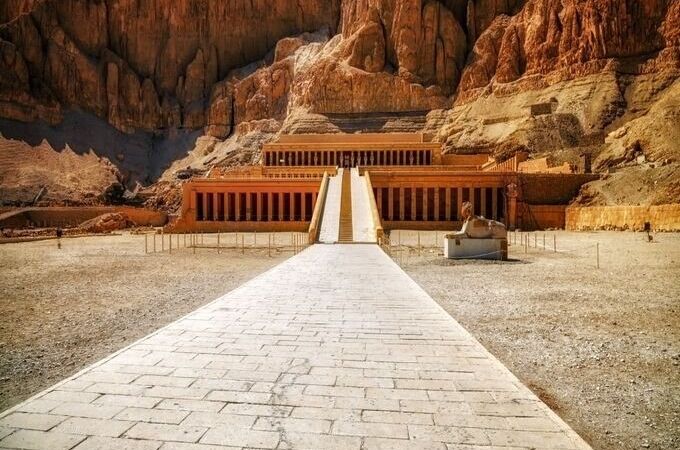
Put the two destinations beside each other in an itinerary and Luxor quickly fills the page with archaeological names. Karnak. Valley of the Kings. Luxor Temple. Hatshepsut. Another temple can always be added if the schedule still contains an unoccupied afternoon.
Then you reach Aswan.
There is Philae, the Nile, Elephantine Island, Nubian heritage, the Unfinished Obelisk and several other places of interest, but the list can appear less formidable. Abu Simbel is frequently placed beneath Aswan too, although it is a substantial journey south rather than another attraction around the corner.
The natural reaction is understandable.
Perhaps Aswan needs only one night.
Sometimes it does.
But reducing Aswan according to the number of famous monuments misses what the destination contributes to an Egypt journey. Aswan changes the pace, geography and cultural perspective of the trip, particularly after several intensive days of archaeological sightseeing.
The real planning question is therefore not how many attractions you can fit into Aswan.
It is how much time you need before Aswan begins to feel like Aswan rather than somewhere you slept between a cruise and Abu Simbel.
Aswan Is Easy to Underestimate Before You Arrive
Some destinations sell themselves before you have researched them.
Most travelers considering Egypt already recognize the Pyramids of Giza. Many know that Luxor is filled with temples and tombs. Abu Simbel has two enormous rock-cut temples whose photographs tend to settle the argument quickly.
Aswan is less immediate.
Its value is spread across the Nile landscape, archaeological sites, islands, Nubian cultural context and a noticeably different rhythm from the country's more intensive sightseeing destinations.
That can make it vulnerable during itinerary editing.
When a fourteen-day trip becomes twelve days, Aswan often loses a night because removing one appears less consequential than cutting Cairo or Luxor.
This can be the right decision.
But it should be made with an understanding of what is disappearing.
You are not merely removing another attraction.
You may be removing the only part of the journey that was not asking you to spend every available hour pursuing the next major monument.
Aswan Loses the Attraction-Count Competition. That Is Not the Point.
If your preferred method of evaluating destinations is counting internationally famous archaeological sites, Luxor wins.
Comfortably.
That does not make Aswan an inferior version of Luxor because it was never trying to perform the same job.
Luxor rewards archaeological concentration. A traveler can move through different periods of ancient Egyptian history while visiting major temples, royal tombs and monumental landscapes within a relatively concentrated region.
Aswan opens the journey in another direction.
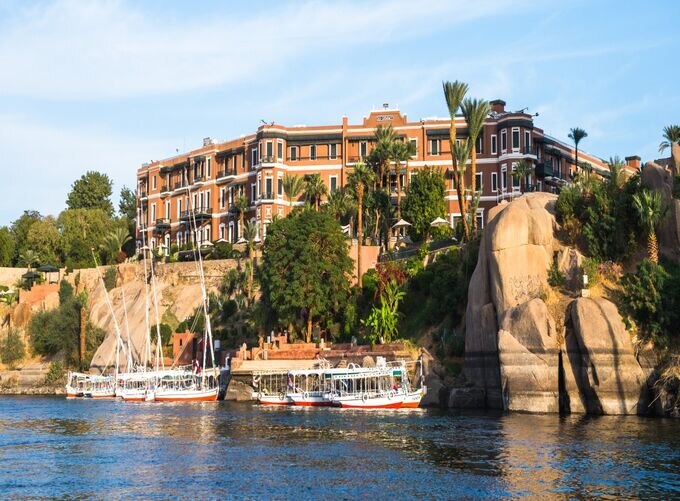
The Nile becomes more visually dominant. Islands interrupt the river. Granite formations shape the landscape. Nubian history and contemporary culture become much more relevant to understanding where you are.
The further south you travel, the less useful it becomes to think of Egypt as one continuous cultural landscape.
That difference is precisely why Aswan belongs in many itineraries.
You do not travel there to obtain a smaller collection of Luxor's experiences.
You go because it changes the conversation.
Philae Makes the Nile Part of the Arrival
Philae is one of Aswan's major archaeological experiences, but its importance to the destination is not simply another temple to tick off.
The setting matters.
The temple complex was relocated to Agilkia Island as part of the international campaign to protect Nubian monuments threatened by changing water levels following the construction of the Aswan High Dam.
That modern rescue history creates an unusual layer around an ancient site.
Then there is the approach itself.
Reaching an island temple by boat makes the Nile part of the experience rather than scenery visible through a vehicle window. This relationship between water, islands and archaeology feels particularly appropriate in Aswan, where the river repeatedly becomes part of how the destination is experienced.
There is plenty more to say about Philae's history, architecture and religious importance.
We do not need to say all of it here.
For the traveler deciding whether Aswan deserves time, the important point is that Philae does not feel like an archaeological leftover added after Luxor.
It belongs to a different landscape.
The Nile Stops Behaving Like Background Scenery
The Nile appears throughout an Egypt journey.
You cross it, drive beside it, fly over it and perhaps spend several nights cruising along it.
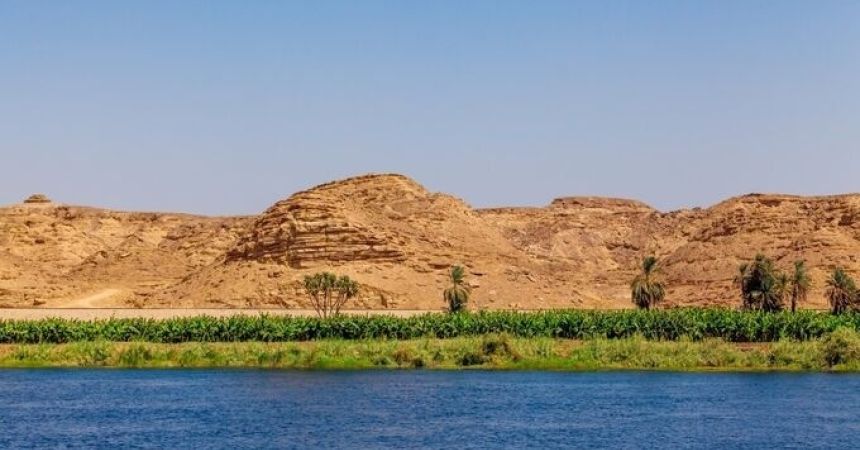
In Aswan, however, the river can become the destination's organizing feature.
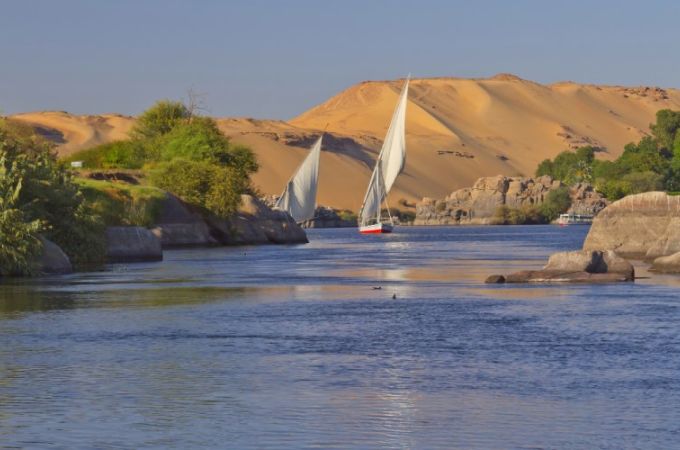
Islands, rocky outcrops, boats and opposing banks break the water into a landscape that encourages you to look rather than simply move.
This is why a felucca experience in Aswan can contribute something that sounds unimpressive when reduced to an itinerary line.
“Felucca sailing.”
Two words.
Not exactly a match for “Valley of the Kings.”
Yet travel is full of experiences whose value disappears when written as bullet points. Time on the Nile without a major monument waiting at the end can be one of them.
A good Aswan stay leaves room for that distinction.
Otherwise, the city becomes another place where the river is visible while you hurry somewhere else.
Nubian Culture Is Not a Decorative Addition to Aswan
“Nubian village” is frequently inserted into itineraries almost as though it were a themed attraction.
That framing deserves more care.
Nubian culture did not develop for the benefit of travelers looking for colorful photographs. Nubian communities have their own histories, languages, traditions, architecture, food and relationships with the Nile Valley that long predate modern tourism.
This matters particularly around Aswan because the destination sits within a geographical and cultural context that is noticeably different from Cairo or Luxor.
Travelers do not need to become specialists in Nubian history before arriving.
They should, however, resist treating Nubian identity as decoration around a conventional Egyptian sightseeing program.
A thoughtful cultural encounter can add considerably more to an Aswan stay than another rushed stop inserted because there was space before dinner.
The difference is partly about time.
Culture is difficult to encounter meaningfully when the itinerary gives everything twenty minutes.
One Night in Aswan Often Means Less Than It Sounds
Hotel-night mathematics causes a remarkable amount of travel confusion.
Imagine arriving in Aswan late afternoon.
You check in, have dinner and sleep.
The next morning you leave.
Your booking says:
1 night in Aswan.
Your experience says:
almost no Aswan.
Now imagine arriving early enough for meaningful sightseeing, staying overnight and departing the following afternoon.
Same number of hotel nights.
Completely different trip.
This is why we should stop treating “nights” as though they were standardized units of destination experience.
Arrival time matters.
Departure time matters.
Cruise embarkation matters.
Abu Simbel matters enormously.
The correct question is:
How many usable mornings and afternoons do I actually have?
Once that is answered, the hotel-night count becomes much more informative.
What Does an Aswan Booking Actually Give You?
This is not a prescription because flight, cruise and transfer schedules vary. It is a way to expose the difference between accommodation nights and destination time.
| What the Booking Says | What Could Be Happening | What It Means for Aswan |
|---|---|---|
| 1 night | Late arrival followed by morning departure | Potentially little meaningful Aswan time |
| 2 nights | Arrival plus one largely usable day | Can work well for a focused stay |
| 3 nights | Aswan sightseeing plus Abu Simbel | Often provides a more comfortable balance |
| Cruise + 1 hotel night | Embarkation/disembarkation consumes part of the schedule | Cruise presence should not automatically be counted as Aswan sightseeing |
| 3+ nights without Abu Simbel | More time for Nile and cultural experiences | Better suited to travelers deliberately choosing a slower pace |
The table is intentionally conditional.
There is no universal rule that Aswan requires exactly two nights or exactly three.
A well-timed two-night stay can provide more usable Aswan than a badly structured three-night booking.
Two Nights Is Where Aswan Often Begins to Make Sense
For many first-time travelers, two properly scheduled nights can provide a useful Aswan experience.
The phrase properly scheduled is doing important work.
If arrival and departure allow enough usable time, two nights can accommodate significant sightseeing without requiring the destination to become an extended stay.
This suits travelers whose overall Egypt itinerary is relatively compact and who want Aswan to provide a meaningful southern component without taking too much time from Cairo, Luxor or other priorities.
But two nights become much tighter once Abu Simbel enters the plan.
That is where travelers frequently miscalculate.
They see two Aswan nights and imagine two relaxed Aswan days.
The itinerary sees transfers, hotel check-in, an excursion and perhaps a cruise schedule.
Both are technically looking at the same booking.
Only one has done the arithmetic.
Abu Simbel Creates Aswan's Biggest Scheduling Illusion
Abu Simbel is strongly associated with Aswan because Aswan commonly functions as the gateway for visiting it.
That does not make Abu Simbel part of Aswan.
The temples lie roughly 280 kilometers south of Aswan, close to Egypt's border with Sudan. Visiting them therefore requires meaningful travel time, whether the journey is arranged overland or by air.
This distinction is crucial.
Suppose you book three nights in Aswan and devote a substantial portion of one day to Abu Simbel. You have not experienced three full days in Aswan.
You have used Aswan as both a destination and a logistical base for another major destination.
There is nothing wrong with that.
Abu Simbel can be one of the great experiences of an Egypt journey.
The mistake is pretending it costs no time.
When we structure Aswan Tours, the useful question is therefore not simply whether Abu Simbel fits.
Almost anything can be made to fit if the itinerary is squeezed hard enough.
The better question is what remains of Aswan after it does.
Three Nights Is Not Too Much If You Know Why You Added the Third
A third night can look indulgent in a fast-moving Egypt itinerary.
Sometimes it is unnecessary.
If you have limited travel time, are not visiting Abu Simbel and prefer intensive sightseeing, those hours may genuinely be more valuable somewhere else.
For another traveler, the third night solves the trip.
It allows Abu Simbel and Aswan to coexist without making every hour compete. It can create room for a less structured Nile experience or allow the itinerary to absorb awkward arrival and departure times.
There is an important difference between slow travel and unused time.
Slow travel has a purpose.
Unused time exists because nobody planned properly.
Aswan benefits from the former, but that does not mean we automatically add nights and call the itinerary relaxed.
Every additional night still needs to earn its place.
A Cruise Night Is Not Automatically an Aswan Night
This is one of the most common counting errors in Luxor–Aswan itineraries.
A Nile cruise itinerary may mention Aswan on the day of embarkation, during excursions or when the cruise ends.
That does not necessarily mean the traveler has received a complete Aswan experience.
Cruise schedules have their own operational logic. Embarkation, meals, excursions, sailing arrangements and disembarkation all influence how much usable time exists.
Therefore:
“The cruise includes Aswan”
and
“I have enough time in Aswan”
are not interchangeable statements.
Travelers considering Nile Cruise Trips should examine what the cruise actually includes and when those experiences happen before deciding whether an additional hotel night is unnecessary.
The same principle applies at Luxor.
A destination appearing on a cruise itinerary does not automatically mean every experience associated with that destination has been covered.
Before the Cruise and After the Cruise Are Different Decisions
Where an Aswan hotel stay sits in relation to the cruise can change its purpose.
A pre-cruise night may provide protection against tight international or domestic flight connections while creating time for sightseeing before embarkation.
A post-cruise stay can prevent the final cruise day from becoming an immediate sequence of disembarkation, transfer and departure.
Neither arrangement is inherently superior.
The right choice depends on cruise direction, flight schedule and what you want to do in Aswan.
This is exactly the kind of itinerary detail that disappears when a trip is summarized as:
Cairo – Luxor – Nile Cruise – Aswan – Cairo
The route looks beautifully simple.
The clock may have other opinions.
Good planning happens in the spaces between those destination names.
You Can Visit Aswan Without Going to Abu Simbel
Yes, and this distinction is worth making clearly.
Abu Simbel is not a qualification exam that determines whether you have completed Aswan correctly.
A traveler can spend meaningful time around Aswan, experience Philae and the Nile landscape, engage with Nubian cultural context and leave without traveling farther south.
Whether that is the right choice depends on the rest of the itinerary.
For travelers with limited time, removing Abu Simbel may protect the quality of the Aswan stay.
For travelers fascinated by monumental ancient Egypt, doing the opposite may make sense: Abu Simbel becomes a priority and Aswan's schedule is built around it.
Neither decision is universally correct.
What matters is recognizing that they are two decisions, not one.
The Unfinished Obelisk Is Interesting for What Never Happened
Egypt's famous monuments usually impress us because somebody completed them.
The Unfinished Obelisk reverses the logic.
Its importance lies partly in the fact that it remained attached to the bedrock, offering an unusual perspective on ancient stone-working processes.
For travelers who have already spent days looking at completed temples and monumental architecture, this can be surprisingly useful context.
You begin to think about production rather than only finished results.
Where did enormous pieces of stone come from?
What did working at this scale involve?
What happens when a monumental project goes wrong?
Again, Aswan's value appears through contrast.
The site does not need to compete visually with Karnak.
It helps explain a different part of the world that produced places such as Karnak.
Elephantine Makes More Sense When You Stop Expecting a Headline Attraction
Elephantine Island has layers of archaeological and historical significance, but its role within an Aswan stay is different from that of Egypt's most immediately spectacular monuments.
This is precisely where travel style matters.
A traveler who wants every stop to deliver instant visual drama may prefer to concentrate time elsewhere.
Someone interested in understanding Aswan as a historical Nile settlement rather than merely a base for excursions may find the island much more rewarding.
Not every important place has to shout.
That principle is particularly relevant in Aswan, where the destination becomes stronger once you stop forcing every hour to compete for the title of “trip highlight.”
Do You Need Aswan If You Have Already Seen Luxor?
If your only objective is accumulating major ancient monuments, you could reasonably give Luxor greater priority.
But that question defines Egypt rather narrowly.
Luxor and Aswan complement one another because they do not feel the same.
Luxor can sustain an extraordinary density of archaeological sightseeing. Aswan introduces a different Nile environment and stronger Nubian context while giving the journey a chance to change pace.
One does not complete the other.
Nor does visiting Luxor make Aswan redundant.
A traveler who finishes Luxor thinking, “Excellent, I would like another three days exactly like that,” may not value Aswan for the same reasons as someone thinking, “That was extraordinary; now I would like the trip to breathe.”
Both reactions are perfectly reasonable.

A travel professional specializing in tailor-made travel planning, guest experience management, and multi-destination tourism operations.
With over 23 years of experience in the travel industry, he designs and manages private and cultural tours for international travelers across Türkiye, Greece, Egypt, Jordan, Morocco, and other destinations.
He has strong expertise in both online and face-to-face guest communication, sales processes, and end-to-end travel operations.
Working closely with hotels, travel agencies, and local partners, he ensures smooth coordination and high-quality travel experiences at every stage of the journey.
His focus is on delivering personalized, reliable, and seamless travel experiences for international guests worldwide.