Athens & Acropolis: How to Experience the Heart of Ancient Athens
- Home
- Travel Guides for Better-Planned Trips
- Greece
- Athens & Acropolis: How to Experience the Heart of Ancient Athens
Athens & Acropolis: How to Experience the Heart of Ancient Athens
Updated: August 2026
The Acropolis is so familiar before you reach Athens that it is easy to underestimate how different the experience feels in person. The Parthenon has appeared in textbooks, films, advertisements and travel photographs for generations, yet the moment that stays with many visitors is not simply seeing its columns. It is realizing how deliberately the entire complex occupies the landscape above Athens and how many layers of the ancient city remain visible around it.
For a first visit, the most useful way to think about the Acropolis is not as a monument you go upstairs to photograph and then leave. It is an archaeological landscape containing several important structures, connected to sanctuaries and theaters on its slopes and made considerably easier to understand by the collections of the Acropolis Museum below.
Most travelers need roughly 1½ to 2½ hours for the Acropolis itself, depending on crowds, walking pace and interest in archaeology, while combining the site with the Acropolis Museum creates a much more substantial half-day experience. Trying to compress both between several other major archaeological visits can be done, but it often reduces one of Europe's most significant historical sites to a sightseeing obligation.
Athens rewards a different approach: give the Acropolis enough time to become the center of the day rather than another item competing for it.
Before You Look at the Parthenon, Look at Where You Are Standing
The first thing the Acropolis explains is geography.
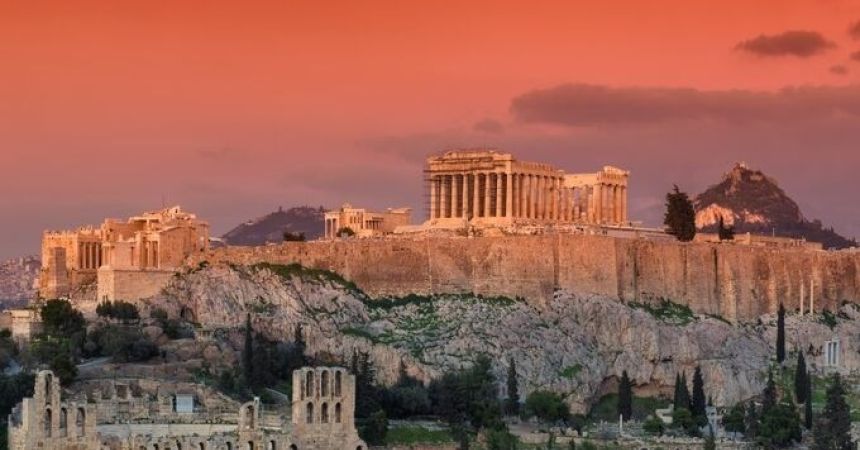
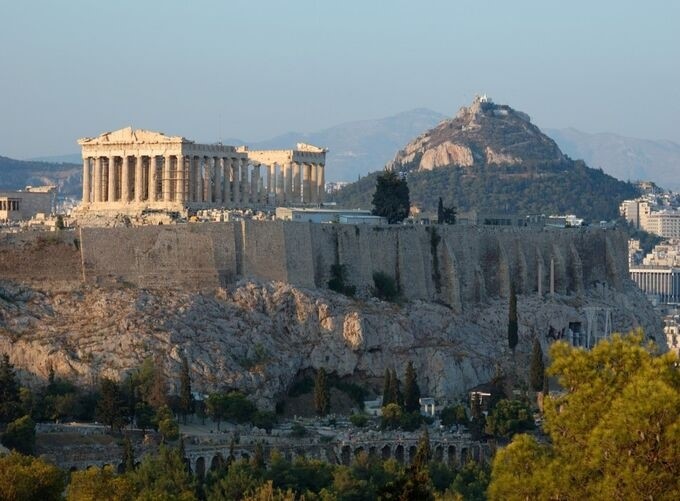
Its rocky plateau rises above central Athens, which is precisely why it carried such symbolic and strategic importance through different periods of the city's history. From the summit, the relationship between ancient monuments and modern Athens becomes far easier to grasp than it appears on a street map.
This perspective is useful because travelers often arrive thinking of the Acropolis and Parthenon as interchangeable terms.
They are not.
The Acropolis is the fortified hill and monumental complex. The Parthenon is its most famous temple, dedicated to Athena and constructed during the fifth century BCE as part of the extraordinary building program associated with Periclean Athens.
Once that distinction is understood, the visit changes. Instead of walking toward one building, you begin reading the hill as a collection of monuments that communicated religion, civic identity, power and the city's relationship with its patron goddess.
The Entrance Was Part of the Statement
Approaching the summit through the Propylaea helps explain why ancient architecture should be experienced in sequence rather than only as isolated structures.
The monumental gateway was not merely a practical entrance. Its scale prepared visitors for the sacred precinct beyond, controlling the transition from the approach to the summit.
Nearby stands the compact Temple of Athena Nike, positioned dramatically near the edge of the Acropolis. Its dimensions are modest compared with the Parthenon, yet its location gives it visual importance far beyond its size.
This is an excellent example of why rushing toward the largest monument weakens the visit.
The Acropolis was conceived through relationships between buildings, movement, topography and sightlines. Spending a few moments noticing those relationships provides more understanding than simply photographing every named structure.
The Parthenon Makes More Sense When You Stop Expecting a Complete Temple
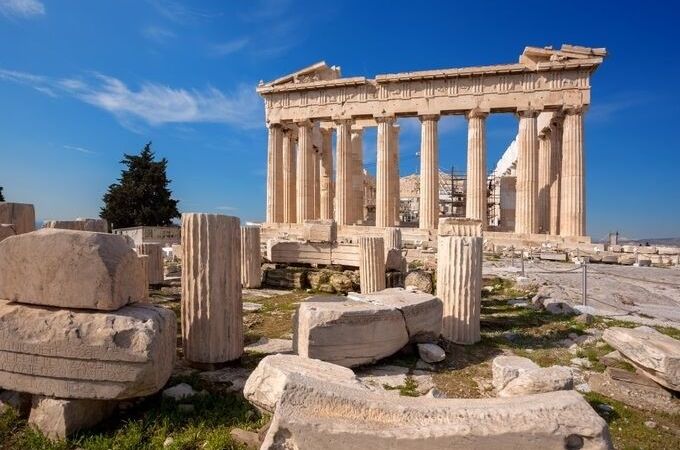
The Parthenon dominates the summit, but visitors expecting a perfectly preserved classical building can initially be surprised by its condition, ongoing conservation work and the amount that has changed during more than two millennia.
That history is part of the monument.
Completed in the fifth century BCE and associated with the architects Iktinos and Kallikrates and the sculptural program overseen by Pheidias, the Parthenon was built as a temple dedicated to Athena Parthenos. Over subsequent centuries it experienced religious conversion, political change, structural alteration, conflict and major damage.
What survives therefore should not be approached as a frozen object from classical Athens.
It is a monument with a biography.
Conservation activity is equally important to understand in that context. Scaffolding or restoration equipment may not match the untouched image visitors imagine beforehand, but preserving a structure of this age requires long-term archaeological and engineering intervention.
The objective is not to recreate a brand-new Parthenon.
It is to protect what survives while respecting the historical evidence embedded within it.
The Erechtheion Tells a More Complicated Story
The Parthenon inevitably attracts the greatest attention, yet the Erechtheion often becomes the building that makes visitors curious.
Its irregular architecture reflects a complex sacred function associated with multiple cults and traditions, making it quite different from the visual symmetry travelers often associate with Greek temples.
The famous Porch of the Caryatids is immediately recognizable because female figures perform the architectural role normally occupied by columns. The figures visible on the monument today should also prompt an important question: where are the originals?
That question leads naturally toward the Acropolis Museum, where surviving original Caryatids from the Acropolis can be examined under controlled conditions.
This connection between archaeological site and museum is one reason the two experiences should ideally not be treated as unrelated attractions.
On the hill you understand place and scale.
In the museum you can examine objects, sculpture and detail that exposure on the Acropolis would make impossible to appreciate in the same way.
The Acropolis Museum Is Not the Indoor Version of the Acropolis
Travelers sometimes wonder whether the museum is necessary after seeing the archaeological site, particularly when their time in Athens is limited.
For visitors genuinely interested in understanding what they have seen, it adds considerable value because the museum and hill perform different jobs.
The site provides architecture in its original landscape. The museum provides context, surviving sculpture, architectural fragments and a closer relationship with material that once belonged to the monuments above.
One particularly effective aspect of the experience is the visual connection back toward the Acropolis. The museum does not remove the objects from their geographical story; its position continually reminds visitors where they came from.
The sequence can work in either direction. Some travelers prefer the museum first because it gives them vocabulary before climbing the hill, while others enjoy seeing the architecture first and then using the museum to answer questions that arose during the visit.
Neither sequence is universally superior.
The better choice depends on how you absorb information.
Site First or Museum First? Choose According to the Day
Rather than treating this as a historical debate, use practical considerations.
| Your Situation | Better Starting Point | Why |
|---|---|---|
| First visit with mild weather | Acropolis | Seeing the landscape first gives the museum's objects a physical context |
| Very hot day | Acropolis early | Outdoor sightseeing can be completed before the strongest heat |
| You want historical orientation first | Museum | Exhibits help explain monuments you will later encounter above |
| Children need visual context | Acropolis first | The hill and monumental scale can make the history more tangible |
| Weather makes outdoor timing uncertain | Museum | Indoor time can be used while conditions are less comfortable |
| You have a knowledgeable guide | Either | The sequence can be adapted around interpretation and crowd conditions |
The important point is not to find a universal “correct” order.
It is to prevent the museum from becoming an exhausted afterthought simply because it appears second on a checklist.
Heat Can Change the Quality of the Visit More Than Your Reading List
Athens in warmer months can become intensely hot, and the Acropolis is an exposed archaeological site rather than a shaded park.
That affects how the visit should be planned.
Visitors who arrive already tired from several hours of walking through Athens may find the ascent and exposed summit more demanding than expected, particularly around midday. Families with children, older travelers and anyone less comfortable in heat should treat timing as part of the sightseeing decision rather than merely an admission issue.
Water, sun protection and appropriate clothing matter, but scheduling matters more.
An early visit can create a completely different physical experience from reaching the site after lunch on a hot summer day.
Operational conditions and access arrangements can change, especially during exceptional heat or other circumstances, so current official information should always be checked shortly before the visit rather than assuming that historical opening patterns will apply unchanged.
Footwear Is Not a Trivial Detail on the Acropolis
The Acropolis is ancient stone, uneven surfaces, gradients and polished areas that can become surprisingly slippery.
This is not the day for footwear selected primarily for photographs.
Comfortable shoes with reliable grip make the experience considerably easier, particularly because most visitors combine the Acropolis with substantial walking elsewhere in central Athens.
The issue is not athletic ability. Even physically fit travelers can find polished stone awkward when wearing smooth-soled shoes.
This practical detail rarely appears in romantic photographs of Athens, yet it can influence whether a visitor spends two hours looking at monuments or twenty minutes thinking about every step.
Dress for an archaeological site first and a photograph second.
You will still have the photograph.
Do Not Judge the Acropolis by How Long the Walk Looks on Google Maps
Central Athens can appear compact on a map, which encourages ambitious walking plans.
A route from the hotel through Plaka, up to the Acropolis, around the slopes, into the museum and onward toward additional ancient sites may involve relatively modest distances geographically, but archaeological sightseeing is slower than ordinary city walking.
You stop repeatedly. You stand while listening to explanations. Surfaces are uneven. There is limited shade in some areas, and the mental concentration required to understand several ancient sites is easy to underestimate.
This is why “everything is close” does not mean “everything belongs in the same morning.”
Athens becomes much more rewarding when walking distance and sightseeing intensity are treated as separate measurements.
The Southern Slope Changes the Story From Temples to Public Life
The summit represents only part of the archaeological landscape.
The southern slope contains monuments that broaden the visitor's understanding of ancient Athens beyond temples and religious architecture, most notably the Theatre of Dionysus, associated with the development of ancient Greek drama.
Nearby, the Odeon of Herodes Atticus belongs to a later Roman-era chapter of the city's history and remains one of the most visually striking structures beneath the Acropolis.
This difference in period matters.
Athens is often marketed through a single classical image, but the archaeological landscape contains layers accumulated across centuries. Recognizing those layers prevents the city from becoming an artificial reconstruction of one famous moment in the fifth century BCE.
A knowledgeable guide can be particularly valuable here because the stones themselves do not always reveal their chronology to an untrained visitor.
Plaka Works Best as a Change of Rhythm, Not Another Monument
After several hours of archaeology, many travelers instinctively continue collecting historical sites because they are already in the area.
There is another option.
Walking into Plaka allows the day to change tempo without abandoning the historical center of Athens. Streets, cafés, houses, shops and everyday movement create a different relationship with the city after the monumentality of the Acropolis.
This page deliberately does not turn Plaka into a complete neighborhood guide because that belongs to broader Athens content.
Its relevance here is strategic.
A good sightseeing day benefits from changes in intensity. After concentrating on architecture, mythology, chronology and conservation, lunch or an unstructured walk can give the information time to settle before another historical experience begins.
Travelers do not absorb more simply because they schedule more.
Should You Visit the Ancient Agora on the Same Day?
You can, and historically the combination makes considerable sense.
The Acropolis represented the sacred and monumental heights of ancient Athens, while the Ancient Agora below was deeply connected with civic, political, commercial and social life. Seeing both helps transform ancient Athens from a collection of temples into something closer to an actual city.
The question is whether you still have the attention for it.
Travelers with a strong interest in archaeology may find the sequence excellent, particularly with a guide who can explain the relationship between the two areas. Visitors who are already reaching saturation after the Acropolis and museum may gain more by leaving the Agora for another period.
Archaeological fatigue is real.
After several hours, another significant ruin can start looking like “more stones,” which is unfair to both the site and the traveler.
A Guide Changes What You Notice Rather Than What You See
The Acropolis can certainly be visited independently.
Information panels, prior reading and the museum can provide substantial context, and independent travelers may enjoy moving entirely at their own pace.
A knowledgeable licensed guide offers a different advantage: interpretation can happen exactly where the architecture makes the explanation relevant.
Instead of remembering disconnected dates, visitors can understand why the monuments occupy particular positions, how religious practices related to civic identity, what changed during later historical periods and which reconstructions are based on surviving evidence.
For travelers choosing private Athens tours with an expert local guide, the value is therefore not access to a secret version of the Acropolis.
Everyone sees the same hill.
The difference is how much of its meaning becomes visible.
Children Usually Need a Story, Not a Lecture
The Acropolis can work remarkably well for families because ancient Greece contains characters, myths and conflicts that children may already recognize.
The mistake is expecting children to absorb the site through the same explanation that interests adults.
Athena and Poseidon, the naming of Athens, the architectural role of the Caryatids and the development of ancient theater can provide entry points that make the ruins feel less abstract.
Physical pacing matters just as much.
A family that reaches the summit before children are exhausted has a better chance of creating genuine interest than one that arrives after several other attractions, a long lunch and an afternoon walk.
For families, reducing the amount of content can increase the amount remembered.
Photography Is Better When You Stop Chasing an Empty Acropolis
Visitors understandably want photographs, but expecting the Acropolis to resemble a private archaeological set is unrealistic during popular travel periods.
Instead of allowing other visitors to become the dominant frustration of the experience, work with the architecture and viewpoints available.
The relationship between columns, city and landscape often produces more interesting photographs than repeatedly trying to isolate the Parthenon from everyone around it.
More importantly, do not let photography consume the visit.
The Acropolis is unusually powerful because it changes as you move through it. Architectural proportions, distant views and relationships between monuments are experienced spatially, something a camera cannot completely preserve.
Take the photograph, then spend some time looking without one.
The Acropolis Should Influence Where You Place Athens in a Larger Greece Journey
When Athens forms part of a longer trip through Greece, the Acropolis often provides the historical foundation for what follows.
Visiting Athens before Delphi, the Peloponnese or other archaeological destinations can give travelers useful context, while visiting it before the islands creates a strong contrast between concentrated cultural sightseeing and the slower rhythm that may follow.
This does not mean Athens must always come first.
International flights, ferry schedules and the wider itinerary can make another sequence more practical. What matters is recognizing that the Acropolis is not simply an attraction to squeeze into the hours before an island departure.
Within Greece cultural journeys combining Athens and the islands, giving Athens a meaningful sightseeing period usually creates a stronger transition than landing, photographing the Parthenon and immediately heading for the port.
What Should You Not Combine With the Acropolis?
There is no prohibited combination, but there is a point where ambition begins reducing value.
Acropolis, Acropolis Museum, Ancient Agora, National Archaeological Museum, several neighborhoods and an evening excursion may fit mathematically into a long day. That does not make it a good day.
A better approach is to identify the Acropolis as the principal experience, decide whether the museum belongs before or after it, then add one or two contrasting elements according to energy and interests.
This is particularly important for travelers spending only a short time in Athens. Limited time creates pressure to maximize quantity, yet the city rewards visitors who preserve enough attention to understand what they came to see.
The Acropolis is one of those places where slightly less itinerary can produce considerably more experience.
What a Well-Planned Acropolis Half Day Actually Feels Like
A strong visit begins before the climb.
You know roughly what the major monuments are, but you have not tried to memorize an entire classical-history textbook. You arrive at a sensible time for the season, wear shoes appropriate for ancient stone and allow enough flexibility that a crowded entrance does not immediately destroy the schedule.
On the hill, the Parthenon remains the visual centerpiece, but it no longer monopolizes the visit. The Propylaea, Temple of Athena Nike and Erechtheion begin to form a larger architectural story, while the views explain why this particular rock became inseparable from the identity of Athens.
Later, the museum gives physical detail to what distance and conservation prevent you from seeing above.
By the time you walk into the surrounding city, you have not “done” the Acropolis.
You have understood enough of it that the rest of Athens looks different.
That is a much more useful objective.
The Acropolis Is Famous Enough to Need No Sales Pitch
Few travelers need to be convinced that the Parthenon matters.
The more important task is preventing familiarity from making the visit superficial.
Ancient Athens becomes easier to understand when the Acropolis is treated as a landscape rather than a single temple, when the museum is used as interpretation rather than shelter from the heat, and when the day leaves enough space for observation instead of measuring success by the number of archaeological admissions collected.
For travelers building custom Greece tours centered on history and archaeology, Athens often becomes the natural intellectual starting point because so many later places connect back to ideas encountered here.
Yet even without a specialist interest in antiquity, the Acropolis deserves time for a simpler reason.
Standing above a modern capital inside a sacred landscape constructed more than two thousand years ago makes the enormous distance between ancient and contemporary Greece feel strangely small.
That experience is difficult to reproduce anywhere else.
Frequently Asked Questions About Visiting the Athens Acropolis
1. Is the Acropolis the same thing as the Parthenon?
No. The Acropolis is the elevated ancient complex containing several monuments, while the Parthenon is its largest and most famous classical temple. Understanding the distinction helps visitors appreciate the Erechtheion, Propylaea and Temple of Athena Nike rather than focusing on one building.
2. How much time should I allow for the Acropolis?
Many travelers spend approximately 1½ to 2½ hours at the archaeological site, although interest, crowds, weather and walking pace can change this considerably. Adding the Acropolis Museum turns the experience into a more substantial half-day rather than a quick monument visit.
3. Should I visit the Acropolis Museum before or after the Acropolis?
Both sequences work. Visiting the museum first provides historical and artistic context before seeing the monuments, while visiting it afterward allows exhibits to answer questions generated on the hill. Weather and energy levels can be more important than following a fixed order.
4. Is the Acropolis difficult to walk around?
Visitors should expect uphill walking, uneven ancient surfaces and polished stone that can be slippery. The experience is manageable for many travelers, but comfortable footwear and realistic pacing matter, particularly during hot weather or for visitors with mobility considerations.
5. What is the best time of day to visit during hot weather?
Earlier sightseeing is often more comfortable because the Acropolis is exposed and offers limited protection from strong summer sun. Conditions and operating arrangements can change, however, so travelers should check current access information shortly before their planned visit.
6. Why are there Caryatids in both the Erechtheion and Acropolis Museum?
The figures seen supporting the porch on the Erechtheion are replacements used to protect the surviving originals from outdoor exposure. Original Caryatids preserved in Athens can be viewed more closely inside the Acropolis Museum, where conservation conditions are controlled.
7. Is a guided Acropolis visit worth it?
A guide is particularly valuable for travelers wanting to understand the relationships between architecture, religion, politics and the later history of the monuments. Independent visits can also work well, especially for travelers comfortable researching context and moving at their own pace.
8. Can children enjoy the Acropolis?
Yes, particularly when the experience is presented through mythology, architecture and stories rather than a long chronological lecture. Families should also consider heat and walking conditions, because children who arrive comfortable and rested are much more likely to engage with the site.
9. Should I visit the Ancient Agora on the same day?
The combination provides excellent historical context because the Agora reveals another dimension of ancient Athenian civic life. Whether to include both depends on your interest and stamina; travelers experiencing archaeological fatigue may appreciate the Agora more at another time.
10. What shoes should I wear to the Acropolis?
Choose comfortable walking shoes with dependable grip rather than smooth soles. Ancient stone can be polished and uneven, while most visitors also accumulate considerable walking around the surrounding archaeological areas and neighborhoods during the same sightseeing period.
11. Is the Acropolis worth visiting if restoration scaffolding is visible?
Yes. Conservation is part of preserving an ancient monument that has survived extensive historical change and damage. Scaffolding may affect particular photographs, but it does not remove the architectural, archaeological or landscape significance that makes the Acropolis extraordinary.
12. What is the biggest mistake first-time Acropolis visitors make?
Trying to fit the site between too many other major attractions can reduce it to a hurried photograph of the Parthenon. Allow enough time to notice the other monuments, understand the landscape and connect what you see with the Acropolis Museum.

A travel professional specializing in tailor-made travel planning, guest experience management, and multi-destination tourism operations.
With over 23 years of experience in the travel industry, he designs and manages private and cultural tours for international travelers across Türkiye, Greece, Egypt, Jordan, Morocco, and other destinations.
He has strong expertise in both online and face-to-face guest communication, sales processes, and end-to-end travel operations.
Working closely with hotels, travel agencies, and local partners, he ensures smooth coordination and high-quality travel experiences at every stage of the journey.
His focus is on delivering personalized, reliable, and seamless travel experiences for international guests worldwide.