
Athens Weather in March: When the City Opens Outdoors
Last Updated: August 2026
Athens feels physically larger in March.
The streets have not moved, naturally, and the distance between the Acropolis and Lycabettus is exactly what it was several weeks earlier. What changes is how much of that distance you are inclined to cover on foot.
A winter day encourages decisions. Do you stay outside for another hour or move into a museum? Is the hill worth climbing in this wind? Should the coastal afternoon wait because rain is approaching?
March gradually removes some of those negotiations.
Daylight stretches further into the afternoon, mild periods become more frequent and outdoor tables begin looking inviting for reasons other than determined optimism. The hills around central Athens start fitting more naturally into sightseeing days, while the first visible changes in vegetation soften a city whose historical center is otherwise dominated by pale stone, marble and densely built neighborhoods.
This is not settled spring.
Rain remains entirely possible, evenings can still require a jacket and a cold spell can interrupt several days of otherwise encouraging weather. March becomes interesting precisely because the seasonal movement is visible before it is complete.
February makes travelers watch the weather for opportunities.
By March, the city itself is beginning to create them.
You Notice Spring in Distance Before Temperature
Monthly averages tell only part of the story.
March daytime temperatures often reach roughly 15–19°C, while nights commonly fall toward approximately 9–12°C. Warmer afternoons can occur, particularly later in the month, although cooler spells, rain and wind remain realistic.
Those figures suggest gradual warming.
Your feet may notice the change first.
A route that seemed unnecessarily ambitious in January can become comfortable: the Acropolis area in the morning, a long walk through the historic center, lunch somewhere outside if conditions cooperate, then another neighborhood or hill before evening.
The reason is not simply temperature. Longer daylight, reduced winter chill and increasingly frequent mild periods work together.
What Starts Expanding in March?
| Part of the Athens Day | Winter Tendency | March Shift |
|---|---|---|
| Morning sightseeing | Cold start possible | Easier earlier walking |
| Archaeological visit | Often main outdoor block | Can connect with longer route |
| Lunch | Indoor default in poor weather | Outdoor tables increasingly tempting |
| Afternoon | Limited by winter daylight | More room for another district |
| Viewpoints | Highly weather-dependent | Easier to add spontaneously |
| Evening | Clearly winter-like | Gradually milder, still layered |
March does not simply give you better weather.
It gives you a larger usable city.
The Acropolis Can Become the Beginning Rather Than the Day's Main Event
During winter, a substantial archaeological visit can feel like the outdoor centerpiece around which everything else is arranged.
March changes that proportion.
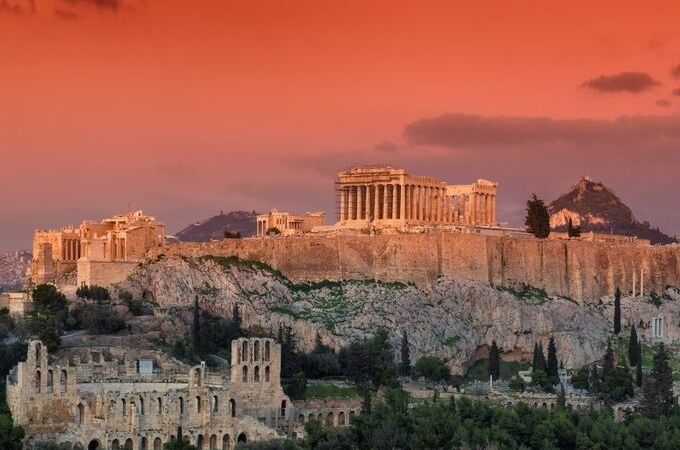
Spend the morning around the Acropolis and its slopes, then continue walking rather than automatically transitioning indoors. Anafiotika, Plaka, Monastiraki and the Ancient Agora can form part of a broader pedestrian day when conditions are mild.
A spring Athens heritage tour fits naturally into this period because comfortable temperatures allow historical sightseeing to connect with the modern city instead of becoming an isolated attraction followed immediately by recovery.
There is an important distinction here.
This is not an Athens itinerary article, so the objective is not prescribing the correct sequence of monuments. The weather point is that March increases the number of places you can comfortably connect on foot.
That changes how Athens is experienced.
March Is the Month of the Jacket You Keep Taking Off
Morning can still feel cool enough that leaving the hotel without a jacket seems foolish.
By early afternoon, particularly in direct sunshine, the same jacket may spend several hours folded over your arm.
Then sunset arrives and you put it back on.
This is the ordinary rhythm of early spring.
The difference between sun and shade can be noticeable, while wind remains capable of making an otherwise mild day feel cooler, especially on hills or exposed archaeological sites.
Packing therefore becomes lighter than in January or February without becoming genuinely summery.
A medium or lightweight jacket, a sweater or similar layer, comfortable trousers and walking shoes will cover most situations. Add rain protection rather than relying on the increasingly frequent sunshine.
March rewards removable clothing.
Rain Begins Competing With Better Weather Instead of Defining Winter
Rain remains a meaningful part of March weather, but its role in the travel experience changes.
In January, rainfall belongs naturally to a winter city-break strategy. February emphasizes variability. March increasingly introduces longer outdoor periods between unsettled conditions, and a wet morning may be followed by an afternoon that feels convincingly spring-like.
This creates an important planning habit: do not surrender the remainder of the day because breakfast happened beneath grey skies.
When March Changes During the Day
| Morning | Afternoon Development | Better Decision |
| Rain | Clears and warms | Move outside immediately |
| Cloud | Breaks into sun | Extend walking route |
| Cool sunshine | Becomes mild | Add hill/viewpoint |
| Warm start | Wind increases | Move toward sheltered streets |
| Clear | Remains stable | Use full outdoor day |
| Showers continue | No improvement | Cultural/indoor focus |
The day is increasingly capable of rescuing itself.
Give it the opportunity.
Athens Begins Growing Green Around Its Ancient Stone
March introduces a visual change that deserves its own place in this cluster.
After winter rainfall, vegetation around Athens begins responding to increasing daylight and warmer conditions. Hillsides, archaeological landscapes and urban green spaces can show noticeably more life than during the dry summer months.
This is not the lush green Greece sometimes imagined by travelers accustomed to wetter climates.
Athens remains a Mediterranean city.
The contrast matters because summer visitors often see the landscape after months of drying. March shows it moving in the opposite direction.
Philopappos Hill, the National Garden and vegetation around archaeological areas begin providing softer visual relief from the city's stone and concrete.
For photographers, walkers and repeat visitors, this seasonal version of Athens can feel unexpectedly fresh.
The Hills Stop Being Optional Extras
Athens is often described horizontally through neighborhoods and archaeological sites, but its hills explain the city vertically.
March is particularly good for discovering that relationship.
Philopappos Hill can extend naturally from the historical center, while Lycabettus provides a completely different perspective over the modern city toward the surrounding mountains and, in clear conditions, the Saronic Gulf.
Winter wind can make viewpoints uncomfortable.
Summer heat can make the climb poorly timed.
March often sits between those problems.
A Athens hills and history experience becomes much easier to justify when temperatures support climbing and increasing daylight reduces the need to choose between a viewpoint and another major attraction.
Which Conditions Suit an Athens Hill?
| Weather | Walking Comfort | View Potential |
| Clear, mild, light wind | Excellent | Excellent |
| Bright but cool | Very good | Excellent |
| High cloud | Excellent | Good |
| After rain clears | Good; watch surfaces | Often excellent |
| Strong wind | Moderate | Potentially uncomfortable |
| Active rain | Poor | Postpone |
Do not climb simply because the itinerary says “sunset.”
March gives you enough daylight to choose a better moment.
Outdoor Café Season Returns Before Outdoor Dinner Season
This distinction is small but very Athens.
A sunny March lunchtime can feel genuinely warm at a sheltered outdoor table. Coffee stretches longer, jackets come off and the city's street life begins resembling spring.
Dinner is another matter.
Temperatures drop after sunset, and an outdoor table that looked appealing at 2:00 p.m. may feel considerably less comfortable at 8:00 p.m.
This creates a seasonal progression across the day.
Use the afternoon for outdoor café culture when weather cooperates, while treating evening terraces according to actual temperature, wind protection and heating rather than assuming March has already become May.
The city moves outside gradually.
Lunch gets there first.
Early March and Late March Should Not Be Sold as the Same Trip
A March 3 visit and a March 29 visit belong to the same statistical month but can occupy noticeably different points in the seasonal transition.
Early March remains more vulnerable to winter-like spells and cooler evenings.
Late March benefits from longer daylight and generally stronger spring influence, although weather never follows the calendar perfectly.
March Changes While You're Not Looking
| Early March | Late March |
| Winter still close | Spring more established |
| Cooler nights | Milder evening potential |
| Greater need for layers | Lighter daytime clothing |
| Shorter sightseeing window | Longer afternoon |
| Green season developing | Spring landscape clearer |
| Outdoor dining conditional | Lunchtime outdoor dining easier |
This is why March cannot be reduced to one temperature figure.
The month is traveling in the same direction as you are.
The Athens Riviera Starts Becoming More Tempting
The coast remains outside true beach season, and March should not compete with Greek-island spring or swimming content.
Its value is different.
On a clear day, the southern suburbs and Saronic Gulf provide space after several days in the dense historical center. Walking by the water becomes more comfortable as temperatures rise, while longer daylight makes a coastal afternoon easier to incorporate without sacrificing the morning.
A March Athens coastal escape can therefore function as a change of scenery rather than an attempt to manufacture summer early.
Swimming remains a personal decision for cold-tolerant visitors rather than a general recommendation.
The coast is attractive because spring makes being outside easier.
The water does not need to be warm for that to matter.
March Photography Has More Than Blue Sky to Work With
Summer Athens photography can be technically challenging during the middle of the day because sunlight becomes hard and contrast severe.
March provides a broader palette.
Clouds, softer sunlight, greener landscapes and clearer post-rain conditions can create more dimensional photographs. Longer afternoons also provide additional opportunities to wait for favorable light without sacrificing most of the sightseeing day.
The Acropolis seen through fresh spring vegetation belongs to a different visual Athens than the pale, dry city of August.
Neither is more authentic.
Season simply changes the color balance.
Travelers interested in photography should keep plans flexible enough to respond when rain clears or visibility improves.
The hour after poor weather can sometimes be more interesting than the entire cloudless day before it.
March Is Not Yet the Month to Stop Checking the Forecast
Spring optimism can create bad packing decisions.
A week of mild historical averages does not guarantee that your particular dates will avoid cold rain or strong wind.
Check conditions before departure and again each morning.
The difference from February is that the forecast increasingly determines how much outdoor time to add, rather than whether an outdoor day is possible at all.
That is a meaningful seasonal shift.
The base assumption is gradually becoming movement.
Weather now decides the distance.
What March Is Really Good At
It is tempting to call March a shoulder-season bargain, but price and crowd avoidance are not its strongest semantic territory.
March is valuable because different parts of Athens begin reconnecting.
Archaeological sites connect with neighborhoods because walking is comfortable. Hills connect with afternoon sightseeing because daylight is increasing. Outdoor cafés reconnect with street life as sunshine becomes more persuasive, while winter rainfall begins revealing a greener version of the urban landscape.
The city stops feeling like a collection of weather-dependent choices and begins functioning as one continuous outdoor environment again.
April will refine that advantage into some of the year's strongest conditions for intensive archaeological walking.
March owns the moment before that confidence arrives, when every mild afternoon still feels slightly earned.

How Far Do You Feel Like Walking Today?
March Athens can be measured surprisingly well in kilometers.
Not because visitors need to count their steps, but because the distance you are willing to cover tells you more about early-spring weather than another monthly temperature average.
On a cold, wet morning, the city contracts. You naturally remain around the historical center, museums and neighborhoods where shelter is easy to find. Give the same traveler a calm 18°C afternoon beneath broken sunshine and Athens expands rapidly; another district seems close enough, the climb toward a viewpoint becomes appealing and taking the metro for a relatively short journey suddenly feels unnecessary.
This elasticity is one of March's defining characteristics.
Instead of creating one ideal walking itinerary, decide each morning how large Athens feels.
Then explore that version.
A Five-Kilometer Day Can Become Ten Without Planning It
Mild March weather encourages accidental sightseeing.
You finish one archaeological area, notice that the next neighborhood is within comfortable walking distance and continue. Lunch lasts an hour, yet the afternoon remains long enough that another part of central Athens still fits naturally.
These are often better days than itineraries designed to maximize attraction counts.
Walking connects the historical layers between major sites: ordinary residential streets, small churches, modern buildings, cafés and glimpses of the Acropolis appearing unexpectedly between them.
Public transport remains useful, of course, particularly when crossing larger distances.
The difference is that March gives you the choice.
In midsummer, taking the metro may be an energy-management decision.
In March, walking can become part of the attraction.
Match the Route to the Weather, Not Your Fitness App
A long walking day is worthwhile only when conditions support it.
There is no reason to cover twelve kilometers in persistent rain simply because your planned route says you should.
March Walking Radius
| Conditions | Sensible Walking Style |
|---|---|
| 17–20°C, dry, light wind | Full-day walking exploration |
| 14–17°C, sunny | Excellent for hills + neighborhoods |
| Mild, high cloud | Long archaeological walking day |
| Cool with showers | Short connected walking sections |
| Strong wind | Favor sheltered central districts |
| Persistent rain | Museums + shorter outdoor links |
This table is deliberately not a step-count target.
Some travelers comfortably walk twenty kilometers; others prefer five.
The weather question is whether March encourages you to extend your normal distance, whatever that distance happens to be.
On its better days, it often does.
Three Days Work Differently in March Than in Winter
A three-day Athens visit in January benefits from weather insurance because one wet day can consume a substantial portion of available outdoor sightseeing.
By March, the emphasis begins changing.
Three days increasingly provide enough time to combine archaeological sites, neighborhoods and at least one elevated viewpoint without making every decision defensive.
You should still retain flexibility, particularly early in the month, but the itinerary can begin with a stronger outdoor bias.
A fourth day becomes valuable for a different reason.
Rather than merely protecting against weather, it allows the walking radius to expand toward the coast, additional neighborhoods or a slower historical exploration.
How March Changes With Trip Length
| Stay | What March Allows |
| 2 nights | Historic core with limited flexibility |
| 3 nights | Strong first-time city break |
| 4 nights | Hills + wider neighborhoods become easier |
| 5 nights | Add coast or slower cultural exploration |
| 6+ nights | Athens begins feeling residential rather than visited |
Longer stays should not automatically produce longer attraction lists.
March is one of the first months when additional time can simply mean spending more of the day outside.
Shoes Matter More as the Weather Improves
Winter packing naturally emphasizes warmth and rain protection.
March adds another consideration: you may walk considerably farther than expected.
Comfortable footwear therefore becomes central to the trip.
Athens combines modern pavements, hills, stairs, uneven archaeological surfaces and polished stone. Shoes that feel perfectly adequate during a short city walk can become unpleasant after several consecutive long days.
Grip remains useful because spring showers can leave stone slippery.
Footwear and Layers for March
| Item | March Reason |
| Broken-in walking shoes | Longer spontaneous routes |
| Light/medium jacket | Cool mornings and evenings |
| Removable mid-layer | Afternoon warming |
| Light rain protection | Spring showers remain possible |
| Sunglasses | Increasing bright periods |
| Small day bag | Carrying removed layers |
| Water bottle | Longer outdoor periods |
The most useful March outfit is the one you can forget about after breakfast.
If you spend the day repeatedly adjusting uncomfortable clothing or footwear, the seasonal advantage is being wasted.
Early March Travelers Should Keep Winter in the Suitcase
The beginning of March can still produce conditions that belong emotionally to February.
Cool rain, northerly wind and colder evenings remain possible, which makes aggressive spring packing risky.
If you travel during the first ten days, keep a warmer layer and proper outer jacket available.
This does not mean early March is a poor choice.
The city can still produce beautiful mild periods, visitor pressure remains relatively moderate and the changing landscape is already visible.
You simply have less reason to assume spring will win every day.
Late March Travelers Gain Daylight Before They Gain Certainty
By the final third of March, longer days become increasingly obvious and daylight saving time eventually pushes evening light later when the annual clock change occurs.
That can transform the rhythm of a trip.
An afternoon no longer feels close to completion simply because lunch ended late. There is time for another neighborhood, a hill or an unplanned walk before dinner.
Weather can still reverse temporarily.
A late-March cold or wet spell is entirely possible.
The difference is that the season now has momentum. Even when a poor-weather day arrives, the overall travel experience increasingly feels oriented toward spring rather than away from winter.
The National Garden Makes More Sense as a Route Than an Attraction
March vegetation can tempt travel writing into overstating Athens as a spring garden destination.
That would be misleading.
The National Garden is valuable partly because of where it sits and what it connects. It provides a green walking environment within central Athens and offers a visual change after hours among stone archaeological sites and dense urban streets.
In March, emerging vegetation and comfortable temperatures make that connection more pleasant.
Walk through rather than feeling obliged to “complete” it.
This is another way spring expands Athens: places between famous attractions become worth experiencing rather than merely crossing.
March Is Good for Travelers Who Dislike Choosing
Some couples face a familiar city-break disagreement.
One person wants museums and history.
The other wants to walk neighborhoods, sit outside and experience the contemporary city.
March increasingly allows both within the same day.
You can spend the morning focused on antiquity, walk for several hours afterward and stop at an outdoor café if conditions cooperate without either side of the trip feeling secondary.
Who Benefits Most From March?
| Traveler | March Fit | Main Advantage |
| First-time Athens visitor | Excellent | Broad sightseeing balance |
| History enthusiast | Excellent | Comfortable archaeological walking |
| Walking-focused traveler | Excellent | Expanding outdoor range |
| Photographer | Very good | Spring light + variable skies |
| Couple with mixed interests | Excellent | Culture and outdoor life combine |
| Heat-sensitive traveler | Excellent | Mild conditions |
| Guaranteed-warmth seeker | Moderate | Spring remains variable |
| Beach-focused traveler | Poor | Sea is not the month's purpose |
This is why March should not be sold primarily as a cheaper alternative to April.
It offers its own experience.
The city is changing while you are inside it.
February, March or April?
These three months form a natural progression, but their travel logic should remain distinct.
| February | March | April |
| Late-winter variability | Visible spring emergence | Spring sightseeing confidence |
| Grab good-weather windows | Walking radius expands | Long outdoor days become central |
| Winter clothing dominates | Layers constantly change | Lighter spring clothing |
| Outdoor café moments | Outdoor life returns | Outdoor life established |
| Weather opportunism | Seasonal transformation | Prime archaeological walking |
| Spring is suggested | Spring becomes visible | Spring becomes dependable |
March is the only one of the three where the transition itself is the experience.
February hints.
April delivers.
March changes in front of you.
Don't Use March as a Summer Preview
The temptation grows as the weather improves.
A warm afternoon, outdoor lunch and bright blue sky can make travelers imagine that Athens has entered an early version of summer.
That expectation causes poor decisions.
Evenings remain cooler, rainfall is still possible and the sea is not yet the reason to travel. A colder weather system can appear after several mild days without anything unusual having happened.
March is much more satisfying when judged against winter rather than summer.
Notice how much farther you can walk.
Notice the extra daylight.
Notice the hills becoming greener and outdoor tables filling when the sun appears.
Those are genuine seasonal gains.
They do not need to imitate July.
Twelve FAQs About Athens Weather in March
1. Is March a good time to visit Athens?
March is an excellent choice for travelers interested in archaeology, neighborhoods and extensive walking without summer heat. Spring becomes increasingly visible, daylight grows and mild periods become more common, although rain, cooler spells and significant differences between early and late March remain possible.
2. How warm is Athens in March?
Daytime temperatures commonly reach approximately 15–19°C, while nights often fall toward 9–12°C. Warmer afternoons become increasingly possible later in the month, but March remains transitional enough that travelers should prepare for both mild spring sunshine and temporarily cooler weather.
3. Does it rain in Athens in March?
Rain remains possible throughout March, although increasingly long dry and mild periods support outdoor sightseeing. Conditions can change during the day, so light waterproof protection remains useful. A wet morning should not automatically be interpreted as evidence that the entire sightseeing day is lost.
4. Is Athens warm in late March?
Late March is generally milder than the beginning of the month and benefits from substantially increasing daylight. Pleasant spring afternoons are common enough to influence travel planning, although occasional cooler or unsettled periods mean visitors should still carry layers rather than packing exclusively for warm weather.
5. What should I wear in Athens in March?
Bring comfortable walking shoes, a light or medium jacket, removable layers, trousers and some rain protection. Sunglasses are useful during bright periods. Early-March travelers may appreciate warmer clothing, while late-March visitors can often spend mild afternoons wearing considerably lighter layers.
6. Is March good for visiting the Acropolis?
Yes. March temperatures are generally very comfortable for exposed archaeological sightseeing, particularly for visitors who find summer heat difficult. Rain and wind remain possible, but increasing daylight also makes it easier to combine the Acropolis with longer neighborhood walks or another outdoor attraction.
7. Is Athens crowded in March?
Tourism activity begins increasing as spring approaches, but March generally remains less pressured than major spring holiday periods and peak summer. Visitor numbers vary by date and event calendar, so famous sites should never be assumed empty even during relatively quieter seasonal periods.
8. Can you eat outside in Athens in March?
Outdoor lunches and café stops become increasingly comfortable during mild, sunny weather, particularly at sheltered tables. Evenings remain cooler and weather can change quickly, so outdoor dinner is less dependable. Late March generally offers stronger outdoor-dining potential than the beginning of the month.
9. Is the Athens Riviera worth visiting in March?
Yes, particularly on a clear, mild day when the coast provides a pleasant contrast to central Athens. March is not a conventional beach month, so the Riviera is better approached for walking, scenery, lunch and coastal atmosphere rather than dependable swimming or sunbathing.
10. How many days should I spend in Athens in March?
Three days provide a strong first visit, while four or five allow longer neighborhood walks, hills, museums and possible coastal exploration without creating a rushed itinerary. Improving weather means extra days increasingly add outdoor variety rather than serving primarily as insurance against winter conditions.
11. Is March or April better for Athens?
March suits travelers who enjoy the first visible spring transition, moderate visitor pressure and highly comfortable walking conditions while accepting some weather variability. April generally provides greater spring confidence and stronger outdoor reliability, although holiday periods can influence demand and the city's seasonal rhythm.
12. Is March a good month for walking around Athens?
March is one of the most appealing periods for extensive city walking because temperatures are generally mild and daylight is increasing. Hills and neighborhoods can be connected more comfortably than during winter, while the intense heat that complicates long summer walking days remains absent.

A travel professional specializing in tailor-made travel planning, guest experience management, and multi-destination tourism operations.
With over 23 years of experience in the travel industry, he designs and manages private and cultural tours for international travelers across Türkiye, Greece, Egypt, Jordan, Morocco, and other destinations.
He has strong expertise in both online and face-to-face guest communication, sales processes, and end-to-end travel operations.
Working closely with hotels, travel agencies, and local partners, he ensures smooth coordination and high-quality travel experiences at every stage of the journey.
His focus is on delivering personalized, reliable, and seamless travel experiences for international guests worldwide.