Mykonos Weather in September: When the Sea Outlasts Summer
Last Updated: August 2026
September performs a small trick in Mykonos.
The hottest part of summer begins fading, but the sea has not received the message.
After months of absorbing Aegean sunshine, the water retains much of its warmth even as daytime temperatures become easier for walking, sightseeing and spending time away from the beach. This creates a combination that spring cannot reproduce: comfortable swimming without needing the strongest heat of the year.
Mykonos remains very much alive. Restaurants are operating, beach venues continue their season, Chora still has nightlife and ferry connections remain extensive. Early September, in particular, can feel unmistakably summery.
Yet something has shifted.
Lunch does not need to become an escape from midday heat. Walking through Chora in the afternoon becomes more appealing. Ano Mera can return to the itinerary without feeling like the activity you reluctantly scheduled instead of another beach day.
The sea remains summer.
The rest of the island starts becoming available again.
That separation is September's story.
The Water Remembers August Longer Than the Air Does
Air temperature responds relatively quickly as the season changes.
The sea does not.
Water has substantial thermal inertia, meaning the Aegean warms gradually through spring and early summer, then releases that accumulated heat gradually as autumn approaches.
For travelers, the science produces a simple advantage.
September seawater can remain beautifully suitable for swimming even when daytime temperatures have softened from July and August levels.
Typical daytime highs often sit around 24–28°C, while evenings generally fall toward approximately 19–22°C. Early September can still produce hotter summer-like conditions, while the end of the month naturally carries greater variability.
Why September Feels Different
| Part of the Trip | August | September |
|---|---|---|
| Daytime heat | Peak summer | Gradually softer |
| Sea | Very warm season | Retains summer warmth |
| Chora walking | Better outside midday | Easier through more of the day |
| Beach time | Often dominates | Easier to balance |
| Evenings | Very warm | Mild and comfortable |
| Visitor pressure | Peak | Gradually easing |
| Island exploration | Heat affects timing | Becomes easier |
The important difference is not that September suddenly becomes quiet or cool.
It is that you have more choices about how to use the day.
September Stops Making You Choose Between the Beach and the Island
Imagine a four-night trip in August.
You may hesitate to give the middle of a beautiful day to inland sightseeing because the weather is so perfectly suited to the beach.
In September, that trade-off weakens.
Spend several hours exploring Chora. Continue toward Ano Mera. Have lunch inland. Reach the coast later and the sea is still warm enough to make the afternoon feel entirely worthwhile.
A September Mykonos island escape can therefore cover more than beaches without treating them as an afterthought.
This balance is particularly useful for first-time visitors.
Mykonos becomes easier to understand when you see both its famous coast and the landscape connecting Chora with the rest of the island.
September gives both enough room.
Early September Hasn't Finished With Summer
The first part of September should not be mistaken for conventional autumn.
Beaches remain active, restaurants and nightlife operate strongly, daytime temperatures can feel distinctly summery and demand can still be considerable.
Travelers expecting empty Chora and spontaneous access to every popular venue may be disappointed.
The difference from August is gradual rather than immediate.
There is no midnight on August 31 when the crowds disappear.
Early September vs Late September
| Early September | Late September |
| Strong summer atmosphere | Clearer shoulder-season feeling |
| Higher visitor demand | More breathing room |
| Very reliable beach focus | Beach + sightseeing balance |
| Warm evenings | Slightly fresher nights |
| Full nightlife energy | Still active, gradually softer |
| Summer clothing dominates | Light evening layer more useful |
| Sea firmly warm | Sea often remains excellent |
For travelers primarily interested in nightlife and summer energy, early September is the stronger choice.
For those seeking the month’s famous balance, the second half becomes particularly interesting.
Late September Is Not October in Disguise
This distinction matters for cluster separation.
Late September naturally sits closer to autumn, but it should not be treated as October arriving early.
Many days can remain warm and dry, the sea retains substantial summer heat and beach time is still a realistic central activity.
October introduces greater uncertainty around weather systems, seasonal closures and how consistently a trip can depend on swimming.
September remains much more securely connected to summer.
The shift occurs in the way you use summer, not in whether summer experiences remain available.
The Best Beach Hour Moves Later
During peak summer, arriving at the coast earlier can help with demand and heat management.
September allows a different approach.
Spend the morning elsewhere.
Visit Chora before lunch or drive toward Ano Mera. Then move to the beach in the afternoon when the sea remains warm and the strongest part of the day's heat has become less important.
Late-afternoon swimming can be particularly enjoyable because the water has been warmed by months of summer rather than merely by that day's sunshine.
A late-summer Mykonos beach day does not need to begin at 10:00 a.m. to feel complete.
That freedom changes how much of the island can fit around it.
You Can Walk Through Chora Without Planning Around the Sun
August Chora requires timing.
September Chora allows wandering.
There will still be hot days, particularly early in the month, but temperatures increasingly support longer exploration outside the coolest morning and evening periods.
This matters because Mykonos Town is easy to underestimate when every visit is compressed between beach and dinner.
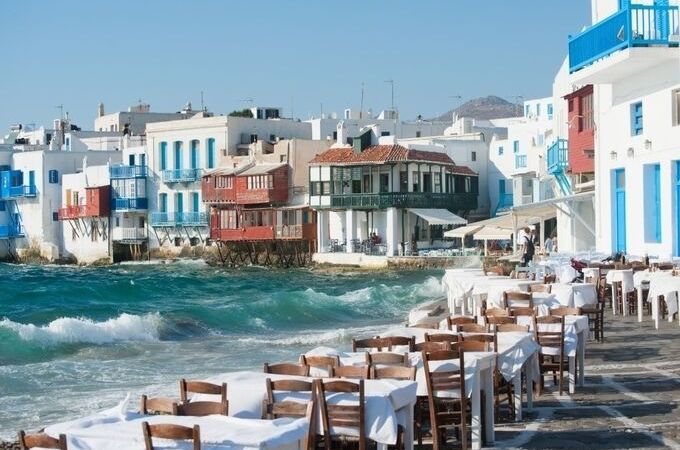
Walk beyond Little Venice.
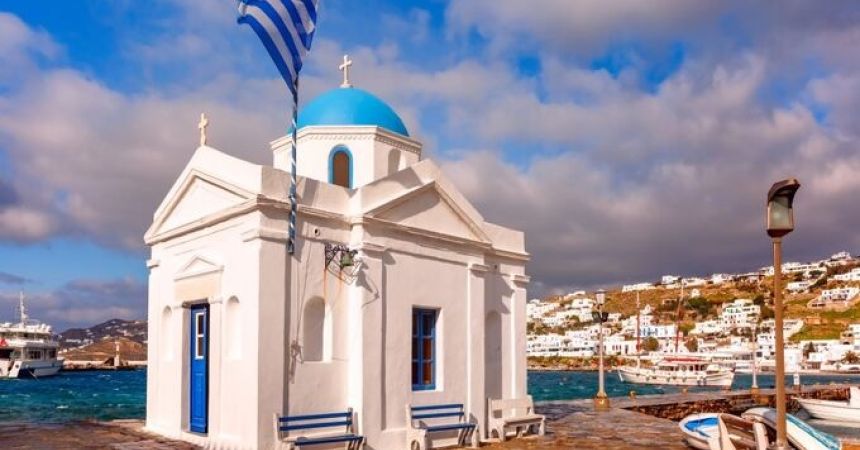
Spend time around the churches and smaller lanes rather than moving directly between the windmills and the waterfront. Sit somewhere because you like the street, not because you need to escape the heat.
The town begins becoming a daytime destination again.
That is a surprisingly large seasonal change.
Ano Mera Returns to the Middle of the Day
The inland village never went anywhere.
Your willingness to visit it at lunchtime probably did.
September's softer temperatures make Ano Mera and the island interior easier to incorporate without organizing the route entirely around early morning.
The surrounding landscape remains dry after summer, so this is not the green Mykonos described in March. Instead, you see the Cycladic terrain after months of sun: pale hills, stone walls, scattered chapels and vegetation carrying the visual imprint of the dry season.
A Mykonos villages and Aegean coast journey works particularly well now because inland and coastal experiences can share equal weight.
Neither needs to be the backup plan.
Beach Clubs Are Still Part of September — but Check the Calendar
September does not shut down Mykonos beach life.
Many seasonal venues continue operating, particularly during the earlier part of the month, and the island remains socially active.
However, individual businesses determine their own closing schedules, event calendars and operating hours.
If one particular beach club or nightlife event is essential to the trip, verify it directly for your dates rather than assuming September operates identically from the 1st through the 30th.
This becomes increasingly important later in the month.
General beach life remains easy to find.
A very specific event requires more homework.
September Wind Doesn't Need Another Meltemi Chapter
Breezy conditions remain entirely possible.
Stronger winds can still affect individual beach days or marine activities, and travelers should continue checking forecasts.
However, repeating July's detailed discussion of coastal orientation would add little value.
The September decision is different.
With softer daytime temperatures, wind can make evenings feel fresher than expected, particularly later in the month. A light layer becomes increasingly useful after sunset or on boat trips.
The emphasis moves from which beach is protected? toward how does the changing season feel across the whole day?
That is a different search intent.
Boat Trips Gain Something From Softer Heat
A boat day in July or August can involve substantial sun exposure.
September retains the warm sea while gradually reducing some of that thermal intensity.
This can make sailing, swimming cruises and Delos combinations particularly attractive, especially for travelers who dislike spending hours under the strongest summer heat.
Sun protection remains essential.
The September sun is perfectly capable of causing sunburn, particularly when reflected from the sea, and a comfortable breeze can disguise exposure.
The advantage is comfort.
Not immunity.
September Is Excellent for Travelers Who Actually Want to Explore
Mykonos sometimes attracts visitors who later realize they have spent almost the entire trip moving between hotel, beach, restaurant and nightlife venue.
There is nothing wrong with that if it was the intention.
September makes another version easier.
You can explore the countryside without sacrificing comfortable swimming. Spend longer in Chora without waiting until evening. Visit Ano Mera and still have hours left for the coast.
This creates a particularly good month for couples or groups with mixed priorities.
One person can want the beach.
Another can want sightseeing.
September has enough summer left for both.
The Suitcase Starts Needing One Extra Thing
Most of the bag still looks like summer.
Swimwear, light clothing, sandals, sunglasses, sunscreen and a hat remain fundamental.
Add a light sweater, overshirt or jacket.
You may not use it every night, particularly during early September, but later evenings, boat trips and breezy conditions can make it worthwhile.
Comfortable walking shoes also become more valuable because sightseeing occupies a larger part of the trip again.
Do not pack as though autumn has arrived in full.
Pack as though summer occasionally stays out later than you do.
September vs October: How Much Certainty Do You Want?
This comparison is more useful than September versus August for travelers primarily concerned with weather.
| Choose September | Choose October |
| Swimming is important | Swimming is desirable but not essential |
| Warm sea matters | Mild sightseeing matters more |
| Beach venues matter | Seasonal atmosphere can be quieter |
| Summer nightlife still appeals | Reduced tourism intensity preferred |
| Weather confidence matters | Greater variability is acceptable |
| Beach + sightseeing balance wanted | Autumn island experience wanted |
October will deal with the uncertainty properly.
September still allows you to plan around the sea with considerable confidence.
The Island Doesn't Cool Down All at Once
September Mykonos is not summer ending on schedule.
It is summer loosening its grip unevenly.
The afternoon heat becomes less demanding before the sea becomes cold. Chora becomes easier to walk before nightlife disappears. Inland exploration becomes comfortable while beach afternoons remain genuinely worthwhile.
For a few weeks, those changes overlap.
That is why September appeals to travelers who want more than one version of Mykonos.
You can still swim for hours.
You can still stay out late.
You can still spend the afternoon at a beach venue and return to a lively Chora.
The difference is that you no longer have to build the entire day around surviving the strongest summer heat or navigating the absolute peak of seasonal demand.
August asks you to choose Mykonos at full intensity.
October will ask how much autumn uncertainty you can accept.
September sits between them with one significant advantage:
The air has started moving on.
The sea hasn't.
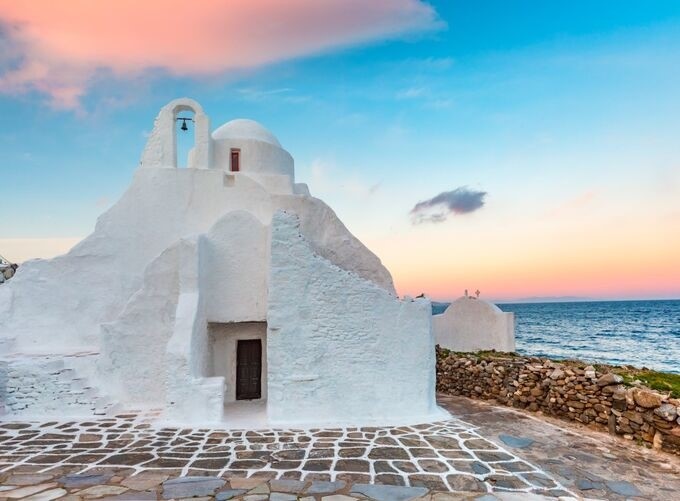
What Kind of September Are You Actually Booking?
Saying “I’m going to Mykonos in September” is less precise than it sounds.
A trip beginning on September 3 can still sit comfortably inside the island’s main summer rhythm. Move the same holiday three weeks later and the sea may remain beautifully swimmable while evenings feel fresher, visitor numbers soften and seasonal businesses begin thinking about how much longer they will operate.
This is why September should be chosen according to priorities rather than averages.
If nightlife matters almost as much as swimming, lean earlier.
If your ideal day combines a long walk, lunch in Chora and several hours beside the sea, the second half becomes particularly appealing.
The entire month belongs to late summer.
It simply does not belong to the same version of it.
The First Half: Summer Without August at Full Volume
Early September suits travelers who want very little compromise.
The sea has accumulated months of warmth. Beach venues remain active, Chora still has substantial evening energy and daytime conditions can feel almost indistinguishable from late August.
Demand does not disappear immediately either.
Popular accommodation and restaurants may remain busy, particularly during the first part of the month, so travelers should not rely on the word “September” as a substitute for making important reservations.
What begins changing is pressure.
The island can gradually become easier to navigate without losing the experiences that made you choose summer in the first place.
For many visitors, that is enough reason to wait.
The Second Half: When the Balance Becomes More Obvious
Late September gives the month its strongest individual identity.
The sea retains warmth more effectively than the atmosphere, allowing swimming to remain a serious part of the trip even as sightseeing becomes increasingly comfortable.
Evenings can feel fresher, and a light layer becomes more useful.
Some seasonal venues may begin adjusting hours or schedules as October approaches, so specific businesses should be checked individually.
What you gain is flexibility.
A midday walk through Chora no longer feels like poor planning. An inland lunch does not sacrifice the only comfortable sightseeing hours. The beach can wait until later because the sea does not suddenly become cold at four in the afternoon.
September begins feeling less like a timetable and more like a holiday.
Sea Temperature and Air Temperature Don't Leave Summer Together
This delayed cooling is the practical reason September works.
The Seasonal Lag
| Seasonal Change | Air | Sea |
|---|---|---|
| Early September | Still strongly summer-like | Holds peak-summer warmth |
| Mid-September | Heat gradually moderates | Remains very suitable for swimming |
| Late September | More noticeable morning/evening softness | Usually retains substantial warmth |
| Moving toward October | Greater day-to-day variation | Cools more slowly |
This table should not be interpreted as a daily forecast.
An unusually hot late-September day or a cooler early-September period can easily occur.
The value lies in understanding the direction of travel.
The atmosphere responds first.
The Aegean follows later.
Three Nights: Keep One Day Almost Entirely Coastal
A short September stay should not try to prove how much of Mykonos can fit into 72 hours.
Spend one substantial period in Chora, give another day or long afternoon to the beach, and use the remaining time for either Ano Mera, broader island exploration or a boat-based experience.
Because the weather is generally comfortable for several different activities, the temptation is to combine all of them.
Resist it.
Three nights work when priorities are clear.
They become tiring when every advantage of September turns into another item on the schedule.
Four Nights: The Balance Starts Making Sense
Four nights are particularly well suited to September because you can allow weather and mood to influence the order.
One day may become beach-focused.
Another can move inland before ending at the coast. A third might include a boat excursion or Delos, while Chora can occupy both daytime and evening hours without being compressed into a single visit.
Choosing the Length of Your Stay
| Stay | Best For | What to Avoid |
| 2 nights | Quick island introduction | Long checklist |
| 3 nights | Chora + beach + one extra | Too many beach changes |
| 4 nights | Full September balance | Overscheduling |
| 5 nights | Slow beach and island mix | Filling every day with tours |
| 6+ nights | Settling into island rhythm | Treating relaxation as wasted time |
September rewards staying slightly longer because the island offers more than one compelling use of good weather.
Five Nights: Allow Yourself to Repeat Something
This is where Mykonos starts becoming less about coverage.
If yesterday's beach was excellent, return.
If you found a restaurant in Chora that suited you perfectly, there is no rule requiring another famous reservation tonight.
A five-night September stay allows repetition without creating the feeling that you have missed something essential.
It also protects the trip against a breezier or cloudier period. You can shift the main beach day rather than forcing it into conditions that do not suit you.
The extra time creates resilience.
It also creates something travel itineraries often forget to include:
Preference.
Don't Assume September Means Bargain Mykonos
Prices can ease compared with the highest-demand part of summer, particularly as the month progresses, but September should not automatically be described as cheap.
Mykonos remains a premium Greek island destination.
Popular hotels, restaurants and experiences can command substantial prices while demand remains healthy, especially early in the month.
Value comes from receiving a different combination for the money: warm swimming conditions, functioning tourism infrastructure, more comfortable sightseeing and gradually reduced pressure.
That can be excellent value.
It is not the same thing as low cost.
A Late Ferry Doesn't Need to Steal Your Final Swim
September's comfortable conditions make departure days surprisingly usable when schedules allow.
If your ferry or flight leaves later, there may still be time for a relaxed breakfast, a final walk through Chora or even a short beach visit before collecting luggage.
Do not build a fragile itinerary around this.
Ports and airports deserve sensible margins, and transfers should account for seasonal traffic and possible operational changes.
But equally, do not mentally end the holiday at breakfast simply because it is departure day.
A four-night stay can sometimes provide almost five useful days when transport timing cooperates.
Seasonal Closing Dates Matter More Than Monthly Labels
This becomes particularly relevant toward late September.
A traveler may read that “Mykonos is open in September” and assume every seasonal business operates through the final day of the month.
That is not how seasonal destinations work.
Individual venues make their own decisions based on bookings, events, staffing and expected demand. Most general tourism services remain available, but a particular beach venue or nightlife experience should be verified directly if it matters.
This is especially important when your entire reason for visiting depends on one named place.
Never allow a general destination guide to confirm a specific business schedule.
Twelve FAQs About Mykonos Weather in September
1. Is September a good time to visit Mykonos?
September is particularly attractive for travelers wanting warm swimming conditions with less intense summer heat. The island remains active, especially early in the month, while sightseeing becomes increasingly comfortable. Later September also offers a more balanced atmosphere as peak-season visitor pressure gradually eases.
2. How hot is Mykonos in September?
Typical daytime temperatures often range around 24–28°C, although early September can produce hotter summer-like periods. Evenings generally fall toward approximately 19–22°C. Conditions become more variable later in the month, but substantial warm and sunny weather remains common.
3. Is the sea warm in Mykonos in September?
Yes. The Aegean retains heat accumulated throughout summer, making September one of the strongest months for combining comfortable swimming with softer air temperatures. The sea cools more slowly than the atmosphere, which is central to the month's appeal for beach-oriented travelers.
4. Can you swim in Mykonos in late September?
Swimming commonly remains very realistic during late September because sea temperatures retain substantial summer warmth. Individual weather conditions naturally vary, and breezier or cooler days can affect comfort, but the end of September is generally still much more swimming-oriented than conventional autumn weather might suggest.
5. Is Mykonos crowded in September?
Early September can remain busy, with active beaches, nightlife and significant visitor demand. Crowds generally begin easing as the month progresses. Late September often provides more breathing room, although famous parts of Chora and popular beaches should not be expected to become completely empty.
6. Are Mykonos beach clubs open in September?
Many beach venues continue operating during September, particularly earlier in the month, but individual closing dates and event schedules vary. If a specific club is central to your trip, check directly with the venue rather than assuming every seasonal business follows the same calendar.
7. Does it rain in Mykonos in September?
September is generally much drier than the later autumn and winter period, although the chance of unsettled weather gradually increases as the month advances. Most trips still provide substantial outdoor time, but short-range forecasts become increasingly useful toward the end of September.
8. Is Mykonos windy in September?
Breezy conditions remain possible, and stronger winds can occasionally influence beaches or boat excursions. However, September's defining weather feature is the combination of warm seawater and gradually softer air temperatures rather than the detailed Meltemi beach-selection decisions associated more strongly with July.
9. What should I wear in Mykonos in September?
Summer clothing, swimwear, sunscreen, sunglasses and comfortable footwear remain appropriate throughout most of September. Add a light sweater, overshirt or jacket for evenings, particularly later in the month or during breezy conditions. Heavy autumn clothing is generally unnecessary under typical conditions.
10. Is early or late September better for Mykonos?
Choose early September for stronger summer energy, nightlife and highly reliable beach conditions. Late September better suits travelers wanting warm swimming combined with more comfortable sightseeing and gradually reduced crowds. Both periods work well, but they deliver noticeably different versions of the island.
11. How many days should I spend in Mykonos in September?
Three nights provide a useful introduction, while four nights offer a stronger balance between Chora, beaches and inland exploration. Five nights suit travelers who want to slow down, repeat favorite places and retain flexibility around individual weather conditions rather than tightly scheduling every day.
12. Is September or October better for Mykonos?
September is better when swimming, beach time and active seasonal tourism remain important. October suits travelers willing to accept greater weather variability in exchange for a quieter autumn atmosphere. September offers significantly more confidence for visitors whose holiday still depends on the Aegean.

A travel professional specializing in tailor-made travel planning, guest experience management, and multi-destination tourism operations.
With over 23 years of experience in the travel industry, he designs and manages private and cultural tours for international travelers across Türkiye, Greece, Egypt, Jordan, Morocco, and other destinations.
He has strong expertise in both online and face-to-face guest communication, sales processes, and end-to-end travel operations.
Working closely with hotels, travel agencies, and local partners, he ensures smooth coordination and high-quality travel experiences at every stage of the journey.
His focus is on delivering personalized, reliable, and seamless travel experiences for international guests worldwide.