Best Beaches in Greece: Choosing the Right Beach for Your Trip
Updated: August 2026
There is a predictable moment when planning a Greek holiday begins to get complicated. You search for the country's best beaches, save a photograph of impossibly clear water beneath white cliffs, find another beach with pale sand and almost Caribbean-looking shallows, and suddenly your itinerary contains islands scattered across completely different parts of Greece.
The photographs are not the problem. The word “best” is.
A beach can be spectacular and still be wrong for your holiday. It may require a substantial detour, sit on an island that offers little else you personally want, involve more difficult access than the photographs suggest, or simply provide a style of beach day that does not match the way you like to travel.
For most visitors, choosing the best beaches in Greece should therefore begin one level higher.
Do you want long sandy beaches where staying nearby makes beach days effortless? Are you willing to drive or take boats to find more dramatic scenery? Do you want organized beaches with restaurants and facilities, or would you rather trade convenience for a quieter setting? Does the rest of the island matter as much as the beach?
Once those questions are answered, Greece becomes much easier to choose.
The Best Beach in Greece Depends on What You Want From the Day
A couple looking for a stylish, social afternoon by the sea is solving a completely different problem from parents who want shallow water, sand and minimal logistics.
Neither is necessarily looking for the same beach as a photographer fascinated by unusual geology.
That is why universal beach rankings are rarely as useful as they appear.
Naxos can be an excellent choice when the priority is making long sandy beach days an easy part of the holiday. Milos attracts travelers who enjoy moving around an island to encounter strikingly different coastal landscapes. Mykonos has a well-developed organized beach culture, while Crete provides enormous variety but asks travelers to take the island's scale seriously.
Move west toward the Ionian islands and the visual character changes again, with dramatic green landscapes and limestone coastlines creating a very different impression from the Cyclades.
The first question should therefore not be “Which beach is number one?”
Ask:
“What do I want my beach days to feel like?”
Start With the Island, Then Judge the Beach
Choosing an entire destination because of one photograph is one of the easiest ways to build an awkward Greece itinerary.
Suppose a particular beach requires another flight or ferry, an additional hotel change and a long transfer once you arrive. The beach may indeed be magnificent, but you have effectively redesigned several days of the holiday around a few hours beside the sea.
Sometimes that is worth it.
Usually, however, the better question is whether the island and its beaches together justify the journey.
This is particularly important in Greece because beach destinations are distributed across different island groups and mainland regions. The Cyclades, Ionian islands, Dodecanese and Crete should not be treated as though they were neighboring resorts connected by a five-minute boat ride.
Choose a region that fits the wider journey first. Then find the beaches within that region that match your priorities.
Naxos Makes Beach Time Easy to Build Into the Holiday
Naxos has an advantage that tends to matter more after arrival than it does while scrolling through photographs: beach time can be relatively easy to make part of the daily rhythm.
Long sandy stretches such as Agios Prokopios, Agia Anna and Plaka give travelers several choices along the western side of the island, while accommodation and dining options in beach-oriented areas can reduce the need to turn every swim into a logistical expedition.
That makes Naxos particularly appealing when the purpose is to spend substantial time at the beach, rather than merely visit one famous shoreline.
The island also has enough inland character to prevent the holiday from becoming repetitive, but that belongs to a broader Naxos destination discussion.
Within this page, Naxos owns a simpler idea:
great beach holidays do not always require heroic effort.
For travelers who want to wake up and decide that today is simply a beach day, convenience has genuine value.
Milos Rewards Travelers Who Enjoy Looking for the Next Coastline
Milos approaches the beach question almost from the opposite direction.
Its appeal lies partly in geological variety. Sarakiniko has become instantly recognizable because its pale volcanic formations create an environment that looks unlike the conventional sandy-beach image of Greece, while other parts of the island present very different coastal settings.
That variety rewards exploration.
The trade-off is that the traveler who wants to experience several distinctive beaches should expect movement to become part of the holiday. Where you stay, how you get around and which coastal areas you prioritize matter more than they might on an island where the main objective is walking from a hotel to the same long sandy beach every morning.
For some travelers, this is precisely the attraction.
Milos makes the beach itself part of discovering the island.
Crete Gives You Choice, but Distance Becomes Part of the Decision
Crete contains some of Greece's most famous coastal scenery, including Elafonissi and Balos, but the island's enormous advantage is also the source of its biggest planning mistake.
Crete is large.
Seeing a beautiful photograph taken somewhere on the island does not mean that beach will be conveniently located relative to your hotel. A traveler based in one region should not casually construct daily plans around attractions at the opposite end of Crete as though the island were geographically comparable to Mykonos.
This is why accommodation location matters enormously on a beach-focused Crete holiday.
Rather than beginning with five famous beaches and attempting to connect them afterward, choose the part of Crete that best suits the wider trip and investigate the coastal possibilities around that base.
Crete rewards travelers who accept its scale.
It frustrates those who try to defeat it.
Mykonos Is Very Good at a Particular Kind of Beach Day
Mykonos does not need to win a competition for Greece's most dramatic natural beach in order to be a strong beach destination.
Its advantage is different.
The island has a developed culture of organized beaches where swimming can be combined with sunbeds, restaurants, music and a more social atmosphere. For travelers who enjoy that style, convenience and energy may matter considerably more than finding the most remote bay in Greece.
For travelers seeking solitude and minimal commercial development, the same characteristics may be reasons to choose somewhere else.
That is exactly why “best beaches” should never be separated from travel style.
Mykonos is not universally better or worse than Naxos or Milos. It is better at delivering a particular version of the Greek beach day.
Understanding that before booking is much more useful than comparing water color in photographs.
The Ionian Islands Change the Visual Language Completely
Travelers who associate Greek beaches exclusively with white Cycladic villages and dry island landscapes may find the Ionian side surprisingly different.
Kefalonia, Lefkada, Zakynthos and Corfu combine blue water with greener surroundings and, in several places, dramatic limestone scenery. Myrtos on Kefalonia and Porto Katsiki on Lefkada are among the names that regularly appear in discussions of spectacular Greek beaches, while Zakynthos is globally recognized for its striking coastline.
Yet the Ionian islands should not be added to a Cyclades itinerary casually just because a particular beach looks irresistible.
They belong to a different geographical travel logic.
If you are already committed to Athens, Mykonos and Santorini, flying or otherwise rerouting west simply to collect another famous beach may create more movement than enjoyment. If the Ionian landscape itself is what attracts you, however, build the coastal portion of the trip around that region rather than treating it as an accessory.
Rhodes Solves the Beach-or-Culture Argument
Some travelers do not want to choose between lying beside the sea and having substantial cultural sightseeing available within the same destination.
Rhodes can be particularly strong in that situation.
The island provides varied coastal possibilities while the Medieval City of Rhodes adds a historical environment entirely different from the Cycladic experience. This makes it easier for couples or families with mixed interests to share one destination without everyone needing to want exactly the same holiday.
One traveler can care primarily about beaches while another values history and urban exploration.
That does not mean Rhodes automatically has Greece's “best” beach.
It means Rhodes may provide the best overall beach-based destination for a group whose interests do not stop at the shoreline.
That is a much more useful distinction.
Santorini Is Famous, but That Does Not Make It the Automatic Beach Winner
Santorini illustrates the difference between choosing Greece's most famous island and choosing Greece specifically for beaches.
The island's volcanic coast creates distinctive beaches, and swimming can certainly be part of a Santorini stay. Nevertheless, most first-time visitors are primarily drawn by the caldera, cliffside settlements, sunsets and extraordinary volcanic landscape rather than by the expectation of a conventional sandy-beach holiday.
For a traveler whose number-one priority is several days on long, soft beaches, Naxos or another beach-oriented island may fit better.
For someone who wants Santorini's landscape first and occasional beach time second, there is no problem at all.
This is not about declaring one island superior.
It is about allowing the purpose of the trip to determine the destination, rather than allowing fame to make the decision automatically.
What Are You Willing to Trade for the Beach You Want?
The most useful beach comparison is not a beauty score. It is an exchange.
| Your Main Priority | Strong Candidate | What You Gain | What You Accept |
|---|---|---|---|
| Long sandy beach days | Naxos | Easy beach-focused rhythm | Less emphasis on iconic caldera scenery |
| Distinctive coastal landscapes | Milos | Exceptional geological variety | More movement to explore |
| Maximum beach variety | Crete | Huge range of coastal choices | Distances require careful planning |
| Organized/social beach days | Mykonos | Facilities, dining and beach culture | Higher-demand, more developed atmosphere |
| Dramatic Ionian scenery | Kefalonia / Lefkada | Cliffs, greenery and striking water | Different routing from Cyclades trips |
| Beach plus cultural depth | Rhodes | Coast and major heritage together | Larger-island planning matters |
| Iconic scenery beyond beaches | Santorini | Caldera and volcanic character | Beach is rarely the sole reason to go |
The “What You Accept” column matters just as much as “What You Gain.”
Every island choice solves one problem while creating another.
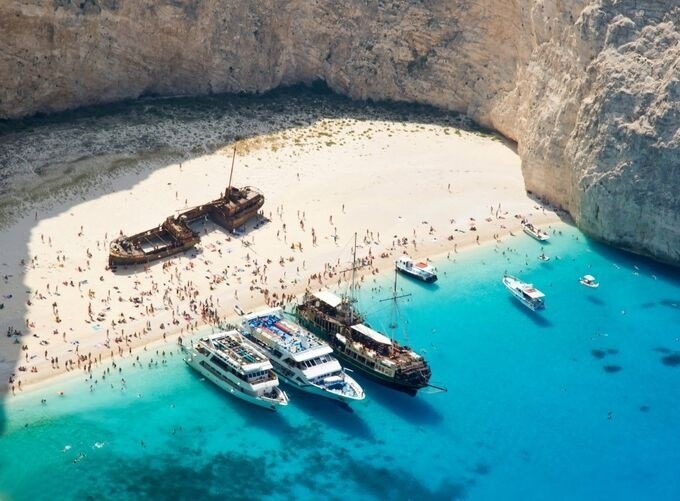
Beautiful Does Not Always Mean Convenient
A remote beach reached after a longer drive, walk or boat journey can become one of the best days of a holiday.
It can also become the day everyone remembers for the wrong reason if nobody considered what reaching it involved.
Beach access varies enormously across Greece. Some locations offer organized facilities and straightforward transport, while others may require more planning, greater mobility or a willingness to spend a significant part of the day reaching and leaving the coast.
Conditions and access arrangements can also change, so famous beaches with special access considerations should always be checked close to travel rather than planned from an old photograph or blog post.
This becomes especially relevant for families, travelers with limited mobility and anyone attempting to visit several beaches in a single day.
A spectacular coastline does not lose its beauty because reaching it requires effort.
But that effort belongs in the decision.
Families Should Choose the Beach Day Before Choosing the Famous Name
A family beach has different requirements from an Instagram-famous beach.
Parents may care about sand, manageable access, nearby food, shade possibilities, facilities and whether returning to the accommodation midway through the day is realistic. Younger children usually do not care that a beach appears on every “Top 10 Greece” list.
This does not mean families should avoid adventurous coastal locations.
It means convenience deserves to be treated as a feature rather than a compromise.
Naxos can work particularly well for families who want straightforward sandy beach time, while larger islands such as Crete and Rhodes provide considerable choice when the accommodation base is selected carefully.
The dedicated family Greece content should own destination-level family comparisons. Here the principle is narrower:
The best family beach is often the one that makes a full beach day easy.
Do Not Build an Island-Hopping Trip Around Individual Beaches
There is a point at which beach discovery becomes destination collecting.
Athens followed by Mykonos, Santorini, Milos, Naxos, Crete and Zakynthos may look impressive as a list, but geography has not disappeared simply because every stop contains blue water.
Each island change introduces packing, check-out, port or airport transfers, transportation time, another check-in and the possibility that schedules dictate more of the day than expected.
Travelers interested in Greek island journeys with meaningful beach time usually gain more by choosing fewer islands and experiencing several beaches within them.
Three memorable beach days on one well-chosen island can produce a better holiday than three famous beaches reached through three separate transfers.
The Beach Should Earn the Detour
There is nothing wrong with traveling specifically for a beach.
If seeing the landscapes of Milos has been a long-standing goal, build Milos into the trip. If the Ionian coastline is the image that made you want to visit Greece, allow that region to become central rather than forcing it around a standard Cyclades itinerary.
The problem begins when every beautiful photograph becomes an obligation.
Before adding a beach that requires a substantial detour, ask three questions:
Would I still want to visit the surrounding island if this beach did not exist?
Does this coastline offer something genuinely different from the beaches already in my itinerary?
Am I comfortable spending the necessary travel time to experience it?
If the answer to all three is yes, the detour may be completely worthwhile.
Choose the Beach Experience First and the Famous Name Second
Greece does not have one beach that is objectively best for everyone, and that is good news.
Travelers seeking effortless sandy days can make a very different choice from those chasing unusual landscapes. Couples wanting organized beach clubs do not need the same island as families seeking easy access, while travelers combining archaeology and swimming may reasonably prioritize Rhodes or Crete over a destination selected exclusively for its coastline.
For Greece holidays balancing coast and cultural experiences, the strongest itinerary often emerges when the beach destination performs more than one role without trying to do everything.
The same principle applies to travelers considering custom Greece trips built around island stays: decide what kind of coastal experience matters before deciding how many islands to include.
Do not ask which beach wins Greece.
Ask which beach makes sense in your Greece.
That smaller question usually produces a much better holiday.
Frequently Asked Questions About Choosing Beaches in Greece
1. Should I choose my Greek island mainly according to its beaches?
Only if beach time is the main purpose of your holiday. Otherwise, consider what the destination offers away from the coast as well. The best island choice usually reflects the balance you want between swimming, sightseeing, food, landscapes and evening atmosphere.
2. Is Naxos a better beach choice than Santorini?
For travelers prioritizing long sandy beach days, Naxos may be the stronger fit. Santorini offers distinctive volcanic beaches, but its principal appeal is usually the caldera landscape and villages. The better island depends on whether beach quality or iconic scenery comes first.
3. Do I need a rental car to enjoy Greece's best beaches?
Not always. Some islands have excellent beaches close to accommodation areas or accessible through local transportation, while others reward independent mobility. Choose your base carefully before deciding whether a vehicle is necessary rather than assuming every famous beach requires driving.
4. Is it worth changing islands for one famous beach?
Sometimes, but the beach should justify the transportation and hotel change involved. If the surrounding island also interests you, the journey can make sense. Traveling several hours purely for one photographable coastline often provides less value than exploring your existing destination more deeply.
5. Are organized beaches better for first-time visitors?
They can be particularly convenient because facilities, food and sunbed services simplify the day, although some travelers prefer quieter undeveloped coastlines. Neither style is inherently better; the right choice depends on how much comfort, activity and independence you want beside the sea.
6. Does where I stay matter more than which beaches I choose?
On larger islands, accommodation location can matter enormously because distances affect how easily you reach different coasts. A sensible base near several beaches you genuinely like may produce a better holiday than staying far away simply to chase one famous location.
7. Can I combine serious sightseeing with a beach holiday in Greece?
Yes. Islands such as Rhodes and Crete can combine substantial cultural experiences with beach time, while Athens can be paired with a beach-oriented island. The key is leaving enough unscheduled time so swimming does not become another activity squeezed between sightseeing appointments.
8. Should families prioritize sandy beaches over dramatic scenery?
Often, but not automatically. Easy access, suitable conditions, nearby facilities and the ability to return comfortably to accommodation can matter more than scenery when traveling with younger children. Families should evaluate how the entire beach day works rather than choosing from photographs alone.
9. Are the Cyclades or Ionian islands better for beach scenery?
Neither group is universally better. The Cyclades offer their characteristic Aegean landscapes, while Ionian islands often combine striking blue water with greener surroundings and dramatic limestone coastlines. Your wider Greece route and preferred visual environment should influence the choice.
10. How many beach islands should I include in a two-week Greece trip?
There is no fixed number, although fewer islands usually provide more usable beach time. Every island change consumes part of a day through packing, transfers and transportation, so adding destinations can paradoxically reduce the amount of time actually spent beside the sea.
11. Are Greece's most famous beaches always the best ones to visit?
No. Fame reflects scenery and visibility rather than individual travel needs. A lesser-known beach close to your accommodation with suitable facilities and easy access can produce a far better day than an iconic beach requiring substantial effort to reach.
12. What makes a Greek beach worth traveling out of the way for?
A detour makes sense when the coastline offers something genuinely distinctive, the surrounding destination also interests you and the journey fits comfortably within the itinerary. If reaching one beach destabilizes several other days, its fame alone is rarely enough justification.

A travel professional specializing in tailor-made travel planning, guest experience management, and multi-destination tourism operations.
With over 23 years of experience in the travel industry, he designs and manages private and cultural tours for international travelers across Türkiye, Greece, Egypt, Jordan, Morocco, and other destinations.
He has strong expertise in both online and face-to-face guest communication, sales processes, and end-to-end travel operations.
Working closely with hotels, travel agencies, and local partners, he ensures smooth coordination and high-quality travel experiences at every stage of the journey.
His focus is on delivering personalized, reliable, and seamless travel experiences for international guests worldwide.