Ajloun Makes Sense When You Want Northern Jordan to Change Character
Updated: August 2026
Ajloun is rarely the destination that convinces somebody to book a flight to Jordan, which may actually be one of its advantages.
There is less pressure surrounding the visit. Nobody arrives feeling that a particular photograph must be recreated, there is no world-famous façade waiting at the end of a dramatic approach, and the experience does not need to compete with years of expectations built from travel advertising.
Instead, Ajloun becomes interesting because of what happens to the journey on the way there.
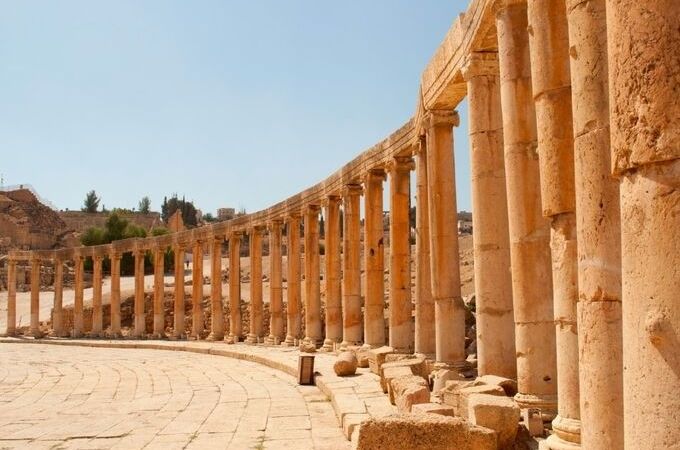
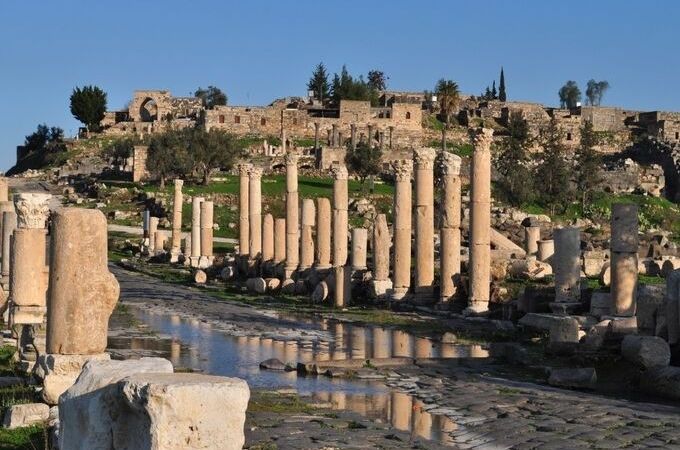
Northern Jordan becomes greener and more elevated, the landscape feels increasingly removed from the country's better-known desert imagery, and Ajloun Castle introduces a medieval defensive story that contrasts sharply with the Roman urban archaeology travelers may have experienced earlier at Jerash.
For most first-time visitors, Ajloun works best as a carefully chosen addition to a northern Jordan day rather than as a destination requiring its own hotel stay. The addition is particularly worthwhile for travelers interested in castles, medieval history, landscape and seeing a side of Jordan that looks noticeably different from Petra and Wadi Rum.
The decision becomes less convincing when Ajloun is added simply because it is geographically possible.
Jordan contains many places that fit on a map.
That does not mean they all belong in the same day.
Ajloun's Value Begins With Contrast
The strongest reason to include Ajloun is not that Jordan needs another historical monument in the itinerary.
Most cultural journeys already contain plenty of history.
Ajloun earns its place because it changes the type of history being experienced.
A traveler moving through Jordan can encounter Nabataean architecture at Petra, Roman urbanism at Jerash, Byzantine mosaics around Madaba and Islamic-era history elsewhere. Ajloun Castle contributes a medieval defensive perspective that feels materially different from walking through an ancient ceremonial street or examining a rock-cut façade.
The surrounding geography strengthens that distinction.
Northern Jordan can appear surprisingly green to travelers whose mental image of the country has been shaped almost entirely by Wadi Rum. Elevation, vegetation and agricultural landscapes create another visual vocabulary, particularly during seasons when the countryside is at its most expressive.
This combination of historical and geographical contrast is the real argument for Ajloun.
Without that interest, the castle can become simply another stop.
The Castle Is the Reason Most First-Time Visitors Come
Ajloun Castle, also known as Qal'at ar-Rabad, is the natural center of a first visit.
Its origins date to the late 12th century, when the fortress was constructed in the context of regional defense during the period associated with Saladin and the Crusades. Later alterations and historical events changed the structure over time, which means what visitors see today reflects more than one moment in its history.
That background matters, although the castle becomes easier to understand when the architecture is connected to its position.
This was not a decorative building placed on high ground because somebody appreciated the view.
Elevation had strategic value.
Looking outward from the castle therefore contributes to understanding why a fortress belonged here, while the surrounding hills make the visit feel considerably different from exploring an archaeological site on a flatter urban plan.
The landscape is not scenery added behind the monument.
It is part of the explanation.
Ajloun Should Not Be Sold as “Jerash Plus a Castle”
Jerash and Ajloun are often mentioned together, which can accidentally make Ajloun sound like an appendix.
Visit the Roman ruins, have lunch, see a castle, return to Amman.
Operationally, the combination can work well, but the destinations deserve clearer separation.
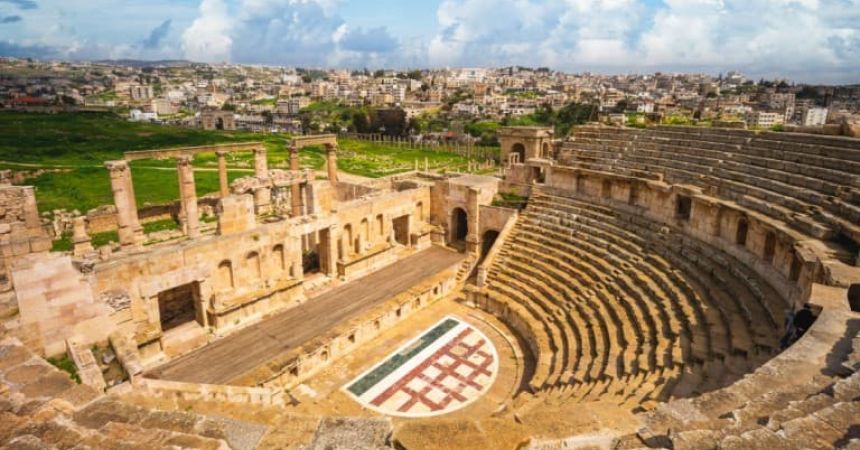
Jerash asks visitors to understand the structure of an ancient city through streets, plazas, temples and theatres. Ajloun is more concentrated, with a defensive monument occupying a landscape that explains part of its historical purpose.
The intellectual rhythm is therefore different.
At Jerash, you move through an urban archaeological environment.
At Ajloun, you spend more of the visit thinking about position, defense, territory and visibility.
This difference is precisely why combining them can be worthwhile. If Ajloun merely reproduced the experience of Jerash, adding it would make little sense.
Our Northern Jordan internal content can connect the broader geography, while each destination retains its own search intent.
The Real Cost of Ajloun Is Not the Entrance Fee; It Is the Afternoon
Travelers deciding whether to add Ajloun often ask whether the castle is “worth it,” as though the answer can be measured by the monument alone.
The more useful calculation concerns time.
Once Ajloun enters a northern Jordan day, the schedule acquires additional driving, another substantial visit and whatever practical time is needed for lunch, rest stops and transitions. If the day began early in Amman and already includes a meaningful Jerash visit, Ajloun changes the return time and overall intensity.
This may be exactly what you want.
A full northern Jordan day with two contrasting historical experiences can be extremely satisfying.
However, travelers who prefer slow archaeological visits may discover that protecting more time at Jerash provides greater value than adding another destination.
Ajloun therefore has an opportunity cost.
That is not an argument against going.
It is the information needed to decide intelligently.
A Combined Day Works Best When Neither Destination Is Treated as a Race
The problem with combination days is rarely the combination itself.
It is optimism.
An itinerary begins with an early departure from Amman, allows a substantial Jerash visit, adds Ajloun, inserts lunch and promises a comfortable return to the capital. Each individual component appears reasonable until the day encounters normal travel behavior: somebody spends longer taking photographs, lunch service takes time, the guide answers questions, traffic changes or the group simply moves more slowly than a spreadsheet anticipated.
This is why combination days need margin.
If Jerash is your dominant priority, protect its time first and allow Ajloun to follow without forcing an artificially early departure from the archaeological site.
If Ajloun interests you equally, begin early enough that the castle is not visited under end-of-day pressure.
The objective should be two worthwhile experiences rather than two successful check-ins.
Ajloun Works Better for Some Travelers Than Others
Ajloun becomes particularly attractive for travelers who already know they enjoy castles and defensive architecture.
It also suits people who value landscape transitions and want to see more of northern Jordan rather than concentrating exclusively on the country's headline archaeological destinations.
Photographers may appreciate the relationship between the castle and surrounding hills, while travelers interested in medieval history gain a period that can be relatively underrepresented in itineraries dominated by ancient civilizations.
The destination becomes less essential for visitors whose Jordan trip is short and whose historical interest centers strongly on Petra, Jerash or biblical archaeology.
This is where itinerary design should resist universal recommendations.
“Worth visiting” is not an intrinsic property that a destination either possesses or lacks.
It depends on what the additional hours prevent you from doing elsewhere.
The Northern Landscape Is Part of Why the Detour Feels Worthwhile
Jordan is frequently imagined through sandstone.
That image is understandable because Petra and Wadi Rum dominate international visual coverage of the country, although it leaves first-time travelers poorly prepared for the variation found farther north.
Ajloun's hills and vegetation can therefore provide a useful visual reset.
The effect is especially noticeable when the journey later continues south, because the traveler has experienced a broader progression of Jordanian landscapes rather than moving immediately from capital city to desert-associated destinations.
Season naturally influences what the countryside looks like, so no article should promise a permanently lush green panorama throughout the year.
What remains consistent is the geographical contrast.
Ajloun helps dismantle the idea that Jordan has one landscape.
For travelers who care about that diversity, the road itself contributes to the visit.
Do You Need a Guide at Ajloun Castle?
A traveler can certainly appreciate the fortress visually without continuous explanation, particularly if they have researched the basic historical background beforehand.
Guiding becomes more valuable when you want to understand why the castle was positioned here, how defensive architecture functioned, what changed through later periods and how the structure relates to the wider political geography of the region.
This is different from Jerash, where interpretation often helps reconstruct an entire urban system.
At Ajloun, the guide can be more selective.
The strongest explanation connects architecture to landscape rather than turning every chamber into a separate lecture.
Travelers using Jordan Guides for a broader northern day can also benefit from continuity because the guide can distinguish the historical periods encountered without repeating a generic Jordan history lesson at every stop.
The purpose is context, not commentary by the minute.
How Much Time Should You Actually Allow at the Castle?
Ajloun Castle does not require the same time commitment as Jerash.
For many first-time visitors, approximately one to two hours can provide a comfortable castle experience, depending on interest, walking pace, photography and how much interpretation is included.
That range should not be treated as a guarantee or rigid appointment.
Travelers deeply interested in medieval architecture may remain longer, while others may feel satisfied sooner.
What matters operationally is that the visit should not be calculated from the moment the vehicle reaches the general area until the moment it leaves. Parking, approaching the site, ticket arrangements and normal group movement all consume time.
If the itinerary provides precisely sixty minutes because “the castle takes an hour,” the actual exploration time will inevitably be shorter.
A little margin prevents an interesting visit from becoming unnecessarily mechanical.
Ajloun Castle Is Compact, but That Does Not Mean Every Traveler Experiences It Equally
Historic fortifications contain the sort of features modern accessibility standards were not designed around.
Steps, uneven surfaces, enclosed passages and changes in level can affect how comfortable the visit feels, particularly for travelers with mobility limitations.
Current access conditions and any specific assistance requirements should therefore be confirmed before the visit rather than assumed from photographs.
Families should make a similar assessment for young children, although many children find castles easier to engage with than conventional archaeological ruins because the architecture naturally encourages questions about defense, towers and how people used the building.
The important distinction is that “shorter visit” does not automatically mean “easier visit.”
Duration and physical accessibility are separate considerations.
Lunch Can Decide Whether the Day Feels Comfortable
When Jerash and Ajloun share the same day, lunch stops being an incidental detail.
A long restaurant meal between the two can provide a welcome break after several hours of walking, but it also pushes the second visit later. A very quick lunch preserves sightseeing time while potentially making the day feel more transactional.
The correct choice depends on the group.
Older travelers and families may benefit from a proper pause. Travelers who prefer an early return to Amman may want a more efficient meal. During warmer periods, lunch can also provide useful time away from direct outdoor exposure.
This is the kind of operational decision that generic destination articles usually ignore because lunch does not sound exciting.
On an actual tour, however, a poorly timed lunch can influence the afternoon more than another paragraph of castle history ever will.
Ajloun Forest Reserve Is a Different Reason to Come North
The wider Ajloun area also attracts travelers interested in nature, walking and rural landscapes, but this is where we need to maintain strict cluster discipline.
A traveler adding Ajloun Castle to a Jerash day is making a historical-route decision.
Someone traveling specifically for trails, forest environments, local community experiences or a slower nature stay is making a different decision that deserves its own content architecture.
Combining both into one enormous “Ajloun Complete Guide” would weaken both intents.
For this destination page, nature matters because it explains why the region looks and feels different.
It does not need to become a comprehensive hiking guide.
That boundary also protects our future Dana and Wadi Mujib content, where active outdoor travel has a much more central role.
Ajloun Is Not the Castle Stop for the King's Highway
Jordan's castles are another obvious source of cannibalization.
Ajloun and Kerak both involve fortifications, but they occupy different routes and solve different itinerary questions.
Ajloun belongs naturally to a northern Jordan decision, often connected geographically with Jerash and an Amman base.
Kerak belongs to the southbound route discussion, particularly when travelers are considering the King's Highway toward Petra.
Treating them as interchangeable “Jordan castles” would flatten their geographical roles.
Our later Kerak article will therefore ask how much time that castle deserves within a King's Highway travel day, while Ajloun asks whether a northern Jordan day benefits from another destination after Jerash.
Same broad monument category.
Different travel problem.
That is exactly the separation we want.
Ajloun Does Not Usually Need Its Own Hotel Night
For a conventional first-time Jordan itinerary, most travelers can experience Ajloun effectively while remaining based in Amman or continuing according to a wider northern route.
An overnight becomes more relevant when the traveler wants the region itself to become part of the holiday rather than merely visiting the castle.
That could involve nature, hiking, rural experiences or a deliberately slower approach to northern Jordan.
Those interests change the purpose of the stay.
For someone primarily interested in the castle, moving hotels usually introduces more luggage handling and check-in time than the destination requires.
This is another example of why accommodation nights should not be used as a measure of destination importance.
Ajloun can be worthwhile without sleeping there.
Sometimes the most respectful itinerary decision is knowing when not to add a hotel.
Ajloun Versus More Time in Jerash Is the Decision That Actually Matters
If your day already includes Jerash, you effectively have two options.
You can protect additional time for a slower archaeological visit, perhaps allowing more photography, interpretation and breaks.
Or you can accept a more defined Jerash schedule and use the remaining portion of the day to experience Ajloun's castle and northern landscape.
Neither option is inherently superior.
The decision should follow interest.
A traveler fascinated by Roman archaeology may gain more from another hour at Jerash than from changing destinations. Someone who values historical variety may prefer leaving Jerash after a focused visit and moving into a completely different medieval setting.
This is much more useful than asking whether Ajloun is “a must-see.”
Very few places are universally mandatory.
Travel becomes better when recommendations admit that.
When the Weather Changes, Ajloun Changes More Than the Castle Does
The fortress remains the historical centerpiece throughout the year, while the surrounding landscape responds much more visibly to seasonal conditions.
Vegetation, visibility, temperature and the general character of the hills can vary, influencing how much the countryside contributes to the day.
This means travelers attracted mainly by the castle have a more stable reason to visit than those whose interest comes primarily from photographs of green northern scenery.
It is better to understand that difference before arrival.
A destination should not disappoint merely because nature failed to reproduce an image taken in another month.
Seasonality is part of place.
It is not a defect in it.
A Northern Jordan Day Needs an Exit Strategy
This sounds overly operational until the day begins running late.
If you are returning to Amman after Ajloun, consider what is waiting that evening.
A casual dinner leaves plenty of flexibility.
A fixed restaurant reservation, evening activity or early flight the following morning changes the calculation.
The final sightseeing stop of a combination day is particularly vulnerable because every delay earlier in the schedule eventually arrives there.
This is why Ajloun should not be added with no discussion of return timing.
The castle may only require a relatively contained visit, but the day includes everything that happened before it.
Building thirty to sixty minutes of flexibility around the broader schedule can protect the experience far better than trying to predict every movement precisely.
Travel rarely follows the minute.
Good planning knows that in advance.
When Ajloun Adds More Than It Costs
Ajloun is a strong addition when you have enough time to experience Jerash properly, remain interested in another historical period and appreciate the idea of seeing northern Jordan's landscape rather than returning directly to Amman.
It also works well when the trip would otherwise be dominated by Petra, desert landscapes and southern Jordan, because the northern environment broadens the visual experience of the country.
In that context, the extra road time is doing useful work.
You are not merely traveling to another monument.
You are changing both landscape and historical period.
When You Should Leave Ajloun Out
Skip Ajloun when including it would force Jerash into an unnecessarily short visit, when the group is already tired, when your wider itinerary is extremely compressed or when medieval castles simply do not interest you enough to justify extending the day.
Leaving it out is not a planning failure.
The worst reason to visit Ajloun is that somebody described it as “must-see” without knowing how many days you have in Jordan.
The strongest itineraries contain deliberate omissions.
You cannot give meaningful time to everything.
Ajloun Works Best as the Destination You Chose, Not the One That Happened to Fit
That distinction summarizes the page.
Ajloun is close enough to other northern attractions that it can easily become an automatic addition, yet proximity alone is not a compelling reason to visit.
The stronger case is contrast.
A medieval fortress after Roman Jerash changes the historical period. The hills change the landscape. The route shows travelers a greener northern environment that many did not associate with Jordan before arriving.
When those differences interest you, Ajloun can turn a straightforward archaeological excursion into a much broader northern Jordan day.
When they do not, give Jerash more time and return to Amman without guilt.
A destination does not become more valuable because you managed to squeeze it in.
Ajloun becomes valuable when you leave enough room to notice why you came.
Ajloun Questions That Depend on the Kind of Day You Are Building
1. Is Ajloun worth visiting if I am not going to Jerash?
Yes, particularly for travelers interested in medieval fortifications, northern landscapes or the wider Ajloun region. Pairing it with Jerash is convenient rather than compulsory, although visiting Ajloun alone from Amman requires deciding whether the castle and regional scenery justify the road time for your interests.
2. Is Ajloun Castle mainly a viewpoint or is there enough to explore inside?
The elevated setting and surrounding views are important, but the fortress itself provides the historical substance of the visit. Travelers interested in defensive architecture will gain more from understanding the internal spaces and strategic position rather than treating the castle merely as a panoramic stop.
3. Will Ajloun feel repetitive if I am visiting Kerak later?
Not necessarily, because the two castles occupy different landscapes, historical contexts and positions within a Jordan route. Ajloun functions naturally within northern Jordan, while Kerak usually enters a southbound King's Highway journey, so their itinerary roles are quite different.
4. Can I visit Ajloun and still have a relaxed evening in Amman?
Usually this can be arranged when the northern day begins at a sensible time and the visits are paced realistically, although traffic, lunch duration and individual sightseeing pace influence the return. Avoid scheduling an inflexible evening commitment immediately after an already full combination day.
5. Is Ajloun interesting for travelers who have already seen many European castles?
Potentially, because the value lies partly in regional history and the castle's relationship with Jordan's northern geography rather than architectural novelty alone. Travelers interested only in the scale or decorative richness of castles may find other Jordan experiences a higher priority.
6. Does Ajloun deserve a separate day from Jerash?
For most first-time visitors focused primarily on Ajloun Castle, a separate day is usually unnecessary. It becomes more reasonable when nature, hiking or slower exploration of the wider region is important enough that Ajloun itself, rather than the castle alone, becomes a principal destination.
7. How much additional time does Ajloun add to a Jerash day?
The answer depends on the exact route, traffic, lunch arrangements and starting point, so it is better to calculate the complete day for your travel date than apply a universal number. Remember that the addition includes road movement and practical transition time, not only the castle visit.
8. Is Ajloun a good choice for a multigenerational family?
It can be, particularly when different generations enjoy history and scenery, although steps and uneven historic surfaces should be considered for anyone with mobility limitations. Confirm current access arrangements beforehand rather than assuming that a relatively short castle visit will automatically be physically easy.
9. Should photographers visit Ajloun at a particular time of day?
Light and visibility can influence landscape photography, although the best timing varies with season and weather. If photography is a major priority, allow enough flexibility to explore different perspectives instead of building the visit around a single promised lighting condition that nature may not provide.
10. Can Ajloun replace a nature stop elsewhere in Jordan?
Not simply because the surrounding region is greener. A castle-focused Ajloun visit provides landscape contrast but does not reproduce the hiking and nature experiences associated with destinations such as Dana or Wadi Mujib. Those places should remain separate decisions within the itinerary.
11. Is Ajloun suitable as a stop on the way to another overnight destination?
That depends on the wider route and whether the stop creates sensible geography rather than a detour. Ajloun works particularly naturally within northern Jordan planning, but adding it to an unrelated transfer merely because the road connection is technically possible can produce an unnecessarily long travel day.
12. What is the best reason to add Ajloun to a first Jordan trip?
The strongest reason is contrast: after the Roman urban environment of Jerash, Ajloun introduces medieval defensive history within a noticeably different northern landscape. If that combination interests you and the schedule can accommodate it without rushing Jerash, the additional journey usually has a clear purpose.

A travel professional specializing in tailor-made travel planning, guest experience management, and multi-destination tourism operations.
With over 23 years of experience in the travel industry, he designs and manages private and cultural tours for international travelers across Türkiye, Greece, Egypt, Jordan, Morocco, and other destinations.
He has strong expertise in both online and face-to-face guest communication, sales processes, and end-to-end travel operations.
Working closely with hotels, travel agencies, and local partners, he ensures smooth coordination and high-quality travel experiences at every stage of the journey.
His focus is on delivering personalized, reliable, and seamless travel experiences for international guests worldwide.