Kusadasi Turkey: How to Plan the Right Aegean Stay
Updated: August 2026
Kuşadası is one of western Turkey’s easiest destinations to misclassify.
Some travelers see it only as the coastal base for Ephesus. Others know it mainly as a cruise port. A third group arrives expecting a straightforward beach resort, while another treats it as a convenient overnight between archaeological sites.
All of those descriptions are partly true, which is precisely why they are not enough.
Kuşadası works best when you understand its real strength: it connects several different travel styles without forcing you to change hotels constantly.
You can spend one day at Ephesus, another by the sea, walk along the waterfront in the evening, visit Pigeon Island, use the town as a springboard for nearby historical or natural excursions and still have the convenience of a functioning coastal center rather than a resort isolated from local life.
The planning question is therefore not whether Kuşadası is “worth visiting” in the abstract.
It is:
Does Kuşadası make sense as the base for the version of western Turkey I want to experience?
Kuşadası Makes Sense When You Want the Evening to Continue After Sightseeing
This is one of the clearest reasons travelers choose Kuşadası instead of staying closer to Ephesus itself.
An archaeological day can be intensive. You may spend hours walking through Ephesus, perhaps add another nearby historical site, and return to the hotel mentally full of ancient history.
Kuşadası then changes the atmosphere.
The waterfront, restaurants, harbor and coastal setting give the evening a different rhythm from the sightseeing day. You are no longer inside an archaeological destination; you are back in a living Aegean town where dinner, a walk and sea air can become the entire plan.
This contrast is important.
A trip does not need every hour to continue the same theme.
Sometimes a strong archaeological day becomes more enjoyable precisely because the evening does not try to compete with it.
Kuşadası and Selçuk Are Not the Same Base
This is perhaps the most useful comparison for travelers interested in Ephesus.
Selçuk places you closer to Ephesus and several related historical sites. It tends to suit travelers whose priority is archaeology, local historical context and minimizing the morning journey to the ancient city.
Kuşadası offers the stronger coastal-holiday component.
It provides a larger concentration of hotels, restaurants, sea views, waterfront activity and resort-style options, which can make it more attractive to couples, families and mixed-interest groups.
Neither base is automatically superior.
The better choice depends on what you want after 17:00.
| If your priority is... | Kuşadası may fit better | Selçuk may fit better |
|---|---|---|
| Evening waterfront atmosphere | ✓ | |
| Closest possible Ephesus focus | ✓ | |
| Larger hotel choice | ✓ | |
| Coastal relaxation | ✓ | |
| Archaeology-heavy stay | ✓ | |
| Family resort facilities | ✓ | |
| Small-town historical atmosphere | ✓ | |
| Mixed beach + history trip | ✓ |
That distinction prevents a lot of unnecessary hotel regret.
Ephesus Should Be the Reason for One Day, Not Every Day
For many international travelers, Ephesus is the main cultural reason for staying in the area.
That makes sense.
What does not make sense is allowing every part of the Kuşadası stay to become an extension of Ephesus.
A well-balanced trip gives the ancient city enough time to matter without using it to erase the coastal identity of the base.
Ephesus deserves a proper visit, comfortable footwear, enough water and enough mental attention that you are not constantly checking the time.
The next day does not need another six-hour archaeological program simply because western Turkey contains more ruins.
Kuşadası is valuable precisely because it allows contrast.
Travelers planning a stronger archaeology-led route can use Ephesus and Kusadasi tours to connect the two experiences without turning this destination page into another Ephesus guide.
Pigeon Island Works Best as Part of the Town, Not as a Separate Excursion
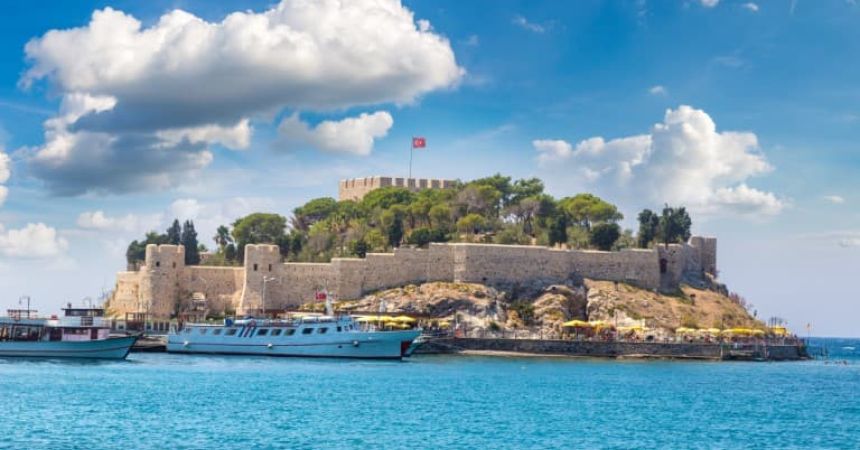
Pigeon Island, or Güvercinada, is one of Kuşadası’s most recognizable landmarks.
Its real value comes from how naturally it fits the town.
You do not need a full day or complicated transfer. It can be incorporated into a waterfront walk, a slower afternoon or an evening when you want to do something without committing to another major sightseeing program.
That ease is part of Kuşadası’s strength.
The destination contains several places worth seeing that do not demand a formal excursion.
This creates a different rhythm from a multi-city Turkey tour where almost every major experience begins with a pickup time.
Kuşadası can give you structured days and unstructured hours in the same stay.
Ladies Beach Is About Convenience More Than Mythology
Ladies Beach is one of the best-known beach areas around Kuşadası, but travelers should approach it according to how they intend to use it rather than its reputation.
Its main practical advantage is that it provides a recognizable beach environment close to the town and accommodation zones.
For travelers who want beach access without moving to a remote resort, that can be extremely useful.
For someone expecting an untouched bay or dramatic isolated coastline, another part of the region may suit better.
This is a recurring lesson in destination planning:
a good beach for a holiday is not always the beach that looks most dramatic in a photograph.
Accessibility, hotel proximity, restaurants and the ability to return easily all contribute to actual value.
Kuşadası Is a Cruise Port, but You Do Not Need to Experience It Like a Cruise Passenger
The port plays a major role in the town’s tourism economy, especially because cruise passengers use Kuşadası as a gateway to Ephesus.
This creates a distinctive daily rhythm.
At certain times, central areas can feel considerably busier as ships arrive and excursions operate. Later, the atmosphere can change again.
Independent travelers staying several nights have an advantage cruise visitors do not: time.
You can avoid treating the town as a few-hour stop.
You can eat after the day-trip crowds have moved on, visit the waterfront at a different pace and plan Ephesus according to your own itinerary rather than a ship schedule.
This is one reason overnighting can produce a much more nuanced experience of Kuşadası than a port call ever can.
The Hotel Area Matters More Than the Hotel Name
Kuşadası accommodation spans different settings, and the best choice depends on how independent you expect to be.
A centrally located hotel makes it easier to walk to restaurants, waterfront areas and town activity.
A property near Ladies Beach shifts the holiday toward beach access.
A larger resort farther from the town can provide more extensive facilities but may make spontaneous evenings outside the hotel less convenient.
This is the decision framework I would use:
Stay central if:
you enjoy dining outside, evening walks and minimal local transport.
Stay near the beach if:
swimming and easy coastal access matter every day.
Stay in a resort zone if:
the hotel itself is one of the main reasons for the holiday.
A five-star property can still be the wrong choice if its geography works against the way you want to spend the day.
Kuşadası Works Particularly Well for Couples With Different Priorities
This is one of the destination’s quiet strengths.
One traveler may be deeply interested in archaeology.
The other may enjoy history but not want every day shaped by ruins.
Kuşadası allows the two preferences to coexist.
Spend one serious day at Ephesus.
Use another for the coast.
Eat well in the evening.
Add one additional historical or natural excursion if both travelers genuinely want it.
The result is not a compromise where neither person gets the holiday they wanted.
It can become a genuinely balanced trip.
That is harder to achieve in a base whose identity is dominated almost entirely by one activity.
Families Should Decide Whether They Need a Resort or a Town
For families, accommodation choice becomes even more important.
A large resort can simplify meals, pools, children's facilities and daily rhythm, particularly when younger travelers do not need to leave the property every day.
A central hotel works better for families who prefer walking to dinner, exploring the town and using Kuşadası as an active base.
Neither family style is more authentic.
The mistake is assuming every family requires an all-inclusive resort or, conversely, that staying centrally always creates a more interesting experience.
The children’s ages, appetite for sightseeing, swimming priorities and tolerance for transport should determine the answer.
Dilek Peninsula Adds the Kind of Day Kuşadası Itself Cannot Provide
If you want a genuine contrast to town life, the Dilek Peninsula can be one of the strongest nearby additions.
The attraction is not another historical monument or another resort.
It is landscape.
The protected natural environment, coastline and more open setting give travelers a break from the urban waterfront and archaeological intensity associated with Ephesus.
This makes it particularly valuable after a busy sightseeing day.
Rather than stacking archaeology on archaeology, you can shift completely toward nature.
That kind of contrast usually improves a multi-day stay more than adding another famous place simply because it appears nearby.
Şirince Should Be Chosen for Atmosphere, Not Because Everyone Adds It
The village of Şirince is frequently paired with Ephesus and Selçuk in visitor itineraries.
It can be a pleasant addition for travelers interested in village atmosphere, local products and a change from archaeological sightseeing.
What it should not become is an automatic checkbox.
If the Ephesus day is already full and everyone is tired, forcing another stop into the afternoon may reduce the quality of both experiences.
Şirince works better when you actually want the village experience rather than merely having heard it is “near Ephesus.”
Proximity is not enough reason to visit anywhere.
Interest should still matter.
Pamukkale Is Possible From Kuşadası — but It Is Not a Casual Half-Day
This is where realistic distance planning becomes important.
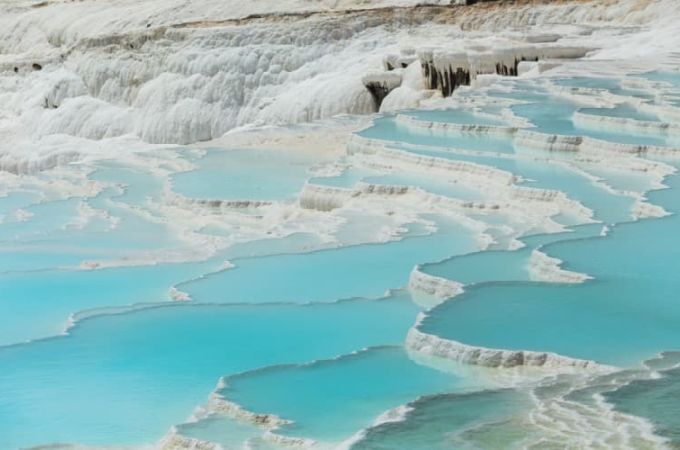
Pamukkale is often sold in the same western Turkey conversation as Ephesus and Kuşadası, which can make the destinations feel closer than they really are.
A day trip is possible, but it involves meaningful road travel.
That means the day should be planned as a substantial excursion rather than something casually added around lunch.
For travelers continuing inland or southward, an open route may make more sense than returning to Kuşadası after every major destination.
If Pamukkale is part of a wider itinerary, consider whether sleeping there or continuing onward reduces unnecessary backtracking.
Good route design is often more valuable than squeezing another night from one hotel booking.
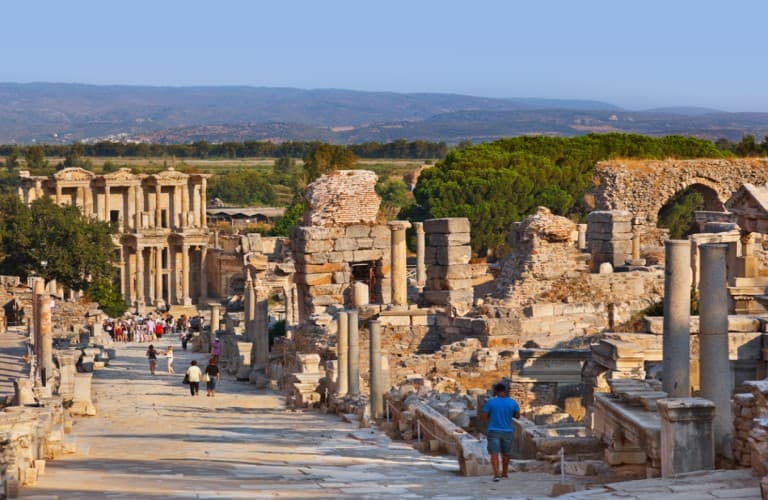
Kuşadası Is Stronger as a Western Turkey Connector Than as a Standalone Resort
This is where the destination earns its place in broader Turkey itineraries.
Kuşadası can sit naturally between archaeological and coastal experiences.
It connects well with the Ephesus region, can form part of western Turkey road routes and gives travelers a comfortable sea-facing base before or after more intensive historical touring.
That makes it particularly useful within western Turkey coastal itineraries, where the destination performs a transition role rather than trying to compete with Bodrum or Marmaris as a pure leisure resort.
A good itinerary uses Kuşadası for what it does best.
It does not ask it to become every coastal destination at once.
Kuşadası and Bodrum Create Different Aegean Holidays
Both are on Turkey’s western coast, but their personalities are not interchangeable.
Bodrum places more emphasis on peninsula lifestyle, marina culture, sailing and an upscale coastal social scene in several areas.
Kuşadası is more directly connected to the Ephesus travel corridor and functions exceptionally well for travelers who want archaeology to remain central while still staying on the coast.
Choose Bodrum if the Aegean lifestyle itself is the main attraction.
Choose Kuşadası if the sea should complement an archaeology-led western Turkey trip.
That distinction is much more useful than comparing restaurant counts or beaches.
Two Nights and Five Nights Need Different Expectations
A two-night Kuşadası stay often functions primarily as an Ephesus base with one or two pleasant coastal evenings.
That is perfectly valid.
With three or four nights, the destination becomes more balanced. You can give Ephesus a full day, retain genuine beach or town time and perhaps include one contrasting excursion.
At five nights or more, Kuşadası begins functioning as a holiday base rather than simply a cultural stop.
That only works if you actually want slower coastal time.
Adding nights merely to schedule more day trips defeats the benefit.
Kuşadası Is Better When You Stop Trying to Turn Every Day Into an Excursion
This is particularly important because the region offers so many tempting possibilities.
Ephesus.
Şirince.
Dilek Peninsula.
Pamukkale.
Boat trips.
Other archaeological sites.
Soon a five-night coastal stay contains five hotel breakfasts followed by five departures.
At that point, the hotel could be anywhere.
A better rhythm gives one or two days real structure and allows the remainder to remain partly local.
Walk.
Swim.
Spend time around the waterfront.
Return to a restaurant you liked.
The destination begins to feel less like a transportation hub and more like somewhere you actually stayed.
Who Should Choose Kuşadası?
Choose Kuşadası if Ephesus is important but you do not want an archaeology-only holiday.
Choose it if being near the sea improves the evenings.
Choose it if your group contains people with different interests.
Choose it if you want a western Turkey base capable of supporting both significant sightseeing and genuine downtime.
Choose Selçuk instead if archaeological proximity outweighs the coast.
Choose Bodrum or Marmaris if the holiday is fundamentally about coastal lifestyle rather than Ephesus.
Kuşadası is at its best when history and holiday atmosphere carry roughly equal weight.
The town does not need to outshine Ephesus.
Its job is to make the days surrounding Ephesus enjoyable enough that the entire western Turkey experience becomes stronger.
Frequently Asked Questions About Kusadasi
1. Is Kusadasi worth staying in if I mainly want to visit Ephesus?
Yes, particularly if you value a coastal setting, larger hotel choice and lively evenings after archaeological sightseeing. Travelers whose only priority is maximizing proximity to Ephesus may prefer Selçuk, while Kuşadası provides a broader holiday experience around the visit.
2. Is Kusadasi better than Selcuk as an Ephesus base?
Kuşadası is generally stronger for travelers wanting beaches, restaurants and waterfront atmosphere, while Selçuk provides a more archaeology-centered stay and closer relationship with Ephesus. The better base depends mainly on what you want to do after sightseeing ends.
3. How far is Ephesus from Kusadasi?
Ephesus is close enough to make Kuşadası a practical base, though actual transfer time depends on hotel location, traffic and transport arrangements. Travelers should plan the visit as a dedicated sightseeing experience rather than assuming it is a walkable attraction from town.
4. Is Ladies Beach the best area to stay in Kusadasi?
It can be a good choice for travelers prioritizing regular beach access while remaining close to the wider town. Visitors who care more about waterfront restaurants and evening walkability may prefer a more central location, while resort-focused travelers have other options.
5. Is Kusadasi suitable for families?
Yes. Families can combine beach or pool time with selected sightseeing, while the range of central hotels and larger resorts supports different travel styles. The best area depends on children's ages, how often the family intends to leave the hotel and beach priorities.
6. Is Pigeon Island worth visiting?
Yes, especially because it fits naturally into a relaxed town or waterfront day and does not require a major excursion. Its value comes partly from location and atmosphere, making it a useful lighter experience between more demanding archaeological or regional sightseeing days.
7. Should I visit Dilek Peninsula from Kusadasi?
It is especially worthwhile for travelers wanting nature and coastal landscape after spending time at archaeological sites or in town. Its value lies in contrast, so it often adds more to a Kuşadası stay than another consecutive history-focused excursion.
8. Can I visit Pamukkale as a day trip from Kusadasi?
It is possible, but travelers should expect a substantial travel day rather than a quick excursion. If Pamukkale forms part of a longer Turkey route, continuing onward instead of returning to Kuşadası may create a more efficient itinerary.
9. Is Kusadasi only a cruise-port destination?
No. Cruise tourism is highly visible because the port serves Ephesus-bound passengers, but staying several nights creates a different experience. Overnight visitors can use Kuşadası as a coastal base for archaeology, beaches, nature and relaxed evenings after day visitors depart.
10. How many nights do I need in Kusadasi?
Two nights can work when Ephesus is the principal purpose, while three or four provide better balance between sightseeing and the coast. Longer stays make sense when travelers genuinely want beach, resort or slower town time rather than additional consecutive excursions.
11. Is Kusadasi better than Bodrum?
They suit different trips. Bodrum is stronger for peninsula lifestyle, sailing and a more leisure-led Aegean stay, while Kuşadası is particularly practical for travelers who want Ephesus and western Turkey archaeology to remain central alongside coastal accommodation.
12. What is the biggest mistake when planning Kusadasi?
The biggest mistake is treating Kuşadası only as somewhere to sleep before Ephesus or, at the opposite extreme, expecting it to replace every other Aegean resort. Its real strength is balancing important archaeological access with a functional coastal holiday base.

A travel professional specializing in tailor-made travel planning, guest experience management, and multi-destination tourism operations.
With over 23 years of experience in the travel industry, he designs and manages private and cultural tours for international travelers across Türkiye, Greece, Egypt, Jordan, Morocco, and other destinations.
He has strong expertise in both online and face-to-face guest communication, sales processes, and end-to-end travel operations.
Working closely with hotels, travel agencies, and local partners, he ensures smooth coordination and high-quality travel experiences at every stage of the journey.
His focus is on delivering personalized, reliable, and seamless travel experiences for international guests worldwide.