Pamukkale Turkey: How to Experience the Travertines and Hierapolis
Updated: August 2026
Pamukkale is one of those places where the photographs are both completely accurate and strangely misleading.
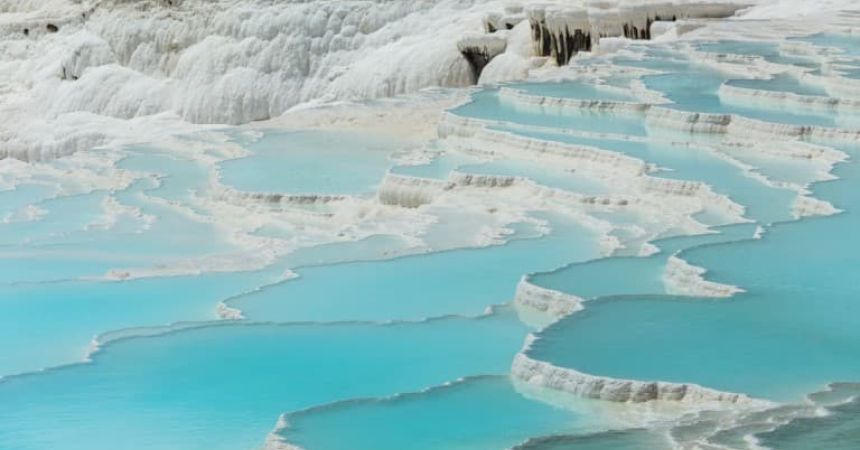
The white travertine terraces really do descend across the hillside above the plain, and under the right light the landscape can look almost unreal. Water runs across pale mineral surfaces, shallow pools reflect the sky, and the visual contrast between the white formations and the surrounding countryside explains immediately why Pamukkale has become one of Turkey’s most recognizable natural attractions.
Yet if you arrive expecting only a beautiful white slope, you will understand barely half of what makes the site important.
Pamukkale and Hierapolis occupy the same cultural landscape. The thermal waters that created the travertines also shaped an ancient city, attracted visitors seeking healing and supported a long tradition of bathing and religious activity. The archaeological remains above the terraces are therefore not a separate attraction that happens to sit nearby.
They are part of the same story.
That changes the way the visit should be planned.
The question is not simply how long you need for the travertines or whether Hierapolis is worth adding afterward.
It is:
How do you experience the natural and ancient parts of Pamukkale as one place without rushing either of them?
Pamukkale Makes More Sense When You Begin With the Water
The word “Pamukkale” is commonly translated as “Cotton Castle,” an understandable description when the hillside is viewed from below.
What looks like snow or cotton from a distance is actually travertine, formed through mineral-rich thermal water flowing across the slope and depositing calcium carbonate over long periods.
The process is ongoing.
That matters because Pamukkale is not simply a static geological monument carved millions of years ago and left unchanged. Water management remains important to preserving the terraces and influencing which sections are wet or dry at a particular time.
This also explains why visitors sometimes arrive with a photograph in mind and discover that the exact pool or flow pattern they expected looks different.
The landscape is being managed as a fragile natural system.
You are visiting a living geological environment, not a decorative white staircase created for tourism.
The Travertines Are Fragile Enough That Your Feet Matter
One of Pamukkale’s most distinctive visitor experiences is walking across designated travertine areas without shoes.
This rule is not a gimmick.
Footwear can damage and dirty the mineral surfaces, so visitors are expected to remove shoes where access requires it and follow the current designated walking route.
That means preparation should be practical.
You need to carry your shoes with you rather than assuming they will remain beside the starting point. A lightweight bag can be useful. The surface can also feel different from what photographs suggest: some areas may be wet, others textured, and sections can be uncomfortable for very sensitive feet.
Walk carefully.
Pamukkale is not a water park, and the white surface should never be treated as though visitors have unlimited freedom to move wherever they like.
Respecting restricted areas is part of preserving the reason you came.
Do Not Judge the Travertines by How Full the Pools Look
This is one of the most useful expectation adjustments.
Historic photographs sometimes show broad sections of the hillside filled with abundant water. Modern conservation requires controlled water distribution, so not every visible terrace will necessarily contain water at the same time.
That does not mean Pamukkale has “dried up” or that your visit has gone wrong.
It means preservation affects presentation.
The stronger way to experience the travertines is to look at the entire mineral landscape rather than judging success according to whether one famous pool resembles a photograph from another year.
Light also changes the appearance dramatically.
Early and later parts of the day can create softer contrast, while intense midday sun makes the white surfaces exceptionally bright.
Pamukkale is therefore one of those places where timing affects perception as much as crowd levels.
Hierapolis Should Begin Before You Finish Thinking About the Travertines
Once you reach the upper plateau, the experience changes almost without warning.
The white natural landscape gives way to archaeological remains from Hierapolis, an ancient city whose development was intimately connected with the thermal springs.
This transition is one of Pamukkale’s greatest strengths.
You move from geology into urban history without needing another transfer.
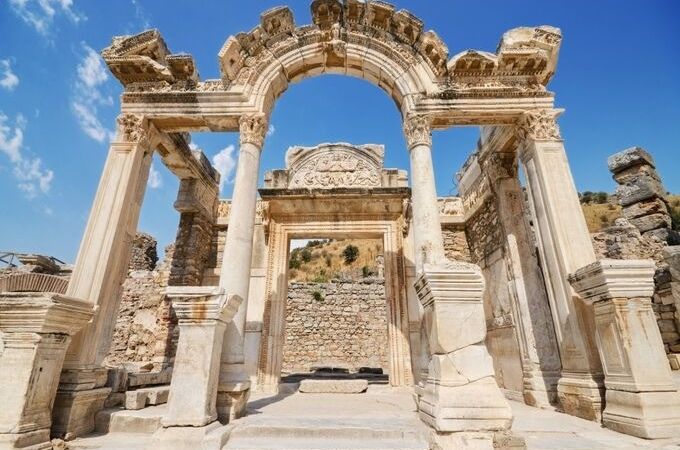
Hierapolis grew through Hellenistic and Roman periods and became known for its thermal environment, religious significance and later Christian history. The city contained baths, temples, monumental streets, a theatre, necropolis areas and other public structures.
The scale often surprises visitors.
People who budget ninety minutes because they believe Pamukkale means only the white terraces suddenly realize that a substantial archaeological city is spread across the plateau.
This is exactly why the site deserves better planning.
Think of the Visit as Three Experiences, Not One Attraction
Pamukkale works best when divided mentally into three overlapping layers.
| Experience layer | What you are actually seeing | What requires most attention |
|---|---|---|
| Travertines | Active mineral landscape | Surface protection, water, light |
| Hierapolis | Ancient thermal city | Scale, theatre, streets, baths |
| Thermal legacy | Relationship between water and people | Bathing, healing, city development |
The most common mistake is allowing one layer to consume all the time.
Photography-focused travelers can spend too long around the terraces and rush Hierapolis.
Archaeology enthusiasts can hurry through the natural formations because the theatre interests them more.
A stronger visit acknowledges that neither side fully explains Pamukkale without the other.
The Theatre Is Where Hierapolis Suddenly Becomes a City
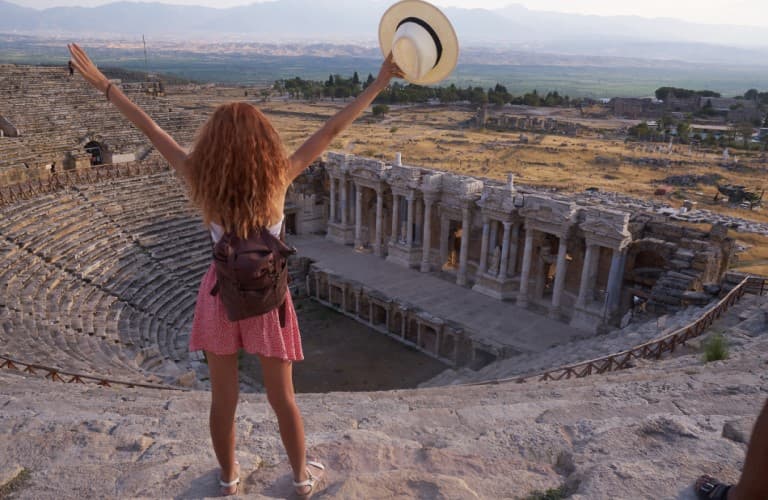
Among the archaeological remains, the Hierapolis Theatre provides one of the most immediate visual experiences.
Its scale and surviving architectural decoration help visitors move beyond foundations and fragmented walls to imagine a functioning Roman urban center.
This is useful because Hierapolis can initially feel dispersed.
The city occupies a broad area, and not every structure survives in a form that communicates its original function instantly.
The theatre does.
Take time there.
Look beyond the seating and consider where it sits in relation to the rest of the ancient city. From elevated positions, the scale of the archaeological landscape becomes easier to understand.
This is the moment many visitors realize that Hierapolis was not simply “the ruins next to Pamukkale.”
It was a major urban community with its own public and cultural life.
The Necropolis Tells a Different Story From the Monumental Center
The necropolis of Hierapolis is one of the most extensive and historically revealing parts of the site.
Tombs, sarcophagi and funerary structures show that people came here not only to live or bathe but also to die and be buried within a landscape associated with healing, religion and thermal activity.
This introduces a quieter dimension.
The theatre speaks of public life.
The necropolis speaks of individuals, families, status and memory.
Visitors who are short on time often skip it because it lies farther from the most photographed sections of Pamukkale.
That can be understandable, particularly when walking ability is limited, but archaeology-focused travelers should recognize what they are giving up.
Hierapolis becomes much more human when you move beyond its monumental architecture.
The Ancient Pool Is Not the Whole Thermal Story
The so-called Cleopatra’s Pool, commonly known as the Antique Pool, has become one of Pamukkale’s best-known experiences.
The association with Cleopatra is part of modern tourism storytelling and should not be treated casually as established proof that the Egyptian queen personally used the pool.
What matters more is the thermal environment itself.
Bathing in warm mineral-rich water among ancient architectural fragments creates an unusual connection between modern visitors and a long history of thermal use.
Whether you personally need to swim is another question.
Some travelers love the experience.
Others find that the time, extra logistics and crowds pull attention away from the wider archaeological site.
There is no requirement to enter the pool in order to have “done Pamukkale properly.”
The visit remains complete without it.
Pamukkale Is Much Larger on Foot Than It Appears Online
This is where operational realism matters.
Photographs compress distance.
A white slope, a theatre and a pool can all appear to sit almost beside one another, but the complete site involves considerable walking when explored properly.
The necropolis extends farther again.
Comfortable footwear is therefore essential once you leave the barefoot travertine areas, especially because ancient surfaces can be uneven and much of the archaeological zone is exposed.
Water and sun protection also matter during warmer periods.
Visitors with limited mobility should plan carefully around which sections are realistic rather than assuming the entire UNESCO landscape can be experienced with minimal walking.
A good visit is not measured by the number of kilometers completed.
It is measured by how much you understand and enjoy.
Entrance Choice Can Change the Rhythm of the Entire Visit
Pamukkale has different access points, and where you begin can influence how the day unfolds.
Some visitors prefer approaching from below and walking upward through the travertines, allowing the white landscape to build gradually before arriving at Hierapolis.
Others may enter from an upper area and experience the archaeological city first.
There is no single sequence that is best for everyone.
The decision should consider transportation, walking ability, temperature and how strongly you prioritize photography or archaeology.
Travertines first suits you if:
you want the dramatic natural landscape to introduce the destination and are comfortable walking upward.
Hierapolis first suits you if:
archaeology is your main interest or you want to prioritize the ancient city before becoming tired.
This is a much more useful decision than simply asking which entrance is “best.”
Day Trip or Overnight? This Is the Most Important Planning Choice
Pamukkale can be visited as a day trip from several western Turkey bases.
That does not mean a day trip is always the best structure.
If you are coming from Kuşadası or another regional destination, the road journey creates a long day once sightseeing is added. It can still be worthwhile, especially when overall itinerary time is limited.
An overnight stay changes the experience.
You gain more freedom around opening and closing hours, can avoid having every minute dictated by the return transfer and may see the travertines under different light.
The real question is whether Pamukkale is:
an important destination in your trip
or
a valuable stop between other destinations.
If it is central to your interests, overnighting deserves consideration.
If the itinerary is already tight, a well-organized day trip may be the more sensible compromise.
Pamukkale Works Especially Well as a Route Connector
One of the strongest ways to use Pamukkale is to avoid returning to the city you came from.
For example, travelers moving through western and southern Turkey can sometimes visit Pamukkale and continue toward the next region rather than treating every excursion as a round trip.
That approach reduces backtracking.
It also gives the destination a natural place in a broader journey.
Travelers can arrive from the Ephesus/Kuşadası region, experience Pamukkale and then continue onward according to their itinerary rather than automatically returning west.
This is where Ephesus and Pamukkale tours can make operational sense when the two archaeological regions belong to a linear route rather than two disconnected excursions.
Pamukkale and Ephesus Should Never Be Compared as Alternatives
They are frequently paired, which encourages travelers to ask which one is “better.”
The comparison is not particularly useful.
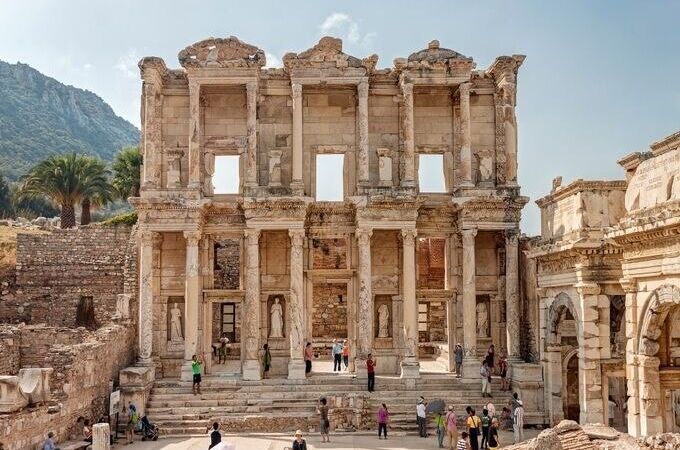
Ephesus offers a monumental ancient urban environment where streets, library façades, theatres and domestic spaces help visitors reconstruct Greco-Roman city life.
Pamukkale combines natural geology with an ancient thermal city.
Its archaeological component is important, but its identity depends equally on the travertine landscape.
Visit Ephesus for one reason.
Visit Pamukkale for another.
If you have enough time, seeing both adds range rather than repetition.
Photography Works Better When You Stop Chasing Empty Frames
Pamukkale is popular.
That means travelers searching for a completely empty white terrace at a convenient hour can spend more effort avoiding people than experiencing the site.
Photography becomes easier when you work with the place rather than against it.
Use angles.
Use scale.
Let people sometimes demonstrate how large the landscape is.
Pay attention to reflections and the way the white surface changes under different light.
Early or later access can help, especially if you stay nearby, but no one should build the entire visit around reproducing a highly edited image that erased every other visitor.
A real Pamukkale visit contains people.
That does not make the landscape less extraordinary.
The Village Below and the Plateau Above Feel Like Separate Worlds
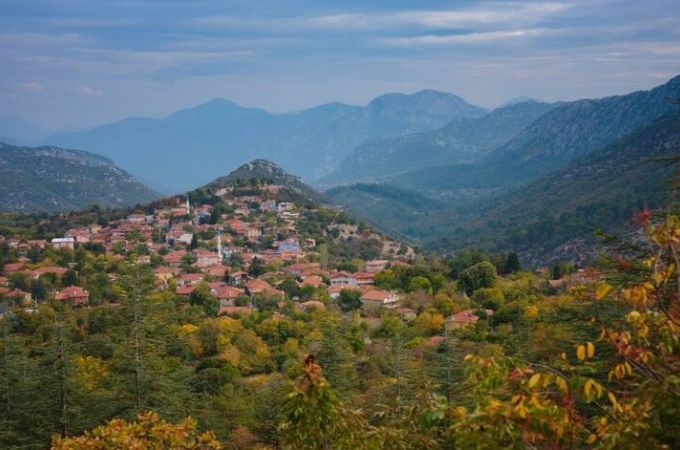
Pamukkale town sits beneath the white hillside and functions largely around the visitors arriving for the protected site.
The ancient city occupies the plateau above.
Understanding this vertical relationship makes accommodation choices easier.
Staying locally can be practical if Pamukkale itself is the priority, while nearby Denizli offers a larger urban environment and important transport connections.
Most first-time sightseeing travelers do not need an extensive Denizli city stay simply because it is the major nearby city.
Again, choose according to purpose.
If your priority is getting into the UNESCO landscape early or staying later, proximity to Pamukkale has obvious value.
If transportation connections dominate, Denizli may enter the calculation differently.
Families Should Not Try to Complete Every Section
Pamukkale can be very engaging for children because the landscape is visually immediate and walking barefoot through designated water sections feels different from conventional sightseeing.
The challenge begins when adults try to add the complete archaeological city, museum, pool, necropolis and every viewpoint to the same family day.
Children do not need to experience Pamukkale like archaeology students.
Choose priorities.
Travertines plus the theatre may create a strong introduction.
Older children with a genuine interest in history may enjoy more.
The most successful family visit usually ends before fatigue turns an unusual landscape into another long day they were forced to finish.
Pamukkale Is Not a Resort Spa in the Modern Sense
The thermal identity can create the wrong expectation.
Pamukkale’s significance comes from the natural springs and their relationship with Hierapolis, but a visit to the protected site is not equivalent to booking several days at a luxury wellness resort.
Travelers wanting dedicated thermal relaxation can examine regional hotels and spa facilities separately.
Travelers wanting Pamukkale should come primarily for the cultural-natural landscape.
This distinction protects the URL from drifting into generic Turkish thermal tourism and, more importantly, helps the traveler understand what the destination actually delivers.
One Night Can Change Pamukkale More Than Adding Another Attraction
If your schedule allows, staying overnight is not valuable because there are dozens of extra things to do after dark.
It is valuable because time pressure disappears.
You can arrive without fearing the return drive.
Spend longer at Hierapolis.
Eat afterward.
Sleep.
Continue your Turkey journey the next morning.
That is a different emotional experience from watching the clock because the vehicle leaves at a fixed hour.
The extra night buys pace, not attraction count.
That can be one of the smartest uses of accommodation in a multi-region itinerary.
Travelers building a linear western Turkey journey can use Pamukkale cultural tour routes to position the overnight according to geography rather than adding nights arbitrarily.
Who Should Prioritize Pamukkale?
Pamukkale is particularly worthwhile for travelers who enjoy destinations where nature and human history cannot be separated neatly.
Come if geological landscapes interest you.
Come if Hierapolis’s thermal and religious history adds value beyond the photograph.
Come if your western Turkey route passes naturally through the region.
Come if you enjoy walking through places where the surrounding terrain explains why an ancient city developed where it did.
If your itinerary is extremely short and every major regional transfer damages another destination, Pamukkale may need a harder decision.
It does not become less important because you leave it for another trip.
Strong itineraries are built partly by knowing what not to include.
The Best Pamukkale Visit Ends With the Realization That the White Hill Was Only the Beginning
The travertines get you there.
They deserve their fame.
Few landscapes in Turkey are immediately recognizable from such a distance, and walking across the designated white mineral surfaces is genuinely unlike visiting an ordinary archaeological destination.
But Pamukkale becomes more meaningful after you begin seeing the relationship between the water and the city above it.
Hierapolis existed in conversation with this thermal landscape.
Bathing, healing, religious life, public architecture and death all became connected to the same place.
The theatre helps you imagine the city.
The necropolis introduces the people who lived and died there.
The thermal waters explain why they came.
The travertines show that the same natural system is still shaping what visitors experience today.
Pamukkale is therefore not simply Turkey’s white landscape.
It is a place where geology created the conditions for human history, and where both stories remain visible at once.
That is what makes the journey worthwhile.
Frequently Asked Questions About Pamukkale
1. Is Pamukkale worth visiting for more than the white terraces?
Absolutely. The travertines are only one part of the experience. The same thermal landscape also contains Hierapolis, with its theatre, necropolis, baths and other archaeological remains, giving Pamukkale far greater historical depth than photographs of the white hillside suggest.
2. Why do visitors have to remove their shoes on the travertines?
Shoes are restricted on designated sections to help protect the fragile mineral surface from damage and dirt. Visitors should follow the current access route carefully and be prepared to carry footwear while walking barefoot through permitted areas.
3. Are all Pamukkale travertine pools always full of water?
No. Water distribution is managed to help preserve the natural formation, so different terraces may appear wetter or drier at different times. Visitors should expect a living, managed geological landscape rather than assuming every pool will resemble older photographs.
4. Is Hierapolis included in the same Pamukkale visit?
Yes, the archaeological city of Hierapolis lies directly above the travertines and forms part of the same cultural landscape. Travelers should allow enough time for both rather than visiting the white formations and assuming they have completed the destination.
5. Is Cleopatra’s Pool historically connected to Cleopatra?
The pool is popularly called Cleopatra’s Pool, but travelers should be cautious about treating every romantic story around that name as proven history. Its more important significance is the long thermal tradition of Hierapolis and the experience of bathing among ancient fragments.
6. How much walking is involved at Pamukkale?
A complete visit can involve substantial walking, particularly when exploring Hierapolis, the theatre and the necropolis in addition to the travertines. Comfortable footwear, water and realistic expectations are important, especially for travelers planning several hours across exposed archaeological terrain.
7. Is Pamukkale suitable as a day trip from Kusadasi?
Yes, but it becomes a long day because meaningful road travel is required in addition to sightseeing. Travelers continuing elsewhere in Turkey may find a linear route or overnight stay more efficient than automatically returning to Kuşadası afterward.
8. Should I stay overnight in Pamukkale?
An overnight stay is particularly useful when you want a slower visit, greater flexibility around arrival and departure, or different light on the travertines. It is less necessary when Pamukkale functions primarily as one stop within a tightly planned regional route.
9. Is Pamukkale similar to Ephesus?
No. Ephesus is primarily a major ancient urban archaeological site, while Pamukkale combines a unique travertine landscape with the ancient thermal city of Hierapolis. Visiting both creates complementary experiences rather than repeating the same type of attraction.
10. Is Pamukkale good for families with children?
Yes, especially because the travertines offer a more tactile and visually immediate experience than many archaeological sites. Families should still control the overall walking load and avoid trying to complete every part of Hierapolis if children become tired.
11. What should I wear for Pamukkale?
Wear comfortable clothing suitable for extensive outdoor sightseeing, carry good walking shoes for Hierapolis and expect to remove footwear on designated travertine sections. Sun protection and water are especially important because much of the site is open and exposed.
12. What is the biggest mistake visitors make at Pamukkale?
The biggest mistake is treating Pamukkale as a quick photo stop at the white terraces. The destination becomes significantly more rewarding when visitors allocate enough time to understand Hierapolis, the thermal landscape and the relationship between the ancient city and the mineral waters.

A travel professional specializing in tailor-made travel planning, guest experience management, and multi-destination tourism operations.
With over 23 years of experience in the travel industry, he designs and manages private and cultural tours for international travelers across Türkiye, Greece, Egypt, Jordan, Morocco, and other destinations.
He has strong expertise in both online and face-to-face guest communication, sales processes, and end-to-end travel operations.
Working closely with hotels, travel agencies, and local partners, he ensures smooth coordination and high-quality travel experiences at every stage of the journey.
His focus is on delivering personalized, reliable, and seamless travel experiences for international guests worldwide.