Islamic Cairo: How to Understand the Historic City
Updated: August 2026
Islamic Cairo can be confusing during the first twenty minutes.
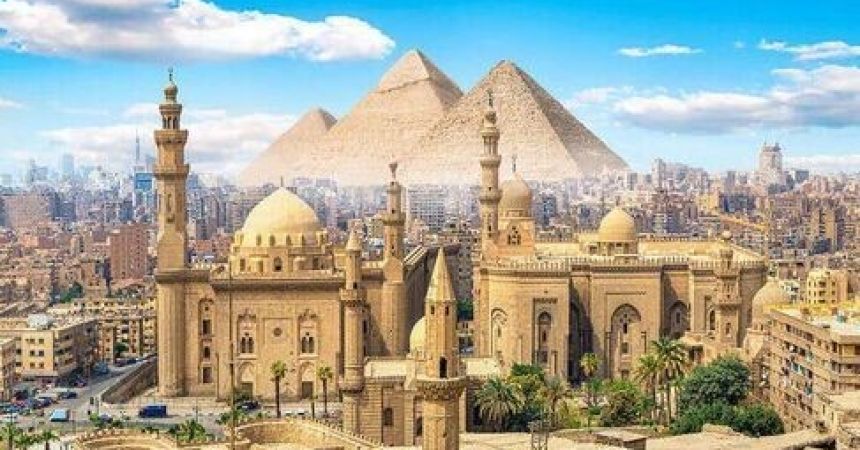
A minaret appears above a crowded street. A monumental stone façade sits beside a shop selling everyday household goods. Through one doorway there may be a quiet courtyard several centuries old, while motorcycles, delivery carts and pedestrians compete for space only meters away. Before you have properly understood one building, another dome or decorated entrance appears farther along the street.
It is tempting to respond by making a list.
Which mosque should I enter? Which monument is the oldest? Where is the famous market? What are the five buildings I absolutely must photograph?
That approach can get you through Islamic Cairo, but it does not necessarily help you understand it.
The district becomes much more interesting once you recognize that the monuments were never intended to exist as isolated tourist attractions. Mosques, schools, mausoleums, fountains, markets and commercial buildings formed parts of an urban system that developed through different dynasties and continued changing long after their founders disappeared.
The real experience, therefore, lies in the connections.
Islamic Cairo makes considerably more sense when you stop treating the street as the space between monuments and begin treating the street itself as part of the monument.
“Islamic Cairo” Is More Useful as a Historical Idea Than a Precise Neighborhood
The name can create the impression that Islamic Cairo is one neatly defined quarter with obvious boundaries.
The reality is more complicated.
The term is commonly used for a large historical area containing an exceptional concentration of Islamic architecture produced across many centuries. Different parts of the district developed under different rulers and for different purposes, so walking through it is not the equivalent of entering a preserved medieval town that belongs to one particular moment.
This matters because visitors sometimes expect visual consistency.
Instead, you encounter layers.
A Fatimid street can contain later Mamluk monuments. Ottoman additions appear within an older urban structure. Modern businesses occupy historic surroundings. Restoration has changed the appearance and use of certain buildings, while everyday city life continues around them.
That mixture is not an inconvenience preventing you from seeing “the old Cairo.”
It is one of the reasons the area is historically valuable.
Al-Muizz Street Works Better as a Sequence Than a Checklist
Al-Muizz Street contains such a concentration of important architecture that it naturally encourages monument collecting.
See this building. Photograph that façade. Enter the next courtyard.
Yet the street becomes more revealing when experienced as a sequence.
Notice how architecture addresses the street rather than standing apart from it. Entrances compete for attention. Minarets announce institutions vertically while façades communicate status at pedestrian level. Commercial activity occupies the spaces between religious and charitable foundations.
This tells you something important about the city that individual building descriptions cannot.
Medieval Cairo was not designed according to the modern assumption that historically important structures should sit alone behind fences with generous open space around them.
Institutions belonged to the urban fabric.
Walking Al-Muizz slowly allows you to see that relationship repeatedly, which is why a traveler interested in Cairo Heritage Tours gains more from understanding the sequence than from simply increasing the number of buildings entered.
The Buildings Were Often Doing Several Jobs at Once
A common modern instinct is to classify historic buildings according to one function.
That is a mosque.
That is a tomb.
That is a school.
Islamic Cairo frequently resists such simplicity.
Patrons commissioned architectural complexes that could combine worship, education, burial, charitable services and public functions. A monumental foundation was therefore not merely a beautiful building; it could become an institution woven into the social and religious life of the surrounding city.
Understanding those relationships changes what you notice.
A mausoleum beside a madrasa no longer appears to be an architectural coincidence. A public water facility is not just an unusually decorated small structure. Commercial activity around religious institutions does not automatically represent a modern intrusion into an otherwise sacred landscape.
The city operated through overlapping systems.
That complexity is one reason walking through Islamic Cairo with historical context feels so different from visiting a collection of detached monuments.
Mamluk Cairo Makes Architecture Feel Like Public Language
Among the most striking layers of Islamic Cairo is the architectural legacy of the Mamluk period.
You do not need to memorize rulers and dates before arriving to appreciate it.
What helps is understanding that monumental architecture communicated.
Scale mattered. Placement mattered. Decorative stonework mattered. A building could express religious patronage, political legitimacy, wealth and memory at the same time.
This becomes particularly clear around major complexes where architecture seems almost to press itself into the surrounding urban space.
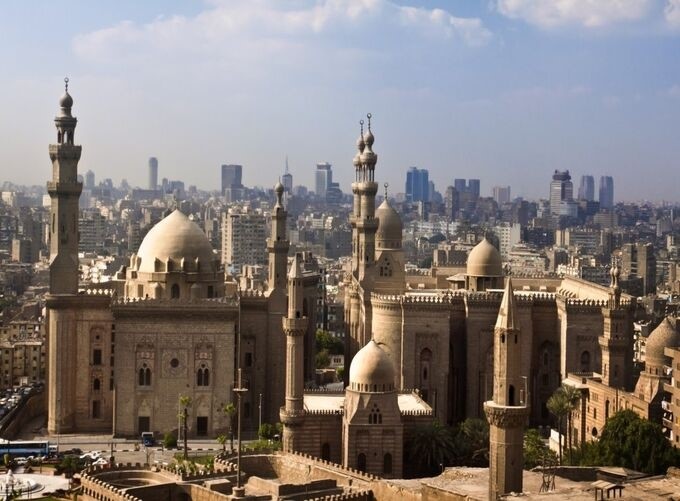
The Mosque-Madrasa of Sultan Hassan is an especially powerful example of monumental scale. Its presence is not subtle, and it was never meant to be.
Rather than asking only, “When was this built?”, try asking:
What was this building trying to say to somebody standing here when it was new?
That question turns architecture into evidence.
Suddenly height, entrance design, location and decoration become parts of a political and social story rather than simply aesthetic features.
A Minaret Is Not Just Something to Photograph Against the Sky
Islamic Cairo's skyline encourages visitors to look upward.
That is understandable.
Domes and minarets are among the district's most visually recognizable elements, particularly where several historical structures appear within the same field of view.
But looking only upward can cause you to miss half the story.
Bring your attention back to street level.
Look at doorways, stone surfaces and changes in façade. Notice where buildings meet shops and houses. Observe how narrow streets affect your perception of a large structure; sometimes a building reveals itself gradually because there is simply no distant viewpoint from which to absorb the whole façade at once.
That restricted perspective is part of the experience.
Historic architecture here often belongs to a dense city rather than a ceremonial landscape designed around uninterrupted views.
Photography becomes more interesting once you stop trying to remove the city from the monument.
The Sabil Explains Something a Grand Mosque Cannot
Some of Islamic Cairo's smaller architectural elements tell remarkably large stories.
A sabil, associated with providing drinking water to the public, can easily be overshadowed by a nearby mosque or monumental complex. Yet it reveals something important about charitable patronage and the practical life of the city.
The same principle applies to other building types.
| Urban Element | Historical Role | What It Helps You Understand |
|---|---|---|
| Mosque | Worship and community life | Religion within the urban fabric |
| Madrasa | Religious education | Knowledge, patronage and institutional life |
| Mausoleum | Burial and commemoration | Memory, status and dynastic identity |
| Sabil | Public water provision | Charity expressed through architecture |
| Wikala | Commerce and accommodation | Cairo's relationship with trade |
| Souq | Production and exchange | Economic life within the historic city |
This is why visiting only the largest mosques gives an incomplete picture.
The smaller structures often explain how the city functioned between the monuments.
Khan el-Khalili Makes More Sense When It Stops Being “The Souvenir Market”
For many visitors, Khan el-Khalili enters the itinerary as the place to shop after sightseeing.
That description is too narrow.
Commerce belongs to the historical identity of this part of Cairo. Markets, workshops, merchants and trade were not added after the monuments became tourist attractions; economic activity helped shape the urban environment in which many of those institutions existed.
Of course, today's market serves modern residents and visitors in ways that differ from the medieval economy.
It should not be romanticized as a perfectly preserved historical marketplace.
Yet seeing it only through the question “What should I buy?” misses the more interesting relationship.
The commercial and monumental city grew beside one another.
That is why moving from an architectural complex into busy market streets does not necessarily mean you have left historic Cairo behind.
You have simply encountered another part of its identity.
Islamic Cairo Is Not the Same Thing as “Old Cairo”
Travel terminology creates confusion here.
Visitors sometimes use Islamic Cairo, Historic Cairo and Old Cairo interchangeably, but doing so can blur distinct parts of the city.
Old Cairo is particularly associated with areas farther south that include major Coptic Christian heritage. Islamic Cairo refers broadly to historical areas distinguished by their extraordinary Islamic architectural heritage, while Historic Cairo is a broader heritage concept.
For a traveler, the important lesson is not memorizing administrative boundaries.
It is avoiding the assumption that Cairo possesses one single “old town” where all pre-modern history sits together.
It does not.
Cairo developed through multiple historical centers and layers, and understanding those distinctions helps explain why moving between Coptic and Islamic heritage areas can feel like moving between different historical chapters of the same city.
Religious Buildings Are Active Spaces, Not Merely Architectural Interiors
There is an important behavioral difference between entering a museum and entering a functioning mosque.
One exists primarily to be visited.
The other may welcome visitors while continuing to serve its religious purpose.
That distinction should shape the way travelers behave.
Appropriate clothing, respectful conduct and awareness of prayer activity matter. Access can also vary according to religious use and local arrangements, so a sightseeing plan should retain some flexibility rather than assuming every interior functions according to tourist expectations throughout the day.
This is not a burden attached to visiting Islamic Cairo.
It is part of encountering living heritage.
A mosque becomes more meaningful when you recognize that its historical importance has not necessarily reduced it to an architectural artifact.
The District Is Better When You Leave Some Time Unclaimed
Islamic Cairo punishes an over-engineered sightseeing schedule.
There is simply too much visual information.
If every twenty minutes has already been assigned to another monument, the street begins functioning as a corridor through which you hurry in order to reach the next entrance.
That sacrifices one of the area's strongest qualities.
You need enough unclaimed time to notice a doorway you were not expecting, look back at a minaret from a different angle, allow your guide to explain why an apparently modest building matters or simply watch how the historical environment and contemporary city occupy the same space.
This does not require wandering without purpose for an entire day.
It requires resisting the assumption that every useful minute must correspond to an attraction.
In Islamic Cairo, the transitions often contain the explanation.
Restoration Can Make the Past Look More Orderly Than It Was
Historic districts present another challenge: visitors naturally assume that what they see represents the past exactly as it existed.
Restoration complicates that assumption.
Buildings survive because people have repaired, reconstructed, conserved and sometimes repurposed them. Streets have changed. Urban uses have shifted. Structures that now appear prominently may once have existed within a different physical context.
This does not make them less authentic or less valuable.
It simply means heritage should be read critically.
A knowledgeable guide can be particularly useful here because the visible building is only one layer of the story. Understanding what has changed, what has survived and how a structure originally related to its surroundings can be more revealing than memorizing another architectural date.
For travelers interested in Egypt Culture Trips, this interpretive layer is often where guided sightseeing earns its value.
You Do Not Need to Enter Every Mosque
This is worth saying clearly.
More interiors do not automatically produce more understanding.
After several monumental religious buildings, architectural details can begin merging together unless you have a particular interest in Islamic architecture.
A stronger visit may involve entering fewer buildings while understanding why each was chosen.
One could demonstrate scale. Another might illustrate a particular institutional arrangement. A smaller building may reveal public charity or commercial relationships more clearly than a famous mosque.
Selection creates contrast.
Without it, the experience can become an architectural marathon where the traveler remembers that everything was beautiful but struggles to distinguish one building from another later.
The objective is not to complete Islamic Cairo.
There is far too much history for that.
Sultan Hassan and Al-Rifa'i Show Why Adjacent Buildings Can Belong to Different Stories
Standing around the Sultan Hassan and Al-Rifa'i mosques provides an excellent lesson in reading Cairo historically.
The buildings are visually associated because of their proximity, yet they belong to very different periods.
That juxtaposition demonstrates something fundamental about the city.
Historical Cairo is not arranged chronologically for visitor convenience.
Later generations built beside earlier ones. Architectural styles responded to different political circumstances and different ideas about commemoration, religion and power.
Once you recognize that, apparent inconsistencies become useful.
Instead of asking why two neighboring structures do not look as though they belong to exactly the same historical moment, you begin using the difference to understand how long Cairo continued reinventing itself.
The city becomes a timeline you walk through rather than a historical period you enter.
A Guide Should Slow the District Down, Not Rush You Through More Buildings
Islamic Cairo is one of those places where the value of a guide should not be measured by the number of facts delivered.
Dates are available everywhere.
Context is harder.
A good guide can explain why a building stands where it does, how a charitable foundation functioned, why different dynasties left different architectural signatures and what you are seeing when several periods occupy the same street.
Just as importantly, a guide should know when not to lecture.
There are moments when the district needs to be observed.
For travelers choosing Private Cairo Tours, flexibility can therefore matter more here than the promise of covering an unusually long monument list. Being able to spend longer where curiosity develops is often more valuable than completing every scheduled doorway.
Islamic Cairo Becomes Easier Once You Stop Trying to “Finish” It
The district is too layered to be completed in the way a compact archaeological site might be.
There will always be another mosque, another façade, another alley, another historical connection and another building whose significance becomes apparent only after someone explains it.
That is not a planning failure.
It is part of the attraction.
The strongest first experience usually provides enough architectural variety to establish a vocabulary. You begin recognizing minarets differently. You understand that a madrasa and mausoleum may belong to the same foundation. A sabil no longer looks incidental. Market activity begins fitting into the historical landscape.
Once those connections start forming, Islamic Cairo stops appearing as an overwhelming concentration of old buildings.
It becomes a city whose institutions can be read.
That shift is far more valuable than ticking another six monuments from a list.
What Should You Actually Take Away From Islamic Cairo?
Not a ranking of mosques.
Not a photograph of every dome.
And certainly not the belief that you have “done” medieval Cairo because you walked through Al-Muizz and bought something at Khan el-Khalili.
The deeper value is understanding that architecture here was part of public life.
Religion, education, charity, political legitimacy, burial, trade and daily urban activity occupied overlapping spaces. Different dynasties added their own institutions without erasing everything that came before them, and modern Cairo continues around this inheritance rather than remaining politely outside it.
That is why Islamic Cairo can initially feel chaotic to someone expecting a carefully separated heritage zone.
Its historical importance is not contained only behind monument doors.
It exists in the relationship between those doors.
Walk slowly enough to notice that relationship, and Islamic Cairo becomes considerably easier to understand.
More importantly, it becomes much harder to reduce to a list.
Frequently Asked Questions About Understanding Islamic Cairo
1. Is Islamic Cairo an actual neighborhood of Cairo?
It is more useful to understand Islamic Cairo as a broad historical and architectural area rather than one modern neighborhood with perfectly defined tourist boundaries. It contains multiple districts and monuments created during different periods of Cairo's development.
2. Why is Al-Muizz Street so important to understanding the area?
Al-Muizz brings an exceptional concentration of historical structures into one urban sequence. Its value lies not only in individual monuments but in seeing how religious, charitable, commercial and civic architecture interacted within a dense historical street environment.
3. Is Islamic Cairo mainly Mamluk?
Mamluk architecture is exceptionally prominent and forms an important part of the area's visual identity, but Islamic Cairo contains layers associated with several periods, including Fatimid and Ottoman rule. Treating the entire district as Mamluk would flatten its much longer development.
4. Do I need to understand Islamic history before visiting?
No. A basic understanding of the major historical periods can make architectural differences easier to recognize, but specialist knowledge is unnecessary. Curiosity about why buildings were created and how they functioned is more useful than memorizing dynasties beforehand.
5. Why are madrasas and mausoleums sometimes connected to mosques?
Historic religious complexes could serve several purposes simultaneously, including worship, education, charitable activity and commemoration. Wealthy patrons often created foundations combining these functions, which is why labeling an entire complex simply as a “mosque” can conceal much of its original purpose.
6. Is Khan el-Khalili part of the Islamic Cairo experience or mainly shopping?
It can be both. Modern commerce naturally differs from its historical predecessors, but trade has deep roots in this part of Cairo. Understanding that commercial history makes the market more meaningful than treating it exclusively as a place to purchase souvenirs.
7. Is Islamic Cairo the same as Coptic Cairo?
No. They represent different historical and religious landscapes within the wider city. Cairo does not have one single “old town,” so treating Coptic Cairo and Islamic Cairo as interchangeable can obscure important differences in their development and heritage.
8. Can I appreciate Islamic Cairo without entering many monuments?
Absolutely. Interiors add important architectural context, but streets, façades, markets, minarets and the relationships between buildings also tell the district's story. A selective combination of interiors and street observation can be more rewarding than attempting to enter everything.
9. Why are some Islamic Cairo monuments surrounded by ordinary modern businesses?
Because the historical district remains part of a living city rather than an isolated archaeological park. Commercial and residential life has continued and changed around its monuments, creating the visual mixture that distinguishes the area from a purpose-built heritage complex.
10. What architectural details should a first-time visitor pay attention to?
Instead of trying to recognize every decorative style, notice entrances, minarets, domes, stone façades and how buildings occupy the street. Then consider how different structures relate to one another; those relationships often reveal more than identifying individual decorative motifs.
11. Is a private guide particularly useful in Islamic Cairo?
A guide can add substantial value when the objective is understanding relationships between buildings, dynasties and urban functions rather than simply finding monuments. Private guiding is especially useful for travelers who want the freedom to slow down around subjects that interest them.
12. What is the biggest mistake when visiting Islamic Cairo?
Trying to maximize the number of monuments is one of the easiest ways to lose the district's character. Islamic Cairo becomes more intelligible when you leave enough time to observe streets, architecture and everyday activity between major buildings rather than treating those spaces as transfers.

A travel professional specializing in tailor-made travel planning, guest experience management, and multi-destination tourism operations.
With over 23 years of experience in the travel industry, he designs and manages private and cultural tours for international travelers across Türkiye, Greece, Egypt, Jordan, Morocco, and other destinations.
He has strong expertise in both online and face-to-face guest communication, sales processes, and end-to-end travel operations.
Working closely with hotels, travel agencies, and local partners, he ensures smooth coordination and high-quality travel experiences at every stage of the journey.
His focus is on delivering personalized, reliable, and seamless travel experiences for international guests worldwide.