Kefalonia, Greece: The Complete Ionian Island Guide
Updated: August 2026
Kefalonia has a habit of looking easier on a map than it feels from behind the wheel.
A beach may appear relatively close to a village you want to visit afterward, yet the road between them can climb, curve and take considerably longer than the straight-line distance suggests. A hotel can seem conveniently central until you realize that the places attracting you most are concentrated in the north. Conversely, staying in one of the island's most atmospheric northern villages may create unnecessary driving if your plans repeatedly pull you toward Argostoli and the south.
None of this makes Kefalonia complicated. It simply means the island rewards a different style of planning from smaller Greek destinations.
The most useful first question is not which beach should be first on your itinerary or whether Fiskardo deserves half a day. It is more fundamental:
Which version of Kefalonia are you actually coming to experience most often?
Once that answer is clear, accommodation, transportation and the number of nights become much easier to decide.
Read Kefalonia North to South Before You Book Anything
Kefalonia is the largest of the Ionian Islands, and its landscape is divided by mountains rather than organized around one dominant tourism center.
Argostoli, the island capital, sits in the southwest and provides restaurants, shops, local life and convenient access to several southern and western areas. Lassi, nearby, creates an easier beach-holiday environment while keeping the capital accessible.
Move north and the island begins to feel different. Assos occupies a striking position on a peninsula along the western side, while Fiskardo in the far north offers a polished harbor environment surrounded by green hills and sheltered water.
The eastern side introduces another geography, including Sami and access to well-known natural attractions such as Melissani and Drogarati, while Mount Ainos dominates the interior.
This distribution is why “centrally located” is not always the best accommodation criterion.
Kefalonia is better approached as several travel zones connected by scenic but sometimes slow roads.
Your Accommodation Decision Is Really a Driving Decision
Instead of asking which town is most beautiful, calculate how often you intend to leave it and in which direction.
A traveler staying near Argostoli can enjoy town life, nearby beaches and relatively practical access to the airport, then dedicate individual days to longer exploration.
Someone staying in Fiskardo gains a very different benefit: northern Kefalonia is no longer a distant excursion. Morning and evening belong to one of the island's most attractive harbor settings, while nearby northern landscapes become much easier to experience slowly.
The price of that atmosphere is geographical commitment.
If you repeatedly plan activities in the south, the beautiful hotel in the north starts creating a substantial amount of road time.
This leads to a useful rule for Kefalonia:
Do not choose the most beautiful base. Choose the base that keeps your most important days beautiful.
That may sound like a small distinction, but across five or six nights it can remove hours of unnecessary driving.
There Are Three Sensible Ways to Use One Hotel — and One Bad One
A single-base stay can work perfectly well when travelers accept what that choice means.
From an Argostoli or Lassi base, one day can be dedicated to the north, another to eastern Kefalonia, while several easier days remain closer to the hotel. The arrangement becomes inefficient only when travelers cross substantial sections of the island every day because they chose accommodation without considering the itinerary.
A northern base works on the same principle in reverse.
The bad version is attempting to make every area equally convenient.
Kefalonia does not offer that.
Rather than forcing artificial centrality, decide which part of the island deserves your mornings and evenings, then accept occasional longer drives as the cost of exploring elsewhere.
This is particularly effective for travelers who dislike changing hotels and would rather unpack once.
When Splitting the Stay Actually Earns the Extra Check-In
Changing hotels is often recommended too casually in Greece itineraries. Every additional property introduces packing, check-out, luggage and check-in, which can consume more holiday time than expected.
Kefalonia is one of the islands where a split stay can nevertheless make sense.
The key is duration.
On a three- or four-night visit, changing hotels usually creates more disruption than benefit. With six or seven nights, however, dividing the stay between southern/central Kefalonia and the north can substantially change the experience because Fiskardo and its surroundings stop being destinations reached at the far end of a long day.
Consider the actual exchange:
| Stay Design | You Gain | You Give Up | Best Fit |
|---|---|---|---|
| One southern base | Simplicity, town access, fewer hotel changes | Longer northern day | 3–5 nights |
| One northern base | Slow north, atmospheric evenings | More effort for south | Repeat visitors or north-focused stays |
| South + north split | Two distinct island rhythms | One packing/check-in day | 6–8 nights |
| Three bases | Reduced individual drives | Too much accommodation movement | Rarely necessary first time |
The table is not ranking areas. It is measuring the cost of moving your bedroom versus the cost of moving yourself every day.
That is the accommodation calculation Kefalonia actually requires.
Myrtos Is a Landmark, but It Should Not Design the Whole Holiday
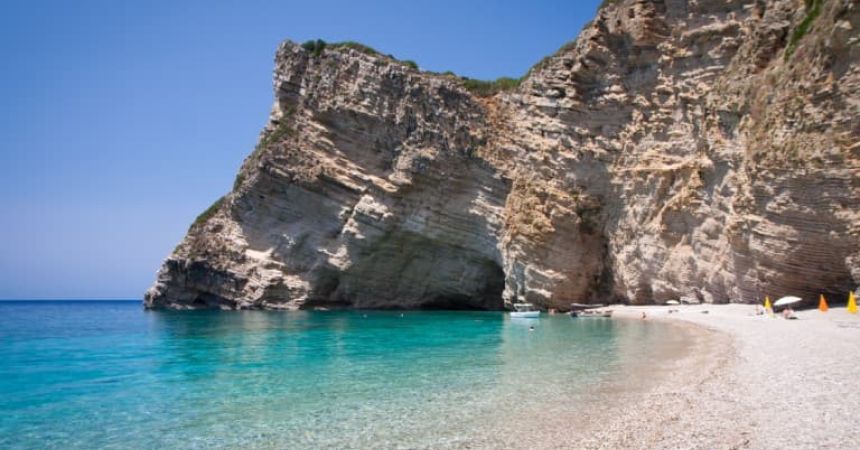
Myrtos Beach has become one of Kefalonia's defining images, with pale stones, dramatic cliffs and intensely colored water creating a coastline recognizable far beyond the island.
It deserves attention.
What it does not deserve is forcing every other day to revolve around famous-beach collecting.
Sea conditions can affect the character of swimming, while the exposed setting is different from smaller protected coves elsewhere on the island. Travelers should therefore separate two ideas that travel photography often combines: a spectacular beach and the ideal beach for your particular swimming day are not always the same thing.
Myrtos can be incorporated naturally while moving through western or northern Kefalonia, especially when Assos is also part of the day.
That is much more efficient than repeatedly driving across the island simply to reproduce a famous photograph.
Assos Is Small Enough to Punish an Overloaded Schedule
Assos occupies one of Kefalonia's most memorable settings, where a narrow strip of land connects the village with a peninsula rising above the sea.
Its scale is part of its appeal.
This is not a destination that becomes more valuable because you identify twelve separate things to do. The pleasure lies in walking through the village, seeing how the settlement meets the water, perhaps climbing toward the Venetian fortress if conditions and energy suit, and allowing the setting to remain the main event.
Trying to combine Assos, Fiskardo, Myrtos, caves and multiple beaches into one heroic day creates precisely the wrong rhythm.
The road may technically allow it.
That does not make it good travel planning.
Assos benefits from being paired geographically rather than accumulated competitively.
Fiskardo Deserves Either More Time or Less Expectation
Fiskardo creates an interesting planning dilemma because it is attractive enough to draw visitors from across Kefalonia but distant enough that reaching it from the south represents a meaningful part of the day.
Its harbor, preserved architecture, restaurants and surrounding greenery provide a distinctly polished northern atmosphere.
If you are making the journey, allow enough time for Fiskardo to function as more than a lunch stop squeezed between driving segments. Alternatively, if your itinerary is already overloaded and the north has no other purpose, accept that skipping Fiskardo may produce a better holiday than spending several hours in transit simply because it appears on every recommendation list.
This is genuine itinerary editing.
Not seeing something is occasionally the decision that improves everything else.
Melissani Works Best When You Understand Its Scale
Melissani Cave near Sami is another place where expectations influence satisfaction.
The underground lake and changing interaction between water, rock and daylight create the attraction, but the actual experience should not be imagined as a half-day subterranean expedition.
That makes Melissani useful as part of an eastern Kefalonia day rather than the sole reason to cross the island.
Nearby geography can be considered together, potentially incorporating Sami, other natural attractions or coastal time depending on the traveler's interests and current operating conditions.
The important point is not to overinflate one stop because it photographs dramatically.
Kefalonia becomes much easier to organize when smaller attractions are grouped geographically and major landscapes are given the time they deserve.
Mount Ainos Explains Why Kefalonia Never Feels Like a Flat Beach Island
The mountain presence changes Kefalonia even for travelers who never plan a serious hike.
Mount Ainos rises through the island's interior and helps explain the winding roads, changing vegetation and abrupt transitions between coast and elevation. The mountain environment also provides a visual counterweight to the beaches that dominate Kefalonia marketing.
Travelers interested in walking or nature can explore more deliberately, but detailed hiking routes belong to a different search intent.
For a first-time destination planner, the more important realization is that the interior is not empty space between beaches.
Driving through Kefalonia is part of the experience precisely because the terrain keeps changing.
This is also why estimated road time matters more here than raw kilometers.
Twenty kilometers through an island landscape should never automatically be interpreted as twenty minutes.
Argostoli Gives the Holiday Something the Scenic Villages Cannot
Argostoli rarely wins a beauty contest against Assos or Fiskardo, but that comparison misunderstands its role.
The capital offers ordinary island life alongside tourism: restaurants, cafés, shopping, waterfront movement and practical services. Staying nearby can make evenings easier and gives travelers somewhere to return to that does not depend on being a preserved harbor village.
The waterfront is also associated with sightings of loggerhead turtles, although wildlife should never be treated as a scheduled performance or approached irresponsibly.
For travelers who enjoy having options after a long driving day, Argostoli's practicality can be an advantage rather than a compromise.
A beautiful isolated base is wonderful until everyone wants dinner and nobody wants another forty-minute drive.
Kefalonia Is an Island Where the Driver Needs a Holiday Too
Rental cars provide enormous freedom here, but itinerary planners sometimes forget that one traveler usually does most of the driving.
A day that looks relaxed to passengers may involve hours of concentration for the person navigating winding roads, parking in unfamiliar villages and returning after dinner.
That should affect planning.
Do not schedule major cross-island driving every day. Alternate longer exploration with local days. If a destination involves dinner and wine, consider whether transportation arrangements need to change.
For Kefalonia private island exploration, professionally arranged transportation can be particularly useful on selected sightseeing days, especially when nobody in the group wants driving to become part of their responsibility.
A rental car remains excellent for independence.
It simply should not turn one member of the party into unpaid holiday staff.
Six Nights Can Feel Longer Than Eight Badly Planned Nights
Kefalonia benefits from time, but duration alone does not solve geographical mistakes.
Three nights provide an introduction, although travelers need to choose priorities aggressively. Four or five nights allow a strong first visit from one base. Around six or seven nights, the island becomes substantially more relaxed and a split stay begins to make strategic sense.
Beyond that, travelers can introduce genuinely slow days rather than filling the additional time with more road mileage.
The important distinction is between coverage and depth.
A five-night visitor who organizes areas geographically may experience Kefalonia more fully than an eight-night visitor who drives from one end of the island to the other repeatedly.
This is why a good itinerary should count road hours as carefully as hotel nights.
Families Should Design Around the Midday Return Question
For families, especially those traveling with younger children, one question clarifies accommodation remarkably quickly:
Will we regularly want to return to the hotel during the afternoon?
If the answer is yes, choose a base near the beaches and activities likely to dominate most days. A theoretically central location offers little advantage when nap time, pool time or a change of clothes requires a long mountain drive.
Families with teenagers can operate differently because full-day exploration becomes easier, and a rental car may expand the holiday rather than complicate it.
This is a better family-planning tool than labeling entire towns “family friendly.”
The correct base is the one that supports the family's actual daily rhythm.
Kefalonia Works Particularly Well After a Faster Part of Greece
Not every island needs to contribute the same energy to a multi-stop itinerary.
After Athens, intensive archaeological touring or a busier island, Kefalonia can function as a deliberate slowdown while still providing enough geography to reward exploration.
That makes it useful within slow-paced Ionian Greece journeys, where the purpose is not to increase the island count but to introduce a destination capable of supporting several different types of day from one longer stay.
The itinerary might contain a northern road day, a local beach day, an eastern exploration day and then almost nothing scheduled the following morning.
That empty space is not poor planning.
It is what prevents a holiday from becoming a field trip.
Zakynthos and Kefalonia Need Different Planning Instincts
The two Ionian islands are close enough to invite comparison, but their strongest planning questions are not the same.
Zakynthos asks travelers to understand different coastal personalities, marine environments and the role of boat-based experiences.
Kefalonia asks travelers to respect scale.
Its mountains, long north-south geography and dispersed villages make road planning more influential, while accommodation location determines how much driving appears in ordinary days.
A combined Kefalonia and Ionian island itinerary can certainly work when transport and available nights justify it, but the second island should not be added merely because another ferry connection exists.
If the journey gains another island but loses the slow days that make Kefalonia worthwhile, the mathematics is working against the holiday.
A Better Way to Build Your First Kefalonia Week
Rather than assigning a famous attraction to every morning, start with geography.
Give northern Kefalonia one coherent period rather than visiting it repeatedly. Group eastern attractions when possible. Keep one or two days geographically close to the accommodation, and protect at least one flexible period that can respond to weather, energy or a beach you unexpectedly prefer.
Then examine the itinerary from the driver's perspective.
If several consecutive days involve long road journeys, simplify it.
Finally, ask whether changing hotels once would remove enough repeated driving to justify packing again.
This approach produces a Kefalonia holiday that may look less impressive as a bullet list but feels considerably better on the ground.
That difference is the entire point.
Frequently Asked Questions About Planning Kefalonia
1. Can I enjoy Kefalonia without driving myself?
Yes, although your accommodation location becomes more important and dispersed sightseeing requires greater planning. Private transfers, selected excursions and taxis can replace some rental-car use, but travelers should organize these around their intended itinerary rather than expecting spontaneous island-wide mobility.
2. Is Argostoli a poor choice if beaches are important to me?
No. Staying around Argostoli or nearby Lassi can provide access to beaches while retaining restaurants and practical services. The better question is whether you want beach isolation or prefer being able to combine swimming with an active town environment.
3. Is Fiskardo worth the drive if I am staying near Argostoli?
It can be, particularly when combined with other northern experiences rather than treated as an isolated lunch destination. Travelers with a short itinerary should consider whether the time spent reaching the far north displaces experiences they value more elsewhere.
4. Should I reserve a rental car for every day of my Kefalonia holiday?
Not automatically. Travelers staying in areas where restaurants and beaches are accessible locally may need a vehicle mainly for exploration days. Villas or more isolated accommodation can make full-period rental considerably more practical, so the hotel location should determine the decision.
5. How difficult are Kefalonia's roads for an average driver?
Main routes are manageable for experienced drivers, but mountainous terrain, curves, narrower sections and unfamiliar village access can make journeys slower than expected. Travelers uncomfortable with this style of driving should avoid constructing an itinerary dependent on daily long-distance road trips.
6. Can I visit Myrtos, Assos and Fiskardo on the same day?
They can be connected geographically, but whether you should do so depends on your starting point, season and desired pace. A schedule that is technically possible may still leave too little time to appreciate Assos or Fiskardo beyond photographs.
7. Does Kefalonia suit travelers who mainly want to stay beside the hotel pool?
Yes, provided the accommodation itself offers the environment you want. Kefalonia's size does not create an obligation to explore constantly, and travelers can combine a few carefully selected road days with long periods staying close to their chosen resort.
8. Is Melissani Cave worth crossing the island for on its own?
For most visitors, it makes more sense when incorporated into a wider eastern Kefalonia day. The experience is distinctive but relatively concentrated, so combining it geographically with other nearby interests generally produces a more efficient use of travel time.
9. What should I consider before booking a villa in Kefalonia?
Check actual driving time to restaurants, supermarkets and the beaches you expect to use frequently, not merely distance in kilometers. A spectacular isolated property can be ideal, but only when everyone accepts that routine errands and dinners may require driving.
10. How early should I decide whether to split my Kefalonia stay?
Ideally before booking accommodation, because the decision should reflect total nights and intended geography. For a longer stay, dividing north and south can reduce repeated driving, while short visits usually benefit more from remaining in one carefully chosen property.
11. Is Kefalonia suitable for a first Greek island holiday?
Yes, especially for travelers who enjoy scenic driving, varied beaches, villages and a less concentrated island geography. Visitors wanting to walk everywhere from one town or avoid transportation almost completely may find a smaller, more compact island easier.
12. What is the most common planning mistake on Kefalonia?
Treating map distance as realistic travel time leads to overloaded days and unnecessary driving. Kefalonia is most enjoyable when attractions are grouped geographically, longer road days are separated by local ones and accommodation is chosen according to the areas travelers value most.

A travel professional specializing in tailor-made travel planning, guest experience management, and multi-destination tourism operations.
With over 23 years of experience in the travel industry, he designs and manages private and cultural tours for international travelers across Türkiye, Greece, Egypt, Jordan, Morocco, and other destinations.
He has strong expertise in both online and face-to-face guest communication, sales processes, and end-to-end travel operations.
Working closely with hotels, travel agencies, and local partners, he ensures smooth coordination and high-quality travel experiences at every stage of the journey.
His focus is on delivering personalized, reliable, and seamless travel experiences for international guests worldwide.