Meteora Greece: Plan the Landscape, Not Just the Monasteries
Updated: August 2026
The first surprise at Meteora is not that monasteries were built on enormous rock pillars. Most travelers already know that before arriving; the photographs are probably the reason they came.
The surprise is how poorly those photographs explain the place.
Meteora is not a monument with an entrance gate, nor is it a collection of six monasteries standing conveniently beside one another. Roads curve between immense sandstone formations, monasteries appear and disappear as the landscape changes, viewpoints interrupt the journey, and every monastery involves its own combination of opening arrangements, walking, stairs and time inside.
This is why a traveler can spend six rushed hours at Meteora and technically see more monasteries than someone who stays overnight, yet leave with a much thinner sense of the place.
For a first visit, the most useful principle is surprisingly simple: do not measure Meteora by how many monasteries you manage to enter. Two or three thoughtfully chosen visits, combined with enough time outside them, will usually reveal considerably more than a race through every open door.
Before Choosing a Monastery, Understand What You Are Actually Visiting
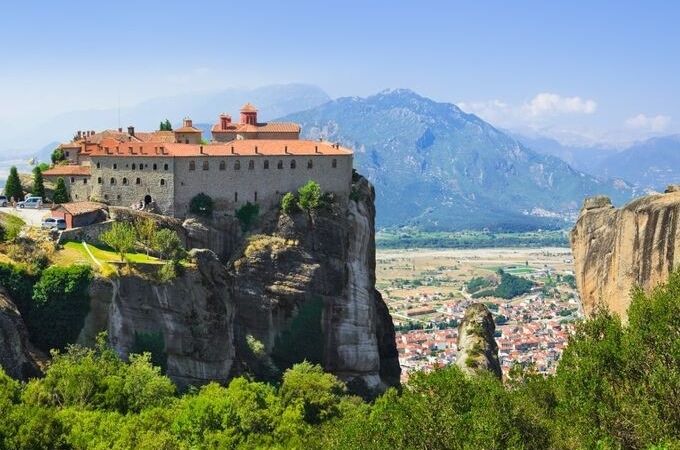
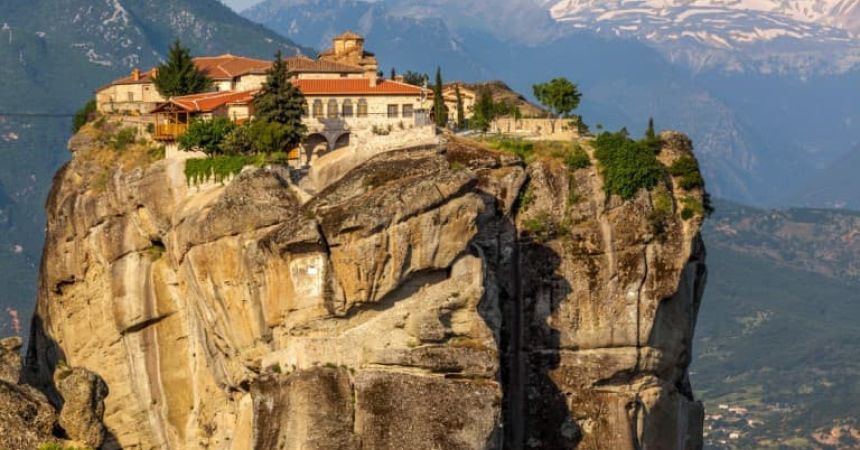
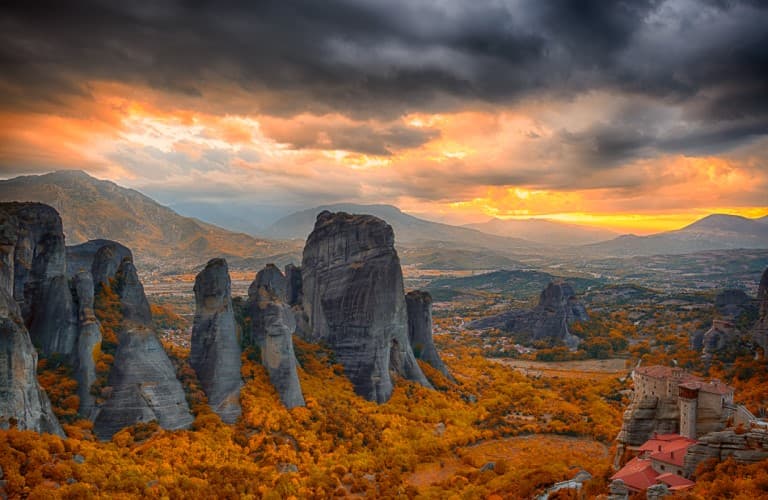
Meteora rises above the Thessalian town of Kalambaka, where enormous rock pillars form one of Greece's most unusual cultural landscapes. Religious communities began establishing themselves among these formations centuries ago, eventually developing monasteries in extraordinarily inaccessible positions.
Twenty-four monasteries existed during the height of the monastic community. Today, six remain active and are normally associated with the visitor experience: the Great Meteoron, Varlaam, Roussanou, St. Nicholas Anapausas, Holy Trinity and St. Stephen.
The number six causes trouble.
It looks achievable.
A traveler sees six names, notices that roads connect them and naturally assumes that a complete Meteora visit means seeing all six. Yet these are functioning religious sites rather than six rooms of one museum, and reaching several involves substantial steps and repeated changes of elevation.
Once entrances, interiors, walking, photographs, viewpoints and transportation are included, the day begins disappearing surprisingly quickly.
Meteora becomes more rewarding when completeness stops being the objective.
Two or Three Monasteries Can Tell the Story Better Than Six
There is no universal combination that every traveler should follow because monastery opening arrangements vary and individual mobility matters enormously.
A history-focused visitor may want to devote considerable time to Great Meteoron, the largest of the active monasteries, while someone concerned about strenuous access may prioritize differently. A photographer may willingly sacrifice an additional interior visit to remain longer along the road when conditions around the rock formations are particularly good.
Instead of asking which monasteries rank first, build the day around contrast.
One substantial monastery can provide historical depth. Another may offer a different relationship with the surrounding cliffs. A third makes sense only if energy, operating hours and the pace of the day still support it.
By the fourth or fifth consecutive monastery, travelers who are not specifically studying Orthodox monastic history can begin absorbing less rather than more.
That is the point at which quantity starts working against the destination.
The Most Important Meteora Planning Document Is the Opening Schedule
Meteora does not have one universal opening timetable.
Each monastery maintains its own visiting schedule, and closing days can differ. Hours may also change seasonally or for religious and operational reasons, which means an itinerary created around assumptions from an old travel article can fail before the first monastery is reached.
This affects more than whether a particular door is open.
Imagine choosing three monasteries and discovering that their closing patterns leave only one practical visiting sequence on your date. Suddenly the route, lunch timing, viewpoints and even the preferred overnight structure can change.
For that reason, monastery selection should remain provisional until the schedule for the actual travel period has been checked.
This is genuine operational planning rather than administrative detail. At Meteora, opening patterns partly design the sightseeing day for you.
Not Every Monastery Asks the Same Thing of Your Legs
One of the details most easily underestimated before arrival is physical access.
Photographs usually show monasteries from a distance, where stairs become almost invisible against the rock. Once you arrive, the practical reality becomes clearer: walking surfaces, slopes and staircases vary, and a route that sounds simple in an itinerary can feel very different to someone with knee problems, limited mobility or difficulty with repeated climbing.
St. Stephen is generally associated with easier access than several alternatives, making it relevant when mobility is a significant consideration. Other monastery approaches can involve considerably more steps.
This does not mean travelers with mobility limitations should remove Meteora from their plans.
Quite the opposite.
The landscape can be experienced from roads and viewpoints without climbing into every monastery, while the interior visits can be selected according to realistic physical ability.
A professionally planned visit should therefore ask about mobility before choosing monasteries, not after a traveler reaches the bottom of a staircase.
What Kind of Meteora Day Are You Actually Planning?
Instead of comparing monasteries against one another, it is more useful to compare the consequences of different visit styles.
| Visit Style | Monastery Interiors | Landscape Time | Physical Demand | Likely Experience |
|---|---|---|---|---|
| Checklist visit | 4–6 | Limited | High | Comprehensive on paper, often rushed |
| Balanced first visit | 2–3 | Generous | Moderate | Strongest option for most travelers |
| Mobility-conscious visit | 1–2 selected carefully | High | Lower | Landscape remains central |
| Photography-led visit | 1–2 | Very high | Variable | Light and viewpoints drive timing |
| Religious/history-focused visit | 3–4 | Moderate | Moderate–high | Greater interior depth |
| Family visit | 1–2 | High | Controlled | Less cultural fatigue |
This is a more useful distinction than ranking Great Meteoron against Varlaam because travelers are not choosing monuments in isolation; they are choosing how the whole day will feel.
The Road Between the Monasteries Is Part of Meteora
There is an unfortunate habit in sightseeing itineraries of treating transportation between attractions as dead time.
At Meteora, that would be a serious mistake.
The road itself repeatedly opens onto different perspectives, sometimes revealing monasteries perched above valleys and sometimes bringing the rock formations so close that their scale becomes difficult to judge.
Stopping matters.
A viewpoint does not need a ticket or an hour-long guided explanation to deserve fifteen or twenty minutes. In fact, some of the moments travelers remember most strongly occur precisely when they are no longer inside a monastery.
This is also why private transportation can add genuine practical value in Meteora. The benefit is not luxury for its own sake; it is the ability to adapt the pace around operating monasteries, mobility and worthwhile stops rather than following a large group's fixed sequence.
For travelers incorporating private mainland Greece cultural touring into a wider journey, that flexibility can substantially change how Meteora feels.
Kastraki and Kalambaka Solve Different Overnight Problems
Travelers searching for accommodation around Meteora quickly encounter two names: Kalambaka and Kastraki.
They are close enough that choosing one does not fundamentally determine which monasteries you can visit, but the atmosphere after sightseeing is different.
Kalambaka is the larger town, with broader infrastructure, restaurants, shops and transport connections. It can be particularly practical for travelers arriving or departing through public transportation or anyone who values having more facilities within easy reach.
Kastraki sits closer beneath the dramatic rock formations and offers a smaller village atmosphere. For travelers who came specifically because they want Meteora to remain visually present even after the sightseeing vehicle has stopped, that setting can be especially appealing.
Neither should automatically be labeled “better.”
The distinction is between convenience and immersion, although good accommodation options can naturally blur that line.
The Overnight Question Matters More Than the Hotel Question
Whether you sleep in Kalambaka or Kastraki is less consequential than whether you sleep in the area at all.
A long same-day visit from Athens may be technically possible depending on transportation, but feasibility and quality are different questions. When several hours of travel sit on both sides of the sightseeing window, monastery visits become the center of a logistical sandwich.
Staying overnight changes the emotional structure.
The main excursion traffic eventually thins. The rocks remain. Evening light begins changing their shape and color, and dinner no longer needs to be followed immediately by a long return journey.
The next morning, you wake beneath the same formations and can continue before leaving for the next destination.
For travelers already exploring classical and northern Greece routes, one night around Meteora is therefore not simply accommodation. It divides the destination into two more manageable periods.
Sunset Is Better When You Have Not Spent the Day Chasing It
Meteora is frequently marketed around sunset, and the landscape can certainly be extraordinary as evening light moves across the pillars.
The problem begins when sunset becomes another appointment.
Travelers rush through the final monastery, hurry toward a famous roadside viewpoint and join everyone else trying to occupy the same position before the light disappears.
There is another way to approach it.
If you are staying overnight, allow the afternoon to loosen after the final monastery visit. Move through several viewpoints and let weather, visibility and crowd levels influence where you stop.
Clouds may completely change the expected photograph while making the rocks more atmospheric.
The destination has not failed because the sky did not turn orange.
A landscape this unusual does not need a color filter to justify the journey.
Meteora Is Still Worth Visiting If You Are Not Religious
The religious history matters enormously, but visitors do not need a personal religious interest to find Meteora compelling.
Architecture is part of the fascination. So is geology. Human isolation, engineering, survival and the decision to establish communities in such difficult locations raise questions that remain interesting regardless of belief.
This is also where responsible guiding adds depth.
A good explanation should not turn the monasteries into religious curiosities, nor should it strip away their spiritual meaning and discuss only construction. Meteora becomes more understandable when both are allowed to coexist.
Visitors are entering active Orthodox religious spaces, so appropriate clothing and respectful behavior are necessary. Photography restrictions may apply within particular areas and should always be followed according to current instructions.
Respect here is not tourism etiquette added after the fact.
It is part of visiting a living monastic landscape.
Families Should Build the Day Around Attention, Not Endurance
Meteora can be surprisingly successful with children because the physical setting is immediately understandable.
A monastery on top of an enormous rock requires very little explanation to seem extraordinary.
The challenge comes later, when adults attempt to turn that initial curiosity into four consecutive monastery interiors.
Families usually benefit from alternating experiences. Visit a monastery, drive through the landscape, stop at a viewpoint, have lunch and then decide whether another interior still makes sense.
Older children may become interested in how supplies once reached the monasteries or why communities chose such inaccessible locations, while younger children may respond much more strongly to the rocks and stairs than to religious art.
A successful family visit does not need to simplify Meteora.
It needs to vary the rhythm.
Walking Changes the Scale, Even Without a Full Hiking Day
Traveling by road makes Meteora accessible, but even limited walking changes the perception of distance and height.
Once outside the vehicle, the rocks stop behaving like scenery through a window. Their vertical scale becomes more obvious, vegetation and paths become part of the environment, and the physical isolation of the monasteries becomes easier to appreciate.
Dedicated hiking routes deserve their own planning and should not be casually folded into a general destination article as though every trail has identical difficulty.
However, travelers comfortable on foot can benefit from adding some walking rather than spending the entire visit moving from parking area to parking area.
This becomes particularly worthwhile during a two-night stay, when there is enough time for the landscape itself to occupy part of a day without competing directly with monastery opening hours.
One Night or Two Depends on Why Meteora Is in Your Trip
A single overnight is enough for many first-time visitors because it removes the worst time pressure while keeping the wider Greece itinerary efficient.
Two nights serve a different traveler.
Photography enthusiasts can experience changing light more than once. Walkers gain room for trails. Travelers deeply interested in Orthodox heritage can enter more monasteries without compressing them into one exhausting sequence.
The extra night should therefore add depth rather than another checklist.
If your only reason for staying two nights is to enter all six monasteries, reconsider whether that objective actually improves the trip.
If the second night creates a morning walk, slower lunch, additional monastery and another evening beneath the rocks, it has a clear purpose.
Meteora and Delphi Belong in Different Mental Compartments
They frequently appear together in mainland Greece planning, but treating them as similar destinations weakens both.
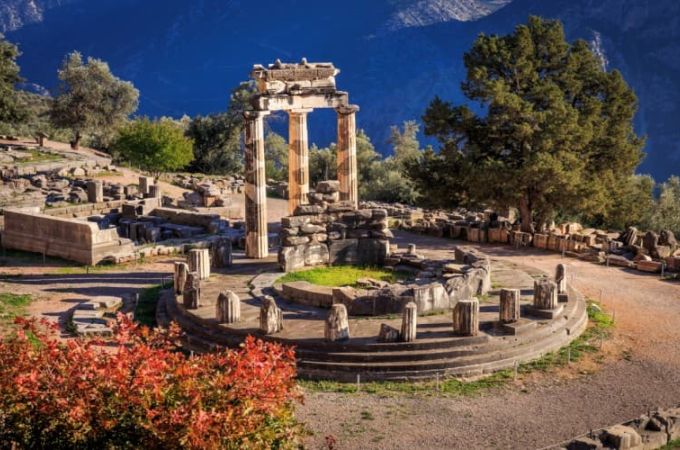
Delphi is fundamentally tied to ancient Greek religion, Apollo, prophecy and the archaeological landscape of Mount Parnassus. The intellectual journey is backward into the classical world.
Meteora presents another relationship between landscape and belief. Its monasteries belong to Orthodox Christian history and remain connected with living religious communities.
Operationally, the visits are different as well.
Delphi revolves primarily around a concentrated archaeological environment. Meteora distributes the traveler among several active monasteries, roads, viewpoints and villages.
This distinction is precisely why a well-designed Greece history and landscape itinerary can contain both without either becoming redundant.
They are not two scenic historical stops.
They tell entirely different Greek stories.
Where Meteora Fits Best in a Longer Greece Journey
Meteora becomes awkward when it is added simply because everyone agrees it should not be missed.
A journey that moves Athens → Meteora → Athens → island ferry can involve considerable backtracking, especially when the mainland section has not been planned geographically from the beginning.
It works more naturally as part of a broader mainland movement, potentially connecting central Greece with northern destinations depending on the itinerary.
This is where practical experience matters more than adding another attraction to a brochure. Since 1997, planning multi-stop Greece journeys has repeatedly shown us that a destination's quality depends partly on what comes before and after it; Meteora deserves enough time that the journey there does not overwhelm the reason for going.
For some travelers, one night is sufficient.
For others, removing a less important stop elsewhere and giving Meteora two nights produces a substantially better journey.
The itinerary should answer that question before the hotel booking does.
The Best Meteora Visit Leaves Something Uncounted
Travelers often leave destinations remembering numbers: six monasteries, three museums, fourteen islands, twenty-seven photographs.
Meteora is better when the arithmetic fades.
You may enter Great Meteoron and Varlaam but skip another monastery because the afternoon light becomes beautiful. You may remain at a viewpoint longer than expected or spend more time over lunch in Kastraki because the day does not need to be optimized down to the minute.
Nothing has been lost.
The purpose of visiting Meteora is not to prove that every accessible monastery was entered. It is to understand how an extraordinary geological landscape became inseparable from centuries of monastic life.
Once that relationship becomes clear, the destination has done considerably more than provide a photograph.
Frequently Asked Questions About Visiting Meteora
1. What happens if the monastery I most want to see is closed on my visit day?
Build the visit around the monasteries operating that day rather than forcing the entire itinerary around one closure. The six active monasteries offer different perspectives, and a carefully selected alternative combined with landscape stops can still produce an excellent Meteora experience.
2. How tiring is a normal day at Meteora?
Physical effort varies considerably according to monastery selection because access can involve stairs, slopes and uneven surfaces. Travelers with mobility concerns should choose monasteries before arrival according to access rather than discovering during the day that their preferred sequence is unnecessarily demanding.
3. Is it worth visiting only one monastery if my mobility is limited?
Yes. Entering one suitable monastery can provide enough interior context to make the wider landscape meaningful, while roads and viewpoints still reveal Meteora's extraordinary geography. A rewarding visit does not depend on physically reaching every monastery open that day.
4. Will I understand Meteora without taking a guided tour?
You can certainly appreciate the landscape independently, but professional interpretation adds context around Orthodox monastic life, historical development and the relationship between individual monasteries. Travelers particularly interested in history usually gain more when at least part of the visit is guided.
5. Does staying in Kastraki make monastery visits easier than staying in Kalambaka?
Kastraki provides a closer visual relationship with the rock landscape, while Kalambaka generally offers broader town infrastructure. Actual monastery sightseeing still requires appropriate transportation or walking arrangements, so accommodation atmosphere should matter more than assuming one base eliminates transfers.
6. What if bad weather affects the viewpoints?
Meteora remains atmospheric in cloud, mist and changing light, although severe conditions can naturally affect access or visibility. A flexible overnight itinerary provides an advantage because travelers are not relying entirely on one brief sightseeing window for every important view.
7. Are shorts acceptable inside the Meteora monasteries?
Visitors should expect modest dress requirements appropriate to active Orthodox religious sites. Because detailed rules and available coverings can vary, the safest approach is to arrive with suitable clothing and follow the instructions displayed or provided at each monastery entrance.
8. Is Meteora enjoyable in the middle of summer?
Yes, although heat and visitor numbers make pacing particularly important. Earlier monastery visits, realistic stair expectations, water and breaks can improve the experience considerably, while an overnight stay prevents travelers from forcing every major viewpoint and monastery into the busiest part of one day.
9. Can older travelers experience Meteora without feeling excluded?
Absolutely. The landscape itself is accessible from numerous road perspectives, and monastery selection can be adapted around physical ability. Planning becomes important because the objective should be choosing rewarding access rather than comparing the traveler against an unrealistic six-monastery itinerary.
10. Is a sunset tour necessary if I already have a daytime Meteora tour?
Not necessarily. Travelers staying locally can often experience evening light without treating sunset as another formal excursion. A separate tour becomes more useful when transportation, guiding or specific photographic access adds value that the existing arrangements do not provide.
11. Should photographers stay two nights in Meteora?
Two nights can be worthwhile because they provide multiple opportunities for changing light, weather and viewpoint selection without sacrificing monastery visits. Photography-focused travelers benefit particularly from flexibility because the most interesting conditions rarely follow a sightseeing timetable created months in advance.
12. What should I confirm immediately before traveling to Meteora?
Recheck the operating days and hours of the monasteries you intend to visit, along with any current access information affecting the route. Meteora planning depends on live operational details more than a conventional attraction list, so older schedules should never be treated as permanent.

A travel professional specializing in tailor-made travel planning, guest experience management, and multi-destination tourism operations.
With over 23 years of experience in the travel industry, he designs and manages private and cultural tours for international travelers across Türkiye, Greece, Egypt, Jordan, Morocco, and other destinations.
He has strong expertise in both online and face-to-face guest communication, sales processes, and end-to-end travel operations.
Working closely with hotels, travel agencies, and local partners, he ensures smooth coordination and high-quality travel experiences at every stage of the journey.
His focus is on delivering personalized, reliable, and seamless travel experiences for international guests worldwide.