Delphi Greece: Is a Day Trip Enough to Understand It?
Updated: August 2026
Delphi is close enough to Athens to be sold as an easy excursion, yet important enough that treating it merely as a day away from the capital can undersell the reason people have traveled here for centuries.
The archaeological remains are certainly central to the visit. You come to see the Sanctuary of Apollo, stand near the place where the ancient oracle delivered prophecies, walk past treasuries erected by Greek city-states and enter a museum containing objects that transform broken foundations outside into something considerably more intelligible.
Yet Delphi's power has never belonged to architecture alone.
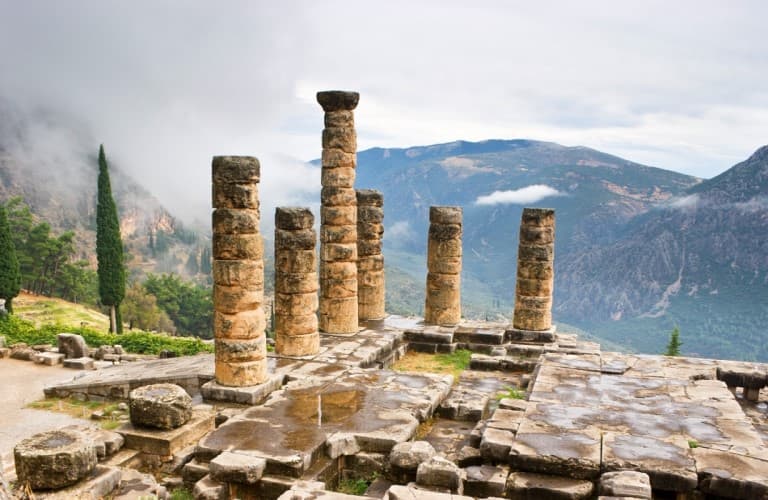
The sanctuary occupies the southern slopes of Mount Parnassus above a vast valley of olive trees, with mountains framing the horizon and the Gulf of Corinth visible beyond. Once you are there, it becomes much easier to understand why ancient Greeks considered this landscape capable of carrying religious significance.
That creates the real planning question. Do you visit Delphi efficiently from Athens, or give it enough time to become part of a mainland Greece journey?
Both can work, but they produce noticeably different experiences.
The Reason Delphi Feels Different Becomes Obvious Before You Reach the Temple
A first visit often begins with expectations shaped by photographs of columns and reconstructed monuments. The approach provides a more useful introduction.
As the road rises toward Delphi, the geography changes. Mount Parnassus becomes dominant, the slopes become steeper, and the immense olive-growing landscape below creates a sense of separation from the urban world left behind.
That setting was not incidental to ancient Delphi.
The sanctuary was associated with Apollo and the Pythia, the priestess whose oracular pronouncements made Delphi one of the most influential religious centers of the ancient Greek world. Individuals, rulers and city-states sought guidance here, while dedications accumulated around a sanctuary whose influence reached far beyond its physical size.
Understanding that importance makes the ruins easier to read.
You are not visiting the remains of an ordinary ancient town. You are moving through a sanctuary where religion, politics, wealth and competition between Greek communities repeatedly intersected.
The Sacred Way Is More Useful Than a List of Ruins
The archaeological site makes the most sense when experienced as a progression.
Rather than moving from monument name to monument name, imagine how an ancient visitor encountered the sanctuary. The Sacred Way climbed through a landscape filled with monuments and treasuries before reaching the Temple of Apollo, creating a deliberate transition through sacred space.
The Treasury of the Athenians is particularly useful for understanding this idea because treasuries were not simply decorative buildings. Greek city-states used them to house dedications, while their presence also communicated prestige within a sanctuary visited by people from across the Greek world.
Higher up, the theater introduces another layer to the site, while the stadium—when access arrangements permit—extends the physical visit further up the slope.
This vertical organization matters.
Delphi is not a flat archaeological park where visitors can casually wander between adjacent ruins. The climb is part of the experience, and the changing views increasingly connect the sanctuary with the surrounding landscape.
How Far Up the Site Should You Actually Walk?
This question receives surprisingly little attention in generic Delphi guides.
Travelers frequently arrive assuming that visiting the archaeological site means following one obvious route until everything has been seen. In reality, physical ability, weather, available time and current access conditions should determine how far and how quickly you continue.
The Temple of Apollo will naturally be a priority for almost every first-time visitor. Beyond it, continuing higher can add the theater and broader perspectives across the sanctuary, while additional climbing may be worthwhile for travelers interested in the site's fuller topography.
However, there is no prize for reaching the highest possible point while exhausted.
Older travelers, families and visitors arriving during hot conditions should be especially realistic about the ascent. Comfortable footwear, water and a pace that allows stops are more important here than squeezing another monument into the schedule.
Delphi should feel like an archaeological landscape being understood gradually, not a hill being conquered.
The Museum Is Where Fragments Become People Again
Some archaeological museums function as useful additions after seeing a site.
At Delphi, the museum is closer to essential.
Outside, visitors encounter foundations, architectural remains and reconstructed elements whose original meaning is not always immediately obvious. Inside the Archaeological Museum of Delphi, sculpture and objects recovered from the sanctuary restore detail, craftsmanship and human presence to that landscape.
The Charioteer of Delphi is among the museum's best-known works, but approaching the collection only through one masterpiece misses its larger function. The exhibits help explain the wealth that reached Delphi, the dedications made there and the artistic world surrounding the sanctuary.
For travelers who normally become museum-fatigued, Delphi presents an interesting exception because the collection directly answers questions created outside.
The site gives the objects geography.
The museum gives the ruins faces, materials and detail.
Skipping either weakens the other.
Site First or Museum First? The Answer Depends on How You Learn
There is no need to turn sequencing into a rigid rule.
Travelers who enjoy approaching ancient places visually may prefer the archaeological site first. They encounter the landscape without having every object explained in advance, then use the museum to interpret what they have just walked through.
Others benefit from reversing the order. Seeing models, sculptures and historical context before climbing the sanctuary can make architectural remains easier to recognize once outside.
The decision becomes more practical during busy or hot periods, when visitor flow and temperature may matter more than theoretical learning style.
| Your Situation | Better Starting Point | Practical Reason |
|---|---|---|
| First visit, moderate weather | Archaeological site | Landscape establishes context naturally |
| Very warm day | Site earlier | Complete exposed walking before stronger heat |
| History-focused traveler | Museum can work first | Context improves interpretation outside |
| Limited energy | Site first | Prioritize physically demanding section |
| Photography-focused visit | Site according to light | Exterior conditions matter most |
| Uncertain weather | Adapt on arrival | Preserve flexibility rather than rigid order |
The strongest itinerary treats the two as a single intellectual experience, even though they occupy different physical spaces.
The Tholos Changes the Visual Language of Delphi
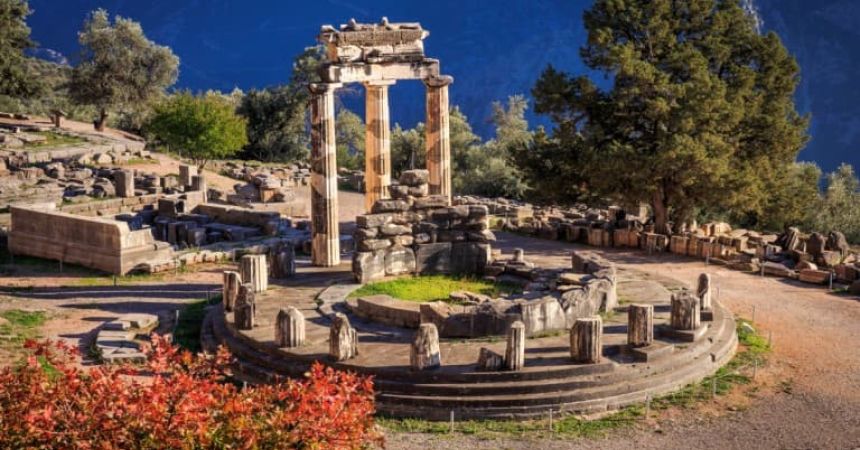
Many travelers recognize the circular Tholos of Athena Pronaia before they know its name.
Its setting below the principal Sanctuary of Apollo has produced one of Delphi's most familiar images, yet the Athena Pronaia area should not be mentally folded into the main archaeological site as though everything occupies one continuous enclosure.
That distinction matters when budgeting time.
Travelers who arrive expecting to walk seamlessly from every famous monument to the next can underestimate both the geography and the amount of movement involved.
It also illustrates why Delphi rewards preparation without requiring obsessive scheduling. Knowing that important remains occupy different areas allows you to structure the visit sensibly while still leaving enough freedom to appreciate the landscape between them.
A Day Trip From Athens Is Enough—For the Right Traveler
There is nothing inherently wrong with seeing Delphi as a day excursion from Athens.
For travelers with limited time, it can be an excellent decision. You can experience one of Greece's most important archaeological landscapes without changing hotels, and a well-organized departure can provide enough time for the principal sanctuary and museum.
The compromise is not necessarily what you see.
It is how the day feels.
A same-day return means substantial road travel surrounds the archaeological visit, and the schedule naturally becomes more disciplined. Lunch, site time and museum time all operate within the knowledge that Athens is still waiting at the other end of the day.
That suits travelers whose Greece journey is primarily Athens and the islands.
It is less compelling for someone already interested in central or northern mainland Greece, because returning south simply to depart north again can create unnecessary repetition.
Overnighting Changes Delphi More Subtly Than Meteora
An overnight stay at Delphi does not produce the same dramatic transformation as sleeping beneath Meteora's rock pillars, and pretending otherwise would flatten two very different destinations into the same content template.
The value here is quieter.
Once day visitors begin leaving, Delphi village settles into a different rhythm. The surrounding mountains and valley remain visible, dinner can happen without a return journey hanging over the evening, and the archaeological visit can be separated from the transportation day.
Staying locally also creates flexibility for travelers continuing through mainland Greece the following morning.
The decision therefore depends less on “Do I need two days to see Delphi?” and more on “Does sleeping here improve the direction and pace of my wider route?”
That is the more useful question.
Delphi Village Is Practical; Arachova Serves a Different Mood
Delphi village sits immediately beside the archaeological landscape and is the straightforward overnight choice for travelers whose primary purpose is the ancient sanctuary.
Hotels and restaurants occupy a mountain setting with extensive views, while proximity makes it possible to keep the archaeological experience central rather than commuting to it.
Arachova, farther along the mountain environment, has developed a stronger identity as a stylish mountain destination and becomes especially lively in association with winter travel and Mount Parnassus.
These places should not be treated as interchangeable hotel zones.
Stay in Delphi when archaeological proximity and simplicity are the priorities. Consider Arachova when you deliberately want a more developed mountain-town atmosphere to become part of the experience.
Choosing Arachova solely because it appears fashionable online can add movement without adding value if your actual interest is Delphi.
What Changes When You Give Delphi Different Amounts of Time?
Instead of a conventional itinerary table, it is more useful to examine what additional time actually buys.
| Time Commitment | What You Gain | What You Sacrifice |
|---|---|---|
| Half-day on site | Core archaeological experience | Museum/site pacing becomes tighter |
| Full Athens day trip | Site + museum with organized logistics | Long travel day, limited flexibility |
| One overnight | Slower archaeology + evening locally | Additional hotel change |
| Two nights | Space for wider mountain context | Often unnecessary for classic first visits |
| Mainland route stop | Delphi becomes geographically efficient | Requires broader itinerary planning |
For most travelers, Delphi does not require several nights.
The critical improvement often occurs between rushing through it and giving it one properly structured day.
Spring and Autumn Change More Than the Temperature
Season influences Delphi differently from a conventional island destination because much of the important experience involves walking through an exposed archaeological landscape.
Spring can bring greener surroundings and comfortable conditions, while autumn often suits travelers who prefer cultural sightseeing after peak summer intensity. Summer remains completely viable, but the timing of outdoor exploration becomes more important because climbing through exposed areas in strong midday heat can reduce both concentration and enjoyment.
Winter produces another version of central Greece entirely, particularly in the wider Parnassus region.
This article deliberately does not take ownership of a month-by-month Delphi weather query. The planning point is narrower: temperature affects archaeological stamina, and archaeological stamina determines how much of Delphi you actually absorb.
That relationship should influence the day's starting time.
A Licensed Guide Adds Most Value Where the Stones Stop Explaining Themselves
Delphi is visually impressive enough to visit independently, but it is also a place where interpretation can materially change what the traveler understands.
Foundations rarely explain political rivalry.
A reconstructed treasury does not automatically reveal why a city-state wanted to display wealth at Delphi.
The Temple of Apollo cannot, by itself, explain the oracle's extraordinary influence across the Greek world.
This is where guiding becomes more than logistical accompaniment. A knowledgeable licensed guide can connect mythology, religion, politics, art and physical remains without requiring visitors to spend the entire day reading signs.
For travelers incorporating privately guided Delphi archaeology into a wider Greece journey, the greatest value lies in interpretation rather than simply having someone lead the way between monuments.
Delphi Belongs Naturally Between Athens and Mainland Greece
The most efficient role for Delphi becomes clearer when looking at a map rather than an attraction list.
Travelers continuing toward central or northern Greece can often use Delphi as part of forward movement instead of making it an out-and-back excursion from Athens. Depending on the wider route, this can reduce unnecessary repetition while turning a sightseeing day into a transition between regions.
This is particularly useful for Athens and mainland Greece journeys that already include destinations beyond Attica.
Operational planning matters here because luggage, private transportation, hotel check-in times and the next day's route need to work together. Simply drawing a line between destinations does not guarantee an elegant itinerary.
When those details align, however, Delphi stops being an excursion attached to Athens and becomes a meaningful stage in the journey through mainland Greece.
Families Often Need More Story and Less Chronology
Children rarely arrive at Delphi concerned with the sequence of Archaic, Classical and Hellenistic development.
They may respond much more strongly to another question:
Why did powerful people travel all the way here to ask a priestess what they should do?
That question opens the site.
Stories about the oracle, Apollo, competition between city-states and ancient visitors can make apparently fragmented ruins understandable without turning the day into a history lesson.
Families should also be conservative about walking expectations during hot weather. A child who has stopped enjoying the climb will not become more interested because another important monument lies higher up.
Good family interpretation uses the stories to create curiosity and lets the itinerary follow the available energy.
Delphi Should Not Become a Second Meteora Page
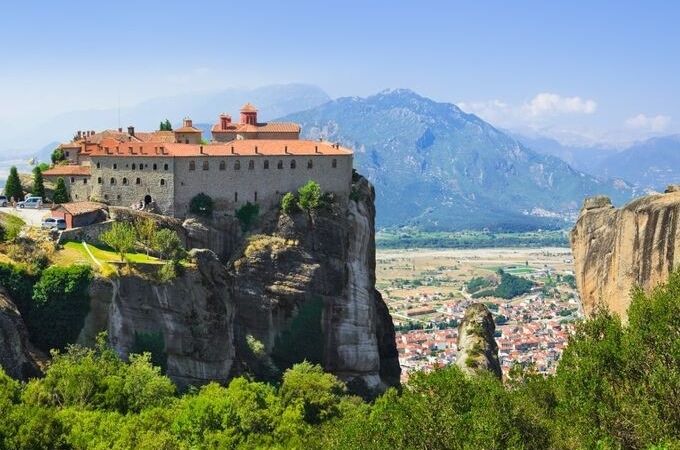
Both destinations combine dramatic landscapes with major cultural significance, and both appear frequently on mainland itineraries. Their resemblance should stop there.
Meteora's visitor challenge is distributed access: multiple functioning monasteries, varying opening schedules, stairs, viewpoints and the decision about how many religious sites to enter.
Delphi's challenge is interpretation and pacing within an archaeological landscape: understanding how the sanctuary developed vertically, connecting the museum with the ruins and deciding whether an overnight improves the wider route.
This separation is essential.
Meteora owns monastic landscape planning.
Delphi owns archaeological sanctuary interpretation and day-trip-versus-overnight planning.
A traveler may visit both during classical Greece cultural journeys, but they should never feel like consecutive versions of the same sightseeing day.
The Best Reason to Stay Longer Is Not Another Attraction
Delphi does not need to be stretched artificially.
There is no reason to manufacture two days of sightseeing simply because slower travel sounds more sophisticated. If your itinerary is short and Athens remains the logical base, a carefully planned day trip can work extremely well.
Stay when staying solves something.
Perhaps you want the archaeological site without a long return journey. Perhaps Delphi lies naturally on the way toward another mainland destination. Perhaps you prefer seeing the museum and sanctuary without watching the clock.
That is meaningful slow travel.
Adding nights without changing the experience is merely a longer booking.
The distinction is important because good itinerary design is not measured by how slowly you travel. It is measured by whether the time assigned to each place matches what you came to understand.
Frequently Asked Questions About Delphi
1. Is Delphi worthwhile if I know very little about Greek mythology?
Yes. You do not need detailed knowledge before arriving, although understanding the basic role of Apollo, the oracle and the sanctuary will make the ruins considerably easier to interpret. A guide or museum visit can provide that context during the day.
2. Should travelers with limited walking ability skip Delphi?
Not automatically. The archaeological terrain rises along a slope, so the full route can be demanding, but visitors can adapt how far they climb according to their ability. Discussing mobility beforehand allows the most important areas to be prioritized realistically.
3. Can I visit Delphi with luggage while traveling between hotels?
Yes when transportation and luggage storage are properly arranged, which is particularly relevant when Delphi forms part of a private mainland route. Travelers using public transportation should verify practical baggage arrangements rather than assuming the archaeological site itself solves the problem.
4. Is Delphi mainly interesting because of the Oracle?
The Oracle of Delphi is central to the sanctuary's historical significance, but the site also reveals ancient religion, interstate competition, art and monumental building. The museum substantially broadens the experience beyond the familiar story of prophetic consultations.
5. How much difference does a guide make at Delphi?
A guide can make a substantial difference because many surviving remains need interpretation before their political and religious significance becomes apparent. Travelers already knowledgeable about ancient Greece may prefer independent exploration, while first-time visitors often benefit considerably from contextual explanation.
6. Should I eat in Delphi or continue to Arachova for lunch?
That depends on the direction and pace of the day rather than on a universal restaurant rule. Eating locally can preserve archaeological time, while Arachova makes sense when the mountain town is deliberately included instead of being added simply because it is nearby.
7. Is the Delphi museum suitable for travelers who normally avoid museums?
It is particularly relevant because its collection comes directly from the sanctuary visitors have just explored. Seeing sculpture and dedications after encountering their archaeological context makes the museum feel like a continuation of the site rather than an unrelated indoor attraction.
8. Does Delphi work well with children?
Yes, particularly when the visit emphasizes the oracle, mythology and the question of why ancient people traveled here. Families should moderate the amount of climbing and detailed archaeological explanation according to children's ages, weather conditions and attention span.
9. Should I visit the museum if I have only limited time?
Generally, yes, although the balance depends on exactly how limited the visit is. The museum contains important objects that clarify the sanctuary's history, so reducing both site and museum slightly can be more meaningful than seeing the ruins while skipping context entirely.
10. Is two nights in Delphi too much?
For a conventional first archaeological visit, two nights are often more than necessary. They become worthwhile when the traveler wants a slower mountain stay, additional regional exploration or a route where Delphi functions naturally between other mainland destinations.
11. Can Delphi and Meteora be combined in the same mainland trip?
Yes, and they complement each other precisely because their historical identities are so different. The route should be planned geographically with realistic driving and overnight arrangements rather than treating both as independent day trips repeatedly returning to Athens.
12. What is the planning mistake that most reduces a Delphi visit?
Underestimating the combination of driving, uphill archaeological walking and museum time can compress the visit unnecessarily. Travelers should decide beforehand whether Delphi is an Athens excursion or a mainland stop, because trying to make it function as both often creates inefficient routing.

A travel professional specializing in tailor-made travel planning, guest experience management, and multi-destination tourism operations.
With over 23 years of experience in the travel industry, he designs and manages private and cultural tours for international travelers across Türkiye, Greece, Egypt, Jordan, Morocco, and other destinations.
He has strong expertise in both online and face-to-face guest communication, sales processes, and end-to-end travel operations.
Working closely with hotels, travel agencies, and local partners, he ensures smooth coordination and high-quality travel experiences at every stage of the journey.
His focus is on delivering personalized, reliable, and seamless travel experiences for international guests worldwide.