Milos Greece: How to Explore an Island Shaped by the Sea
Updated: August 2026
Milos makes a poor first impression on travelers who arrive with a conventional Greek-island checklist.
Find the prettiest town. Choose the best beach. Add a sunset viewpoint. Take a ferry onward.
The island becomes much more interesting once you realize that its identity is not concentrated in one village or one postcard bay. Milos is shaped by geology, erosion and a complicated coastline where white volcanic rock, colored cliffs, protected coves and old fishing settlements appear in dramatically different forms around the island.
That means the most rewarding way to experience Milos is not to chase beaches according to popularity.
It is to understand which parts of the coastline are best reached by road, which deserve to be seen from the water, where to stay so that evenings remain easy, and how much unstructured time the island needs before it begins to feel different from every other Cycladic stop.
For most travelers, that means combining one strong boat day with several land-based days rather than attempting to reach every famous coastline from the road.
Milos Is a Coastal Geography Problem Disguised as a Beach Holiday
Many Greek islands have beaches.
Milos has coastlines that become destinations in their own right.
Sarakiniko is the clearest example. Its smooth pale rock creates an environment that looks more geological than resort-like, and the visual impact comes as much from the surrounding formations as from the water itself.
Elsewhere, colored cliffs and protected bays produce completely different settings. The southern coast feels unlike the north, while western areas become more complicated to approach independently.
This is why a standard “top ten beaches” article does very little to explain Milos.
A useful itinerary needs to distinguish between easy coastal stops, places worth planning around, and sections of the island where arriving from the sea gives a much stronger experience than reaching them by land.
Adamas, Pollonia and Plaka Create Three Different Versions of Milos
Where you stay changes the rhythm considerably.
Adamas is the practical option. It is the principal port, offers a broad range of services and makes ferry-arrival days uncomplicated. Boat excursions also commonly connect naturally with the port environment.
Pollonia, on the northeastern side, provides a quieter coastal atmosphere that appeals to couples and travelers who want evenings near the water without staying in the island’s busiest transport hub.
Plaka, inland and elevated, provides an entirely different experience built around traditional Cycladic lanes, views and sunset atmosphere rather than immediate beach or port convenience.
| Base | Main Advantage | Best For | What Requires More Planning |
|---|---|---|---|
| Adamas | Port and transport practicality | First visits, short stays, boat days | Less intimate than smaller bases |
| Pollonia | Quiet seaside rhythm | Couples, relaxed stays | Greater dependence on transport |
| Plaka | Village atmosphere and views | Travelers prioritizing character | Beaches and port are not outside the door |
| South-coast accommodation | Beach proximity | Coast-first holidays | Evenings become more location-dependent |
The correct base is therefore not whichever hotel has the most attractive pool.
It is whichever base places the part of Milos you intend to use most often within easy reach.
Adamas Is Useful Precisely Because It Does Not Pretend to Be the Island’s Prettiest Village
Adamas sometimes loses accommodation comparisons because travelers immediately gravitate toward Plaka or Pollonia.
Operationally, however, the port can be extremely useful.
If Milos forms part of an island-hopping journey, arriving and departing without a long transfer makes a short stay noticeably easier. Restaurants, rental services and excursion departures are accessible, and travelers can organize several different kinds of day without making the base itself the main attraction.
This makes Adamas particularly sensible for three- or four-night visits.
You can spend the day elsewhere and return somewhere practical.
There is no requirement that every hotel window on a Greek island reproduce the reason you came.
Sometimes the best accommodation decision is the one that gives you more time outside the accommodation.
Pollonia Appeals to Couples Who Want Evenings to Feel Smaller
Pollonia provides a different balance.
Its seaside setting and more compact evening atmosphere suit couples who value restaurants, a coastal walk and a quieter conclusion to the day.
The trade-off is that Milos still needs to be explored.
Staying in Pollonia does not move Sarakiniko, Plaka or the southern beaches conveniently beside your hotel. Transportation remains part of the trip, particularly if you want several full days crossing different parts of the island.
This is a useful distinction because travelers often confuse a peaceful base with a geographically central one.
Pollonia works because of how it feels in the morning and evening.
Choose it for that reason.
Not because it eliminates the need to move around Milos.
Plaka Works Best When Sunset Is Allowed to Happen Naturally
Plaka sits above the coastline and offers one of the island’s strongest village experiences.
Its narrow lanes and elevated setting create an atmosphere particularly suited to late afternoon and evening. Travelers naturally come for sunset, but staying nearby allows Plaka to become something more than a viewpoint reached shortly before the sky changes color.
You can walk without counting minutes.
You can have dinner after everyone stops looking west.
You can return the following morning and notice how different the village feels when sunset is no longer the entire purpose of the visit.
This is one of the recurring themes in good island planning.
Famous moments improve when they become part of a stay rather than a deadline.
Sarakiniko Is Better Understood as a Landscape Than as a Beach
Travelers frequently describe Sarakiniko as one of Greece’s most distinctive beaches, but that description is almost too narrow.
The attraction is geological.
Pale volcanic rock has been sculpted into unusual forms around the sea, creating a stark landscape that feels very different from conventional sandy beach environments.
That means your expectations should change.
If you arrive simply looking for sunbeds, facilities and a straightforward day beside the water, Sarakiniko may not function like the resort beach you imagined.
If you arrive interested in exploring the formations, swimming when conditions suit and seeing Milos’s geology expressed dramatically along the coast, it becomes much more meaningful.
Timing can also influence the experience considerably.
A popular landscape rarely feels identical early in the day and during the busiest hours.
Milos rewards travelers who understand that some famous places deserve to be experienced as environments rather than checked off as attractions.
Kleftiko Is the Reason a Boat Day Should Not Be Treated as Optional Decoration
For many first-time visitors, Kleftiko is the strongest argument for seeing Milos from the sea.
Its cliffs, sea caves and formations belong to a coastal landscape that makes the maritime approach part of the experience itself. This is very different from joining a boat trip simply because “you should take one in Greece.”
On Milos, the boat can solve a geographical limitation.
Sections of the coastline are simply better understood from the water, which means a well-designed boat excursion reveals a version of the island that a rental car cannot reproduce.
That gives Milos coast and sailing experiences a specific purpose.
The objective is not spending a day on a boat for its own sake.
It is accessing the island in the direction from which some of its most dramatic landscapes make the most sense.
Full-Island Cruise or Shorter Sailing Day? The Best Choice Depends on What You Are Missing
Boat-tour decisions should begin with the land itinerary.
If you have several days and intend to explore many road-accessible beaches independently, a longer boat day can be valuable because it concentrates on coastline you cannot experience as effectively from land.
If the entire stay is short, spending almost every daylight hour aboard may leave too little time for Plaka, Klima, Sarakiniko and village life.
The useful comparison is therefore not simply longer versus shorter.
| If Your Land Plans Already Include... | Boat Day Should Prioritize... | Why |
|---|---|---|
| Many accessible beaches | Remote coastline | Avoid repeating the same experience |
| Plaka and villages | Sea caves and swimming | Adds a completely different dimension |
| Very short stay | Focused coastal route | Preserve time on land |
| Five or more nights | Longer sailing experience | Enough time remains for island exploration |
| No rental car | Broad coastal coverage | Boat adds geographic reach |
| Strong swimming interest | Multiple water stops | Sea becomes the day's main experience |
Milos works best when land and sea complement each other rather than compete.
Klima Shows a Different Relationship With the Water
Klima introduces travelers to the syrmata, traditional fishermen’s boat houses built along the waterfront, many recognizable by brightly colored doors.
This is a very different kind of coastal experience from Sarakiniko or Kleftiko.
Here, the interest lies in human adaptation to the shoreline rather than geological drama.
That contrast is important because Milos can easily become visually dominated by beaches and cliffs. Klima reminds visitors that the coastline also shaped settlement, work and everyday life.
The village is particularly atmospheric when approached without expecting a long attraction list.
Walk.
Look at how the buildings meet the water.
Allow enough time for the place to feel inhabited rather than staged for photographs.
That slower observation is part of what separates destination travel from content collection.
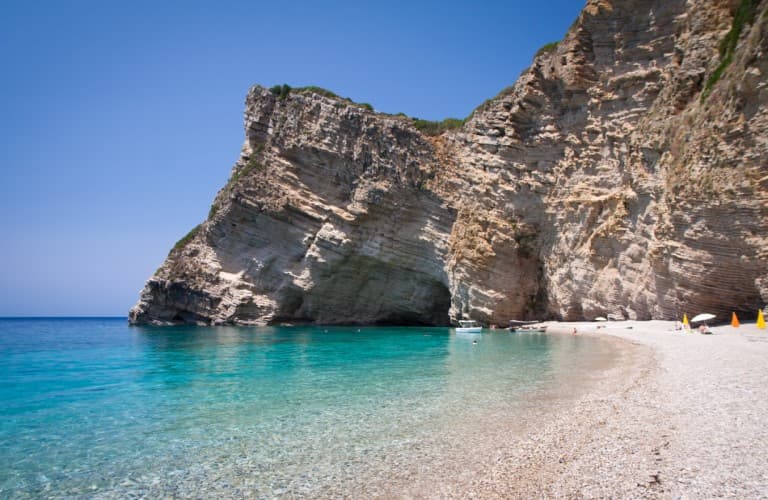
Southern Milos Is Where Beach-Hopping Becomes Most Tempting
The southern coastline contains several beaches that regularly appear on first-time lists, including Firiplaka and other visually distinctive bays.
This is where travelers can easily lose an entire day moving every ninety minutes.
A better approach is to choose fewer beaches according to access, wind conditions, facilities and how much time you genuinely want beside the sea.
The phrase “beach hopping” sounds efficient.
It often means changing parking areas repeatedly while never remaining anywhere long enough to relax.
Milos is particularly vulnerable to this because the coast keeps offering another photogenic option.
Resist the urge to collect them.
A beach enjoyed for three hours is usually more memorable than four beaches photographed for thirty minutes each.
Road Access Should Be Checked Before You Treat the Entire Island as a Rental-Car Circuit
A rental car can be extremely useful on Milos, particularly for connecting villages and accessible coastal areas.
The western side requires more care.
Not every route should be approached as though you were driving between conventional tourist roads, and rental-vehicle restrictions can vary according to company and vehicle type.
This is a practical area where travelers should listen to local operational advice rather than assuming every line visible on a digital map represents an equally appropriate rental-car route.
The broader lesson is important:
having a car gives you independence, not immunity from terrain.
Use the road network intelligently and let boats handle the coastline where boats genuinely work better.
Milos Needs Fewer Scheduled Attractions Than Travelers Think
The island’s best days often contain remarkably little on paper.
Drive somewhere interesting.
Swim.
Stay longer because the water is good.
Have lunch somewhere you did not research.
Continue toward Plaka later because there is no reason to arrive at exactly 17:30.
This is where Milos differs from a destination such as Athens or Rhodes, where historical attractions can create more structured sightseeing days.
Milos works through visual and geographical contrast.
That means a tightly timed itinerary can actually diminish the experience.
The island needs enough structure to avoid inefficient driving and enough freedom to respond to weather, sea conditions and mood.
Three Nights Gives You Milos Highlights; Five Nights Gives You Milos
A short stay can work extremely well.
With three nights, travelers can experience Sarakiniko, Plaka or Klima, selected beaches and a carefully chosen boat excursion.
The problem is that almost every day now has an assignment.
Four or five nights changes the character.
A windy day no longer threatens the whole plan. Boat timing can move if necessary. You can spend longer in one village without calculating what has been sacrificed elsewhere.
| Stay Length | What Milos Becomes | Main Limitation |
|---|---|---|
| 2 nights | Visual introduction | Boat/land balance becomes difficult |
| 3 nights | Strong first visit | Every day needs purposeful planning |
| 4 nights | Balanced coast + villages | Good for most first-time visitors |
| 5 nights | Slower island experience | Flexibility improves considerably |
| 6+ nights | Coastal holiday with depth | Ideal if swimming is central |
Milos does not require a week.
It simply becomes less fragile when given more than a weekend.
Couples Often Like Milos Because It Does Not Need to Announce That It Is Romantic
Milos has become increasingly associated with couples, but its appeal is different from Santorini.
There is less emphasis on one iconic sunset setting and more on shared experiences: a boat day, swimming in a cove, driving between villages, eating somewhere small and returning to a quieter hotel.
That suits couples who prefer privacy and movement over highly choreographed romantic settings.
For private Cyclades escapes for two, Milos can therefore provide a valuable contrast within a larger Greece journey, particularly when another destination already supplies more formal luxury or nightlife.
Romance here is often geographical.
You are somewhere beautiful, together, without needing the destination to continuously remind you that it is romantic.
Families Need to Judge Milos by Access, Not Only by Beauty
Families can enjoy Milos enormously, but beach access deserves careful thought.
A photograph rarely tells you whether reaching the water involves uneven terrain, limited facilities, substantial sun exposure or an approach that younger children will enjoy.
Families should therefore choose coastal stops according to the practical reality of the day.
Some beaches provide easier conditions and facilities. Others are better suited to adults who are comfortable with more independent access.
The same applies to boat excursions.
Trip duration, shade, swimming frequency and onboard arrangements matter more with children than the simple promise of visiting famous coastline.
Milos works for families when beauty is filtered through practicality.
Milos and Santorini Should Not Compete for the Same Semantic Territory
Both islands have volcanic origins and unusual landscapes.
That does not make them equivalent.
Santorini is organized around the caldera. Accommodation choices, views, villages and much of the island’s tourism identity revolve around that dominant geographical feature.
Milos works differently.
Its geology is dispersed around a complicated coastline. The visitor moves between different formations rather than continuously looking toward one defining landscape.
This distinction is crucial for cluster separation.
Santorini owns the caldera-oriented destination experience.
Milos owns coastal geology and land-versus-sea exploration.
The more clearly those identities are written, the less reason Google or the reader has to see the pages as interchangeable Greek-island content.
How Magnificent Travel Would Position Milos in a Greece Journey
Since 1997, Magnificent Travel has arranged Greece journeys where island selection is based not only on fame but on what each stop contributes to the overall rhythm.
Milos works particularly well when the itinerary needs a visually distinctive island that is more about coastal exploration than nightlife or intensive sightseeing.
We first look at ferry or flight access for the relevant dates, how many nights are available, whether the travelers are comfortable driving and how important a boat day is to them. If another Cycladic island already provides a busy social environment, Milos can create a slower contrast. If the trip already contains several beach-heavy stops, we make sure Milos is not reduced to more of the same.
For tailor-made Milos island stays, the main operational decision is balancing road-based exploration with the coastline best experienced from the water.
Once that balance is right, the island becomes remarkably easy to enjoy.
Frequently Asked Questions About Milos
1. Can I enjoy Milos if I do not want to rent a car?
Yes, although transportation needs to be planned more deliberately. A convenient base such as Adamas, selected transfers, taxis and boat excursions can cover much of a short visit, while independent access to dispersed beaches becomes easier with a rental vehicle.
2. Is Sarakiniko comfortable for an entire beach day?
It depends on what you expect from a beach day. Sarakiniko is primarily remarkable for its volcanic landscape and swimming environment rather than conventional resort facilities, so many travelers experience it as a distinctive coastal stop rather than staying there all day.
3. Should I book my Milos boat trip for the first available day?
When possible, avoiding the final day gives you more flexibility if sea or weather conditions affect operations. A boat experience can be important enough on Milos that leaving some schedule flexibility may be preferable to placing it immediately before departure.
4. Is Pollonia inconvenient if my ferry arrives in Adamas?
Not necessarily, provided you arrange the onward transfer appropriately. Pollonia offers a different atmosphere from the port and can justify the additional movement, particularly for couples or travelers who value a quieter seaside base over immediate ferry convenience.
5. Is Klima a beach destination?
Not primarily. Klima is better understood as a traditional fishing settlement closely tied to the shoreline, known for its colorful boat houses and distinctive relationship with the sea. Visit for atmosphere and cultural landscape rather than conventional beach facilities.
6. Can I reach Kleftiko without taking a boat?
The broader area may be approached in different ways depending on route and conditions, but for most visitors Kleftiko is fundamentally associated with the maritime experience. Seeing its cliffs and sea formations from the water is a major part of its appeal.
7. Is Milos suitable for travelers who do not swim much?
Yes, provided coastal landscapes still interest you. Plaka, Klima, volcanic formations, villages and photography offer substantial appeal, although travelers with little interest in either swimming or boat experiences may find another Cycladic destination more aligned with their priorities.
8. Should I stay in Plaka if I have an early ferry departure?
Plaka can provide wonderful atmosphere, but early departures require transportation back to the port in Adamas. Travelers should weigh the value of the village setting against departure-day logistics rather than assuming that island distances make every base equally convenient.
9. Does Milos require special footwear?
Standard comfortable travel footwear works for many areas, but some coastal landscapes involve rock, uneven ground or paths where sandals chosen purely for the beach may be less practical. The appropriate footwear depends on how actively you intend to explore.
10. Is Milos a good island for photography without visiting every beach?
Absolutely. Its appeal comes from geological variety, fishing settlements, villages, cliffs and changing coastal textures rather than one sequence of sandy beaches. Selecting a few contrasting landscapes usually produces a more interesting experience than attempting to photograph every famous shoreline.
11. Should Milos be combined with another Cycladic island?
It can combine very well with another island when transportation and available nights support the route, especially if the second island contributes a different atmosphere. However, travelers with only a few nights may experience Milos more fully by staying rather than adding another ferry.
12. What is the biggest mistake when planning a first Milos trip?
Treating every famous coastline as a road-accessible attraction leads to unnecessary driving and misses the island’s maritime character. The strongest plan divides Milos between land exploration and one purposeful boat experience, allowing each transport method to reveal the coastline it handles best.

A travel professional specializing in tailor-made travel planning, guest experience management, and multi-destination tourism operations.
With over 23 years of experience in the travel industry, he designs and manages private and cultural tours for international travelers across Türkiye, Greece, Egypt, Jordan, Morocco, and other destinations.
He has strong expertise in both online and face-to-face guest communication, sales processes, and end-to-end travel operations.
Working closely with hotels, travel agencies, and local partners, he ensures smooth coordination and high-quality travel experiences at every stage of the journey.
His focus is on delivering personalized, reliable, and seamless travel experiences for international guests worldwide.