Rabat, Morocco: The Capital That Does Not Need to Shout
Updated: August 2026
Rabat creates an unusual first impression because it rarely behaves like a city competing for a visitor’s attention.
The streets feel more ordered than many travelers expect from a major Moroccan city, broad avenues sit beside landscaped spaces, government buildings and embassies coexist with historic quarters, and the Atlantic appears without turning the entire destination into a resort town. The medina is present but does not dominate the city’s identity, while major monuments feel integrated into a functioning capital rather than isolated within a tourism district.
For travelers arriving after Marrakech or Fes, Rabat can initially seem almost too calm.
That reaction usually disappears once the city is allowed to be itself.
Rabat is valuable precisely because it shows a version of Morocco that is contemporary, administrative and lived-in while still carrying substantial historical depth. The Kasbah of the Udayas, Hassan Tower, the Mausoleum of Mohammed V, Chellah, the medina and the Bou Regreg riverfront do not compete with the modern capital; they sit inside it.
The city therefore works best when visitors stop asking why it is not as intense as Marrakech or as labyrinthine as Fes.
Rabat’s strength is balance.
The Capital Status Changes the Way the City Feels
Morocco’s capital functions differently from a city built primarily around trade, pilgrimage, resort tourism or a famous medina.
Government institutions, diplomatic missions, universities, residential neighborhoods and administrative life all shape the urban environment. That produces a city where visitors frequently share space with people who are simply going to work, attending meetings, studying or moving through daily routines.
This matters because tourism feels less dominant.
You can walk through a major boulevard without every business appearing to address visitors, eat in places where the surrounding tables are largely local and spend an afternoon moving between historic and modern districts without feeling that the entire city has been arranged around sightseeing.
For travelers who want to understand Morocco beyond postcard imagery, this is one of Rabat’s strongest qualities.
The capital shows how contemporary national life sits beside the country’s historic identity rather than replacing it.
Rabat’s History Is Easier to Understand When You See It as Layers
Rabat does not present history in one continuous old-city environment.
Its heritage appears in separate layers.
The Kasbah of the Udayas tells one story, Hassan Tower and the unfinished mosque project another, the royal and twentieth-century national narrative appears around the Mausoleum of Mohammed V, while Chellah reaches farther back into Roman and later Islamic history.
This fragmented geography can actually help first-time visitors.
Instead of spending an entire day inside one dense historical district, you move physically between periods and environments, allowing each one to retain a distinct character.
A knowledgeable guide can add value here by connecting those layers, particularly for travelers using Private Rabat Cultural Tours, because the monuments make more sense when they are understood as parts of a capital whose political importance developed over centuries rather than as unrelated attractions.
Rabat’s history is not hidden.
It is distributed.
Hassan Tower Is More Interesting Because It Was Never Completed
Travel often conditions us to admire finished monuments.
Hassan Tower asks visitors to imagine something that never fully existed.
The tower was intended as part of an enormous mosque project begun under the Almohad ruler Yaqub al-Mansur in the late twelfth century, but construction stopped after his death. The site’s surviving columns and incomplete minaret create a landscape of ambition rather than completion.
That unfinished quality gives the monument much of its power.
Instead of simply looking at architecture, visitors are invited to imagine scale, political intent and how dramatically the area might have appeared had the original project been realized.
The experience becomes particularly compelling when paired with the neighboring Mausoleum of Mohammed V, because centuries of Moroccan history occupy the same broader setting without being visually confused.
One site speaks of medieval ambition.
The other belongs to the modern monarchy and national history.
The Mausoleum Requires a Different Kind of Attention
The Mausoleum of Mohammed V is not simply another decorative monument included because it sits conveniently near Hassan Tower.
Its significance is political, national and dynastic.
Visitors should therefore approach it with the respect appropriate to a major national memorial rather than treating the architecture purely as a photography subject.
The craftsmanship is certainly impressive, but understanding who is commemorated and why the site matters to modern Morocco gives the visit considerably more depth.
This is a useful Rabat lesson in general.
The city is full of places where beauty and institutional meaning overlap.
Looking only at decoration provides half the experience.
The Kasbah of the Udayas Changes the Scale of Rabat
The Kasbah of the Udayas feels almost like another town folded into the capital.
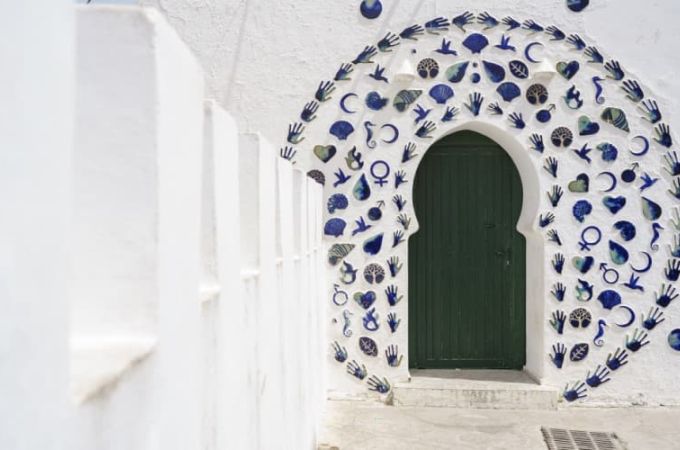
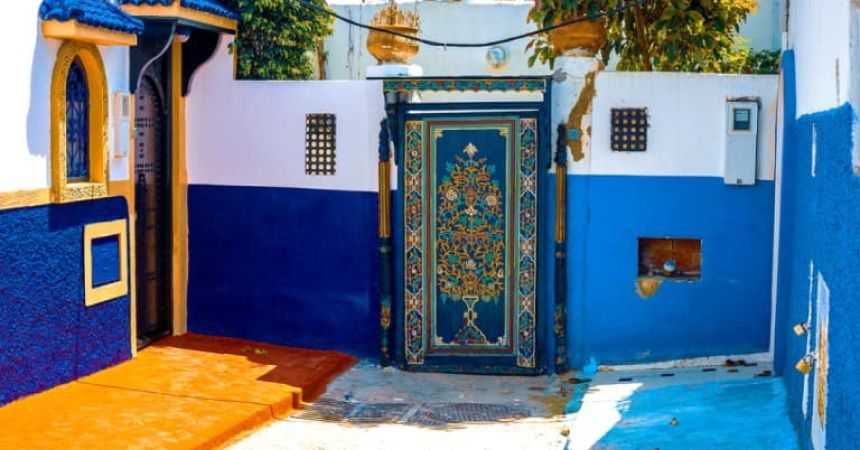
Passing through its monumental gateway leads into narrower streets, white-and-blue façades and a quieter residential atmosphere that contrasts sharply with the broader urban fabric outside.
The location above the Bou Regreg and near the Atlantic gives the kasbah another advantage: geography becomes visible.
From elevated viewpoints, Salé sits across the river, the water leads toward the ocean and Rabat begins to make sense as a city shaped by both inland and maritime connections.
The kasbah is compact enough that it does not require a military-style touring plan.
This is a place where stopping for tea or sitting longer than expected can improve the visit more than squeezing another minor attraction into the same hour.
Rabat’s Blue-and-White Streets Should Not Be Turned Into Chefchaouen
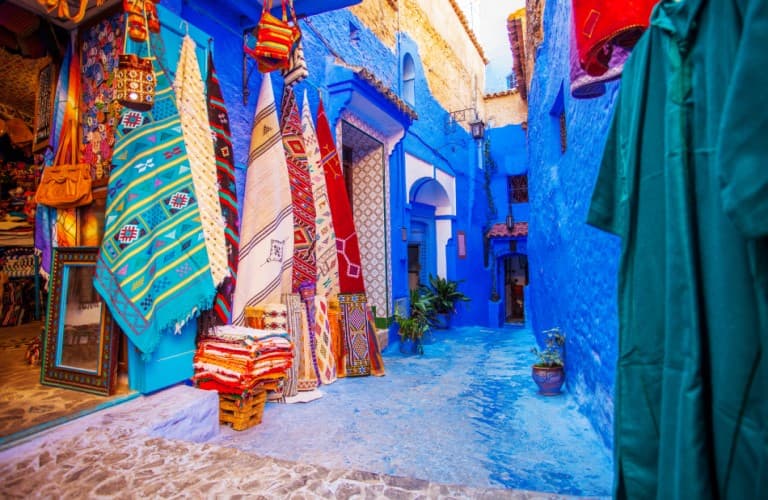
The Udayas contains visually attractive blue-and-white architecture, which inevitably invites comparison with Chefchaouen.
That comparison should remain superficial.
Chefchaouen’s blue-painted medina and Rif Mountain setting are central to the identity of the entire town. In Rabat, the visual character of the Udayas is one element within a much larger capital-city experience.
This distinction matters for cluster separation.
A visitor may enjoy photographing both places, but they are not substitutes.
Rabat’s kasbah gains meaning because of its position beside the river, Atlantic and modern capital, whereas Chefchaouen operates according to a completely different geographical and urban logic.
Visual similarity is not semantic similarity.
Chellah Is Where Rabat Becomes Older Than Expected
Rabat is so visibly modern that Chellah can surprise first-time visitors.
The archaeological site contains layers associated with the ancient settlement of Sala Colonia as well as later Islamic and Marinid history, creating an environment where ruins, walls, vegetation and historical transitions are experienced together.
This is a very different archaeological rhythm from the monumental symmetry of Hassan Tower.
Chellah rewards slower observation.
Rather than looking for one iconic façade, visitors move through a landscape where different periods overlap, making it particularly valuable for travelers interested in how cities develop across centuries rather than simply collecting recognizable landmarks.
Because restoration or access conditions can change over time, current visiting arrangements should always be checked locally rather than assuming that every part described in an older article remains accessible in exactly the same way.
The Medina Is Refreshingly Uninterested in Overwhelming You
Rabat’s medina rarely appears at the top of Morocco’s “most extraordinary medina” rankings, which can be an advantage.
It remains an active commercial environment without forcing the visitor into the navigational intensity associated with larger old cities. Streets are comparatively manageable, shopping can feel less pressured and the experience fits naturally into a wider day rather than demanding complete surrender.
This makes Rabat a particularly good city for travelers who want medina atmosphere without having every hour dominated by it.
You can browse, stop for food, walk through local commercial streets and then leave into a broader modern city without the psychological sense that exiting the medina means ending the destination experience.
That transition is one of Rabat’s defining strengths.
Shopping Here Can Feel More Like Shopping Than Tourism
Because Rabat does not rely on visitor commerce as intensely as some destinations, shopping can feel less theatrical.
This does not mean bargaining disappears or that every shop is somehow untouched by tourism.
It means the commercial environment contains more everyday local demand, particularly in areas where clothing, food, household products and ordinary goods sit alongside handicrafts and souvenirs.
For travelers tired of evaluating every purchase through the lens of “authenticity,” this can be refreshing.
Buy something because you like it.
Not because someone persuaded you that the object represents the soul of Morocco and must therefore be purchased before lunch.
Bou Regreg Gives Rabat a Second Waterfront Personality
Rabat faces the Atlantic, but the Bou Regreg River is equally important to how the city works visually.
Across the water lies Salé, another historic city with its own identity, while riverfront development has created new public spaces that sit alongside much older urban fabric.
This creates a useful contrast.
One moment you are standing inside a historic kasbah; later you can be walking beside a contemporary waterfront where residents, cafés and modern development reshape the edge of the city.
Travelers choosing Rabat Heritage and City Tours should not treat the river simply as scenery between monuments.
It helps explain Rabat’s relationship with Salé and demonstrates how the capital continues to evolve without placing modern development somewhere completely separate from its history.
Salé Should Be Recognized Without Being Absorbed Into Rabat
Rabat and Salé face each other across the Bou Regreg, which makes it tempting to describe them as one destination.
They are not.
Salé has its own medina, historical identity and urban traditions, and travelers with sufficient time may find exploring both worthwhile.
For this blog, however, Salé’s main role is contextual.
Seeing it across the river reminds visitors that Rabat belongs to a larger metropolitan relationship rather than existing in isolation.
This is important for strict cluster separation as well.
Rabat’s destination authority should remain focused on the capital rather than silently becoming a combined Rabat-Salé guide.
The Royal Palace Area Requires Realistic Expectations
Visitors naturally associate a national capital with royal institutions and may imagine touring the Royal Palace as they would a European palace museum.
That is not the right expectation.
The royal complex remains an official and highly significant institutional space, and visitor access is subject to restrictions and current arrangements.
The value is therefore often contextual rather than interior sightseeing.
Understanding the role of the monarchy, the administrative district and how ceremonial architecture fits into Rabat adds to the capital-city experience even when travelers are not wandering through palace rooms.
This is another example of why Rabat is better approached through political and urban context, not merely attraction count.
Rabat Is One of Morocco’s Easier Cities to Experience Without Constantly Negotiating Space
The broad avenues and more open urban structure make Rabat feel physically different from denser medina-led destinations.
That can be especially valuable for travelers who become fatigued by narrow lanes, heavy traffic or constant commercial interaction.
It also helps families and older travelers because several areas can be approached with less navigational stress, although individual monuments and historic quarters naturally retain steps, slopes and uneven surfaces.
Ease should not be confused with blandness.
Rabat’s calmer infrastructure simply allows attention to shift.
Instead of spending energy on navigating chaos, travelers can use more of it on the city itself.
Rabat Works Particularly Well When the Itinerary Needs a Reset
This is not the same reset Agadir provides.
Agadir changes the trip through beach and resort leisure.
Rabat changes it through urban order.
A traveler arriving after several intense sightseeing days can still visit monuments, markets and historic quarters while experiencing a city that demands less logistical effort.
This makes Rabat especially useful in longer Morocco itineraries where every destination does not need to increase intensity.
A strong multi-stop journey needs changes in rhythm.
Rabat can provide one without abandoning culture.
What Rabat Adds Depends on What Came Before It
Rather than comparing Rabat directly with another city, the most useful planning table is to examine what Rabat contributes after different types of Morocco experiences:
| If you arrive after... | Rabat mainly adds... | What travelers often appreciate |
|---|---|---|
| Marrakech | Order, broader streets and calmer sightseeing | A capital that still has history without the same intensity |
| Fes | Easier navigation and modern urban contrast | Historical depth distributed across separate sites |
| Chefchaouen | Institutional and national context | A shift from small-town atmosphere to contemporary capital life |
| Coastal resort time | Cultural structure and monuments | A return to sightseeing without medina overload |
| Long road touring | Walkable urban recovery | Fewer hours spent inside vehicles |
| First arrival in Morocco | Gentle introduction to old and new Morocco | Cultural depth without immediate sensory overload |
This table does not decide whether Rabat is “better” than any destination.
It explains what job the capital can perform depending on itinerary context.
One Night Works Better Than Travelers Expect
Rabat is often given one night because the itinerary regards the capital as a stop between larger priorities.
That can work surprisingly well when arrival happens early enough.
An afternoon and evening can provide orientation, while the following morning accommodates major sights before continuing elsewhere.
The problem comes when a one-night stay means arriving after dark and leaving immediately after breakfast.
At that point, the itinerary has technically included Rabat while barely experiencing it.
If the capital is going to receive only one night, protect the usable hours around that night.
Otherwise, removing the stop may be more honest.
Two Nights Let the Capital Become a City Rather Than a Monument Cluster
A second night changes the experience more than adding another attraction.
With two nights, Chellah does not need to compete with the Udayas. The medina can be walked without watching the clock. Dinner can happen somewhere chosen for interest rather than convenience, and part of the modern city can be experienced rather than treating it merely as road space between historical sites.
Travelers considering Customized Rabat Morocco Holidays may find two nights particularly worthwhile when they enjoy urban culture, architecture and contemporary Morocco rather than focusing exclusively on headline destinations.
Rabat is rarely a city that demands more time.
It is one that rewards the decision when time is available.
Families Often Find Rabat Easier Than They Expected
Children who have already spent several days navigating dense medinas may appreciate Rabat’s open spaces and more varied urban environments.
Parents can combine a monument, riverside walk and historical quarter without every transition involving another long road transfer or complicated navigation.
The city also gives families room to shorten a sightseeing day without making the destination feel wasted.
If everyone is tired after lunch, the afternoon can become a walk, café stop or hotel break rather than forcing another major archaeological visit simply because the itinerary says Rabat must be completed.
That flexibility matters more than families often realize before arriving.
Rabat Is Also Valuable for Travelers Interested in Contemporary Morocco
Historical tourism can accidentally create a country frozen in time.
Rabat helps correct that.
Government institutions, modern neighborhoods, universities, transport infrastructure, cultural venues and everyday professional life remain visible alongside historic monuments.
Travelers who ask guides questions about contemporary society, education, administration or how the capital has developed often gain a much more rounded understanding of Morocco than those who focus entirely on dynasties and architecture.
The country did not stop evolving when its medinas were built.
Rabat makes that obvious.
Do Not Visit Rabat Only Because It Is the Capital
Capital-city status creates a sense of obligation.
Travelers include Rabat because they feel a national capital ought to appear somewhere on a complete itinerary.
That is not a good enough reason.
Visit because the Kasbah, Hassan Tower, Chellah, national history and modern urban character interest you, or because the city provides a useful contrast within the journey.
If you have very limited time and your priorities lie elsewhere, removing Rabat can be entirely rational.
A destination should not be protected by political importance alone.
It should earn its place according to what the traveler wants from Morocco.
Rabat’s Real Strength Is That Its Contrasts Do Not Fight Each Other
Some cities feel divided between old and new.
Rabat feels layered.
Historic walls sit near broad avenues, national monuments beside contemporary institutions, the Kasbah above modern waterfront development, and archaeological remains within a functioning capital that continues changing.
These contrasts rarely feel like separate tourism zones stitched together for visitors.
They belong to the same city.
That cohesion is what makes Rabat quietly compelling.
It may not produce the immediate sensory shock of Marrakech, the navigational intensity of Fes or the dramatic desert anticipation of southern Morocco.
It offers something less theatrical and, for many travelers, equally valuable: a city where Morocco’s historical, political and contemporary identities can be seen without one completely drowning out the others.
12 Rabat Questions That Help Decide Whether the Capital Fits Your Trip
1. Is Rabat worth visiting if I already plan to see Marrakech and Fes?
Yes, if urban variety matters to you. Rabat offers a calmer, more contemporary capital experience where historic monuments sit within broad modern districts, giving travelers a side of Morocco that neither Marrakech nor Fes reproduces particularly closely.
2. Does Rabat have a traditional medina?
Yes, although its medina generally feels more manageable and less destination-dominating than Fes or Marrakech. This makes it particularly suitable for travelers who enjoy traditional commercial streets but also want modern urban areas and major monuments within the same stay.
3. Can I visit Hassan Tower and the Mausoleum of Mohammed V together?
They occupy the same broader monumental area and naturally complement one another, although each represents a very different historical period. Allow enough time to understand both rather than treating the mausoleum as a decorative extension of the Hassan Tower visit.
4. Is Chellah mainly a Roman archaeological site?
No. Chellah contains historical layers extending beyond its Roman-era associations, including important later Islamic and Marinid history. Its appeal comes partly from seeing different periods occupy one archaeological landscape rather than visiting a single-period classical ruin.
5. Is the Kasbah of the Udayas similar to Chefchaouen?
Only superficially because of some blue-and-white streets. The Udayas is a compact historic kasbah within Morocco’s capital and is closely connected to the Bou Regreg and Atlantic, whereas Chefchaouen’s wider identity comes from its blue medina and Rif Mountain setting.
6. Can tourists visit inside Rabat’s Royal Palace?
Visitors should not assume the Royal Palace operates as a conventional museum attraction. Access to official royal areas is restricted and subject to current arrangements, so its value to most travelers lies more in political and architectural context than interior touring.
7. Is Rabat easier for travelers with limited mobility than Fes?
Parts of the city can be easier because of broader streets and more accessible modern areas, although historic sites still involve uneven surfaces, slopes or steps. Travelers with mobility concerns should ask about each planned location rather than relying on a citywide accessibility label.
8. Is Rabat a beach destination?
Rabat has an Atlantic coastline, but its primary visitor identity is cultural and urban rather than resort-oriented. Travelers whose main objective is a beach holiday should evaluate dedicated coastal destinations separately rather than choosing Rabat simply because it sits beside the ocean.
9. Should I stay in Rabat or visit it on a day trip?
A day visit can cover major highlights, but an overnight allows the capital to feel less like a monument circuit and gives time for the medina, Udayas, riverfront and modern city to become part of the experience rather than logistical gaps.
10. Is Salé worth visiting while staying in Rabat?
It can be for travelers with additional time and interest in historic urban Morocco, but Salé has its own identity and should not be treated merely as another Rabat neighborhood. Prioritize Rabat first unless the wider metropolitan relationship genuinely interests you.
11. Does Rabat feel too quiet for travelers who enjoy lively cities?
That depends on what “lively” means to you. Rabat has restaurants, cafés, commercial districts and active daily life, but it generally lacks the concentrated tourism intensity associated with some other Moroccan cities, which many visitors actually find refreshing.
12. What is the biggest mistake travelers make when planning Rabat?
Treating it as a compulsory capital-city stop without deciding what they want from it. Rabat becomes far more rewarding when visitors intentionally seek its combination of national history, archaeological layers, modern urban life and calmer sightseeing rhythm.

A travel professional specializing in tailor-made travel planning, guest experience management, and multi-destination tourism operations.
With over 23 years of experience in the travel industry, he designs and manages private and cultural tours for international travelers across Türkiye, Greece, Egypt, Jordan, Morocco, and other destinations.
He has strong expertise in both online and face-to-face guest communication, sales processes, and end-to-end travel operations.
Working closely with hotels, travel agencies, and local partners, he ensures smooth coordination and high-quality travel experiences at every stage of the journey.
His focus is on delivering personalized, reliable, and seamless travel experiences for international guests worldwide.