
Nine Days in Turkey: When a Four-Region Trip Makes Sense
Last Updated: August 10, 2026
Nine days is where a Turkey itinerary can become impressively ambitious.
It is also where it can go wrong while looking perfectly reasonable.
Istanbul fits. Cappadocia fits. Western Turkey fits. Then you look at the remaining space and realize a fourth region might fit too.
The flights exist. The roads connect. The hotels can be booked.
So why not?
Because there is a difference between a route that can be completed and a journey that works.
Nine days gives you enough time to travel across a substantial part of Turkey, but every new region introduces a transition. At some point, the amount of ground covered begins increasing faster than the amount of meaningful time gained.
That point is different for every traveler.
Finding it is what this nine-day trip is really about.
The Four-Region Question
Forget individual attractions for a moment.
Suppose your itinerary contains four geographically distinct parts of Turkey.
The first destination costs you nothing in domestic travel because it is where the journey begins.
To reach the second, you make one major transition.
The third requires another.
The fourth requires a third.
Then there is the journey to wherever you eventually leave Turkey.
The fourth region therefore does not simply add another place. It changes the movement pattern of the entire trip.
This is why nine-day planning should begin with transitions rather than destinations.
| Regions Visited | Major Transitions | General Character |
|---|---|---|
| 2 | 1 | Deep and spacious |
| 3 | 2 | Broad but manageable |
| 4 | 3 | Active and route-dependent |
| 5 | 4+ | Transportation becomes dominant |
Four regions are not automatically too many.
But once you reach four, route efficiency stops being a nice bonus and becomes essential.
Measure Travel-to-Experience Ratio
A useful way to judge a nine-day route is to compare the time spent reaching a destination with the time spent experiencing it.
Call this the travel-to-experience ratio.
You do not need an exact mathematical formula. The idea is enough.
Imagine traveling five or six door-to-door hours to reach somewhere where you have only an evening and the following morning.
The destination may be spectacular.
The ratio is still poor.
Now imagine the same journey leads to two full days in a region that provides something completely different from the rest of the trip.
The travel cost has not changed.
Its value has.
When Is a Transfer Worth It?
| Travel Commitment | Time at Destination | Likely Value |
| Several hours | One overnight | Low unless it is a major personal priority |
| Several hours | One full day | Depends heavily on the experience |
| Several hours | Two nights | Often reasonable |
| Major regional move | Multiple meaningful days | Stronger justification |
| Long detour + immediate onward travel | Brief visit | Usually poor |
This table should not be treated as a rulebook.
Some places are worth considerable effort.
The point is to make the effort visible.
The Difference Between a Stop and a Region
This distinction becomes important at nine days.
Not every destination needs to function as a separate region in your itinerary.
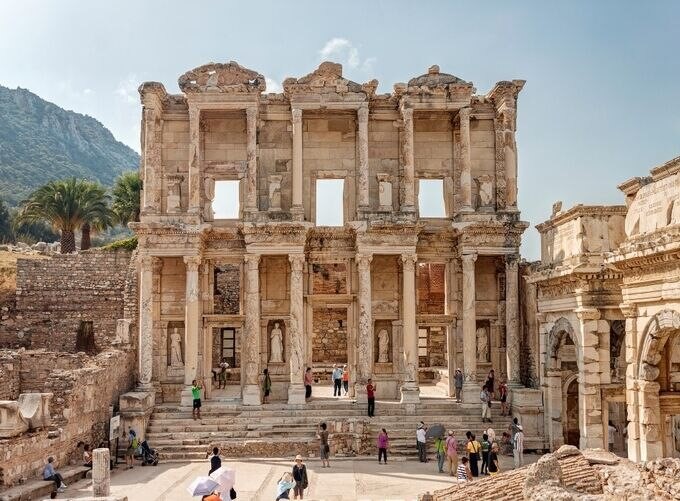
Ephesus, for example, may be part of a broader western Turkey section rather than being treated as an isolated geographical unit. The same can apply to nearby destinations connected by road.
Grouping places correctly makes a route look less dramatic on paper but often makes it much more practical.
Istanbul is clearly one base.
Cappadocia is another geographical chapter.
Western Turkey can contain several experiences without requiring you to mentally count each one as a new region.
The coast may become another.
This matters because itinerary overload often begins with counting cities rather than travel zones.
A nine-day trip with six named places might work beautifully if several sit along one logical corridor.
Another trip with only four names can be exhausting if each requires a flight in a different direction.
The map matters more than the count.
Route Shape Matters More Than Destination Count
There are two ways to connect the same set of places.
One creates a line.
The other creates a zigzag.
The difference can consume hours.
Suppose your priorities include Istanbul, Cappadocia and western Turkey. If transportation allows you to move through them progressively rather than repeatedly returning to the same hub, the route becomes easier to defend.
This is where open-jaw thinking can be useful.
You do not always need to begin and end every section in Istanbul simply because Istanbul has the country's largest international connections. Depending on your flights and wider travel plans, entering through one city and departing from another can remove unnecessary backtracking.
The principle is simple:
Every major transfer should move the journey forward.
If you repeatedly cross the same geography to reach the next destination, reconsider the sequence before removing the destination itself.
When Pamukkale Fits Naturally
Pamukkale is a good test of route logic because its value changes depending on what comes before and after it.
If you are already traveling through western Turkey, combining Ephesus with Pamukkale can create a coherent archaeological and landscape section. You are extending an existing geographical chapter rather than flying across the country for one isolated stop.
The travertines are visually distinct from Ephesus, while Hierapolis adds another historical layer. That makes the combination more than simply “two famous attractions close enough to visit.”
In this context, travelers can look at an Black sea archaeology route to understand how western sites can form one continuous section of a larger Turkey journey.
But Pamukkale becomes much harder to justify if the itinerary has to make a major detour solely to include it.
Same destination.
Different route value.
That distinction is central to a good nine-day plan.
The Fourth Region Must Change the Story
If three regions already provide city life, landscape and archaeology, what does the fourth contribute?
This is the question that should determine whether it stays.
Perhaps it is the Mediterranean.
That changes the trip considerably. You move from cultural touring toward sea, warmer coastal atmosphere and a different pace.
Perhaps the fourth region is another archaeological area.
If ancient history is your main interest, that might be exactly what you want. For someone seeking variety, however, it may add less contrast than the coast.
A destination earns its place when it changes the story of the journey, not merely its length.
Try describing your trip without using place names.
For example:
“Big city and imperial history → unusual landscapes → classical archaeology → Mediterranean finish.”
That has progression.
Now compare:
“Historical site → historical site → another historical site → another historical site.”
That may still be perfect for an archaeology enthusiast.
For everyone else, the fourth region may not be doing enough work.
Do Not Let Domestic Flights Fool You
Turkey's domestic flight network can make distant destinations appear deceptively close.
A flight lasting a little over an hour looks trivial when compared with driving across the country.
But flight duration is not travel duration.
You need to leave your hotel, reach the airport, arrive with enough time before departure, fly, collect any checked baggage and transfer onward at the destination.
Some airports are also outside the places travelers actually stay.
Cappadocia illustrates this well. Flying to Kayseri or Nevşehir gets you into the region, not directly to your cave hotel.
This does not make flying inefficient.
Domestic flights are often what make multi-region Turkey journeys practical in the first place.
It simply means you should budget them honestly.
A 70-minute flight may occupy a four- or five-hour door-to-door block.
Nine-day itineraries become overloaded when the scheduled flight time is counted but everything surrounding it is ignored.
The Transfer Ledger
Before finalizing the route, make a simple ledger.
Do not list attractions.
List only movements.
| Move | Door-to-Door Time | Hotel Change? | What Does It Unlock? |
| Region 1 → Region 2 | ___ | Yes | ___ |
| Region 2 → Region 3 | ___ | Yes | ___ |
| Region 3 → Region 4 | ___ | Yes | ___ |
| Final region → departure | ___ | Maybe | Flight home |
Fill this in with your actual flights and road connections.
Then look at the final column.
If every move unlocks something important, your four-region route may be working.
If one transfer consumes half a day merely to add another famous stop, you have found the weakest part of the itinerary.
This exercise is deliberately boring.
That is why it works.
Destination research makes you want to add things. A transfer ledger forces you to look at what those additions cost.
One-Night Stops Need to Earn Their Place
A single overnight is not automatically a problem.
Some destinations lie naturally between two others. You arrive, experience something worthwhile, sleep and continue in the same direction the next morning.
That can be efficient.
The problem is a one-night stop that requires a substantial diversion.
Now the destination is asking for several hours before arrival and several more after departure, while giving you very little uninterrupted time in return.
On a nine-day trip, these stops accumulate quickly.
One may be fine.
Two begin changing the rhythm.
Three can make the itinerary feel like a relay race.
If a one-night stop is essential, ask what makes it exceptional enough to justify the movement.
“Because it is famous” is usually not a strong enough answer.
A Four-Region Trip Is for a Particular Kind of Traveler
Some travelers will love this pace.
They wake early without complaint, pack quickly, enjoy watching the landscape change and feel energized rather than drained by arriving somewhere new.
For them, four regions in nine days can be exciting.
Others need time to settle into a place before they begin enjoying it. They like returning to the same restaurant, having an unscheduled afternoon and knowing where they are going without checking a map.
For them, the exact same route may feel exhausting.
This is why itinerary advice becomes unreliable when pace is treated as objective.
A nine-day route should fit your tolerance for transition.
Not someone else's ability to wake up at 05:00.
The Point Is Not to Prove Four Regions Fit
They do.
With enough planning, many ambitious combinations can be made technically possible.
That is not the interesting question.
The useful question is whether the fourth region adds enough experience to justify the third major transition.
Sometimes the answer is clearly yes.
Sometimes removing it gives every other destination more room, eliminates a flight and makes the trip noticeably better.
Nine days is long enough to travel widely through Turkey.
It is also short enough that every unnecessary detour still matters.
The best route is not the one that covers the most ground.
It is the one where the ground you cover keeps paying you back.
Find the Expensive Destination
Not expensive in money.
Expensive in time.
Almost every ambitious nine-day route has one destination that costs more hours than the others relative to what it contributes. Finding it can simplify the entire itinerary.
It might be a place reached by a long road transfer for a single night. It could require flying in the wrong direction and then doubling back. Sometimes the destination itself is not the problem at all; the onward connection is.
Remove that stop temporarily and look at what happens.
Does another region gain a full day? Does a domestic flight disappear? Can you stay two nights somewhere instead of one? Does the route suddenly become a clean line?
If removing one destination improves three other parts of the journey, you have identified an expensive stop.
That does not automatically mean you should cut it.
If it is one of your main reasons for traveling, keep it and accept the trade-off.
But at least you are paying the cost deliberately.
Use Geography Before You Use a Checklist
Turkey rewards travelers who think regionally.
Istanbul sits in the northwest. Cappadocia is in central Anatolia. Ephesus belongs to the Aegean side of western Turkey. Pamukkale lies inland in the southwest. Antalya opens a different Mediterranean direction.
These are not attractions lined up beside one another.
Once you understand that, route decisions become easier.
If Ephesus and Pamukkale both matter, they can form a western section of the journey rather than being treated as unrelated stops. If Antalya matters more than Pamukkale, the route may need to evolve south instead.
This is why a fourth region should be chosen in relation to the third.
Do not ask:
“What other famous place can I add?”
Ask:
“Where does the route naturally want to go next?”
The answer may still be somewhere far away. But now the detour has to defeat a logical alternative rather than simply occupy an empty box on the calendar.
What a Coastal Fourth Chapter Actually Costs
The Mediterranean is a strong candidate for the fourth chapter because it offers genuine contrast.
After Istanbul, Cappadocia and western archaeology, reaching the coast changes the visual and emotional rhythm of the trip.
That makes the move attractive.
But coastal time has an unusual requirement: it needs enough room to slow down.
A historical site can justify a concentrated visit. You arrive, spend several substantial hours exploring it and leave having experienced the main reason you came.
The coast behaves differently.
If you reach Antalya or another Mediterranean destination in the evening, spend the next day sightseeing from morning to late afternoon and depart immediately afterward, the coast has technically entered the itinerary without really changing its pace.
For travelers who genuinely want that final contrast, a Turkey Mediterranean route can make sense when the geography and onward departure support it.
But if you cannot give the coast enough time to feel different, another day in an existing region may deliver more.
Four Regions vs Three Regions: What Actually Changes?
The fourth region does not merely increase destination variety.
It changes the operating conditions of the trip.
| Three-Region Journey | Four-Region Journey |
|---|---|
| Fewer major transitions | Another significant transfer |
| Easier to maintain multi-night stays | Greater chance of short stays |
| More flexibility after disruption | Less recovery space |
| Easier to change plans locally | More fixed departure times |
| Greater depth | Greater geographical range |
| Lower packing frequency | More hotel turnover |
Neither column is inherently better.
The right-hand side may describe exactly the kind of journey you enjoy.
The important thing is to recognize that four regions are not simply the three-region experience plus another destination. The pace changes throughout the trip because more of the schedule becomes fixed.
That is the real trade.
Use the Two-Hour Delay Test
Here is a useful stress test before you book everything.
Imagine one of your domestic flights or road connections is delayed by two hours.
What breaks?
If the answer is “nothing important; dinner is later,” the route has resilience.
If the answer is “we miss the only time available for the main reason we traveled to that destination,” the itinerary is fragile.
Now run the same test on each major transition.
A good nine-day route does not need enough spare time to absorb every possible disruption. That would be unrealistic.
But it should survive ordinary travel friction.
Traffic happens. Flights can move. A transfer takes longer than expected. You may simply be tired and start later one morning.
An itinerary that works only when every element operates perfectly is not efficient.
It is brittle.
When Pamukkale Becomes the Bridge Rather Than the Detour
Pamukkale deserves another look because it can function differently depending on route direction.
Placed awkwardly, it becomes the expensive destination discussed earlier.
Placed between compatible sections of western and southwestern Turkey, it can become a bridge.
This is the kind of route logic that makes an ambitious nine-day trip possible.
The distinction is not whether Pamukkale itself is worth seeing. Hierapolis and the travertines provide plenty of reasons to visit.
The question is whether its location helps or interrupts the journey you are already making.
Travelers considering a western section can examine a Pamukkale and Ephesus connection when thinking about these destinations as one regional sequence rather than two isolated checklist items.
The broader lesson applies elsewhere too.
Sometimes the solution to an overloaded itinerary is not removing a destination.
It is changing its position.
Beware of “Just One More Night”
This phrase has destroyed many elegant itineraries.
You have nine days. The main route is finished. Then another place appears possible because it needs “just one night.”
But a night is not an independent unit.
To sleep somewhere new, you have to arrive there.
Then you have to leave.
The night sits between two movements.
This is why one-night additions deserve more scrutiny than two- or three-night stays. Their ratio of transportation to settled time can be unusually high.
There are exceptions.
An overnight may sit perfectly along an overland route. It may solve a transportation problem. Or the experience may be so important to you that the cost is irrelevant.
Those are good reasons.
“I think we can squeeze it in” is not.
What If You Really Want Istanbul, Cappadocia, Ephesus and Pamukkale?
Then build around them from the start.
Do not create an Istanbul–Cappadocia trip and gradually attach western Turkey afterward.
Treat the western section as one geographical chapter.
That changes how you think about the route.
Ephesus and Pamukkale no longer compete individually for leftover days. They form part of a progression. The question becomes how to enter western Turkey, move through it efficiently and continue toward your departure point.
This is a much stronger structure than repeatedly returning to Istanbul between regions simply because it is familiar.
Domestic flights may still be necessary. Road transportation will probably form part of the western section.
The route can work.
But its success depends on sequence, not on proving that all four names fit into nine boxes.
When Three Regions Are Actually the More Ambitious Choice
This sounds contradictory.
How can visiting fewer regions be more ambitious?
Because ambition does not have to mean distance.
Spend longer in Cappadocia and walk rather than seeing valleys mainly from vehicles. Give Istanbul enough time to explore beyond Sultanahmet. Let western Turkey become a region rather than a quick Ephesus visit.
You may cover fewer kilometers and experience more variety within each destination.
That version of nine days asks more from the places rather than from the transportation network.
For some travelers, this is the better form of ambition.
For others, crossing four regions is precisely what makes the journey exciting.
The point is not to declare one style correct.
It is to know which trip you are building before the bookings make the decision for you.
The Final Test: Count Memories, Not Map Pins
Before booking the fourth region, imagine explaining the trip six months after returning home.
What will you remember from each place?
If one destination produces an answer such as “we arrived late, saw the main site the next morning and then left for the airport,” ask whether it deserves its share of nine days.
Now consider the alternative.
Perhaps removing that stop creates another morning in Cappadocia, a longer archaeological day in western Turkey or an evening by the Mediterranean.
That may or may not be better.
But it is the comparison that matters.
Nine days gives you enough time to travel widely. It does not remove trade-offs.
The strongest itinerary accepts those trade-offs openly.
Four regions can work.
They work when geography is respected, transfers move the journey forward, short stays have a clear purpose and the fourth region changes the experience enough to justify reaching it.
Otherwise, three regions may give you the richer trip.
Frequently Asked Questions About 9 Days in Turkey
Can I realistically visit four regions of Turkey in nine days?
Yes, provided the route is geographically coherent and you are comfortable with an active pace. Four regions require at least three major transitions, so transportation must be planned carefully. The question is not simply whether they fit, but whether each receives enough usable time.
How do I know if four regions are too many?
Count major transfers, one-night stays and fragmented days. Then calculate how much uninterrupted time remains in each region. If several destinations involve substantial travel for only a few sightseeing hours, reducing the route to three regions will usually improve the travel-to-experience balance.
What is the travel-to-experience ratio?
It is a practical way of comparing the effort required to reach a destination with the meaningful time spent there. A long transfer for one rushed overnight has a poor ratio, while the same journey may be worthwhile when it opens two substantial days of distinctive experiences.
Should I count Ephesus and Pamukkale as separate regions?
Not necessarily. When connected logically by road, they can function as parts of a broader western Turkey section. Thinking in travel zones rather than individual attraction names makes it easier to judge the real geographical complexity of a nine-day itinerary and avoid exaggerating destination count.
Can Istanbul, Cappadocia, Ephesus and Pamukkale fit in nine days?
They can, but sequence is crucial. Rather than treating Ephesus and Pamukkale as unrelated additions, design them as a connected western section. Avoid unnecessary backtracking and evaluate domestic flight and road-transfer times door to door before deciding how much usable time remains.
Is adding Antalya realistic during a nine-day trip?
It can be when Antalya creates a deliberate Mediterranean chapter and the preceding route leads south naturally. However, coastal time benefits from breathing room. Adding Antalya for a rushed overnight may increase geographical coverage without providing enough time to experience the different pace that justified going there.
Are domestic flights always the best way to save time?
No. They are extremely useful for long regional jumps, but scheduled flight duration tells only part of the story. Airport transfers, check-in and onward transportation must be included. For some regional sequences, direct road travel can create a cleaner and more efficient progression.
Are one-night stops worth including in nine days?
They can be when the destination sits naturally between two others or represents an important personal priority. Be cautious when a one-night stay requires a substantial detour. Arrival and departure travel can consume such a large proportion of the visit that the stop adds little.
How much flexibility should a nine-day itinerary have?
Enough to survive ordinary disruption. Test each major connection by imagining a two-hour delay. If that causes you to miss the only meaningful experience at the next destination, the route may be too fragile. Efficient itineraries should not depend on every connection operating perfectly.
Is three regions better than four for nine days in Turkey?
Neither is universally better. Three regions generally provide more depth, fewer hotel changes and greater flexibility. Four offer wider geographical contrast and can suit travelers who enjoy an active pace. Choose according to what the fourth region contributes relative to the transportation required to reach it.

A travel professional specializing in tailor-made travel planning, guest experience management, and multi-destination tourism operations.
With over 23 years of experience in the travel industry, he designs and manages private and cultural tours for international travelers across Türkiye, Greece, Egypt, Jordan, Morocco, and other destinations.
He has strong expertise in both online and face-to-face guest communication, sales processes, and end-to-end travel operations.
Working closely with hotels, travel agencies, and local partners, he ensures smooth coordination and high-quality travel experiences at every stage of the journey.
His focus is on delivering personalized, reliable, and seamless travel experiences for international guests worldwide.