The Hagia Sophia: The Building That Tells Istanbul's Story
Some landmarks are famous because they are beautiful.
Others are famous because they are old.
The Hagia Sophia is famous because it is both, and because few buildings anywhere in the world have witnessed so much history.
For nearly fifteen centuries, it has stood in the center of what is now Istanbul. Empires have risen and fallen around it. Religions have shaped its identity. Generations of travelers, pilgrims, rulers, merchants, and ordinary residents have passed through its doors.
And yet the building remains.
Today, visitors arrive from every corner of the world to see the Hagia Sophia for themselves. Some come for its architecture. Others come because of its religious significance. Many simply want to understand why this monument appears on nearly every list of the world's greatest historical sites.
The answer becomes clearer the moment you step inside.
The Hagia Sophia is not just a building.
It is the story of Istanbul written in stone, marble, mosaics, and light.
What Does Hagia Sophia Mean?
One of the most common misconceptions is that Hagia Sophia refers to a person.
It doesn't.
The name comes from the Greek phrase meaning "Holy Wisdom."
The building was dedicated to the divine wisdom of God rather than to a particular saint.
Over the centuries, languages, governments, and religions changed around it, but the name remained.
That continuity feels fitting.
Few structures have maintained such a strong connection to their origins while adapting to so many different periods of history.
The Ambitious Vision of Emperor Justinian
The Hagia Sophia that visitors see today is actually the third church built on the site.
Earlier structures were destroyed during periods of unrest in Constantinople, the capital of the Byzantine Empire.
After one such uprising in 532 AD, Emperor Justinian I decided to build something extraordinary.
He wanted a structure that would surpass every church ever constructed.
Work began almost immediately.
Thousands of workers participated in the project, and construction moved at an astonishing pace. In just five years, one of the most ambitious architectural achievements in human history was completed.
When the building opened in 537 AD, it became the largest cathedral in the world.
For centuries, nothing comparable existed.
The achievement was so remarkable that stories spread throughout the medieval world about its size and beauty.
The Cathedral of an Empire
For nearly one thousand years, the Hagia Sophia served as the principal cathedral of Eastern Christianity.
This was not simply an important church.
It was the spiritual heart of the Byzantine Empire.
Coronations took place here.
Religious ceremonies were held here.
Political announcements echoed beneath its dome.
The building became closely tied to the identity of Constantinople itself.
Visitors arriving from distant lands often described the Hagia Sophia with a sense of disbelief.
Many had never seen anything remotely similar.
Even today, it is easy to understand their reaction.
The Transformation After 1453
One of the reasons the Hagia Sophia fascinates modern visitors is that its story did not end with the Byzantine Empire.
In 1453, Ottoman Sultan Mehmed II conquered Constantinople.
The city entered a new chapter.
So did the Hagia Sophia.
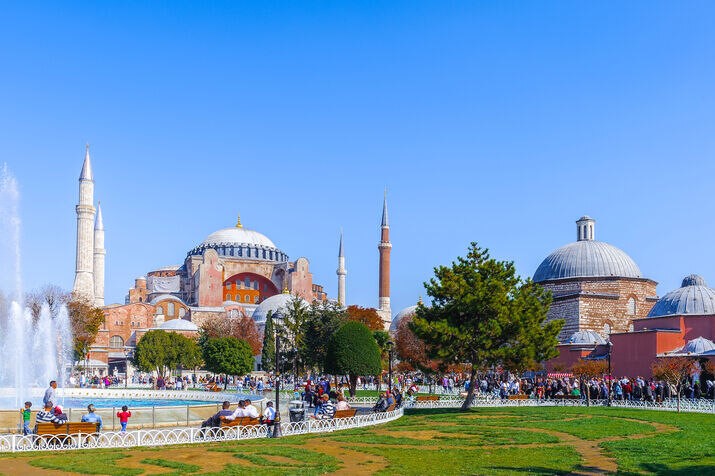
Soon after the conquest, the building was converted into a mosque.
Several changes followed:
- Minarets were added
- Islamic calligraphy appeared
- A mihrab was installed
- Additional architectural elements were introduced
Yet the structure itself remained largely intact.
Rather than erasing the past, the building gradually absorbed another layer of history.
This blending of cultures and traditions is one of the reasons the Hagia Sophia feels so unique today.
The Dome That Changed Architecture
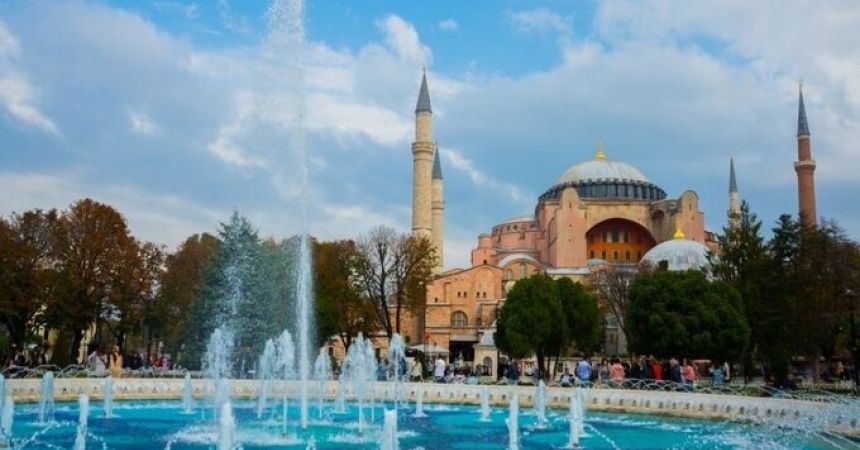
If there is one feature that continues to impress visitors more than any other, it is the dome.
Photographs help.
Standing beneath it is something else entirely.
The central dome rises approximately 55 meters above the floor and spans more than 30 meters across.
These numbers are impressive.
The visual effect is even more remarkable.
The dome appears lighter than logic suggests it should be.
Sunlight enters through windows positioned around its base, creating the impression that it is floating above the structure.
Architects have studied the Hagia Sophia for centuries.
Its influence can be seen in:
- Ottoman mosques
- European cathedrals
- Religious buildings throughout the world
Many architectural historians consider it one of the most influential structures ever built.
What Makes the Interior So Special?
Every visitor notices something different.
Some focus on the architecture.
Others become fascinated by the details.
Several elements deserve particular attention.
Byzantine Mosaics
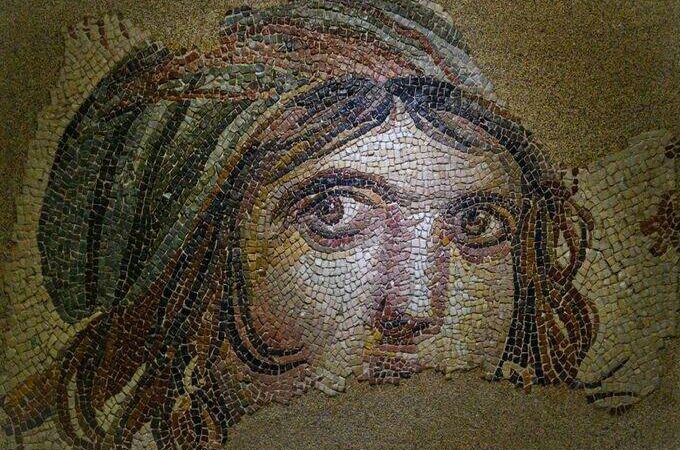
Some of the building's most treasured artworks date back hundreds of years.
These mosaics depict religious figures and scenes from the Byzantine period.
Marble Surfaces
Large sections of the original marble decoration remain visible today.
The craftsmanship remains extraordinary even after centuries of use.
Islamic Calligraphy
Massive circular medallions display elegant Arabic inscriptions added during the Ottoman era.
The Sense of Space
Perhaps more than anything else, visitors remember how the building feels.
The interior somehow manages to feel both immense and intimate at the same time.
That balance is difficult to explain until you experience it yourself.
A Building Where Different Histories Meet
Many historical sites represent a single period.
The Hagia Sophia does not.
As you walk through the building, different chapters of history appear side by side.
A Byzantine mosaic may be visible near an Ottoman inscription.
Christian imagery exists alongside Islamic decorative elements.
Architectural details from different centuries coexist within the same space.
Rather than creating conflict, these layers create depth.
The building becomes a visual record of Istanbul's history.
Few monuments in the world tell such a complex story so clearly.
Visiting the Hagia Sophia Today
Today, the Hagia Sophia functions as an active mosque.
At the same time, it remains one of Turkey's most visited landmarks.
Visitors are welcome, but there are a few practical considerations.
Dress Modestly
Appropriate clothing is required.
Women should cover their hair, shoulders, and knees.
Men should avoid shorts above the knee and sleeveless tops.
Be Aware of Prayer Times
Certain areas may be temporarily restricted during prayer periods.
Arrive Early
Morning visits often provide a quieter experience.
Take Your Time
The Hagia Sophia rewards slow exploration.
Many visitors discover details they initially missed during a second look.
What Else Should You See Nearby?
The Hagia Sophia sits at the center of Istanbul's historic district.
Several major attractions are located within a short walk.
Blue Mosque
Perhaps the Hagia Sophia's most famous neighbor.
Basilica Cistern
An atmospheric underground structure built during the Byzantine period.
Topkapi Palace
The former residence of Ottoman sultans.
Hippodrome
Once the social and political heart of Constantinople.
Grand Bazaar
One of the world's largest and oldest covered markets.
Many travelers spend an entire day exploring the area surrounding the Hagia Sophia.
Why the Hagia Sophia Still Matters
The world contains countless historical buildings.
Very few continue to inspire the way the Hagia Sophia does.
Part of that comes from its age.
Part comes from its architecture.
But the deeper reason is its ability to connect different worlds.
The Hagia Sophia reflects:
- Byzantine history
- Ottoman heritage
- Christian traditions
- Islamic culture
- Architectural innovation
- The story of Istanbul itself
Visitors arrive expecting a famous monument.
Many leave feeling they have experienced something much more significant.
The Hagia Sophia is not simply a place to visit.
It is one of the few buildings that genuinely changes the way people think about history.
Why Explore Istanbul with a Specialized Tour Operator?
The Hagia Sophia becomes even more meaningful when viewed within the broader context of Istanbul's extraordinary history. Understanding how Byzantine, Ottoman, Christian, and Islamic influences shaped the city allows visitors to appreciate the monument on a much deeper level.
Many travelers combine visits to the Blue Mosque Istanbul and other major landmarks through a carefully planned Istanbul Turkey Tour Package. Others begin by exploring broader themes related to Tourism in Turkey before building a more extensive itinerary.
Magnificent Travel specializes in culture-focused and luxury travel experiences throughout Turkey, Greece, Egypt, Jordan, Morocco, and Israel. The company offers carefully designed Istanbul tours and tailor-made journeys that help travelers discover the stories behind the city's most important monuments.
Having welcomed more than 1,100 travelers and maintaining a 5.0/5.0 TripAdvisor rating, Magnificent Travel helps visitors experience Istanbul through expert local knowledge, thoughtfully planned itineraries, and personalized service.
Frequently Asked Questions
Why is the Hagia Sophia famous?
The Hagia Sophia is famous for its enormous dome, remarkable history, and unique combination of Byzantine and Ottoman influences. Having served as a cathedral, mosque, museum, and mosque again, it remains one of the world's most historically significant buildings.
How old is the Hagia Sophia?
The current structure was completed in 537 AD during the reign of Byzantine Emperor Justinian I. This means the Hagia Sophia has stood for nearly fifteen centuries, making it one of the oldest and most important surviving monuments of the Byzantine world.
Is the Hagia Sophia a mosque today?
Yes. The Hagia Sophia currently functions as an active mosque while remaining open to visitors from around the world. It continues to serve both religious and cultural roles, attracting millions of visitors each year.
How much time should I spend at the Hagia Sophia?
Most visitors spend between one and two hours exploring the building. Those interested in architecture, history, religious art, or photography often choose to stay longer to fully appreciate the many details and historical layers.
What should I wear when visiting the Hagia Sophia?
Visitors should dress modestly. Women are generally expected to cover their hair, shoulders, and knees, while men should avoid sleeveless shirts and shorts above the knee. Coverings are usually available near the entrance if needed.
What is the difference between Hagia Sophia and the Blue Mosque?
The Hagia Sophia was originally built as a Byzantine cathedral in the sixth century before later becoming a mosque. The Blue Mosque was constructed as an Ottoman imperial mosque in the seventeenth century. Together, they represent two of the most important periods in Istanbul's history.

A travel professional specializing in tailor-made travel planning, guest experience management, and multi-destination tourism operations.
With over 23 years of experience in the travel industry, he designs and manages private and cultural tours for international travelers across Türkiye, Greece, Egypt, Jordan, Morocco, and other destinations.
He has strong expertise in both online and face-to-face guest communication, sales processes, and end-to-end travel operations.
Working closely with hotels, travel agencies, and local partners, he ensures smooth coordination and high-quality travel experiences at every stage of the journey.
His focus is on delivering personalized, reliable, and seamless travel experiences for international guests worldwide.