February in Cairo: When Winter Begins to Loosen Its Grip
Late February Does Not Feel Quite Like Early February
February is short enough that it is easy to think of the month as one consistent weather period, yet travelers arriving near the beginning and those visiting during the final week may notice a subtle difference in how the day unfolds.
The change is not dramatic enough to require a different wardrobe or itinerary, but daylight continues to extend as the month progresses, and afternoon sunshine can begin to carry more warmth. Early departures may still feel cool, while later in the day the atmosphere increasingly hints that Cairo is moving away from the heart of winter.
For travelers, the practical lesson is not to obsess over whether the trip falls in the first or final week. Instead, expect a month in motion. February sits between established winter conditions and the more obvious seasonal transition that follows, which is precisely what gives it a character distinct from January.
Wind Can Matter More Than the Temperature Suggests
A forecast showing a mild temperature can look ideal on a phone screen, yet an exposed archaeological site may tell a slightly different story.
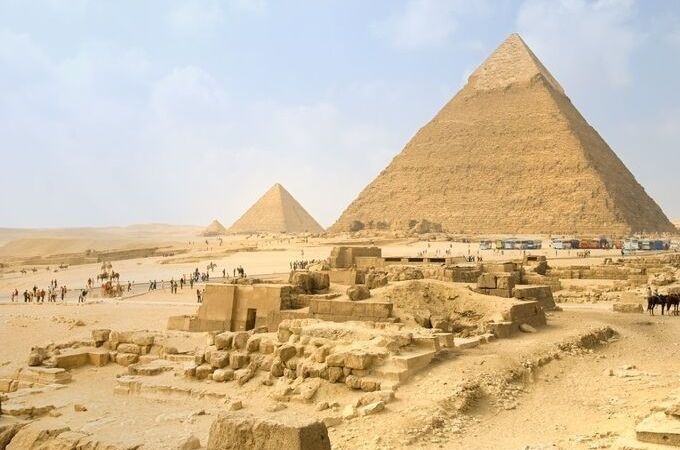
Giza, Saqqara and Dahshur sit in open landscapes where wind is more noticeable than it can be among the dense streets of central Cairo. On a breezy February morning, the difference between standing in direct sunshine and waiting in an exposed area can be surprisingly clear.
This does not normally require specialist clothing. A lightweight jacket or scarf is usually enough to make the difference, and both can disappear into a day bag when conditions become more comfortable.
The important point is that February comfort depends on exposure as well as temperature. Someone spending most of the day inside museums and historic buildings will experience the month differently from a traveler dedicating several hours to desert-edge archaeological sites.
Give Archaeological Days and City Days Different Expectations
Cairo itineraries often contain two very different types of sightseeing day.
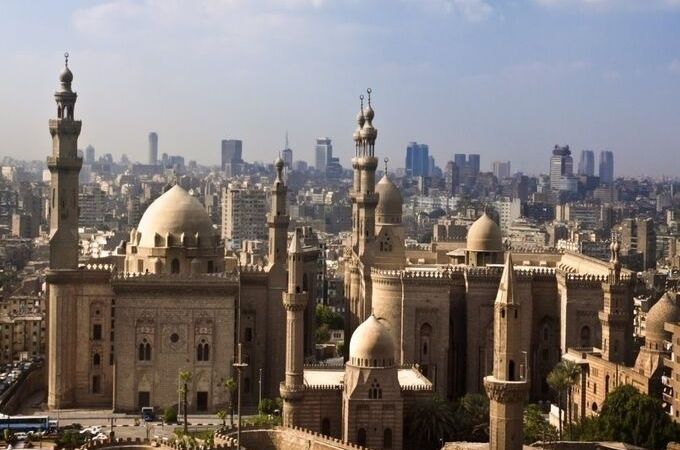
One may involve Giza, Saqqara or Dahshur, where much of the experience takes place in open terrain. Another may move through mosques, museums, markets, churches, historic houses and narrow streets where indoor and outdoor periods alternate naturally.
February accommodates both, but not in exactly the same way.
| Day Character | February Consideration | Useful Approach |
|---|---|---|
| Pyramid-focused | Greater exposure to breeze and sun | Carry a removable outer layer |
| Saqqara/Dahshur | Several hours may be spent outdoors | Avoid dressing for the morning alone |
| Museum-led | Weather plays a smaller role | Add nearby outdoor stops naturally |
| Historic Cairo | Frequent indoor/outdoor transitions | Lightweight layers are convenient |
| Mixed sightseeing | Conditions rarely dominate the schedule | Organize primarily by geography |
This is one reason there is little value in creating a rigid February timetable. The month usually allows the type of sightseeing to determine the day rather than forcing every traveler into the same schedule.
Don't Mistake Comfortable Conditions for Unlimited Energy
Mild weather can create an unexpected planning problem: travelers keep adding things.
When there is no oppressive heat forcing a break, it becomes tempting to combine Giza, Saqqara, a museum, historic Cairo and an evening experience into one ambitious day. Technically, some combinations may be possible. That does not mean they produce a satisfying visit.
Cairo itself requires energy. Archaeological sites involve walking, traffic makes journey times unpredictable, and the visual density of museums and historic districts can become tiring even when the weather is cooperative.
February's advantage is better used to slow down rather than fit more in.
Allowing additional time at a site also creates opportunities that disappear on tightly scheduled itineraries: another viewpoint at Giza, a longer look inside a tomb at Saqqara, an unplanned coffee stop, or enough time to wander through an interesting section of historic Cairo without constantly checking the clock.
What If the February Forecast Changes Before Your Trip?
A long-range monthly average is useful for understanding February's general character, but it cannot predict the exact conditions on a particular Tuesday three weeks from now.
Short-range forecasts become much more useful shortly before departure. If a cooler or windier day appears, you may decide to keep the extra layer in your day bag. If a brighter afternoon is expected, you can avoid overdressing for an outdoor visit.
There is rarely a need to rebuild the itinerary completely.
That distinction is important because weather planning can easily become excessive. Cairo's February conditions generally reward small adjustments, not wholesale changes to sightseeing plans.
Moving South After Cairo Requires a Packing Reset
Many visitors spend only the opening part of their Egypt journey in Cairo before continuing toward Luxor, Aswan or the Nile.
The same suitcase still works, but the way you use it changes.
Southern destinations can feel warmer during daylight hours, which makes adaptable layers particularly valuable on a multi-region itinerary. Clothing chosen exclusively for a cool Cairo morning may become unnecessary later in the journey, while breathable daytime pieces continue to earn their place.
This is where a carefully structured Egypt tour with Cairo and the Nile becomes relevant to weather planning: travelers are not packing for one city but for a journey moving through different parts of the country.
The February article should not become a general Egypt climate guide, however. The important point is simply that Cairo's forecast should not be treated as the forecast for every destination on your itinerary.
February's Practical Weather Checklist
Rather than rating February against other months, it is more useful to check whether you are prepared for the situations the month can actually produce.
Before leaving for Cairo, ask yourself:
- Can I remove and carry my outer layer easily?
- Are my shoes suitable for several hours around archaeological sites?
- Do I have sun protection even though it is still winter?
- Am I prepared for a breezier day at exposed sites?
- Have I checked the short-range forecast rather than relying only on monthly averages?
- Does my itinerary leave enough space to enjoy favorable outdoor conditions rather than filling every available hour?
If the answer to those questions is yes, February generally requires very little complicated weather preparation.
Cairo in February FAQs
1. How warm is Cairo during February?
February generally brings mild daytime conditions, with typical afternoon highs around 20–21°C (68–70°F). Nights and early mornings remain cooler, often around 9–10°C (48–50°F). Direct sunshine can make afternoons feel warmer, so adaptable layers are more practical than dressing for one average temperature.
2. Does February still feel like winter in Cairo?
Yes, although February increasingly feels transitional as the month progresses. Mornings and evenings can retain a winter character, while brighter afternoons may feel considerably milder. The contrast is subtle rather than dramatic, which makes flexible clothing more useful than either heavy winter wear or an entirely summer wardrobe.
3. Is February rainy in Cairo?
Cairo remains an arid destination, and prolonged rainfall is unusual in February. Occasional showers can occur, but rain normally does not determine the structure of a sightseeing itinerary. Checking the short-range forecast before departure is more useful than dedicating substantial luggage space to heavy waterproof clothing.
4. Is February windy around the Pyramids?
Breezy conditions are possible, and wind can feel more noticeable around Giza because much of the archaeological plateau is exposed. A lightweight jacket or scarf can therefore be useful even when the temperature appears mild, particularly during morning visits or periods spent waiting in open areas.
5. What should I wear for a February visit to Giza?
Comfortable trousers, breathable upper layers, supportive walking shoes and a light jacket provide a practical combination. The jacket may be useful early in the day but unnecessary later in sunshine, so choosing something lightweight enough to carry easily is preferable to wearing a bulky winter coat.
6. Does Cairo get more daylight during February?
Yes. Daylight gradually increases throughout February, giving travelers a little more flexibility toward the end of the month. The difference does not require a completely different itinerary, but it can make longer archaeological visits or mixed sightseeing days feel less constrained by an early winter sunset.
7. Can February weather change significantly during one day?
It can feel noticeably different even without a dramatic change in measured temperature. A cool morning may develop into a pleasant sunny afternoon before temperatures fall again later. Wind, cloud cover, direct sunlight and whether you are in an exposed or sheltered location can also change perceived comfort.
8. Are Giza and central Cairo the same temperature in February?
Official temperatures may be similar across the metropolitan area, but the experience can differ. Open archaeological landscapes around Giza, Saqqara and Dahshur offer less shelter from wind, while dense urban neighborhoods provide more protection and naturally alternate between indoor and outdoor environments.
9. Do I need sun protection in Cairo during February?
Yes. Mild air temperatures should not be confused with weak sunlight. Travelers spending several hours outdoors at archaeological sites can still experience substantial sun exposure, so sunglasses and appropriate sun protection remain useful even when the day begins cool or the calendar still says winter.
10. Should I pack a heavy coat for Cairo in February?
Most travelers will find a heavy winter coat unnecessary. A packable jacket combined with lighter layers is considerably more versatile because conditions can change between morning and afternoon. Personal sensitivity to cold varies, however, so travelers who feel the cold easily may prefer an additional mid-layer.
11. Is late February noticeably warmer than early February?
There can be a gradual seasonal shift, but individual weather systems create more variation than the calendar alone. Late February often brings longer daylight and can produce milder-feeling afternoons, yet travelers should not assume every final-week day will automatically be warmer than every day earlier in the month.
12. Should I use Cairo's February forecast for Luxor and Aswan?
No. Egypt covers a substantial north-to-south distance, and conditions in Luxor and Aswan can differ from Cairo during the same trip. Travelers following a Cairo, Luxor and Aswan tour should therefore check destination-specific forecasts shortly before departure rather than packing around Cairo alone.

A travel professional specializing in tailor-made travel planning, guest experience management, and multi-destination tourism operations.
With over 23 years of experience in the travel industry, he designs and manages private and cultural tours for international travelers across Türkiye, Greece, Egypt, Jordan, Morocco, and other destinations.
He has strong expertise in both online and face-to-face guest communication, sales processes, and end-to-end travel operations.
Working closely with hotels, travel agencies, and local partners, he ensures smooth coordination and high-quality travel experiences at every stage of the journey.
His focus is on delivering personalized, reliable, and seamless travel experiences for international guests worldwide.