Morocco 7 Day Itinerary: How to Plan One Week Well
Updated: August 2026
One week is enough for an excellent first journey through Morocco, provided you accept one important limitation: seven days gives you choices, not unlimited coverage.
You can build the week around Marrakech and southern Morocco, concentrate on imperial cities and northern culture, or combine a smaller number of major destinations at a more comfortable pace. What becomes difficult is trying to include Marrakech, Fes, Chefchaouen, Casablanca, the Atlas Mountains and the Sahara simply because they all appear on a list of Morocco highlights.
The problem is not whether such routes can be drawn.
It is what happens to the experience once hotel changes, road journeys and sightseeing are placed between those destinations.
A strong Morocco 7 day itinerary therefore begins with a decision that many travelers initially resist: which version of Morocco matters most to you?
Once that question has an answer, the route becomes much easier.
One Week Forces You to Choose a Travel Story
Morocco contains several experiences that could independently justify a trip.
Marrakech offers medina life, architecture, gardens, food and easy access to contrasting landscapes. Fes provides a different kind of historic urban immersion. Northern Morocco introduces places such as Chefchaouen and Tangier, while southern routes connect the High Atlas, kasbah landscapes, valleys and desert environments.
Seven days allows you to combine some of these.
It does not allow you to experience all of them equally well.
This is why I would avoid starting with a list of “must-see places.” Start instead with the experience you most want the week to deliver.
If the Sahara is fundamental, build the geography around southern Morocco.
If medinas, architecture and cultural history matter more, give cities enough time to become more than overnight stops.
If you dislike long road days, do not choose an itinerary whose main attraction requires several of them and then complain that Morocco involves too much driving.
The route should reflect the traveler rather than the popularity ranking of the destinations.
Route One: Marrakech and Southern Morocco
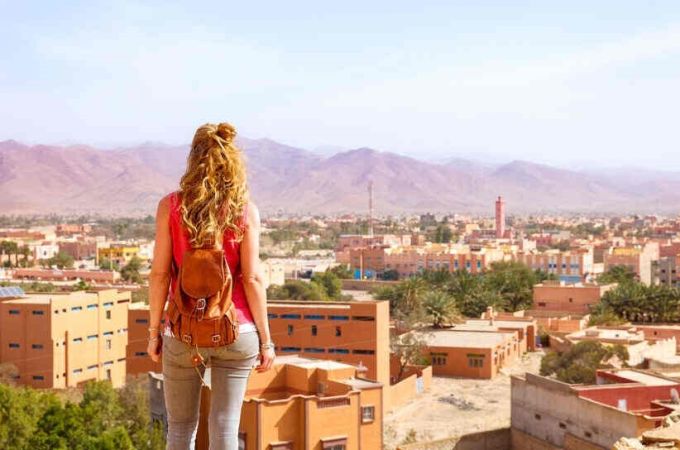
For travelers who strongly associate their first Morocco journey with desert landscapes, kasbahs and the High Atlas, the southern route is usually the most coherent use of a week.
A sensible structure can begin with Marrakech before crossing the Atlas toward Ait Ben Haddou and Ouarzazate, continuing through southern landscapes toward the desert region and eventually returning or finishing according to the wider flight plan.
The strength of this itinerary is progression.
Marrakech does not simply sit beside the Sahara as two unrelated highlights. The road between them introduces mountain scenery, changing architecture, increasingly arid landscapes and smaller settlements that help explain the transition from one environment to another.
The weakness is equally clear.
Road time is substantial.
Travelers choosing Morocco Desert and Kasbah Tours should therefore want the overland journey itself, not merely the photograph of dunes at sunset.
If the road sounds like an inconvenience you must tolerate to reach the desert, another seven-day route may suit you better.
Do Not Turn the Southern Route Into a Desert Delivery Service
A common mistake is treating every intermediate destination as something delaying arrival at the Sahara.
That wastes much of what makes southern Morocco interesting.
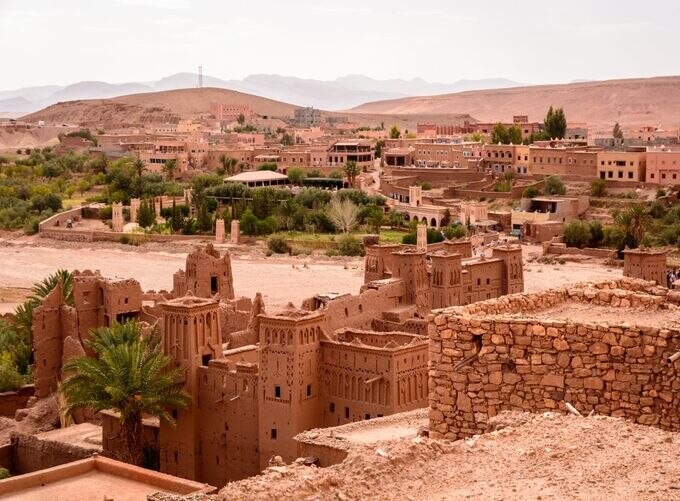
Ait Ben Haddou, the landscapes around Ouarzazate, valleys, mountain roads and changing settlement patterns provide cultural and geographical context. They also prevent the journey from becoming an endurance transfer with a camel ride at the end.
This does not mean stopping at every viewpoint.
Over-planning road days creates the opposite problem, where travelers repeatedly enter and leave the vehicle until scenic stops begin feeling compulsory.
A good southern itinerary needs selectivity.
Choose stops that explain something about the landscape or history and allow enough uninterrupted road time for the journey to retain momentum.
Seven days creates enough space for this approach, but only if several unrelated northern destinations are not competing for the same week.
Route Two: Marrakech and Fes With Cultural Depth
Not every first-time visitor needs the Sahara.
For travelers whose priorities are historic cities, architecture, medinas, craftsmanship and food, Marrakech and Fes can form the backbone of a very different week.
These cities should not be treated as interchangeable.
Marrakech feels more immediately theatrical to many visitors, combining its historic core with a substantial contemporary tourism infrastructure. Fes can demand more patience, particularly within Fes el-Bali, where the density of lanes, workshops, religious heritage and traditional urban structure benefits from interpretation rather than hurried sightseeing.
Giving both cities meaningful time allows travelers to compare them instead of merely confirming that both have medinas.
The challenge is deciding what belongs between them.
A seven-day itinerary does not need to fill every transfer with another overnight stop. Sometimes the strongest choice is simply allocating more time to the two places you came to understand.
That restraint is particularly valuable for travelers who enjoy independent wandering after guided sightseeing.
Route Three: Northern Morocco With Fes
The north offers a third approach that is often overlooked by travelers automatically starting with Marrakech.
A route involving Fes and selected northern destinations such as Chefchaouen or Tangier can produce a coherent week with a character distinct from the southern circuit.
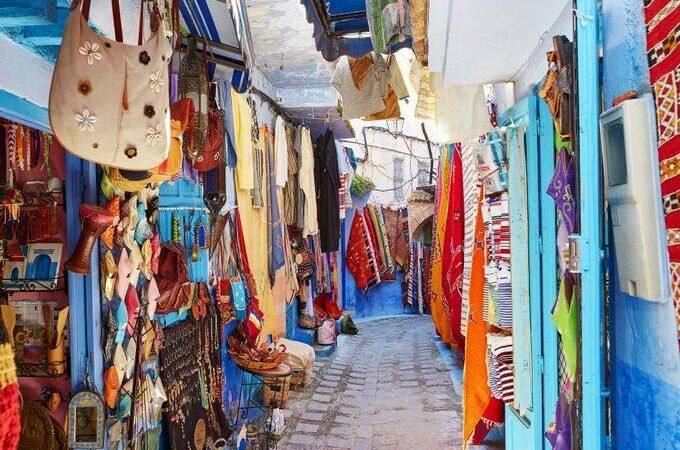
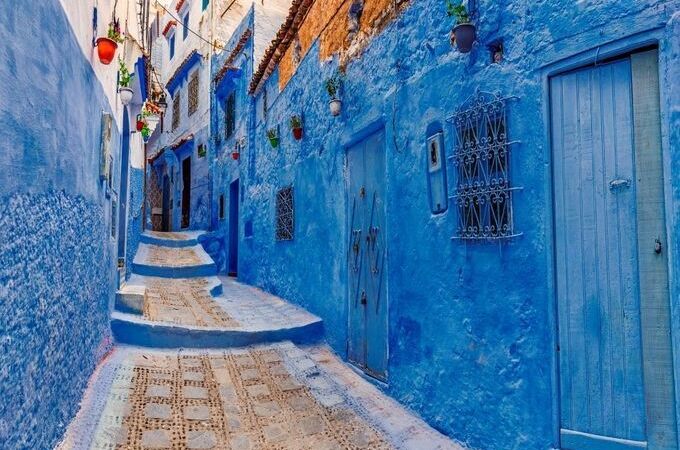
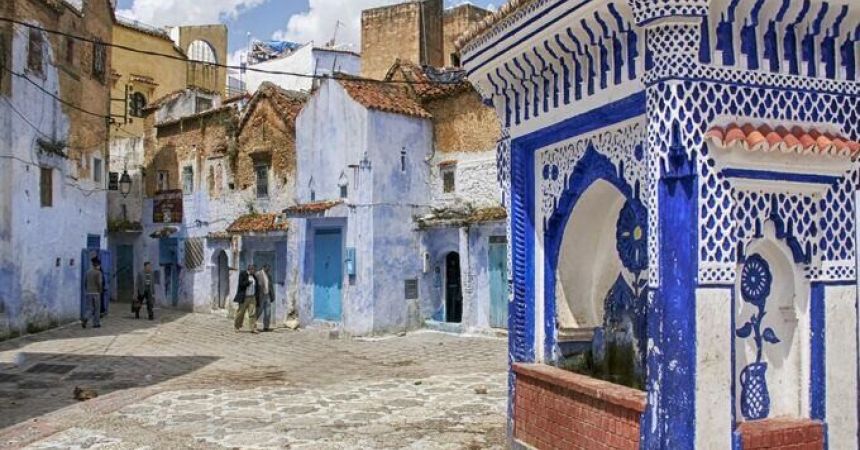
Chefchaouen contributes its mountain setting and recognizable blue-painted streets, although it should not be reduced to photography. Tangier brings Mediterranean and Atlantic influences together with a long history of international connections, while Fes provides the deepest historic-medina experience of the route.
Rabat may also fit depending on arrival and departure logistics.
The advantage is that the week develops around northern geography rather than repeatedly crossing the country to include Marrakech for the sake of name recognition.
This is particularly relevant when international flights or a wider journey already position travelers in northern Morocco.
A good itinerary should exploit geography rather than fight it.
Which Seven-Day Morocco Route Fits You?
Instead of ranking routes from best to worst, decide which compromise you are most comfortable making.
| Your strongest priority | Best route direction | What you gain | What you accept missing |
|---|---|---|---|
| Sahara and landscapes | Marrakech + southern Morocco | Atlas, kasbah route, desert progression | Fes and much of northern Morocco |
| Historic cities | Marrakech + Fes | Two major cultural centers with meaningful time | Full desert circuit |
| Slow cultural travel | Marrakech-focused + nearby region | Less packing and deeper city experience | Broad national coverage |
| Northern atmosphere | Fes + Chefchaouen + selected north | Medina, mountain town and northern contrast | Marrakech and Sahara |
| Less road time | Fewer major bases | More usable destination time | Long-distance highlights |
| Photography and landscapes | Southern route | Strong environmental changes | Wider urban variety |
| Food, architecture and crafts | Marrakech + Fes | Cultural depth | Desert-heavy experience |
| First trip with children | Concentrated route | Easier logistics and fewer transitions | Maximum destination count |
The most important column is the last one.
Every successful seven-day route deliberately excludes something.
Once you are comfortable with that, itinerary planning becomes much more rational.
The Number of Hotel Changes Matters More Than the Number of Cities
Travelers frequently count destinations but rarely count transitions.
Seven nights divided among five hotels sounds manageable when written as a list. In practice, it creates repeated packing, checking out, luggage handling, transportation, arrival and reorientation.
Those transitions have cumulative cost.
Two nights in a destination also do not necessarily mean two sightseeing days. If you arrive late on the first day and leave early after the second night, the actual experience may consist of one usable day.
This is why I prefer evaluating a route according to usable destination time, not nights allocated.
A place worth including should generally be worth experiencing rather than simply sleeping in.
One-night stops can be perfectly logical on an overland route, particularly where geography requires them, but they should have a clear purpose.
Road Days Are Not Automatically Lost Days
This is particularly important when comparing a southern itinerary with a city-focused route.
A long drive looks inefficient if transportation is treated as empty time.
Some Morocco road journeys are part of the experience because landscapes, settlements and architecture change significantly along the way. Crossing the High Atlas belongs in a different category from spending hours on a featureless motorway simply to reposition between cities.
The distinction should influence expectations.
A well-designed Private Morocco One-Week Journey can integrate worthwhile stops into a road day without pretending that every transfer is a full sightseeing tour.
There should still be periods when travelers simply travel.
The objective is not eliminating road time.
It is ensuring that the amount of road time matches the reason you selected that particular itinerary.
The Sahara Costs More Than One Night on the Itinerary
Travelers often allocate “one night Sahara” and assume the desert therefore consumes one day.
Geographically, it does not work that way.
The desert stay requires reaching the region and then leaving it, which influences the days around the overnight. This is why adding the Sahara to an already crowded one-week itinerary can distort the entire route.
If the desert is important, give it geographical respect.
Build the southern section around the journey rather than inserting one desert night between unrelated city stays.
If it is not important enough to justify that commitment, leave it out.
A seven-day Morocco itinerary without the Sahara is not incomplete.
It is simply a different Morocco itinerary.
Marrakech Does Not Need to Be Included in Every Week
This is another assumption worth challenging.
Marrakech is one of Morocco's most important visitor destinations and makes excellent sense for many first journeys. However, travelers arriving through Tangier or planning around Fes and northern Morocco should calculate what adding Marrakech actually contributes compared with the time required to reach it.
Sometimes the answer is plenty.
Sometimes it is simply familiarity.
The same principle applies in reverse. A southern itinerary does not become more culturally complete because Fes has been squeezed into the final night.
Famous destinations should earn their place through the route.
They should not be protected from editing merely because everybody recognizes their names.
Two Nights Can Be More Valuable Than Another Destination
When travelers discover an unused night in their itinerary, the instinct is often to ask what else can be added.
Sometimes the better answer is nothing.
An additional night in Marrakech or Fes can create an unscheduled afternoon, allow a later start after a long travel day or give travelers time to revisit an area independently after seeing it with a guide.
These experiences rarely appear impressive in itinerary summaries.
“Free afternoon in Fes” sounds less ambitious than “visit another city.”
During the actual trip, however, it may provide more value.
This is one of the central differences between designing an itinerary to look good before departure and designing one to feel good while traveling.
Seven Days With Children Requires Different Arithmetic
Families should be especially skeptical of itineraries built around maximum coverage.
Children experience repeated hotel changes, long drives and early departures differently from adults, while parents also absorb the additional work of keeping luggage, meals and daily routines organized.
This does not mean families need to stay in one place for a week.
It means each transition should justify itself.
A pool afternoon in Marrakech, a slower morning after a road day or two consecutive nights in the same hotel can contribute more to family satisfaction than another attraction squeezed into the schedule.
Travel with children often exposes whether an itinerary was designed around actual humans or around a map.
That is useful information for adults too.
Seven Days Should Include at Least One Period With Nothing Urgent Happening
One week is short enough that travelers understandably want structure.
It is also long enough that continuous structure becomes tiring.
I would protect at least one half-day, late afternoon or evening without a major sightseeing obligation. In Marrakech or Fes, this creates time to return somewhere that caught your attention. On a southern route, it can provide recovery after several days of movement.
Unscheduled time also allows the destination to influence the itinerary after arrival.
Perhaps you want to spend longer over lunch, revisit a market, use the hotel hammam or simply sit somewhere and watch the city rather than continuing to the next monument.
Not every valuable travel experience needs a booking reference.
What Changes If You Have Eight or Nine Days Instead?
An additional day should not automatically create an additional destination.
With eight days, I would first look for the most rushed section of the seven-day itinerary and improve it. That might mean adding another night in Marrakech or Fes, breaking up an intensive southern route or protecting more time after a long journey.
Nine days creates more flexibility.
At that point, an additional destination can make sense when it fits geographically, but the same rule remains: add somewhere because it improves the route, not because an empty day appears on the calendar.
This is particularly important with Chefchaouen, the Sahara or the Atlantic coast. Each can be excellent, but none should be attached to a route that otherwise points in the opposite direction.
The extra days should solve itinerary weaknesses before they create new ambitions.
How I Would Build a First Morocco Week
I would begin with one non-negotiable experience.
If that were the Sahara, I would choose the southern route and accept that northern Morocco belongs to another journey.
If it were historic cities, I would build around Marrakech and Fes while resisting the urge to add a full desert circuit.
If the traveler disliked long drives, I would reduce geographical ambition before attempting to optimize transportation.
Then I would look at flights.
Arrival and departure cities can make a substantial difference to whether the route flows naturally or doubles back unnecessarily.
Only after those decisions would I start allocating nights.
This is the opposite of beginning with seven empty boxes labeled Day 1 through Day 7.
A good itinerary starts with priorities and geography.
The calendar comes afterward.
Is Seven Days Enough for Morocco?
Yes. Seven days is enough to experience Morocco meaningfully, but the best itinerary depends on what you are willing to leave for another trip.
A southern route can combine Marrakech, the High Atlas, kasbah landscapes and the desert. A cultural week can give Marrakech and Fes enough space to become more than sightseeing stops, while northern Morocco offers an alternative route built around Fes, Chefchaouen, Tangier or Rabat according to logistics.
What one week does poorly is everything at once.
The strongest itinerary is therefore not the one containing the greatest number of famous places.
It is the one where destinations relate geographically, travel days have a purpose and enough time remains to experience Morocco outside the vehicle.
Seven days gives you enough time to choose well. It does not give you enough time to avoid choosing.
Frequently Asked Questions About a Morocco 7 Day Itinerary
Should I choose Marrakech or Fes if one week cannot comfortably cover everything?
Choose according to the wider route rather than ranking the cities. Marrakech fits naturally with southern Morocco, while Fes works particularly well with northern destinations. Travelers focused primarily on historic urban culture may reasonably include both and sacrifice the desert circuit.
Can I visit the Sahara during a seven-day Morocco trip?
Yes, particularly when the itinerary is designed around Marrakech and southern Morocco. The desert should be treated as part of a multi-day geographical journey rather than a single overnight added to an already crowded circuit involving distant northern cities.
Is Marrakech, Fes and Chefchaouen realistic in seven days?
It can be structured, but travelers should examine how much usable time remains in each city after transfers. If Chefchaouen is particularly important, a northern-focused route may provide a more coherent experience than attaching it to an otherwise southern itinerary.
Should Casablanca be included in every first-time Morocco itinerary?
No. Casablanca may fit naturally because of international flights or personal interest, but it should not automatically consume sightseeing time simply because many travelers arrive there. The best use of the city depends on the route and flight schedule.
How many hotels are reasonable during one week in Morocco?
There is no universal number, although every hotel change should have a geographical or experiential purpose. Several consecutive one-night stays can make the trip feel fragmented, particularly when each change also involves substantial road travel and luggage handling.
Is a one-week Morocco road trip too tiring?
Not necessarily. Road-based itineraries can be rewarding when the landscapes and intermediate stops are part of the reason for traveling. Fatigue becomes more likely when long drives are combined with excessive sightseeing, repeated early departures and too many hotel changes.
Is it better to spend more nights in Marrakech or add another city?
That depends on what the extra city contributes. Another night in Marrakech can create independent exploration and a more relaxed pace, while an additional city is worthwhile when it adds meaningful contrast without introducing disproportionate travel time.
Can families comfortably tour Morocco for seven days?
Yes, but family itineraries generally benefit from fewer transitions, realistic road days and protected downtime. Children rarely value destination count, so adding another city may produce less enjoyment than allowing more time at a well-chosen hotel or existing destination.
Should I include Chefchaouen on my first Morocco trip?
Include it when northern Morocco forms a meaningful part of the route or the town strongly matches your interests. Do not add Chefchaouen solely because of its photographic reputation if reaching it creates an awkward detour from an otherwise southern journey.
What should I do if I have eight days instead of seven?
Use the additional day to improve the weakest part of the itinerary before adding another destination. An extra night can make a rushed city stay, desert journey or long transfer sequence considerably more comfortable without changing the overall geographical logic.
Is nine days significantly better than seven for Morocco?
Nine days provide useful breathing room and can sometimes support another geographically logical destination. The biggest advantage, however, is flexibility: road journeys can be better distributed and major cities can receive more time without forcing another hotel change.
What is the biggest mistake in a seven-day Morocco itinerary?
Trying to turn one week into a condensed grand tour. Marrakech, Fes, northern Morocco, the Atlas and Sahara are individually worthwhile, but forcing all of them into seven days can make transportation and hotel changes more memorable than the destinations themselves.

A travel professional specializing in tailor-made travel planning, guest experience management, and multi-destination tourism operations.
With over 23 years of experience in the travel industry, he designs and manages private and cultural tours for international travelers across Türkiye, Greece, Egypt, Jordan, Morocco, and other destinations.
He has strong expertise in both online and face-to-face guest communication, sales processes, and end-to-end travel operations.
Working closely with hotels, travel agencies, and local partners, he ensures smooth coordination and high-quality travel experiences at every stage of the journey.
His focus is on delivering personalized, reliable, and seamless travel experiences for international guests worldwide.