Morocco Weather in May: Warm Days Before the Summer Heat
Last Updated: August 9, 2026
May is the month when Morocco begins asking travellers to look at the clock as well as the map.
During April, a broad circuit can often be designed primarily around interests, with weather playing a supporting role. By May, that freedom still exists, but the balance has started to shift. Marrakech afternoons become warmer, the Sahara moves more decisively towards its hot season, and sightseeing in southern Morocco increasingly benefits from mornings and later afternoons rather than an uninterrupted day outdoors.
At the same time, the Atlas Mountains become more accessible for a wider range of activities, northern cities remain rewarding, and the Atlantic coast begins making an increasingly persuasive case for a place in the itinerary.
May is therefore not summer in disguise.
It is the month when you can still build an ambitious Morocco circuit, provided you stop expecting every hour of the day to be equally useful.
May Changes the Daily Schedule Before It Changes the Route
The first effect of increasing warmth is not necessarily that a destination should be removed.
Often, it simply needs to be experienced differently.
An early start in Marrakech allows several hours of comfortable sightseeing before lunch, while the middle of the afternoon can be given to a slower meal, a shaded garden, a hammam or time back at the riad. As temperatures ease later, the city becomes active again and the evening stretches naturally towards dinner.
The same principle becomes increasingly useful farther south.
| Region | May Character | Smartest Adjustment |
|---|---|---|
| Fes & North | Warm spring touring | Use the full cultural day |
| Marrakech | Increasing daytime heat | Prioritise mornings and evenings |
| Atlas Mountains | Expanding spring access | Excellent time for active itineraries |
| Ouarzazate & South | Warm to hot periods | Reduce exposed midday activity |
| Sahara | Heat increasingly important | Shift activities away from midday |
| Atlantic Coast | Mild coastal alternative | Add longer outdoor afternoons |
This is the beginning of Morocco's summer scheduling logic, but without the stronger restrictions that will define the hottest months.
Marrakech Becomes a Two-Part Day
Travellers accustomed to sightseeing continuously from breakfast until late afternoon sometimes find May in Marrakech more enjoyable once they abandon that habit.
The city works beautifully in sections.
Morning belongs to walking.
You can explore the medina while the day is still developing, visit architectural sites and move through the souks before the strongest afternoon warmth arrives. Lunch can then become an actual break rather than another item fitted between attractions.
Later, Marrakech returns.
Rooftops, squares and restaurant terraces become increasingly appealing as the light softens, while the city often feels more atmospheric once the urgency of daytime sightseeing disappears.
Travellers who enjoy building the itinerary around their own pace can consider Morocco private escapes, particularly when daily timing matters more than following a fixed group schedule.
Fes Still Supports a Fuller Sightseeing Day
May does not affect every Moroccan city equally.
Fes can remain more comfortable for sustained cultural touring than hotter southern destinations, although warm days are entirely possible and conditions vary throughout the month.
This gives northern Morocco a useful role in May itineraries.
Rather than beginning and ending everything in Marrakech, travellers can devote meaningful time to Fes, Meknes, Rabat or nearby historical landscapes before moving south.
The route then develops with the season.
Longer cultural days come first.
Warmer landscapes arrive later.
For travellers who dislike intense heat, this north-to-south progression can make more sense than immediately beginning in the hottest part of the itinerary.
The Atlas Gains Ground as the Desert Loses Some
May changes the relationship between two of Morocco's defining landscapes.
Higher parts of the Atlas gradually become more accessible as winter conditions retreat, although altitude and current weather remain important for serious trekking. Lower valleys can offer attractive walking conditions, while longer mountain stays become easier to incorporate into active itineraries.
The Sahara moves in the opposite direction.
It remains entirely possible to visit, but heat begins claiming a larger portion of the day.
This does not make one destination better than the other.
It changes their relative value depending on the traveller.
Someone who loves hiking may find May more exciting than April because the mountains offer broader possibilities. Someone who struggles with heat may decide that a long Sahara circuit is becoming less appealing.
May begins asking you to choose.
A Mountain Stay Can Do More Than Fill the Gap Before the Desert
The Atlas is often treated as scenery between Marrakech and southern Morocco, yet May provides a good opportunity to give the mountains their own place in the itinerary.
A village stay, moderate hike or longer trekking programme can create a completely different rhythm from the imperial cities, while elevation provides climatic variation as lower areas become warmer.
Travellers interested in combining activity with cultural encounters can consider Morocco mountain journeys, choosing the level of walking according to altitude, fitness and current trail conditions.
This is also where itinerary length matters.
If you have only seven days and the Sahara is the priority, adding a separate mountain stay may create unnecessary pressure.
With ten or fourteen days, the Atlas can become a destination rather than a stop.
The Sahara Is Still Worth Visiting, but Stop Treating Noon as Neutral
May desert travel requires a different attitude towards time.
A winter itinerary might allow travellers to remain active across much of the day, whereas May increasingly favours early and late periods for exposed experiences.
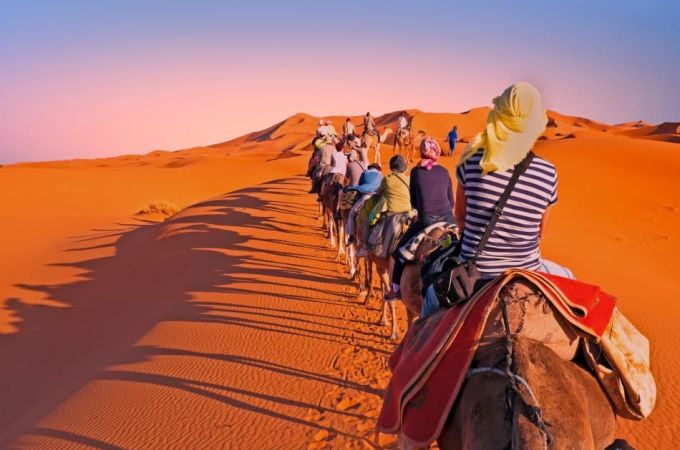
Camel rides, dune walks and outdoor exploration become more comfortable when they follow the sun rather than challenge it.
The middle of the day can slow down.
That does not represent lost holiday time.
A long lunch, a rest at the accommodation or several quiet hours looking across the landscape can become part of the desert experience rather than an interruption to it.
Travellers sometimes arrive in the Sahara determined to stay continuously busy because reaching the desert required several days of travel.
The landscape does not need that level of supervision.
How Heat-Sensitive Are You?
Monthly averages cannot answer this question.
Two travellers can experience exactly the same Marrakech afternoon and describe it completely differently. One considers the warmth perfect, while another begins planning the quickest route back to the hotel.
May itinerary design should therefore consider personal heat tolerance alongside destination averages.
| Traveller Type | Better May Emphasis |
| Comfortable in heat | Marrakech + Southern Valleys + Sahara |
| Moderately heat-sensitive | Fes + Marrakech + Atlas + Coast |
| Very heat-sensitive | Northern cities + Atlas + Atlantic |
| Active traveller | Atlas + cultural cities |
| Desert priority | Sahara, with adapted daily timing |
| Relaxed traveller | Marrakech + Essaouira |
There is no prize for tolerating the hottest itinerary.
Choose the version of Morocco you will actually enjoy.
Essaouira Becomes Increasingly Valuable
The Atlantic coast begins playing a stronger climatic role in May.
Essaouira can feel noticeably different from Marrakech, with ocean influence and wind creating conditions that often suit longer daytime walks. The contrast becomes particularly satisfying after several days inland because the journey changes not only scenery but also daily rhythm.
This is not yet the full summer story, when the coast can become an obvious refuge from stronger inland heat.
In May, Essaouira remains a choice rather than a necessity.
That makes it especially attractive.
Travellers can add the city because they want seafood, the harbour, Atlantic landscapes and a slower finish rather than because the interior has become unbearable.
Agadir Works for a Different Traveller
Essaouira and Agadir are often grouped together under “Atlantic coast,” although they serve different travel styles.
Essaouira appeals strongly to travellers who still want medina character, history and a walkable urban experience. Agadir makes more sense when resort facilities, relaxation and beach-oriented time have greater priority.
May can support either.
The decision should come from what you want the final days of the trip to feel like rather than from comparing two temperature averages.
A cultural circuit may finish beautifully in Essaouira.
A traveller wanting several genuinely slow days may prefer Agadir.
May Is the Month to Start Designing North to South
Route direction rarely receives enough attention in weather planning.
During May, beginning in northern Morocco and gradually travelling south can create a natural climatic progression. Fes, Meknes or Rabat provide substantial cultural touring before the journey moves towards warmer Marrakech, the Atlas and eventually the southeast.
Another option is to finish on the Atlantic coast, allowing the trip to cool down geographically after its warmest section.
Travellers interested in a broader itinerary can explore Morocco discovery tours, particularly when the route connects imperial cities, mountains and southern landscapes rather than treating every region as an isolated excursion.
The sequence matters because May is no longer climatically neutral.
May Is Still Flexible, but Summer Is Beginning to Negotiate
June will push Morocco more clearly towards summer route design, while May retains enough spring balance to keep much of the country comfortably within reach.
That makes it a valuable final window for travellers who want a broad circuit before stronger heat begins influencing the south more decisively.
The key is not trying to preserve an April schedule in warmer conditions.
Start earlier when necessary, allow the middle of the day to slow down, give the Atlas more attention if active travel appeals to you, and recognise that the Atlantic coast is becoming increasingly valuable without yet being essential.
May does not tell you to stop travelling south.
It simply asks whether you need to do it at noon.
In May, the Best Time of Day Depends on What You Are Doing
Travellers often plan Morocco by destination first and hour second. May is the point when reversing that order can noticeably improve the experience, particularly in Marrakech and southern regions where the afternoon begins carrying more weight.
This does not require setting an alarm before sunrise every day. It means recognising that walking through a medina, sitting over lunch, crossing a mountain valley and exploring desert landscapes do not need the same weather conditions.
A well-designed May itinerary gives each experience the part of the day it deserves.
| Experience | Best Part of Day | Why |
|---|---|---|
| Marrakech medina walking | Morning | Cooler for sustained exploration |
| Fes cultural touring | Morning to afternoon | Generally broader sightseeing window |
| Atlas walking | Morning | Cooler and more comfortable for activity |
| Scenic road journey | Morning / late afternoon | Better light and easier stops |
| Sahara activities | Early morning / late afternoon | Avoid stronger midday heat |
| Essaouira exploration | Flexible | Atlantic conditions moderate the day |
| Marrakech rooftop dinner | Evening | Cooler air and changing city atmosphere |
The objective is not to organise the holiday with military precision, but to stop spending the least comfortable hours on the most physically demanding activities.
Give Marrakech's Morning to Your Feet
May mornings are valuable in Marrakech because the medina requires energy.
Walking through the souks, visiting palaces and moving between different sections of the old city can occupy several hours before you notice how far you have travelled. Beginning earlier allows that walking to happen while the day is still relatively comfortable, leaving the warmer afternoon for experiences that demand less physical effort.
This also improves the quality of sightseeing.
When you are comfortable, you notice details. When you are overheated and looking for the next cold drink, the medina gradually becomes something you are trying to finish.
There is no advantage in reaching that point.
Midday Doesn't Need to Be Empty
The phrase “avoid midday heat” sometimes sounds as though travellers are expected to return to their hotel and stare at the ceiling for three hours.
Morocco offers better options.
Lunch can become longer and more deliberate. A hammam can occupy part of the afternoon, while museums, shaded interiors or time at the riad provide a natural change of pace. Depending on conditions, gardens and covered sections of the medina may also remain perfectly enjoyable.
The important point is to reduce the most exposed physical activity when the day is at its warmest.
May rewards travellers who understand that resting is not the opposite of travelling.
Sometimes it is what makes the evening enjoyable.
Fes Gives You More Freedom With the Clock
Although warm periods are possible, Fes can often support a broader sightseeing window than destinations farther south, which means visitors do not necessarily need to divide every day as sharply as they might in Marrakech.
That flexibility is useful because the medina does not always respond well to rigid schedules.
A workshop visit lasts longer than expected, lunch appears at the wrong time, or the route between two monuments becomes interesting enough that nobody wants to hurry.
May allows those detours.
Rather than assigning every attraction a precise hour, protect the larger part of the day and let the medina determine some of the details.
Atlas Walks Deserve the Morning
For active travellers, an early mountain start has advantages beyond temperature.
Morning conditions often provide more comfortable walking, while beginning earlier leaves greater flexibility if the route takes longer than expected. Elevation can moderate temperatures compared with lower areas, but strong sun and physical effort still make sensible timing important.
The exact schedule should depend on the route, altitude and current conditions rather than a universal rule.
A short village walk does not require the same planning as a substantial trek.
What May changes is the amount of outdoor activity that becomes possible in the mountains while the lowlands simultaneously move towards summer.
Don't Waste Scenic Roads in the Harshest Light
May road trips through southern Morocco are not simply transportation days.
The route itself contains viewpoints, kasbah landscapes, villages and changing terrain, so timing can affect what you see as much as where you stop.
Driving the most scenic section during softer morning or later-afternoon light can improve photography and make short walks more comfortable. The middle of the day can then absorb less visually important road sections, lunch or longer transfers.
This is a small itinerary decision that rarely appears on a standard tour programme.
It can make a surprisingly large difference.
The Sahara Owns Sunrise and Late Afternoon
May pushes the desert increasingly towards a split-day rhythm.
Sunrise provides cooler conditions and distinctive light, while late afternoon brings another useful window as temperatures begin easing and shadows return to the dunes.
The hours between them do not need to be filled aggressively.
Travellers who attempt long exposed activities simply because the itinerary lists them at a particular time are missing the point of adapting to the season.
A good desert programme follows conditions rather than fighting them.
The dunes will still be there later.
Marrakech Comes Back After Sunset
One of May's pleasures is discovering that a city day does not end when formal sightseeing does.
As the temperature eases, Marrakech changes personality. Restaurants and terraces become more appealing, squares grow livelier and walking without a destination begins making sense again.
This is why an afternoon break can improve rather than shorten the day.
Someone who has been sightseeing continuously since breakfast may be ready to stop by early evening. A traveller who slowed down during the warmest period can return to the city when it is at its most atmospheric.
May gives Marrakech two useful shifts.
You do not have to work both without a break.
Essaouira Does Not Need the Same Clock
The Atlantic coast breaks many of the rules that become increasingly useful inland.
Ocean influence and wind can make daytime exploration comfortable when Marrakech feels much warmer, although actual conditions still vary. This allows Essaouira to retain a more continuous daily rhythm, with harbour walks, medina exploration and long lunches arranged according to interest rather than a strict heat-avoidance schedule.
That contrast is one reason the coast becomes increasingly attractive as summer approaches.
The difference is not simply a lower temperature.
It is having more freedom over when you do things.
May Is Better When the Itinerary Has a Pulse
A strong May itinerary should not operate at the same intensity from breakfast until dinner.
It should expand and contract with the day.
Use cooler mornings for walking and active sightseeing, allow warmer periods to slow naturally, then return outdoors when conditions become more inviting. In the Atlas, that rhythm supports activity; in the Sahara, it becomes increasingly important; on the Atlantic coast, it may barely be necessary at all.
This is what separates May from April within the Morocco weather cluster.
The country remains widely accessible, but time of day has started becoming part of destination choice.
By designing around that rhythm rather than ignoring it, travellers can still enjoy a broad Morocco circuit without feeling that the approaching summer is constantly chasing them indoors.
Sahara or Atlantic Coast? May Makes the Choice More Personal
Suppose your itinerary already includes Fes and Marrakech, but only three or four nights remain.
Do you cross the Atlas and continue towards the Sahara, knowing that May is moving the desert closer to its hotter season, or turn west towards the Atlantic and finish the journey at a slower, milder pace?
There is no universally correct answer because these are not competing versions of the same experience. The Sahara adds distance, dramatic landscapes and a stronger sense of journey, whereas the coast reduces travel intensity and changes the rhythm of the holiday almost immediately.
May simply makes the difference between them more important.
Start With Travel Style, Not Temperature
Choosing solely from weather averages misses most of what separates these regions.
| Choose the Sahara If... | Choose the Atlantic If... |
|---|---|
| Desert landscapes are a major priority | You want a slower final chapter |
| Long scenic drives appeal to you | You prefer less road time |
| Early starts do not bother you | Flexible daytime exploring matters |
| You tolerate increasing warmth well | You prefer milder conditions |
| A desert camp is a bucket-list experience | Food and coastal atmosphere matter more |
| You have enough days for the journey | Your itinerary is already busy |
May weather should refine the decision rather than make it for you.
The Sahara Requires Enough Time to Earn the Distance
The biggest argument against adding the Sahara to a short May itinerary is not temperature.
It is geography.
Travelling from Marrakech towards the major dune regions involves substantial road time, with the Atlas, Ouarzazate area and southern valleys forming part of the journey. When those landscapes are given sufficient attention, the route can become one of Morocco's great travel experiences.
Compress them too aggressively and the same journey becomes several long days inside a vehicle.
May increases that pressure because warmer conditions make endless midday stops less attractive, particularly farther south.
If you have enough time, go properly.
If you do not, the Sahara deserves a future trip more than it deserves a rushed one.
The Atlantic Gives Time Back to the Itinerary
Essaouira provides almost the opposite experience.
The journey from Marrakech is considerably easier to integrate into a shorter holiday, and once there, the city does not require a complicated sightseeing programme to justify two nights.
You can walk the medina, visit the harbour, eat slowly, spend time beside the ocean and allow the day to organise itself around what feels appealing.
For travellers coming from an intensive cultural itinerary, that simplicity can be surprisingly valuable.
The Atlantic does not necessarily add another major “bucket-list sight.”
It changes how the final days feel.
Heat Tolerance Can Break the Tie
May is early enough that many travellers continue to enjoy the Sahara, particularly when desert activities are organised around cooler parts of the day.
Others find that increasing warmth changes the value calculation.
If you know that hot conditions quickly reduce your enthusiasm for sightseeing, choosing the desert because it appears on every classic Morocco itinerary makes little sense. The coast may allow you to remain outside longer and finish the holiday with considerably more energy.
Conversely, someone comfortable with heat who has dreamed about desert landscapes for years should not automatically abandon the Sahara simply because May is warmer than April.
Personal comfort matters more than an abstract definition of perfect weather.
What Kind of Ending Do You Want?
This may be the most useful question.
The Sahara creates a dramatic ending when the itinerary builds towards it. Cities gradually give way to mountains, valleys and increasingly arid landscapes until the dunes provide a clear geographical climax.
Essaouira offers something different.
Instead of building towards a climax, the trip releases pressure. Distances become shorter, the schedule becomes lighter and the Atlantic changes both the scenery and the atmosphere.
One ending says, “we finally reached it.”
The other says, “we can stop rushing now.”
Both can be memorable.
What About Agadir?
Agadir enters the comparison when the priority shifts from atmospheric coastal exploration towards a more conventional leisure stay.
Travellers looking for resort facilities, beach time and a straightforward place to relax may prefer it, particularly after a demanding circuit. Those wanting their coastal stay to continue the cultural character of the journey generally find Essaouira the more natural fit.
Again, May makes both realistic.
The choice is not simply which coastal city has the better forecast, but whether you want the final days to remain exploratory or become deliberately restful.
Don't Add Both Just Because They Fit on the Map
With a sufficiently long holiday, combining the Sahara and Atlantic coast can work beautifully.
On a shorter itinerary, adding both often produces the exact problem May planning should avoid: too much movement.
A traveller with eight or nine days does not necessarily improve the journey by squeezing Fes, Marrakech, the Sahara and Essaouira into the same route. The result may contain more destinations while providing less experience of each one.
May's broad travel possibilities can make overplanning particularly tempting.
The fact that somewhere is possible does not mean it belongs.
The Better Choice Is the One That Changes the Trip
If the itinerary already contains several cities and you want a dramatic landscape completely unlike anything experienced earlier, the Sahara can justify the extra distance.
If the journey already contains long transfers and early starts, the Atlantic may contribute more precisely because it asks less from you.
That is why the Sahara-versus-coast decision becomes especially useful in May.
As Morocco approaches summer, the two regions begin offering increasingly different answers to the same question: what should the final days of the journey feel like?
Choose according to that answer, and weather becomes a useful planning tool rather than the only reason for going somewhere.
April vs May vs June: Where May Has the Advantage
May sits at a useful point between Morocco's balanced spring and the more decisive arrival of summer. April generally gives travellers greater freedom to explore throughout the day, whereas June increasingly rewards itineraries that account for stronger inland heat and give more weight to mountains or the Atlantic coast.
May still allows a broad circuit, but the daily schedule has started to matter.
| April | May | June | |
|---|---|---|---|
| Seasonal Identity | Balanced spring | Pre-summer shift | Early summer |
| Marrakech | Warm and flexible | Warmer; timing matters | Heat shapes sightseeing |
| Fes & North | Established spring | Strong cultural touring | Increasingly warm |
| Atlas Mountains | Spring access expands | Excellent active-travel potential | Valuable summer alternative |
| Sahara | Increasingly warm | Heat becomes significant | More demanding |
| Atlantic Coast | Useful contrast | Growing advantage | Major climatic alternative |
| Best For | Broad spring circuits | Flexible travellers | Heat-aware itineraries |
May's strength therefore lies in keeping most of Morocco realistically available while giving travellers an early preview of the planning habits that become increasingly important during summer.
Frequently Asked Questions About Morocco in May
Is May a good month to visit Morocco?
Yes. May remains a strong month for multi-region travel, particularly for visitors combining imperial cities, the Atlas and Atlantic coast. The Sahara also remains possible, although increasing daytime heat means activity timing and individual heat tolerance become more important than during March or April.
Is Marrakech too hot in May?
Not necessarily. Many travellers find Marrakech enjoyable in May, particularly when active sightseeing is concentrated in the morning and the warmest part of the afternoon is used more slowly. Conditions vary throughout the month, however, and hotter periods become increasingly possible as summer approaches.
Is Fes cooler than Marrakech in May?
Fes can offer different conditions from Marrakech and may suit travellers wanting substantial cultural sightseeing before moving farther south. Warm weather is still possible, so regional forecasts should be checked close to departure rather than assuming northern Morocco will always remain cool.
Is May too hot for the Sahara?
May is not automatically too hot for Sahara travel, but daytime heat becomes increasingly relevant and can vary considerably between early and late May. Travellers should favour mornings and later afternoons for exposed activities, carry adequate water and choose the desert according to personal heat tolerance.
Are Sahara nights cold in May?
The strong nighttime cold associated with winter becomes much less central by May, although desert temperatures can still fall noticeably after sunset. A light additional layer remains useful, particularly for travellers who feel the cold easily, but winter-style desert preparation is generally less important.
Is May good for hiking in the Atlas Mountains?
May can be excellent for many Atlas walking and trekking itineraries as seasonal access expands, although conditions continue to vary by altitude and route. High-elevation plans should always be based on current information and suitable local guidance rather than assuming every mountain trail follows the same seasonal timetable.
Should I visit Essaouira in May?
Essaouira can be particularly rewarding in May because Atlantic influence provides a strong contrast to increasingly warm inland destinations. The city suits travellers interested in medina exploration, seafood, coastal walking and a slower itinerary, although wind remains an important part of its climate and character.
Is Agadir good in May?
Yes, especially for travellers who want resort facilities, beach-oriented relaxation and a less intensive final section of the journey. Agadir and Essaouira should not be treated as interchangeable coastal destinations; the better choice depends on whether leisure facilities or cultural atmosphere matter more.
What should I wear in Morocco in May?
Lightweight, breathable clothing is useful for warmer daytime conditions, particularly in Marrakech and southern regions, while comfortable walking shoes remain essential for cultural touring. A light additional layer can be useful for evenings, the Atlantic coast and some mountain areas, depending on elevation and conditions.
Is May or June better for Morocco?
May generally provides greater flexibility for travellers wanting a broad circuit that includes inland cities and potentially the Sahara. June moves farther into summer, making heat-aware scheduling increasingly important and strengthening the appeal of the Atlas and Atlantic coast for heat-sensitive visitors.

A travel professional specializing in tailor-made travel planning, guest experience management, and multi-destination tourism operations.
With over 23 years of experience in the travel industry, he designs and manages private and cultural tours for international travelers across Türkiye, Greece, Egypt, Jordan, Morocco, and other destinations.
He has strong expertise in both online and face-to-face guest communication, sales processes, and end-to-end travel operations.
Working closely with hotels, travel agencies, and local partners, he ensures smooth coordination and high-quality travel experiences at every stage of the journey.
His focus is on delivering personalized, reliable, and seamless travel experiences for international guests worldwide.