Antalya Weather in August: Living With Mediterranean Heat
Last Updated: August 10, 2026
By August, Antalya has stopped negotiating with summer.
The sea is thoroughly warm, the beaches have settled into their high-season rhythm, resort pools are rarely an afterthought, and evenings spill naturally into outdoor restaurants, waterfront walks and the narrow streets of Kaleiçi. The heat that was strengthening through June and began reorganising the clock in July has now become part of the basic architecture of the holiday.
This distinction is more important than a few additional degrees on a weather chart.
An enjoyable August trip is rarely built by taking a spring itinerary and moving a few excursions into the morning. The stronger approach is to design the entire stay around the Mediterranean summer environment, choosing accommodation, transport, sightseeing intensity, meal patterns and water-based activities that work together rather than fighting the season.
August is therefore not simply Antalya at its hottest.
It is Antalya at its most summer-dependent.
In August, Your Hotel Becomes Part of the Weather Strategy
During cooler months, a hotel can function mainly as somewhere to sleep, eat breakfast and leave each morning. In August, the property itself can influence how comfortable the entire holiday feels.
Easy pool access matters because it provides immediate cooling without requiring a transfer. A shaded terrace matters because travellers may want to spend an hour outside without sitting directly under the sun. Reliable air conditioning matters because genuine recovery between activities can determine whether the evening remains enjoyable.
Beach access can be equally valuable, particularly for travellers who want to move between sea, shade and room without organising transport every time the temperature becomes tiring.
This does not mean everyone should stay at a large resort. Travellers focused on restaurants, nightlife and urban culture may still prefer Antalya itself or Kaleiçi, but the August question should be broader than location.
How well does the accommodation support the way you will actually live during peak summer?
The August Comfort Equation
Instead of dividing the day by hours, August planning works better when several comfort factors are considered together.
| Holiday Element | What Matters Most in August | Why It Changes the Experience |
|---|---|---|
| Accommodation | Shade, cooling, pool or easy coast access | Reduces unnecessary heat exposure |
| Transport | Efficient air-conditioned transfers | Makes excursions less draining |
| Sightseeing | Selective rather than excessive | Preserves energy |
| Sea access | Convenient and frequent | Swimming becomes part of daily comfort |
| Meals | Flexible timing and lighter daytime choices | Fits the summer rhythm |
| Rest | Built into the holiday rather than improvised | Protects later activities |
| Evenings | Left spacious | Cooler hours carry more value |
None of these elements is complicated individually, but together they explain why two travellers can experience exactly the same August weather and return with completely different opinions of Antalya.
Water Is No Longer One Activity Among Many
By August, the Mediterranean is not merely part of the itinerary; for many visitors, it becomes the environment around which the holiday is organised.
Swimming can happen every day rather than being reserved for a designated beach afternoon. Boat trips can occupy entire days without feeling like a diversion from sightseeing, while hotel pools provide an easy alternative when travellers want water without travelling anywhere.
This creates a very different holiday from May, when sea time and cultural exploration first reached a convincing balance.
August is deliberately unbalanced.
The coast wins.
Travellers choosing Antalya August holidays should therefore expect the strongest itineraries to give water-based experiences substantial space rather than trying to maintain the sightseeing density of spring.
The Mediterranean Is Warm, but the Sun Still Needs Respect
Warm sea temperatures can encourage visitors to remain outside for much longer than they realise.
This is particularly noticeable on beach and boat days because swimming repeatedly reduces the sensation of heat, while sea breezes make exposed conditions feel easier than they actually are. The result can be several hours of substantial sun exposure without the physical discomfort that would normally encourage someone to move indoors.
Shade, sun protection and hydration therefore remain essential even when the body feels comfortable.
August sun management is less about responding to discomfort and more about preventing accumulated exposure before discomfort begins.
A Full Beach Day Needs More Planning Than It Appears
A beach day sounds like the simplest possible itinerary: arrive, swim, relax and return whenever you feel ready.
In August, small decisions make it significantly better.
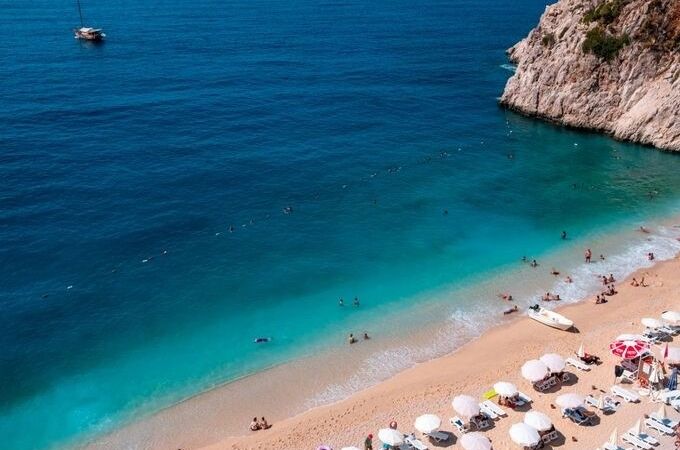
Access to shade matters. Enough drinking water matters. Footwear can matter on surfaces heated by prolonged sunshine. Families may find that a beach with nearby facilities works better than a more beautiful but less serviced location, particularly when children need food, toilets or a break from direct exposure.
The best beach is therefore not automatically the most photogenic one.
In August, convenience has genuine climatic value.
August Changes the Meaning of a Boat Trip
A boat excursion in June can feel like one of several attractive summer options.
In August, it can become one of the most natural ways to experience Antalya.
The reason is not simply swimming.
A boat allows travellers to move through the coastal landscape while alternating between open-air scenery, water and periods of relative rest. Small bays and swimming stops become the activity itself, so there is no pressure to combine the day with additional sightseeing afterwards.
Travellers who want the coast to become the central experience rather than a backdrop can explore Antalya Mediterranean experiences, particularly when swimming, scenery and a slower pace matter more than covering multiple land attractions.
The same sun precautions still apply, however, because breeze over the water can make strong exposure deceptively comfortable.
Archaeology Requires Selectivity in August
Antalya's ancient sites do not become less important because summer reaches its peak, but the way travellers approach them should change.
A spring visitor may reasonably build several days around ruins, historical walking and extended outdoor exploration. An August visitor with broad interests may have a better experience choosing the archaeological sites that matter most and giving them focused attention rather than trying to cover everything.
Perge deserves time, but that does not mean it needs to share the same day with several other exposed sites. Aspendos may be combined intelligently with other experiences, but additional stops should add genuine value rather than simply lengthening the itinerary.
August rewards editing.
A shorter cultural programme completed with curiosity is better than an ambitious one remembered mainly for heat.
Kaleiçi Becomes an Evening Neighbourhood
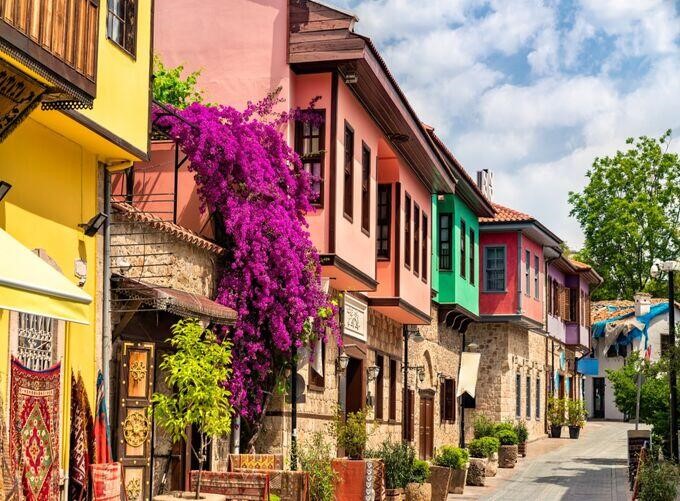
The old city remains visually appealing throughout the day, but August gives its later hours particular importance.
As direct sunshine weakens, walking becomes easier and the relationship between streets, restaurants, courtyards and the old harbour begins to feel more natural. Instead of approaching Kaleiçi as a checklist of Hadrian's Gate, historical houses and viewpoints, visitors can allow it to become the setting for an entire evening.
That shift is especially valuable because it turns sightseeing into atmosphere.
You may still visit specific landmarks, but they appear inside the walk rather than determining it.
August Is a Month for Fewer Transfers
A complicated itinerary carries a hidden summer cost.
Every transfer requires packing belongings, waiting, moving between air-conditioned and outdoor environments, and spending time in places that may not contribute much to the actual experience. During milder months this can be a minor inconvenience; in August, unnecessary movement becomes noticeably tiring.
Staying longer in one place can therefore improve the holiday.
A resort day does not need an excursion added to justify it. A boat day does not need a historical stop afterwards. An evening in Kaleiçi can remain an evening rather than becoming the final item in a twelve-hour itinerary.
This is slow travel created by climate rather than philosophy.
August Holiday Design: Add or Remove?
A useful August planning exercise is to evaluate each activity according to what it adds compared with the energy it requires.
| Proposed Plan | August Question | Better Decision |
| Second archaeological site in one day | Does it add something genuinely different? | Keep only if meaningful |
| Long transfer for a short photo stop | Is the journey worth the experience? | Often remove |
| Full resort afternoon | Does everyone need another activity? | Usually let it remain slow |
| Boat trip + evening programme | Will there be enough recovery? | Keep evening flexible |
| Midday shopping outdoors | Can this happen later? | Move when practical |
| Another coastal town | Does it improve the trip or increase mileage? | Prioritise depth |
This is not about reducing the holiday.
It is about removing the parts that August makes disproportionately expensive in energy.
Families Benefit From Proximity
Families often experience August most successfully when the things they need are close together.
A hotel where the pool, room, food and shaded areas are within a few minutes of one another can make the difference between a relaxed day and one dominated by logistics. The same principle applies to beaches with reliable facilities and excursions that do not require unnecessary waiting in exposed locations.
Children may happily swim for hours, but adults still need to manage sun exposure, meals and rest.
Convenience becomes a form of comfort.
August Dining Belongs Later
One of the pleasures of peak Mediterranean summer is how naturally the evening expands.
A heavy lunch during the strongest heat may feel less appealing than lighter daytime eating followed by a longer dinner once conditions become more comfortable. Restaurants and outdoor terraces then become part of the social life of the destination rather than simply places to refuel between attractions.
This is particularly noticeable around Kaleiçi and coastal areas.
Dinner can begin the evening rather than end the day.
That subtle change gives August nights much of their character.
What Belongs in an August Suitcase?
August packing should focus on lightness, sun management and repeated water use.
Breathable clothing, several swimwear options, a hat, sunglasses and dependable sun protection form the core. Comfortable footwear remains necessary for cultural excursions, but clothing that handles heat well is generally more useful than carrying multiple outfits for different daytime conditions.
A light cover can be useful for sun protection or strongly air-conditioned interiors, while a practical beach or day bag should comfortably hold water and sunscreen.
The objective is not to pack for changing seasons.
It is to make one powerful season easier to live in.
August Is Not July With a Higher Temperature
This distinction protects both blogs.
July owns Heat Changes the Clock. The traveller learns to reorganise activities around the strongest and weakest parts of the day.
August assumes that lesson has already been learned.
Its question is broader: How should the entire holiday operate when peak Mediterranean heat is the normal environment?
The answer reaches accommodation, transfers, beach choice, sightseeing volume, meals, rest and the amount of movement built into the itinerary.
July reorganises hours.
August reorganises habits.
September Must Be Allowed to Change the Story
September will own “Sea Summer, Land Autumn.”
The Mediterranean will remain warm, but the land will begin returning to travellers who want more freedom for sightseeing. Archaeology and walking will gradually become easier while swimming retains much of its summer appeal.
August cannot claim that balance.
Its identity depends on the opposite condition: the land remains firmly under peak-summer rules, while the sea provides the most natural place to spend a substantial part of the holiday.
Keeping that boundary sharp prevents August and September from competing for the same traveller intent.
August Can Be the Coastal Pause in a Larger Journey
Travellers combining several Turkish destinations often arrive in Antalya after days of monuments, museums, flights and road journeys.
August offers an opportunity to stop accumulating attractions.
A broader itinerary using Turkey coastal tour packages can deliberately position Antalya as the slower Mediterranean section of the journey, with swimming, resort time and selected excursions replacing the dense sightseeing schedules used elsewhere.
That contrast can make the entire holiday feel better paced.
Not every destination needs to ask the traveller to achieve something.
August Works When You Stop Fighting It
Peak summer is not a flaw that needs to be engineered out of Antalya.
It is the environment visitors have chosen.
The sea is exceptionally inviting, resorts are operating in their natural season, boat days feel entirely at home, and warm evenings allow the social part of the destination to continue long after direct sunshine has faded.
Problems usually begin when travellers ask August to behave like April.
They schedule too many exposed attractions, move too often, underestimate recovery and treat beach or pool time as empty space that needs to be filled.
A better August holiday accepts that water, shade, rest and long evenings are not interruptions to seeing Antalya.
At this point in the Mediterranean summer, they are part of seeing it.
August Is a Holiday-Style Test
August works brilliantly for travellers who actually want Antalya to behave like a Mediterranean summer destination.
That sounds obvious, yet many disappointing August trips begin with a mismatch between season and expectation. A visitor wants long archaeological days, extensive walking and constant sightseeing, but chooses the month when the coast, water and resort infrastructure naturally offer the greatest value.
The stronger question is not whether August is suitable for Antalya.
It is whether August Antalya is suitable for you.
Which Travellers Benefit Most From August?
| Traveller Type | August Fit | Why |
|---|---|---|
| Beach-first traveller | Excellent | Sea and coast dominate naturally |
| Resort-focused family | Excellent | Pools, shade and facilities simplify the day |
| Boat-trip enthusiast | Excellent | Water-based days fit peak summer perfectly |
| Couple seeking warm evenings | Excellent | Outdoor nightlife and dining remain strong |
| Culture + coast traveller | Good | Works best with selective sightseeing |
| Archaeology-first traveller | Moderate | Requires very early starts and reduced volume |
| Heat-sensitive visitor | Limited | Peak conditions can feel demanding |
| Long-distance walker | Poor | Spring or autumn offers a better fit |
August is therefore not universally “best,” despite being peak season.
It is highly specific.
City Stay or Resort Stay?
Accommodation choice has a particularly strong effect in August because the day often returns to the hotel or resort for genuine recovery.
A city stay supports restaurants, Kaleiçi and urban culture, but travellers may need more deliberate transfers to reach beaches or pools. A resort simplifies water access, shade and midday rest, although it can distance the trip from Antalya's historic core.
August Base Comparison
| Factor | City / Kaleiçi Base | Resort Base |
| Historic atmosphere | Excellent | Less immediate |
| Restaurants and evening streets | Strong | More hotel-centred |
| Beach access | Variable | Usually excellent |
| Pool convenience | Hotel dependent | Usually strong |
| Midday rest | Easy if hotel is nearby | Very easy |
| Family logistics | Good | Often excellent |
| Cultural access | Excellent | Requires more planning |
| Best for | Urban + culture travellers | Sea-first travellers |
August makes the decision more consequential than April or May because accommodation participates directly in climate management.
August Is Not the Month for Daily Cross-City Ambition
Repeatedly moving between distant parts of Antalya can turn a simple summer holiday into a logistics exercise.
A more coherent structure is usually better.
One day may belong mostly to the coast. Another can contain a deliberately selected historical excursion. A third might stay close to the resort until evening, when Kaleiçi or another neighbourhood becomes more attractive.
This larger-block approach reduces unnecessary transfers and gives each experience enough time to justify the effort required to reach it.
Peak summer rewards geographical discipline.
August Cultural Sightseeing Should Have a Reason
One of the best ways to improve an August itinerary is to remove cultural stops added only because they appeared on a “must-see” list.
Keep the sites that matter.
If Roman history genuinely interests you, Perge deserves an early and focused visit. If the old city matters more than archaeology, give Kaleiçi the cooler hours instead.
The problem is not cultural sightseeing itself.
It is trying to complete every possible version of Antalya during the least forgiving season for constant outdoor movement.
Selective culture is still rich culture.
The August Trade-Off Board
| If You Add... | You May Need to Reduce... |
| Full archaeological morning | Long afternoon transfer |
| Boat day | Evening programme intensity |
| Full resort day | Extra attraction “just because” |
| Late Kaleiçi evening | Very early next morning |
| Long coastal excursion | Same-day city sightseeing |
| Second major cultural stop | Pool or rest time |
| Sunset dinner away from hotel | Additional late-night movement |
This is the hidden logic of August: every addition has an energy cost.
The best itinerary is not the fullest one.
It is the one where the cost feels worthwhile.
August Is Strong for Couples Who Like Slow Evenings
Peak summer can suit couples especially well when the holiday does not depend on constant sightseeing.
A morning swim, long lunch, several relaxed hours and a later dinner may sound unambitious on paper, yet it fits the destination extraordinarily well.
Kaleiçi, waterfront restaurants and warm evening walks gain value because travellers are not arriving exhausted from a day of excessive movement.
August often produces its best memories after the formal itinerary has stopped.
Families Should Choose Convenience Over Ambition
Families gain more from a practical August hotel than from an impressive itinerary.
Easy access to food, shade, rooms, pools and the sea can make each day significantly smoother, particularly with younger children.
A family may remember one archaeological site very well.
They are less likely to appreciate three of them visited consecutively under peak summer conditions.
The month rewards parents who design around comfort first and attraction count second.
August Is Also a Strong “Do Less Better” Month
There is sometimes pressure to justify travel by accumulating experiences.
August Antalya resists that approach.
A full day on the water is a complete day.
Several hours beside the pool are not wasted simply because no monument was visited.
A long dinner can be part of the destination rather than an empty period between activities.
Once travellers accept this, August becomes easier to enjoy because the holiday stops behaving like a productivity project.
August vs July vs September
These three months must remain clearly separated.
| Month | Core Ownership | What Changes Most |
| July | Heat Changes the Clock | Activity timing |
| August | Living Around Mediterranean Heat | Overall holiday behaviour |
| September | Sea Summer, Land Autumn | Sightseeing freedom starts returning |
July teaches you when to act.
August teaches you how to live during peak summer.
September will gradually return more of the land to the itinerary while keeping the Mediterranean warm.
That is the cluster line.
August Does Not Need to Compete With September
Travellers sometimes ask whether late August is “basically September.”
For cluster purposes, that is not a useful way to think about the season.
Weather does not change on command when the calendar turns, but the broader travel pattern does evolve. August remains rooted in peak summer logic, while September's defining value will be the return of better sightseeing comfort without immediately losing warm-sea conditions.
August should therefore remain unapologetically summer-first.
12 FAQs About Antalya Weather in August
1. Is August a good time to visit Antalya?
August is excellent for travellers seeking a peak Mediterranean summer holiday built around warm sea conditions, beaches, resorts and long evenings. It is less suitable for visitors who want extensive midday sightseeing or long walking days. The month works best when the coast, water and rest are central to the trip.
2. How hot is Antalya in August?
August is typically one of Antalya's hottest periods, with strong sunshine, warm nights and coastal humidity adding to the perceived heat. Exact conditions vary from year to year, but travellers should expect peak-summer weather rather than occasional warmth and design the holiday accordingly.
3. Is Antalya humid in August?
Yes, humidity can contribute significantly to how hot August feels, especially near the coast and during still periods. Sea breezes can improve comfort without removing heat or sun exposure. Travellers accustomed to dry climates may notice the difference more strongly than visitors from humid regions.
4. Is August too hot for sightseeing?
Not necessarily, but sightseeing needs to become selective and well timed. Early mornings and later evenings are generally much more suitable for walking and archaeology than the middle of the day. Visitors who try to maintain a spring-style sightseeing schedule may find August unnecessarily demanding.
5. Can you swim in Antalya in August?
Yes. August offers very warm Mediterranean water and excellent conditions for regular swimming, beaches and boat trips. For many travellers, the sea becomes a central part of the daily routine rather than one scheduled activity. Sun protection remains important despite the cooling effect of repeated swimming.
6. Are boat trips worth doing in August?
Very much so. Boat trips fit the month naturally because warm sea temperatures and established summer conditions make swimming stops particularly appealing. However, travellers should remember that open decks involve prolonged sun exposure, and sea breezes can make strong sunshine feel less intense than it actually is.
7. Is August good for Perge and Aspendos?
Yes, if visits begin early and are kept focused. Both sites contain exposed areas that can feel demanding under peak summer sun. Visitors strongly interested in archaeology can still have an excellent experience, but August rewards quality of attention rather than trying to cover several major sites in one day.
8. What should I wear in Antalya in August?
Lightweight, breathable summer clothing is the practical standard, together with sun protection, sunglasses, a hat and comfortable footwear appropriate to the activity. Swimwear will likely be used frequently, while a light cover can be useful for sun protection, cultural visits or strongly air-conditioned interiors.
9. Is August good for families visiting Antalya?
Yes, particularly when families stay somewhere with convenient pool, beach, food and shaded facilities. The strongest family itineraries usually prioritise water-based activities and rest while keeping cultural excursions selective. Convenience matters more than ambitious sightseeing because repeated transfers and long exposed periods can become tiring.
10. Is early August better than late August?
Both periods remain firmly within peak summer, and weather differences between individual years can be greater than the calendar difference. Late August may occasionally begin hinting at slightly softer conditions, but travellers should still plan for full summer rather than expecting a reliable transition toward September.
11. Does it rain in Antalya in August?
Rain is generally less central to August planning than during the cooler months, although occasional showers or unsettled weather can still occur. Travellers should check current forecasts rather than assuming every day will be completely dry, particularly before boat trips or other weather-sensitive activities.
12. Is August or September better for Antalya?
Choose August if your priority is peak-summer sea, resort and beach life. Choose September if you still want warm Mediterranean conditions but place greater value on archaeology, walking and broader sightseeing comfort. The sea remains important in both months, but the land becomes progressively easier in September.
August Is Antalya at Its Most Mediterranean
There is no need to apologise for what the month is.
August is hot, sea-centred and strongly connected to resort life, swimming, boats and long evenings.
Trying to turn it into a spring cultural trip usually means fighting the destination's strongest seasonal advantages.
A better approach is to let August determine the structure.
Stay somewhere that makes water and recovery easy. Choose cultural experiences deliberately. Reduce unnecessary transfers, leave enough energy for the evening and allow full beach or boat days to remain complete experiences rather than unfinished itinerary spaces.
July changed the clock.
September will gradually return more freedom to the land.
August belongs entirely to the period between them, when Mediterranean summer is no longer one influence among several but the environment around which almost everything else makes sense.

A travel professional specializing in tailor-made travel planning, guest experience management, and multi-destination tourism operations.
With over 23 years of experience in the travel industry, he designs and manages private and cultural tours for international travelers across Türkiye, Greece, Egypt, Jordan, Morocco, and other destinations.
He has strong expertise in both online and face-to-face guest communication, sales processes, and end-to-end travel operations.
Working closely with hotels, travel agencies, and local partners, he ensures smooth coordination and high-quality travel experiences at every stage of the journey.
His focus is on delivering personalized, reliable, and seamless travel experiences for international guests worldwide.