
Ten Days in Turkey: How to Build the Trip Around Experiences
Last Updated: August 10, 2026
Ten days is enough time for Turkey to stop feeling like a short break and start feeling like a journey.
That distinction matters because the planning problem changes with it. You are no longer deciding whether there is enough time to leave Istanbul or whether another region can somehow be squeezed into the remaining days. With ten days available, several substantial parts of the country become realistic, and the temptation is to respond by making a longer list.
Istanbul. Cappadocia. Ephesus. Pamukkale. Antalya.
Perhaps somewhere on the coast as well.
The itinerary can look impressive before a single flight has been booked, yet a good ten-day journey is not created by finding ten days' worth of famous places. It comes from giving the trip a structure in which each section feels different from the one before it and transportation serves that structure rather than dictating it.
Think of the journey as a series of chapters, not a sequence of stops.
Once you do that, ten days becomes much easier to organize.
Start With the Shape of the Journey
Before deciding what happens on Monday morning or where you will be on Day 7, decide what kind of progression you want the trip to have.
A first chapter might be urban and historical, which naturally points toward Istanbul. Another might be dominated by landscape, making Cappadocia an obvious candidate. A third could focus on classical archaeology in western Turkey, while the final section might slow down near the Aegean or Mediterranean.
The destination names matter, but they come second.
What matters first is the change between them.
Consider the difference between these two ways of describing the same trip:
Istanbul → Cappadocia → Ephesus → Pamukkale → coast
and:
Imperial city → otherworldly landscape → ancient world → natural landmark → slower coastal finish
The first is a route.
The second is a journey with progression.
That progression is what ten days gives you enough time to create.
Build Travel Chapters Before Individual Days
A travel chapter is a section of the journey that has its own character, geography and rhythm.
It may contain one city or several nearby places. The important thing is that you are not mentally starting a new trip every morning.
For example:
| Travel Chapter | What It Contributes | Typical Rhythm |
|---|---|---|
| Istanbul | Urban life and layered history | Dense and varied |
| Cappadocia | Landscape and rock-cut heritage | Outdoor and exploratory |
| Western Turkey | Classical archaeology | Site-focused |
| Coastal ending | Sea and slower atmosphere | Relaxed |
You do not need all four chapters.
In fact, removing one may produce a stronger ten-day journey depending on your interests.
The value of this framework is that it prevents individual destinations from competing for isolated days. Ephesus and nearby western experiences can belong to the same chapter. A coastal town does not automatically become a completely separate itinerary simply because you change hotels.
The question becomes: How much of the journey should each chapter receive?
That is a far more useful starting point than trying to fill Day 1 through Day 10.
Find Your Anchor Days
Some days matter more than others.
Perhaps you want a full day around Istanbul's historic peninsula. Maybe a Cappadocia balloon flight is a major priority, even though its operation remains weather-dependent. Ephesus might be the archaeological experience you most care about. Perhaps the final afternoon beside the sea is the reason you chose a coastal ending.
These are anchor days.
They are the experiences around which the rest of the itinerary should be built.
Most travelers make the opposite mistake. They construct the transportation sequence first, fill every day and then try to insert their priorities into whatever space remains.
Instead, identify three or four experiences you would genuinely regret missing.
Protect enough time around them.
Then connect them.
What Deserves Anchor Status?
An experience probably deserves to anchor the itinerary when at least one of these is true:
- it is one of your main reasons for visiting Turkey;
- it requires a substantial block of uninterrupted time;
- it depends on a particular morning, opening day or operating condition;
- reaching it influences where you should sleep;
- missing it would noticeably change how you felt about the trip.
Not every famous attraction needs anchor status.
Hagia Sophia may be essential to you while another traveler cares far more about a long Bosphorus afternoon. Someone fascinated by classical history may organize western Turkey around Ephesus, while a landscape photographer might protect several Cappadocia mornings instead.
A ten-day itinerary becomes personal when the fixed points reflect the traveler rather than a generic list of highlights.
Fixed Time and Flexible Time Should Coexist
Once the anchors are in place, resist the urge to schedule everything around them.
Ten days gives you enough space to distinguish between fixed time and flexible time, which is one of the biggest advantages over a shorter journey.
Fixed time belongs to things that genuinely need it: flights, pre-arranged activities, important sites with limited opening schedules or experiences you have deliberately chosen to protect.
Flexible time belongs everywhere else.
That might be a free evening in Istanbul, several uncommitted hours after sightseeing in Cappadocia or an afternoon in western Turkey that can absorb whatever happens earlier in the day.
The goal is not to create empty days. It is to stop every hour from depending on the previous one running exactly to schedule.
A Healthy Ten-Day Structure
| Type of Time | Purpose | Example |
| Anchor block | Protect a priority | Major historical visit |
| Transfer block | Move between chapters | Domestic flight or road journey |
| Flexible block | Absorb change | Unscheduled afternoon |
| Exploration block | Experience without strict timing | Neighborhood or valley |
| Recovery block | Change the pace | Slow evening or coastal time |
A journey made entirely from anchor and transfer blocks may be efficient, but it will often feel controlled by the itinerary.
The flexible blocks are what allow it to breathe.
Istanbul Should Establish the Journey, Not Consume It
For many first-time visitors, Istanbul will naturally form the opening chapter.
That makes sense for more than logistical reasons. The city introduces several layers of Turkish history and culture at once, from Byzantine monuments and Ottoman architecture to ferries, markets, contemporary neighborhoods and the daily movement around the Bosphorus.
The danger on a ten-day trip is not giving Istanbul too little time.
It is allowing the city's enormous sightseeing potential to consume every day you could reasonably give it.
You could spend the entire ten days there and still find new things to do, but if the purpose of your journey is to experience several parts of Turkey, Istanbul needs a boundary.
Decide what role it plays.
Perhaps it is where you want the densest concentration of historical sightseeing. In that case, protect those experiences and allow some neighborhood time around them, then move on without worrying about everything left unseen.
There will always be something left unseen in Istanbul.
That is not a planning failure.
Cappadocia Should Change the Texture of the Trip
Moving from Istanbul to Cappadocia should feel like entering a different chapter rather than simply reaching the next set of attractions.
The geography does much of the work for you.
Dense streets and waterfront neighborhoods give way to valleys, volcanic formations, cave architecture and settlements whose relationship with the landscape is completely different from Istanbul's.
This is why Cappadocia often earns its place even though reaching it requires a domestic flight and onward transfer.
It changes the texture of the journey.
Give it enough room for that change to register.
If the entire Cappadocia section consists of arriving late, completing a tightly scheduled sightseeing day and leaving immediately, the region has become an attraction rather than a chapter.
Travelers wanting to understand how Cappadocia can sit within a broader journey can use a Cappadocia cultural route as a reference, but the important principle here is not the number of activities included. It is protecting enough time for the landscape to become part of the experience.
Western Turkey Works Better as a Chapter Than a Checklist
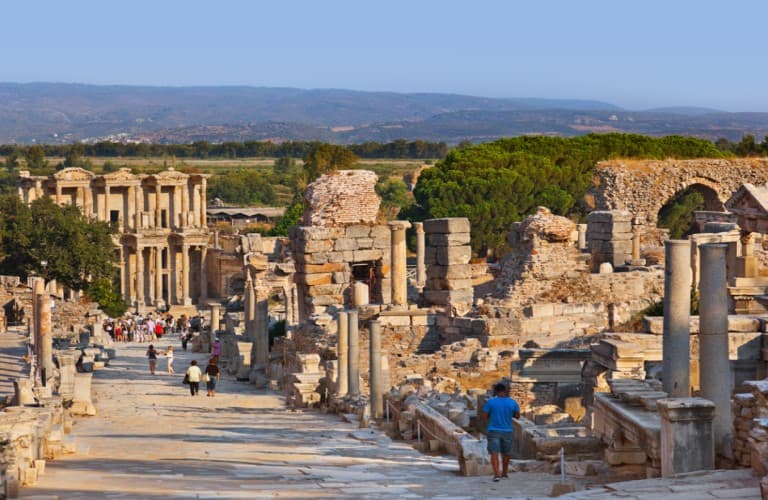
Western Turkey is where ten-day itineraries often begin to fragment.
Ephesus appears first. Then Pamukkale is added. Perhaps Şirince, Pergamon or another ancient site enters the plan. Each is given its own line, and suddenly the itinerary looks as though it contains several new destinations.
Think regionally instead.
Ephesus can anchor the archaeological chapter. Nearby experiences can support it rather than competing for equal status. Pamukkale may connect naturally depending on what comes next, but it should not be added merely because many standard routes place the two names together.
This shift from attractions to chapters helps preserve continuity.
You are not “doing Ephesus” and then beginning another miniature trip.
You are moving through western Turkey with archaeology as the central theme.
That creates a much more coherent middle or later section of a ten-day journey.
Do You Need a Coastal Chapter?
Not every ten-day itinerary does.
The coast is attractive because it offers an obvious change of pace after several days of historical and cultural travel. In warmer months especially, finishing near the Aegean or Mediterranean can make the journey feel as though it gradually loosens rather than simply stops.
But a coastal chapter only works if it has enough time to establish that different rhythm.
Arriving late, completing a full sightseeing program the next day and leaving early the following morning is not much of a coastal ending. You have changed geography without changing pace.
If the sea is important, treat it as one of the journey's chapters from the beginning.
If it is not, do not add it because a ten-day Turkey trip somehow appears incomplete without a coastline.
The best ending is the one that completes the story you have actually chosen.
Design the Direction Before Booking the Middle
Once you know the chapters, look at the map.
The sequence should move through Turkey with as little unnecessary backtracking as practical. This does not mean drawing the shortest possible line between every destination, because flight schedules and road connections sometimes make a slightly less obvious route more efficient.
What you want to avoid is repeated geographical reset.
If every new chapter requires returning through Istanbul even when the journey ultimately continues elsewhere, investigate whether a more progressive sequence is possible.
Likewise, if western Turkey naturally leads toward the coast, consider whether that direction supports your ending rather than returning somewhere simply because it was the original starting point.
The route should have momentum.
You should feel as though you are moving through the country rather than repeatedly leaving and restarting the same journey.
The Middle Days Matter More Than They Look
Travelers tend to focus on beginnings and endings.
The first day is exciting because you have arrived. The final section receives attention because you want the trip to finish well.
Days four through seven can quietly become overloaded.
This is where transfers accumulate, hotel changes happen and the temptation to fit “one more place” becomes strongest. It is also where travel fatigue begins to appear, even among energetic travelers.
When reviewing a ten-day plan, pay particular attention to the middle.
If Day 4 involves a flight, Day 5 begins before sunrise, Day 6 changes hotels and Day 7 contains another long road journey, the itinerary may be technically efficient but emotionally flat. You are spending the heart of the trip preparing for what comes next.
A strong ten-day journey needs at least one middle section where you wake up knowing you are staying in the same region that night.
That continuity gives the trip a center.
A Good Ten-Day Route Has an Internal Rhythm
The itinerary should not become progressively busier simply because more possibilities appear.
Instead, vary the intensity.
A dense historical day can be followed by something less structured. A travel morning can lead into a quiet evening rather than another major attraction. Several active days can be balanced by a slower section later in the journey.
Think of the rhythm as:
focus → explore → move → settle → focus → loosen
rather than:
see → move → see → move → see → move
The first still covers substantial ground.
It simply does not make transportation the punctuation mark at the end of every day.
That is what ten days gives you that shorter journeys often cannot: enough time to shape not only where you go, but how the trip feels while you are going there.

Give the Journey a Center of Gravity
A ten-day itinerary becomes easier to evaluate when you identify where its center of gravity lies.
This does not necessarily mean the destination receiving the most nights. It is the section around which the journey feels organized, either because it matters most to you or because the route naturally changes there.
For some travelers, Istanbul will carry that weight. They may arrive primarily for the city's history and use the rest of the journey to see how different Turkey becomes beyond it. For others, Cappadocia is the experience that inspired the trip in the first place, so Istanbul and western Turkey become chapters surrounding that priority.
An archaeology enthusiast may build the journey around Ephesus and the ancient landscapes of western Anatolia instead.
Once you know where the center lies, decisions become less arbitrary. When two activities compete for the same afternoon, the one supporting the central purpose of the journey has a stronger claim on the time.
Without that hierarchy, every famous destination begins to look equally important, which is rarely true for the person actually traveling.
Protect the Days That Cannot Easily Move
Flexibility works best when it is built around the genuinely inflexible parts of the trip.
An international departure obviously belongs in that category. Domestic flights may also restrict the sequence, particularly where direct services do not operate at useful times every day. Museum closing days, seasonal transportation and weather-sensitive experiences can influence where particular activities sit.
The mistake is allowing every activity to become equally fixed.
Once that happens, a ten-day journey can feel like a chain of appointments.
Instead, identify the small number of elements whose timing genuinely matters and allow the surrounding experiences to remain movable. If weather makes a Cappadocia walk unattractive one afternoon, perhaps an indoor visit can take its place. If you spend longer than expected at Ephesus, something minor later in the day should be able to move without causing a cascade of problems.
Flexibility is most valuable when you actually have permission to use it.
Use the Middle of the Trip for the Hardest Chapter
There is a practical advantage to placing the most logistically demanding section somewhere near the middle rather than at the very end.
By then, you have settled into the journey and recovered from the international arrival. At the same time, you still have enough days remaining to absorb minor disruption without immediately worrying about the flight home.
This can be particularly useful when a chapter involves several connected experiences or overland movement.
Western Turkey is a good example. If Ephesus and Pamukkale both belong in your plan, the section can become a coherent movement through the region rather than two unrelated interruptions.
Travelers interested in that historical progression might consider an ancient western Turkey journey when looking at how the archaeological chapter can connect, but the broader planning principle is more important than any particular sequence: complicated travel generally behaves better when it is surrounded by simpler days.
Placing every demanding transition at the end creates an itinerary that becomes more stressful precisely when you are becoming more tired.
Think About Energy, Not Just Geography
Maps tell you how far apart places are.
They do not tell you how tired you will be when you reach them.
This is one of the most overlooked parts of planning a longer multi-region trip. Ten days is not an expedition, but it is long enough for cumulative fatigue to matter, especially when early departures, extensive walking and frequent hotel changes appear together.
Consider the energy cost of the experiences themselves.
A long day exploring Istanbul on foot can be physically demanding even though no intercity travel is involved. A Cappadocia morning may begin very early. Archaeological sites in western Turkey can involve substantial walking, particularly during warmer months.
Putting several high-energy days together may be perfectly manageable at the beginning of the trip and noticeably less enjoyable a week later.
An Energy-Aware Sequence
| Previous Day | Better Follow-Up | Why It Helps |
|---|---|---|
| Long historical walking day | Flexible neighborhood day | Changes intensity |
| Very early Cappadocia morning | Lighter afternoon | Protects energy |
| Major domestic transfer | Easy evening | Avoids stacking commitments |
| Full archaeological day | Slower next morning | Creates recovery |
| Long road journey | Multi-night stay | Stops constant movement |
This is not about making the trip sedentary.
It is about recognizing that a well-paced journey can contain more substantial experiences because you are not exhausted by the time you reach them.
Leave Some Decisions Until You Arrive
Travel planning has become so detailed that it is possible to decide where you will drink coffee eight months before visiting a city.
There is very little advantage in doing that.
By all means reserve experiences where availability matters, arrange important transportation and know which major sites you want to see. Beyond those essentials, leave some decisions unresolved.
You may discover that you prefer the Asian side of Istanbul and want to return. Perhaps the weather in Cappadocia makes walking more appealing than another indoor visit. You might reach western Turkey and decide that a slower evening sounds better than the additional stop you saved on your phone.
Ten days is long enough for your preferences to evolve while you are traveling.
A completely fixed itinerary assumes that the person planning the trip knows more about what you will enjoy than the person actually standing there.
Those are technically the same person, but they do not have the same information.
The Last Chapter Should Feel Like an Ending
The final part of a journey has a disproportionate effect on how the whole trip is remembered.
This does not mean you need to finish on a beach or book an especially luxurious hotel. It means the final chapter should make sense after everything that came before it.
If the trip has been physically active and culturally dense, a slower ending may feel natural. If your international flight leaves from Istanbul, returning there with enough time for a final evening can create a satisfying sense of closure.
Alternatively, an open-jaw flight may allow the route to finish elsewhere without retracing earlier geography.
The important point is to design the ending rather than simply allowing the itinerary to run out of days.
A traveler deliberately wanting to move from historical touring toward a more relaxed finish might explore a Turkey culture and coast journey as one possible model. The coast is not mandatory; the change of rhythm is what matters.
The final day should not feel like an administrative consequence of whatever happened on Day 9.
Run a Blank-Day Test
When the itinerary appears finished, perform one slightly uncomfortable exercise.
Choose any ordinary day in the middle and remove everything scheduled on it.
What happens?
If the entire route collapses because every hotel, flight and activity depends on that day being used exactly as planned, the journey is probably too tightly constructed.
If the blank day can be absorbed by extending surrounding chapters, moving a flexible activity or simply slowing down, the itinerary has resilience.
You are not actually going to remove the day.
The exercise reveals whether your ten-day structure has any give.
This becomes increasingly important as journeys grow longer. More days mean more opportunities for minor changes, and an itinerary that cannot tolerate any of them may look organized while being surprisingly fragile.
Ask What Each Chapter Leaves Behind
Another way to review the journey is to ignore the attractions and think about what each section contributes to your memory of Turkey.
Perhaps Istanbul leaves you with the Bosphorus, crowded streets, mosque courtyards and layers of history that seem to overlap everywhere.
Cappadocia may leave a completely different impression: open horizons, carved rock, early mornings and landscapes that change character as the light moves.
Western Turkey might be defined by the scale of ancient cities and the realization that archaeological sites are not isolated ruins but fragments of entire urban worlds.
A coastal ending, if you choose one, may leave something less specific: warmer evenings, slower meals and the feeling that the trip gradually released its grip on the schedule.
If two chapters are likely to leave almost identical impressions, question whether both need the amount of time you have given them.
Ten days is long enough to create contrast.
Use it.
What Not to Optimize
Not everything needs to become efficient.
You do not need to choose the shortest lunch because a museum is waiting. You do not need to stay in the hotel closest to a transport hub if another neighborhood would make your evenings better. You do not need to convert every free morning into another excursion.
There is a point where optimization starts removing the reason people travel.
A strong itinerary should eliminate pointless friction: unnecessary backtracking, badly timed transfers, avoidable hotel changes and geographical mistakes.
Once those have been removed, stop optimizing.
The remaining inefficiencies may be the good parts.
Walking farther because a street looks interesting is inefficient. Staying another hour over dinner is inefficient. Taking the ferry because you enjoy being on the Bosphorus when another route is slightly faster is inefficient.
A ten-day journey has enough room for these choices.
That is one of the privileges of having ten days.
The Architecture Should Eventually Disappear
You may spend hours designing chapters, anchor days, transfer blocks and flexible periods before leaving home.
If the structure is good, you should barely notice it once the journey begins.
You wake up knowing where you are going, but the day does not feel dictated by a spreadsheet. Major movements happen in a sensible direction. Important experiences have enough time around them. When something runs late, the following hours do not immediately fall apart.
That is the real purpose of itinerary architecture.
It is not to control the trip.
It is to create enough structure that you no longer have to think about the structure while you are there.
Ten days gives you enough time to see several very different versions of Turkey, but more importantly, it gives those versions enough room to connect.
Build the chapters first, protect the experiences that matter, leave space between them and allow the journey to change rhythm as it moves across the country.
When that works, the itinerary stops feeling like ten separate days.
It becomes one trip.
Frequently Asked Questions About Structuring 10 Days in Turkey
How should I start planning a ten-day Turkey itinerary?
Begin by deciding which contrasting experiences should form the major chapters of your journey rather than assigning attractions to individual days immediately. Once those chapters are clear, identify your most important anchor experiences, connect the regions geographically and only then begin filling the smaller blocks of time.
What is a travel chapter in a ten-day itinerary?
A travel chapter is a section of the journey with a distinct geography, purpose and rhythm. Istanbul might form an urban-history chapter, while Cappadocia provides landscape and rock-cut heritage. Thinking this way prevents every attraction or overnight stop from becoming a separate miniature itinerary.
What are anchor days and why are they useful?
Anchor days protect experiences that strongly influence the success of your trip, whether because they are personal priorities, require substantial uninterrupted time or depend on specific operating conditions. Building around a few anchors is more resilient than giving every attraction an equally rigid position.
How much of a ten-day trip should remain flexible?
There is no required percentage, but several mornings, afternoons or evenings should remain movable whenever possible. Flexibility allows you to respond to weather, fatigue, longer-than-expected visits and discoveries made after arrival without sacrificing one of the experiences that genuinely matters to you.
Should every day contain a major sightseeing experience?
No. Ten consecutive high-intensity days can make even excellent destinations begin to blur together. Mixing substantial sightseeing with neighborhood exploration, easier evenings and occasional slower periods changes the rhythm of the journey and often makes the major experiences more enjoyable when they occur.
Where should the most complicated part of the journey go?
The middle can be a useful place for a more demanding regional chapter because you have recovered from your international arrival but are not yet approaching the flight home. Surrounding complicated travel with simpler multi-night stays also reduces the feeling of constant movement.
Should I plan Turkey geographically or by attractions?
Use both, but geography should shape the sequence once your priorities are known. Group related experiences into regional chapters and avoid unnecessary backtracking between them. An itinerary containing excellent attractions can still perform poorly when those attractions are connected in an inefficient geographical order.
Is it worth leaving activities undecided until I arrive?
Yes, as long as essential transportation and limited-availability priorities are protected. Ten days gives you enough time to discover preferences during the journey. Leaving several smaller decisions open lets the actual weather, energy level and places you enjoy influence what happens next.
How should I plan the final part of a ten-day trip?
Treat the final section as a genuine chapter rather than leftover time before your flight. Consider how its pace contrasts with the preceding days, where your international departure occurs and whether returning to an earlier city or finishing elsewhere creates the most natural conclusion.
How can I tell whether my ten-day itinerary is overplanned?
Try removing one ordinary middle day on paper. If every subsequent booking and activity collapses, the schedule is probably too rigid. A well-structured ten-day journey should contain enough flexible space that a delayed transfer, slower morning or changed plan does not damage the entire route.

A travel professional specializing in tailor-made travel planning, guest experience management, and multi-destination tourism operations.
With over 23 years of experience in the travel industry, he designs and manages private and cultural tours for international travelers across Türkiye, Greece, Egypt, Jordan, Morocco, and other destinations.
He has strong expertise in both online and face-to-face guest communication, sales processes, and end-to-end travel operations.
Working closely with hotels, travel agencies, and local partners, he ensures smooth coordination and high-quality travel experiences at every stage of the journey.
His focus is on delivering personalized, reliable, and seamless travel experiences for international guests worldwide.