Side Turkey: Where Ancient Ruins Meet the Mediterranean
Updated: August 2026
Side is one of the few places on Turkey’s Mediterranean coast where archaeology is not something you leave the hotel to go and find.
It sits in the middle of the holiday.
You can walk past Roman columns on the way to dinner, cross sections of the ancient city before reaching the beach and end the day beside the Temple of Apollo with the Mediterranean directly behind it. That relationship between ruins and everyday resort life gives Side a personality that is quite different from Antalya, Belek or the larger coastal hotel zones.
For some travelers, this is exactly what makes Side work.
You do not need to choose between a cultural stay and a beach stay with the same intensity you would elsewhere. The two experiences occupy the same compact area, and much of the destination can be explored on foot once you are staying close to the historic center.
The useful planning question is therefore not simply whether Side has good ruins or beaches.
It is:
Do you want your history and coastal holiday to happen in the same place, without constantly organizing transport between them?
If the answer is yes, Side deserves serious consideration.
Side Is Best Understood as a Town Built Through Its Ancient City
Modern resort destinations often preserve archaeology in fenced areas that feel completely separate from everyday life.
Side is different.
The ancient city occupies and surrounds the modern center, creating a place where Roman remains, pedestrian streets, shops, restaurants and the coastline coexist within a relatively compact geography.
That can initially feel slightly strange.
You might walk through a modern commercial street and suddenly encounter substantial ancient stonework only minutes later. Rather than reducing the archaeology, that proximity can make the historical landscape easier to understand because you begin seeing Side as a continuously occupied place rather than a ruin isolated from modern settlement.
This is one of the destination’s strongest characteristics.
You do not merely “visit ancient Side.”
You spend several days moving through it.
The Ancient Theatre Gives the Town Its Scale
Side’s Roman theatre is one of the most important surviving structures in the ancient city and immediately changes the way you understand the town.
Unlike a small decorative ruin that can be absorbed in a few minutes, the theatre reveals how significant Side once was as an urban center.
Its scale tells you that this was not a minor coastal settlement.
The structure also reminds visitors that ancient Side belonged to a broader Roman civic world in which entertainment, public architecture and urban identity were closely connected.
The best way to experience it is not to treat the theatre as a single photo stop.
Look outward from it.
Consider its relationship with the rest of the city and with the coastal setting. Side becomes more interesting once each major monument is understood as part of one urban system rather than an isolated ruin.
The Temple of Apollo Is Famous for the Right Reason — but Not the Only One
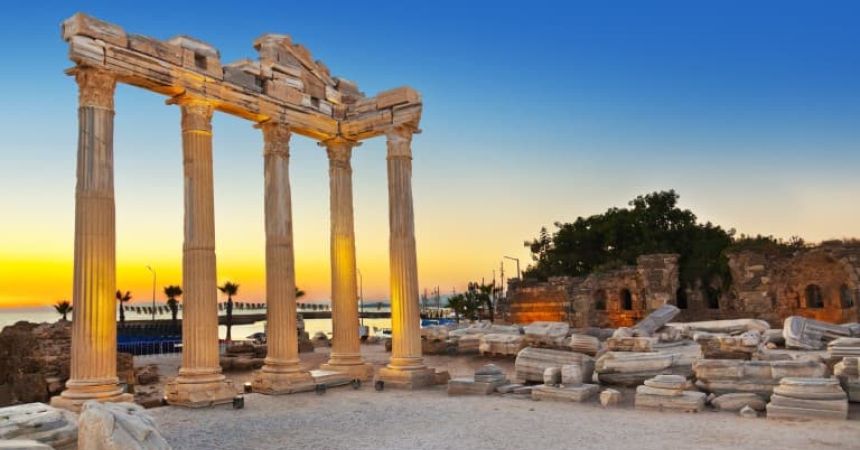
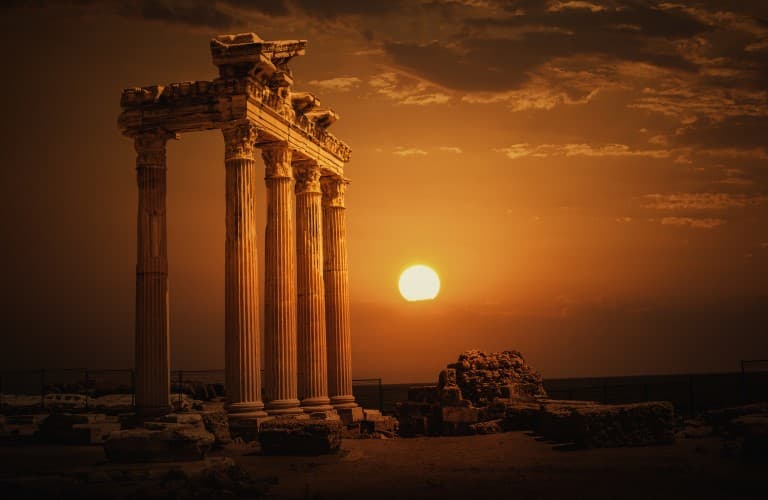
The Temple of Apollo is Side’s most photographed ancient structure.
Its surviving columns stand near the sea, creating the kind of image that explains immediately why Side has become so visually associated with antiquity and the Mediterranean.
The setting is genuinely memorable.
But the temple should not be allowed to define the entire archaeological experience.
Its importance lies partly in context: it stood within a city containing theatres, streets, baths, temples, gates and public spaces. If you arrive only for sunset photographs and leave without exploring the surrounding remains, you see Side’s symbol without really seeing Side.
The better approach is to explore the ancient city first and let the Temple of Apollo become the final visual punctuation.
That sequence gives the famous view more meaning.
Side Works Best When You Do Not Separate “Beach Day” and “History Day” Too Strictly
This is one of the biggest practical advantages of staying here.
In many destinations, archaeology consumes an entire day because the site is distant and transportation becomes part of the excursion.
In Side, the historic core can be woven into the daily rhythm.
A morning can begin with ruins, lunch can take place in town, and the afternoon can shift toward the beach without a long transfer or hotel change.
This makes Side unusually good for couples and families with different priorities.
One person can be genuinely interested in Roman history.
Another may mainly want the sea.
Neither necessarily needs to sacrifice the holiday style they wanted.
East Beach and West Beach Do Different Jobs
Side’s coastline should not be described as one undifferentiated beach experience.
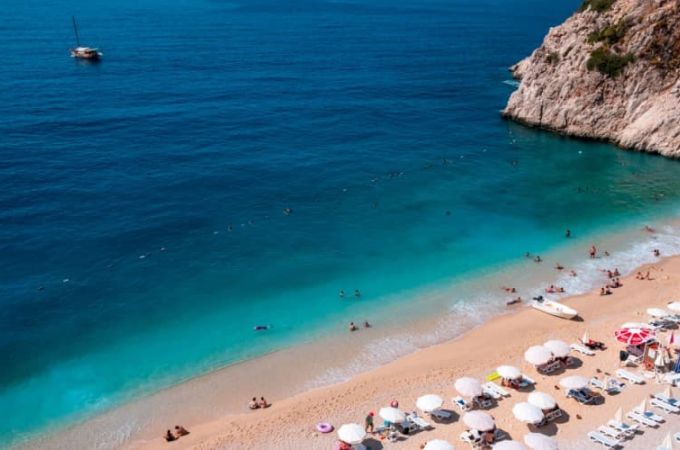
The West Beach is generally more connected to the main resort and hotel infrastructure, making it practical for travelers who want easy access and a more developed environment.
The East Beach can feel more open and less integrated with dense resort infrastructure in some sections.
Which is better depends on how you intend to use the coast.
| Your priority | Better Side approach | Why |
|---|---|---|
| Walkability to town | Central/west-side stay | Easier combination with restaurants and ruins |
| Resort convenience | West Beach zones | More developed hotel infrastructure |
| Quieter coastal feel | East-side areas | Can feel more open depending on exact location |
| Family ease | Close beach access | Reduces daily transport |
| Archaeology-first trip | Near historic center | Ruins stay within walking rhythm |
| Beach-first trip | Resort zone | Hotel facilities become more important |
This is not a ranking of beaches.
It is a way of matching geography to the holiday.
Side Is More Walkable Than Many Antalya-Coast Resorts
This distinction matters.
Belek can provide excellent hotels and golf infrastructure, but the resort environment is more self-contained.
Antalya offers a major city and a much wider range of urban experiences, but distances can be larger.
Side occupies an interesting middle ground.
The historic center, restaurants, harbor-side atmosphere and archaeological remains can be explored within a relatively compact area, while larger resort zones sit nearby.
That means a traveler who dislikes being dependent on taxis and hotel shuttles may find Side more comfortable than a large isolated resort.
Walkability should not be romanticized — heat and exact hotel location still matter — but Side’s structure makes independent evenings particularly easy when you choose accommodation carefully.
The Museum Is Small Enough to Be Useful
The Side Museum adds context to the archaeology without requiring the kind of time commitment associated with a large national museum.
For travelers who enjoy understanding what they are seeing, it can be particularly useful because objects from the archaeological environment help restore detail that ruins alone no longer communicate.
Sculpture and architectural fragments make the ancient city feel more human and less abstract.
This is a good example of a museum that should not be treated as an optional activity only for bad weather.
If ancient Side interests you, the museum can improve the outdoor ruins.
That is a far more useful role.
Side Does Not Need a Packed Itinerary to Justify the Stay
One reason destination guides often become artificial is the pressure to prove there are enough “things to do.”
Side does not need that.
Its value lies partly in ease.
A five-night stay can include ancient Side, beach time, a museum visit, one or two well-chosen excursions and several evenings with no major logistical effort.
That can be more satisfying than a holiday where every morning begins with another pickup time.
This is especially true if Side follows Istanbul, Cappadocia or another intensive cultural region.
The destination can remain interesting without remaining exhausting.
Manavgat Is Useful When You Want a Change of Texture
Nearby Manavgat is often connected with Side in travel planning.
The river and waterfall area can provide a different environment from Side’s archaeology and beaches, making it useful as a lighter excursion rather than a must-do attraction that defines the trip.
The value comes from contrast.
After two days of stone, sea and resort atmosphere, greenery and flowing water change the sensory rhythm.
This is the same principle that makes good itineraries feel balanced.
You do not need every day to deliver another ancient monument.
You need different kinds of experience to stop the destination from becoming repetitive.
Aspendos Is the Better Choice When You Want One Serious Archaeological Excursion
Side itself provides archaeology, but travelers with deeper historical interest may want more.
Aspendos is one of the most natural additions because its Roman theatre offers a very different archaeological impact.
Side gives you an ancient city integrated with your holiday base.
Aspendos gives you a major monumental structure that justifies a focused excursion.
The difference matters.
They are not redundant.
Travelers who want to connect Side with a stronger archaeological day can use Side and Aspendos tours as a route framework without converting Side itself into a regional archaeology guide.
Perge Adds Urban Archaeology Rather Than Another Theatre
Perge is another useful contrast.
Its streets, baths, gates and urban layout allow visitors to reconstruct the workings of an ancient city in a more extended archaeological environment.
If Side shows you how ancient remains can live inside a modern coastal town, Perge lets you spend longer inside a more concentrated archaeological landscape.
For travelers strongly interested in antiquity, the two complement each other.
For casual visitors, Side alone may provide enough historical content.
This is why every day trip should be chosen according to interest, not merely because a guidebook labels it essential.
Side or Antalya? Decide According to Scale
Antalya is a city.
Side is a compact coastal destination built around an ancient town.
That distinction should make the decision easier.
Choose Antalya if you want city neighborhoods, museums, broad restaurant choice and the ability to use a major urban center as a regional base.
Choose Side if you want ruins, beach and evenings to happen within a smaller, more walkable holiday environment.
Neither provides the same experience.
Travelers moving through the Mediterranean region can consider Antalya and Side itineraries when both destinations add different value, but for shorter stays there is often no need to base yourself in both.
Side or Belek? Decide Whether You Want a Town or a Resort
This comparison is even clearer.
Belek is highly effective when the hotel itself is central to the experience, particularly for golf and resort-led holidays.
Side is stronger for travelers who want to leave the property and immediately encounter a town with restaurants, ruins and pedestrian life.
If you expect to spend most of your days inside a high-end resort, Belek may suit you perfectly.
If you want to walk somewhere meaningful after breakfast, Side becomes more interesting.
This is not about hotel quality.
It is about the kind of holiday environment you prefer.
Families Often Find Side Easier Than They Expect
Side can work particularly well with children because sightseeing does not need to become a separate logistical operation.
Parents can introduce ancient ruins in manageable pieces rather than forcing a full archaeological day.
A morning around the theatre and old town can be followed by swimming.
The museum can occupy another shorter period.
A day trip can be added only if everyone still has energy.
That flexibility matters.
Children often enjoy historical places more when history is part of a varied day rather than the entire day.
Side makes that easier than destinations where every attraction requires a long transfer.
Couples Get More From Side When They Stay Near the Historic Core
For couples, Side’s strongest combination is often historical atmosphere plus easy Mediterranean evenings.
Staying close enough to walk into the old town creates opportunities for dinner, the harbor and the Temple of Apollo without turning every evening into transport planning.
A large resort farther away can still be excellent, but the trade-off should be intentional.
Ask whether the holiday is primarily:
resort + occasional Side visit
or
Side + comfortable hotel nearby.
Those are two different products.
The second often suits couples who value atmosphere outside the accommodation.
Side Is One of the Better Choices for Travelers Who Hate Over-Planning
There are enough meaningful experiences to prevent boredom but not so many that missing one creates regret.
That balance is valuable.
Spend an afternoon at the beach because you feel like it.
Return to the ruins at another time.
Take one archaeological day trip instead of three.
Eat somewhere you liked twice.
The destination remains coherent.
For travelers who do not enjoy highly scheduled vacations, this may be more important than the number of famous attractions nearby.
Side’s strength is not abundance.
It is low-friction variety.
How Long Should You Stay?
A three-night stay can work for travelers adding Side to a wider Turkey itinerary, especially when the main goal is experiencing the old town and coast.
Four or five nights provide a much better balance for travelers who want beach time plus one significant excursion.
At six or seven nights, Side begins functioning as a genuine Mediterranean holiday base where slower days become part of the plan.
Longer stays do not require additional sightseeing.
That is worth emphasizing.
The extra value comes from reducing urgency.
Side Fits Particularly Well at the End of a Cultural Turkey Trip
Like several southwestern destinations, Side can work well as the final chapter of a more intensive journey.
After Istanbul, Cappadocia or western archaeological touring, travelers may still want history but no longer want it to dominate every hour.
Side solves that problem elegantly.
The ancient city keeps the cultural continuity alive.
The beach provides permission to stop.
For longer itineraries, Turkey Mediterranean heritage trips can use Side precisely in this role: not as another demanding sightseeing base, but as a place where archaeology and relaxation begin occupying the same day.
The Best Way to Experience Side Is to Stop Dividing It Into Attractions
The theatre matters.
The Temple of Apollo matters.
The museum matters.
The beach matters.
But Side becomes more memorable when these are not treated as separate items competing for time.
Walk through the ruins toward town.
Have lunch.
Spend several hours near the water.
Return through the old streets in the evening.
See the Temple of Apollo under different light rather than visiting once and declaring it completed.
This is the advantage of staying inside the archaeological landscape instead of traveling to it.
Side allows history to become ordinary for a few days.
Ancient columns appear on the route to dinner.
Roman stonework becomes part of the walk home.
The Mediterranean sits behind it all.
That combination is what makes Side distinctive, and it is the reason travelers interested in both culture and relaxation should consider it as more than just another Antalya-coast resort.
Frequently Asked Questions About Side
1. Is Side mainly a beach resort or an archaeological destination?
Side combines both unusually well. Its Roman and Hellenistic remains occupy the same compact coastal environment as modern restaurants, hotels and beaches, allowing travelers to experience meaningful archaeology without sacrificing a relaxed Mediterranean holiday or repeatedly arranging transportation.
2. Is Side better than Antalya for first-time visitors?
Side can be better for travelers wanting a smaller, more walkable base where ruins and beaches sit close together. Antalya is stronger for those wanting a major city, museums and broader regional access, so the right choice depends on preferred scale.
3. Where should I stay in Side for easy sightseeing?
Travelers who want to walk frequently through the historic center should prioritize accommodation close enough to access ancient Side and the old town comfortably. Beach-first visitors may prefer larger resort areas, even when that means relying more on transportation for evening visits.
4. Is the Temple of Apollo worth visiting outside sunset?
Yes. Sunset is famous because of the coastal setting, but visiting at another time can make the architecture easier to appreciate without concentrating entirely on photography. Seeing the temple after exploring ancient Side also gives its remaining columns much stronger historical context.
5. How much archaeology is there to see in Side?
Side contains substantial remains including the theatre, temples, gates, baths and other parts of the ancient city. The experience is especially distinctive because archaeological structures are integrated with the modern town rather than existing as one isolated excavation area.
6. Is Side suitable for families with younger children?
Yes. Families can explore archaeological areas in shorter sessions and combine them easily with beach or pool time, reducing sightseeing fatigue. The compact structure of Side can also mean fewer long transfers compared with coastal holidays built around multiple distant excursions.
7. Should I visit Aspendos while staying in Side?
Aspendos is particularly worthwhile for travelers who enjoy Roman archaeology because its theatre provides a different monumental experience from ancient Side. It can add historical depth without making the Side stay itself overly focused on archaeological sightseeing.
8. Is Manavgat worth adding to a Side holiday?
It can be useful when travelers want a change from beaches and ancient ruins. The river and waterfall environment creates a different type of outing, although it should be treated as an optional contrast rather than something every Side visitor must include.
9. Is Side a good destination for couples?
Yes, particularly when accommodation allows easy access to the old town. Couples can combine beach time, archaeological walks, waterfront dinners and evening visits around the Temple of Apollo without needing a highly structured program or repeated long transfers.
10. How many nights are enough in Side?
Three nights can work as a coastal extension, while four or five allow a better balance between archaeology, beaches and an excursion. A week is most rewarding when travelers genuinely want slower days rather than using the extra time to schedule additional trips.
11. Is Side better than Belek if I do not play golf?
Often, if you want a walkable town, restaurants and historical atmosphere outside the hotel. Belek remains excellent for resort-focused travelers, while Side generally provides more independent activity and a stronger sense of place beyond the accommodation itself.
12. What is the biggest mistake when planning a trip to Side?
The biggest mistake is treating Side either as only a beach resort or only an archaeological site. Its strongest advantage is the coexistence of both, so itineraries become better when history, beach time and ordinary town life are allowed to overlap naturally.

A travel professional specializing in tailor-made travel planning, guest experience management, and multi-destination tourism operations.
With over 23 years of experience in the travel industry, he designs and manages private and cultural tours for international travelers across Türkiye, Greece, Egypt, Jordan, Morocco, and other destinations.
He has strong expertise in both online and face-to-face guest communication, sales processes, and end-to-end travel operations.
Working closely with hotels, travel agencies, and local partners, he ensures smooth coordination and high-quality travel experiences at every stage of the journey.
His focus is on delivering personalized, reliable, and seamless travel experiences for international guests worldwide.