Egypt Weather in June: Summer Heat & Long Sunny Days
Last Updated: August 8, 2026
June gives Egypt plenty of daylight, which sounds useful until you realise that you probably don't want to spend all of it standing outside.
That is the contradiction at the heart of travelling here in early summer. The days are long, skies are often intensely bright, and there is theoretically more time to explore than during winter. In practice, the strongest part of the afternoon becomes something to organise around, particularly in Luxor, Aswan and other exposed inland destinations.
This doesn't make June an unsuitable month for Egypt. It makes it a month that rewards travellers who are willing to abandon the traditional idea of a sightseeing day beginning after breakfast and continuing steadily until late afternoon.
Summer Egypt works differently.
The best hours often sit at opposite ends of the day, with a deliberately quieter period between them. Museums and historic interiors gain importance in Cairo, Nile cruise downtime becomes useful rather than incidental, and evenings begin carrying more of the experience.
The itinerary doesn't necessarily become shorter.
It changes shape.
More Daylight Does Not Mean More Sightseeing
This is the first June paradox worth understanding.
If the sun rises early and sets late, it is tempting to build a correspondingly long touring day. That works much better on a spreadsheet than it does at an exposed archaeological site in Upper Egypt.
A more realistic June day has two active halves.
| Part of Day | Better June Use |
|---|---|
| Early morning | Major outdoor archaeological sites |
| Late morning | Finish exposed sightseeing |
| Midday | Lunch, museum, transfer or rest |
| Early afternoon | Indoor or low-intensity time |
| Late afternoon | Return outdoors selectively |
| Evening | Dining, walking, Nile or city experiences |
This isn't a rigid timetable. Cairo and Aswan shouldn't be treated identically, and weather conditions vary.
The useful idea is the break in the middle.
Once you stop trying to eliminate it, June becomes much easier.
Cairo Has an Advantage in Summer: It Has an Inside
The pyramids may dominate Cairo travel planning, but the city isn't an open-air archaeological site.
That becomes extremely useful in June.
An early visit to Giza can be followed by a museum rather than another long period outdoors. Historic mosques, churches and other interiors allow the day to continue without requiring you to remain in direct sun for hours.
Lunch can also become part of the itinerary rather than a hurried refuelling stop between attractions.
This changes how Cairo feels.
Instead of spending the entire day chasing landmarks, you begin alternating between the city outside and the city inside. The result can actually be more varied than a cooler-season itinerary built almost entirely around continuous sightseeing.
Travellers interested in this broader approach can consider Cairo summer experiences, combining major landmarks with parts of the capital that make more sense once the afternoon heat arrives.
Giza Should Get the First Appointment
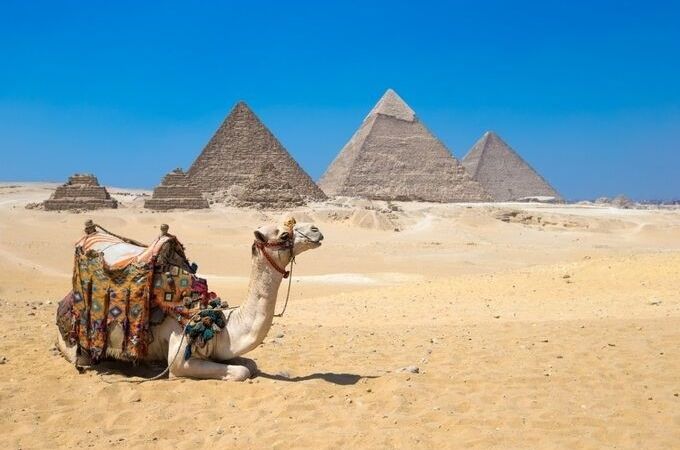
If the pyramids matter to you, give them the morning.
June sunshine on the plateau is not subtle. There is limited shade across large sections of the site, and walking between viewpoints becomes considerably less appealing as the day grows hotter.
An early start isn't about trying to manufacture an empty Giza. The plateau is famous and receives visitors year-round.
It is about giving yourself enough physical comfort to pay attention.
The pyramids deserve more than a quick exit from an air-conditioned vehicle, several photographs and a rapid retreat.
Stand there.
Look at the blocks.
Then look again at the scale.
Just do it before lunch.
Luxor Requires a Split-Screen Itinerary
Luxor in June makes the logic of the two-part day particularly clear.
The archaeological sites are extraordinary, but many are exposed to intense sunshine. Valley of the Kings, Hatshepsut's temple and other West Bank locations make strong candidates for very early visits, while midday is better suited to a completely different pace.
Return to the hotel.
Have lunch.
Swim.
Sleep.
Read.
Do whatever you normally tell yourself you don't have time to do on holiday.
Later, the day can begin again.
Luxor Temple, for example, takes on a different character as the light changes and evening approaches. The city beside the Nile also becomes more appealing once the strongest heat has passed.
June doesn't remove hours from your holiday.
It redistributes them.
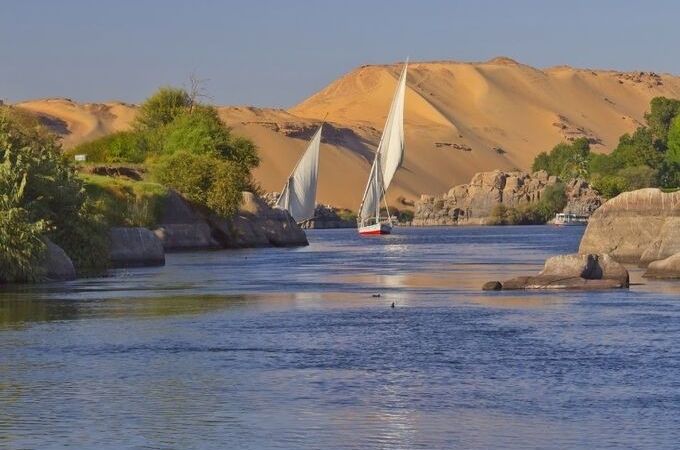
Summer Makes the Nile More Valuable
During cooler months, a Nile cruise provides scenic downtime between major archaeological visits.
In June, that downtime becomes part of the itinerary's architecture.
The ship is not simply carrying you south. It is giving you a place to retreat during hours when continuous outdoor sightseeing would add little to the trip.
A morning temple visit can be followed by lunch and rest while the vessel sails. Later, when the sun drops lower, the deck becomes more attractive again.
Travellers considering summer Nile cruises should therefore look beyond the list of included excursions. The quality of the journey also depends on how intelligently those visits are scheduled around the day.
You don't need entertainment every minute the ship is moving.
The Nile is already outside.
June Evenings Become Part of the Travel Day
This is one of the month's most overlooked advantages.
In winter, an early sunset can bring the outdoor sightseeing day to a natural close. June gives evenings a larger role.
Cairo remains active after dark. Nile-side restaurants fill. People continue moving through the city long after visitors have returned from the major daytime attractions.
Luxor changes too. The intense brightness softens, temperatures begin easing, and being outside starts feeling attractive again.
A summer itinerary that ends every day at 5:00 p.m. misses part of the point.
You don't need a scheduled evening activity every night, but you should leave room for dinner to take longer, for a walk to happen later or for a Nile view to replace another formal attraction.
June encourages a Mediterranean and Middle Eastern habit that many tightly scheduled travellers have forgotten:
the day can pause and restart.
Aswan Is Where You Stop Pretending Midday Is Useful
There is little benefit in pretending a hot Aswan afternoon is prime archaeological time simply because you travelled a long way to get there.
Visit earlier.
Then stop.
This isn't surrendering to the weather; it is understanding the destination.
Aswan offers river views, hotel terraces, pools and a slower pace that fit naturally into the middle of a summer day. Later, a boat journey or time beside the Nile can return you outdoors when conditions are more forgiving.
This is also why June travellers need to be selective about Abu Simbel. The site remains magnificent, but its southern, exposed location makes early timing particularly important.
If it matters deeply to you, plan for it.
If you're adding it only because a checklist says you should, consider what the extra journey actually contributes.
June Is Not About Beating the Heat
That phrase appears constantly in summer travel advice.
It suggests a competition.
You aren't going to win.
Egypt is hot in June because it is Egypt in June.
The more useful strategy is cooperation: use early mornings, let midday slow down, choose air-conditioned transport sensibly, drink water before you need it and allow evenings to carry more of the journey.
This sounds less heroic than “beating the heat.”
It is considerably more enjoyable.
Summer Travel Works When the Schedule Stops Looking Normal
A good June itinerary may look strange before departure.
Why is there a three-hour gap after lunch?
Why are we visiting something at 7:00 a.m.?
Why is dinner at 8:30?
Then you arrive.
Suddenly the logic becomes obvious.
June doesn't ask you to see less Egypt. It asks you to stop insisting that every hour of daylight has the same value.
Use the morning for the places that need your energy. Give the strongest part of the day to rest, travel or indoor experiences. Go outside again later, when cities and riverfronts begin to feel more inviting.
Once you accept that rhythm, summer stops looking like a problem that needs solving.
It becomes simply another way of travelling through Egypt.
The June Day Has Two Beginnings
The first begins earlier than you might normally choose on holiday. The second arrives later, when the hardest light has softened and being outside starts making sense again.
Between them sits the part of the day many travellers initially struggle to accept: the pause.
This is not dead time. In June, it can be the reason you still have the energy to enjoy dinner, walk beside the Nile or spend an evening somewhere rather than collapsing into the hotel after an exhausting eight-hour sightseeing marathon.
Once you begin thinking this way, the entire itinerary becomes easier to design.
Morning Is When You Spend Your Outdoor Budget
Think of comfortable outdoor time as something you have a limited amount of each day.
Spend it on the places that deserve it.
At Giza, that means arriving early enough to walk around the plateau without feeling that the vehicle's air conditioning is the most interesting attraction in Egypt. In Luxor, it means giving the West Bank the first hours rather than reaching the Valley of the Kings after a long, leisurely breakfast.
The principle is not to race through these places before it gets hot. Rushing defeats the purpose of starting early.
Instead, use the morning to stay longer where it matters.
A June itinerary built around Egypt early tours can place the most exposed sites into these stronger hours, leaving the rest of the day available for experiences that do not require several consecutive hours under direct sun.
Lunch Should Be Allowed to Interrupt the Day
Travellers sometimes treat lunch as an administrative inconvenience.
Find restaurant. Eat quickly. Continue sightseeing.
June offers a better idea.
Let lunch become the dividing line.
Sit somewhere comfortable, take longer than you normally would, and allow the conversation to move beyond what time the driver is waiting outside. If you're staying somewhere with a pool, use it. If you're on a Nile cruise, go back to the cabin for an hour without feeling that you've failed to maximise the holiday.
This is one of the great differences between travelling well and travelling efficiently.
Efficiency is useful at airports.
It is overrated at lunch.
The Second Half of the Day Should Feel Different
When you return outside later, don't simply resume the morning checklist.
Change the character of the experience.
If the morning was archaeological, let the evening become social or scenic. Walk somewhere lively, spend time beside the Nile, visit an attraction that benefits from later light or have dinner in a neighbourhood rather than automatically returning to the hotel restaurant.
Cairo is particularly good at this because the city doesn't shut down when formal sightseeing hours end. The streets remain active, restaurants fill later and the Nile becomes part of the evening rather than simply something crossed in traffic.
This is how June begins feeling less like a compromised sightseeing month and more like a different kind of trip.
Nile Cruises Naturally Understand Summer
A well-timed Nile cruise already contains much of the rhythm June requires.
There are excursion periods and sailing periods. Meals interrupt the day. You don't need to repack every morning or spend the afternoon driving to another hotel. Once back on board, the pace changes automatically.
This becomes particularly valuable after an early temple visit.
Instead of immediately moving towards the next attraction, you return to the ship while somebody else handles the journey. By late afternoon, the landscape outside becomes interesting again, and the deck can regain the hours that midday temporarily borrowed.
| June Cruise Rhythm | What It Gives You |
|---|---|
| Early excursion | Better conditions at exposed sites |
| Return before midday | Escape from strongest heat |
| Lunch on board | Natural break in the schedule |
| Afternoon sailing | Recovery without losing travel time |
| Later deck time | River views in softer conditions |
| Evening | A second, slower part of the day |
The important point isn't that every cruise follows this exact schedule. It is that the format itself can complement summer travel when excursions are organised intelligently.
Don't Turn an Early Start Into Sleep Deprivation
There is a limit to all this enthusiasm for mornings.
If every day begins at 5:00 a.m. and ends after 10:00 p.m., you haven't created a smart summer itinerary. You've created a fatigue experiment.
Use very early starts selectively.
Perhaps the West Bank deserves one. Abu Simbel may require another. Giza benefits from an earlier arrival, but that doesn't mean every Cairo morning needs to begin before sunrise.
A good June schedule alternates demanding days with easier ones and protects sleep just as deliberately as it protects the midday break.
This is particularly important for families, older travellers and anyone whose personal definition of a holiday does not involve seeing the sunrise six consecutive times.
June Gives the Evening Back to You
One of the pleasures of travelling in warmer countries is discovering that a day does not have to unfold in one continuous block.
The morning can be serious: pyramids, temples, tombs, guides, dates, dynasties and a great deal of walking.
The afternoon can almost disappear.
Then the evening arrives and Egypt changes register.
Lights appear along the Nile. Restaurants become busier. The air begins to feel more forgiving, and the pressure to accomplish something fades. You can simply go out again because you want to, not because another monument is waiting.
That may not sound as important as seeing Karnak or Giza.
After several days in June, it can become one of the parts of the journey you remember most clearly.
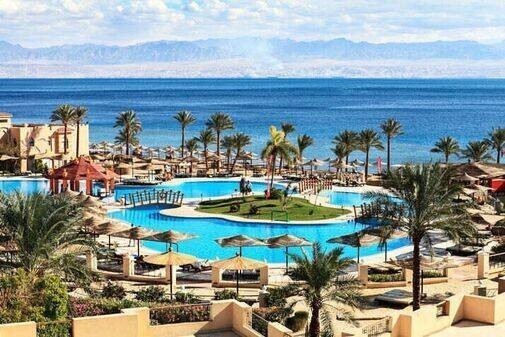
In June, Water Stops Being the Extension
For much of the year, Egypt itineraries are built around monuments first and the Red Sea second. Travellers complete Cairo and the Nile, then add a few coastal nights as a reward for having absorbed several thousand years of history.
June is a good month to reverse that logic.
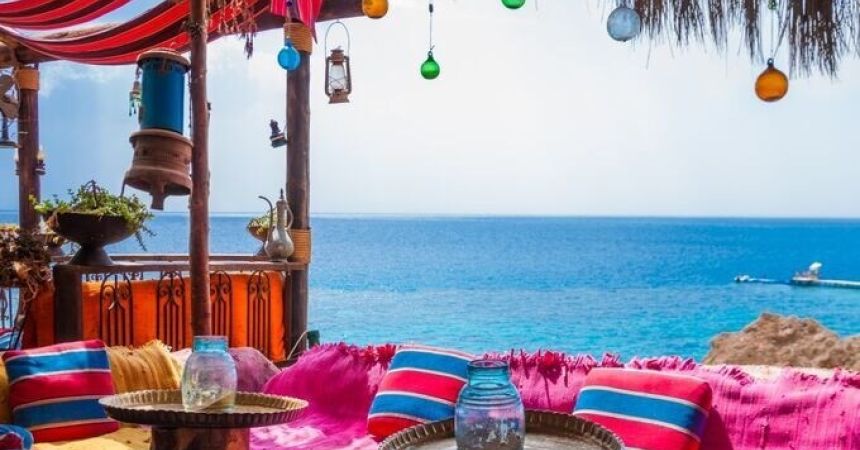
The heat that makes long afternoons at exposed archaeological sites less appealing creates no equivalent problem with spending part of the holiday in and around the water. A Red Sea stay can therefore become one of the structural pieces of a summer itinerary rather than something attached to the end.
This doesn't mean abandoning cultural Egypt. It means changing the proportions.
A week of intensive sightseeing followed by two hurried nights at a resort may make less sense in June than several carefully chosen cultural days combined with a longer stretch on the coast.
A Summer Beach Day Should Not Become Another Full-Day Tour
There is a wonderfully efficient way to ruin a relaxing coastal stay: schedule every day.
Boat excursion on Monday. Diving Tuesday. Desert safari Wednesday. Island trip Thursday. Departure Friday.
Somehow the beach holiday now requires an alarm clock.
June gives you permission to do less because the Red Sea itself is the experience. A morning snorkelling excursion can be followed by an afternoon at the resort without the need to justify the empty hours. A diving day can stand on its own. If the sea is beautiful and you spend half the afternoon in it, nothing is missing from the itinerary.
For travellers who want the coast to play this larger role, Red Sea getaways can balance active marine experiences with genuinely unstructured time.
That last part deserves protecting.
Hurghada Makes Sense When the Journey Comes From Luxor
Hurghada's great summer advantage isn't only the water. It is geography.
Travellers concentrating on Upper Egypt can move from Luxor towards the Red Sea without routing everything back through Cairo. That creates a journey with a natural change of pace: early archaeological mornings give way to swimming, snorkelling and resort time.
The transition can feel surprisingly complete.
One day you're standing inside a tomb listening to a guide explain a royal burial. Soon afterwards, your most pressing question is whether to have lunch before or after going back into the sea.
Both are legitimate uses of a holiday.
June simply makes the second one increasingly persuasive.
Sharm Works Better When You Stop Calling It an Add-On
Sharm el-Sheikh is less naturally connected to the Nile Valley, which is precisely why it deserves to be treated as a destination rather than a box to tick.
If diving and snorkelling are important, give Sharm enough days for those experiences to define part of the trip. Don't fly there for two nights simply to say you saw the Red Sea.
June conditions make water-based travel a logical focus, although strong sunshine also means sun protection becomes particularly important on boats and around the water. The cooling effect of swimming can make it easy to underestimate exposure.
This is one of those holiday lessons usually learned slightly too late, somewhere between the shower and discovering your shoulders have changed colour.
Sunscreen before the boat.
Not after.
The Best June Ratio Depends on Why You're Going
There is no correct percentage of culture versus coast, but summer is a good reason to reconsider the standard balance.
| Your Main Interest | Possible June Balance |
|---|---|
| Ancient Egypt | 70% culture / 30% coast |
| First trip, mixed interests | 50% culture / 50% coast |
| Family holiday | 40% culture / 60% coast |
| Diving and snorkelling | 20% culture / 80% coast |
| Returning visitor | Build around what you missed |
| Heat-sensitive traveller | Coast-led with selective cultural visits |
These are not formulas to follow literally. They are a reminder that a summer itinerary doesn't need to imitate a winter one.
If you love archaeology, spend the mornings with it.
If your children love the pool more than temples, believe them.
If you're travelling to dive, don't apologise for spending most of the holiday underwater.
The Sea Changes How Summer Feels, Not What Summer Is
The Red Sea doesn't make June cool.
That distinction matters.
You are still travelling in a hot, sunny environment, and marine days bring their own considerations. Boats can provide limited shade, reflected sunlight increases exposure, and dehydration remains possible even when you have spent much of the day swimming.
The difference is experiential.
Forty minutes walking across an exposed archaeological landscape and forty minutes swimming over a reef do not feel like the same version of June.
That is why coastal time becomes such a powerful planning tool.
You aren't escaping Egypt's summer.
You're choosing where summer works in your favour.
June Can Be Better When the Holiday Has Two Personalities
There is something satisfying about an itinerary that changes character halfway through.
Cairo may be busy, historical and intense. Luxor asks for early starts and concentration. Then the coast removes the need to understand anything for a while.
The contrast prevents one experience from exhausting the other.
After several days of reefs, you may even find yourself thinking fondly about temples again.
That is probably the right moment to go home.
A strong June trip doesn't need to pretend the heat isn't there, nor does it need to organise every day around avoiding it. Part of the solution is simply spending more time somewhere where sunshine belongs naturally to the experience.
In June, the Red Sea isn't where the itinerary goes to recover.
It can be one of the reasons the itinerary works.
Before Booking June, Be Realistic About How You Travel
June can produce an excellent Egypt trip, but it is not equally suitable for everyone. A traveller who enjoys early mornings, doesn't mind rearranging the day around heat and genuinely wants several nights beside the Red Sea may find the month surprisingly rewarding. Someone who dislikes high temperatures and wants to walk around archaeological sites continuously from late morning until afternoon is asking June to provide a different season.
Neither traveller is doing Egypt incorrectly.
The useful question is whether your normal travel style matches the month.
| If This Sounds Like You... | June May Suit You |
|---|---|
| You are comfortable with hot weather | Yes |
| You don't mind earlier sightseeing | Yes |
| You want culture plus the Red Sea | Very well |
| You enjoy slower afternoons | Yes |
| You need mild weather for long walks | Probably not |
| You want full-day outdoor archaeology | Choose a cooler month |
| You are mainly interested in diving | Strong option |
| You can adapt the daily schedule | Yes |
This is more useful than deciding whether June is universally “good” or “bad.” Egypt doesn't have one best month because travellers don't have one definition of a good holiday.
What June Can Give You
Summer has advantages that disappear when every discussion focuses exclusively on temperature.
Long daylight makes later experiences easier to incorporate. The Red Sea fits naturally into the journey rather than feeling like a seasonal gamble. Early starts can create wonderfully focused archaeological mornings, while the long pause in the middle of the day encourages a less frantic travel rhythm.
There can also be a psychological benefit to knowing in advance that you are not going to see everything. Once that expectation disappears, the trip often improves.
A carefully paced Egypt summer itinerary might include fewer major sites than a winter circuit, but the ones you keep receive your better hours and more of your attention.
That is a worthwhile trade.
Frequently Asked Questions About Egypt in June
1. Is June a good time to visit Egypt?
June can be a good time for travellers who tolerate heat and are comfortable adapting their schedule. Early outdoor sightseeing, quieter afternoons and later activities create a more suitable summer rhythm. The Red Sea is particularly attractive for travellers who want to combine cultural visits with marine activities.
2. How hot does Egypt get in June?
Egypt is hot in June, with particularly strong heat in southern destinations such as Luxor and Aswan. Cairo is also hot, although urban and indoor attractions provide more variety. Exact conditions vary, so check destination-specific forecasts rather than relying on a single national temperature.
3. Is June too hot for the pyramids?
Not necessarily, but timing matters. Giza is exposed and offers limited shade across parts of the plateau, so an early visit is generally more comfortable than arriving around midday. Bring water, sun protection, suitable clothing and enough time that you do not need to rush.
4. Can I visit Luxor in June?
Yes, but a June Luxor itinerary should look different from a winter one. Prioritise exposed West Bank sites early, avoid stacking multiple outdoor attractions through the hottest hours and use midday for rest, lunch or less demanding activities before returning outside later when appropriate.
5. Is a Nile cruise worth taking in June?
It can be. The cruise format provides useful downtime between excursions, allowing travellers to return to an air-conditioned cabin or shaded area after early sightseeing. Check individual cruise schedules and excursion timings carefully because operating arrangements vary between vessels and dates.
6. Is Aswan too hot in June?
Aswan can be extremely hot for travellers accustomed to milder climates, particularly during the middle of the day. It remains possible to visit, but early excursions, air-conditioned transport, hydration and substantial midday downtime become important parts of the experience.
7. Is June good for Hurghada and Sharm el-Sheikh?
Yes for travellers comfortable with hot, sunny conditions. June works particularly well for swimming, diving, snorkelling and resort-based holidays. Strong sunshine means sun protection and hydration remain important, especially during boat trips where exposure can be easy to underestimate.
8. Is Egypt suitable for families in June?
It can be, but family itineraries should be realistic. Shorter cultural visits, air-conditioned transport, hotels with pools and a larger proportion of Red Sea time can work better than consecutive full sightseeing days. Children's tolerance for heat should influence the schedule more than the desire to complete every attraction.
9. What should I wear in Egypt in June?
Choose lightweight, breathable clothing that provides practical sun coverage, together with comfortable footwear, sunglasses and a hat. Respectful clothing remains appropriate for religious and local settings. Extremely cold air conditioning can also make a lightweight extra layer useful indoors or during transport.
10. Do I need to wake up very early every day?
No. Use early starts strategically rather than turning the entire holiday into a test of sleep deprivation. Major exposed sites such as Luxor's West Bank benefit most. Easier days, Red Sea stays and urban experiences can follow a more relaxed schedule.
11. How many Red Sea nights should I include in June?
For travellers who genuinely enjoy the coast, three to five nights often creates a more meaningful change of pace than a rushed one- or two-night extension. The right number depends on trip length and whether the Red Sea is a secondary stop or one of the main reasons for travelling.
12. Is June or July better for visiting Egypt?
June generally gives summer travellers a slightly earlier position in the hot season, while July moves further into peak summer conditions. Heat-sensitive visitors should consider cooler months altogether. Those comfortable with summer weather should choose based on itinerary, particularly how much time will be spent in Upper Egypt versus the Red Sea.
June Works Once You Stop Trying to Turn It Into Winter
That is the central lesson of travelling through Egypt at the beginning of summer.
A winter itinerary cannot simply be copied into June with more bottles of water added to the vehicle. The structure needs to change because the useful parts of the day have changed.
Give Giza the morning rather than whatever time remains after breakfast. Let Luxor's exposed sites have your freshest hours, then allow the middle of the day to become quiet without feeling that something has gone wrong. If you cruise the Nile, use the sailing periods as genuine recovery rather than waiting impatiently for the next excursion.
Most importantly, consider giving the Red Sea a larger role. In June, swimming, snorkelling and diving aren't merely ways to recover from cultural sightseeing; they are experiences naturally suited to the season.
The result may be an Egypt itinerary with fewer archaeological stops than you originally imagined. It may contain longer lunches, later dinners and an afternoon when absolutely nothing happens because everyone decided to stay beside the pool.
That isn't a lesser version of Egypt.
It is a summer version of Egypt, and once the itinerary accepts that distinction, June begins making considerably more sense.

A travel professional specializing in tailor-made travel planning, guest experience management, and multi-destination tourism operations.
With over 23 years of experience in the travel industry, he designs and manages private and cultural tours for international travelers across Türkiye, Greece, Egypt, Jordan, Morocco, and other destinations.
He has strong expertise in both online and face-to-face guest communication, sales processes, and end-to-end travel operations.
Working closely with hotels, travel agencies, and local partners, he ensures smooth coordination and high-quality travel experiences at every stage of the journey.
His focus is on delivering personalized, reliable, and seamless travel experiences for international guests worldwide.