Map of Greece: Understand the Islands, Mainland and Travel Routes
Meteora Is Farther From Athens Than the Map Makes It Feel
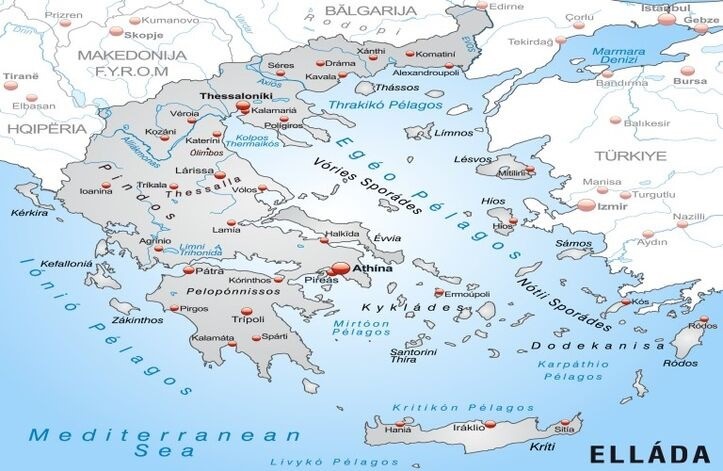
Meteora's monasteries are among Greece's most distinctive sights, but their location is important.
They sit near Kalambaka in central mainland Greece, substantially north of Athens. That means Meteora should not be treated like a short excursion added casually between an Athens morning and an island ferry.
The journey itself needs space.
Combining Delphi and Meteora can make geographical sense because both belong to the mainland section of a broader Greece journey, although the exact structure depends on available transportation and time.
This illustrates an important map principle:
distance is not a reason to exclude somewhere; it is a reason to give the journey the time it deserves.
When travelers ignore that distinction, excellent destinations become exhausting ones.
Ferries Follow Networks, Not the Straight Lines You Draw on a Map
Perhaps the most important operational lesson in Greek geography is that physical proximity does not guarantee convenient transportation.
Travelers often look at two islands, notice that they appear relatively close and assume there must be a direct ferry at a useful time.
That assumption should never form the foundation of the itinerary.
Greek ferry networks vary by route and season, and schedules can change. Major Cycladic combinations generally have stronger connections during the main tourism period, while less obvious island pairings may require different planning.
A map therefore answers only the first question:
Are these places geographically related?
The next question must be:
Does the transportation network connect them in a way that works for my dates?
Those are not the same thing.
This is also why an island itinerary should not be locked around an imagined ferry schedule months before the relevant transportation pattern is confirmed.
Geography suggests the route.
Operations validate it.
Sometimes a Flight Is More “Geographical” Than a Ferry
The romantic image of Greek travel is a ferry crossing blue water between whitewashed islands.
Sometimes the best route involves an aircraft.
If two destinations belong to different island groups or opposite sides of the country, insisting on traveling entirely by ferry can introduce unnecessary connections and consume substantial time.
Flights can also help when combining mainland gateways with larger islands such as Crete or Rhodes.
This does not make the journey less authentic.
Transportation should serve the geography rather than a preconceived idea of how Greece ought to be experienced.
A ferry is wonderful when it naturally continues the route.
A flight is wonderful when it gives you back half a day of your holiday.
Backtracking Through Athens Is Sometimes Necessary—and Sometimes a Warning
Returning to Athens is not automatically inefficient.
International flights, domestic air connections and ferry networks can make Athens the logical transfer point between geographically separate parts of Greece. A traveler moving from an Ionian destination toward the Cyclades, for example, may reasonably need a mainland or air connection.
The problem is unnecessary repetition.
If an itinerary repeatedly returns to Athens between islands that could have been organized into a continuous route, the map should trigger a second look.
Think of Athens as a gateway rather than a compulsory reset button.
Use it when transportation requires it, when you actually want more time in the city or when it connects two distinct sections of the journey.
Do not return simply because every destination was planned independently.
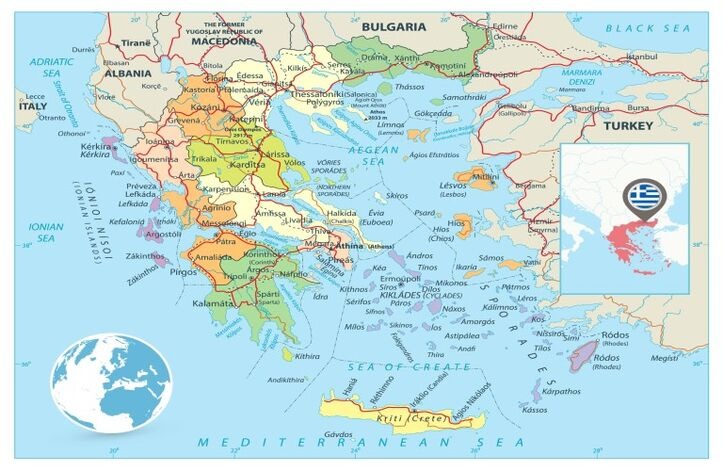
How We Read the Greece Map When Building a Journey
After years of arranging Greece travel, the most useful planning question is rarely “How many islands can we include?”
We look first at where the traveler enters Greece, where the journey should finish and what geographical direction connects the priorities between those points.
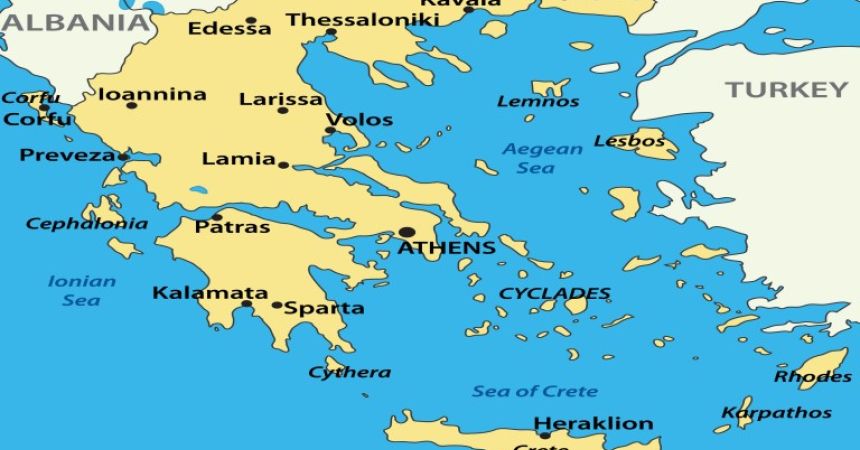
If Athens, Mykonos and Santorini are essential, the map already suggests a Cycladic progression. If Crete is added, the route extends farther south and the available days need to reflect that. If Rhodes replaces Crete, the journey shifts toward the southeastern Aegean. If Corfu becomes essential, we are no longer designing a pure Aegean route at all.
For customized Greece island-hopping tours, this is where genuine customization matters.
Changing a hotel does not fundamentally customize a trip.
Changing the geographical sequence so that the traveler spends more time enjoying Greece and less time repeatedly reaching it does.
The Best Greece Route Is Usually a Corridor, Not a Collection
A strong Greece journey often has a visible direction when you trace it on the map.
Athens can lead into the Cyclades.
Mykonos can lead toward central Cycladic islands and farther south toward Santorini.
Santorini can create a natural transition toward Crete when schedules and season support the connection.
A mainland route can move from Athens toward Delphi and Meteora without repeatedly returning to the capital between every stop.
A Dodecanese journey can develop around Rhodes and neighboring southeastern islands rather than borrowing its structure from a Cyclades itinerary.
None of these corridors is universally best.
The important point is that the destinations have a geographical relationship beyond simply being places you want to visit.
When every stop has a reason for following the previous one, Greece becomes remarkably fluid.
When every famous island is treated as equally close to every other famous island, the holiday begins accumulating ports, airports and waiting rooms.
Use the Map Before You Fall in Love With the Itinerary
Greece invites ambitious planning because so many places look irresistible.
The map provides useful discipline.
Choose the experiences that matter most, identify which geographical family they belong to and then see whether a natural travel corridor emerges. If three of your preferred islands are in the Cyclades and the fourth is Corfu, recognize that the fourth choice changes the structure significantly. If Meteora matters as much as Santorini, protect enough time for both the mainland and island sections instead of squeezing one between ferry days.
The objective is not to create the shortest route imaginable.
Some detours are worth taking precisely because the destination matters to you.
The objective is to understand the geographical price of every choice before paying for it with holiday time.
A good Greece map does not tell you where to go.
It helps you understand what happens to the journey when you decide to go there.
Frequently Asked Questions About the Map of Greece
1. Where is Greece located on the map of Europe?
Greece lies in southeastern Europe at the southern end of the Balkan Peninsula, with extensive coastlines along the Aegean, Ionian and Mediterranean seas. Its position helps explain both its large number of islands and its historical connections across the eastern Mediterranean.
2. Where is Athens on the map of Greece?
Athens lies in the Attica region of southern mainland Greece, facing the Aegean and relatively close to major ferry gateways including Piraeus. Its location makes it an important starting point for both mainland journeys and routes continuing into several Greek island groups.
3. Where is Mykonos compared with Santorini?
Both islands belong to the Cyclades, but Mykonos lies considerably farther north while Santorini occupies the southern Cyclades. Their positions allow them to form part of a broadly north-to-south island route, sometimes with central Cycladic islands included between them.
4. Where are Paros and Naxos on the Greece map?
Paros and Naxos lie in the central Cyclades between the broader northern and southern parts of the island group. Their position makes them particularly relevant to longer Cyclades journeys that extend beyond the familiar Athens, Mykonos and Santorini combination.
5. Is Crete close to Santorini?
Crete lies south of Santorini and can form a geographically logical continuation of a southern Cyclades journey. However, Crete is a much larger island than Santorini, so its position may fit naturally while the amount of time needed there remains a separate consideration.
6. Is Rhodes near Santorini?
Rhodes lies well southeast of Santorini in the Dodecanese rather than the Cyclades. Although the two can be combined when transportation works for the travel dates, they should not be treated as neighboring islands simply because both are in the southern Aegean.
7. Where is Corfu compared with the Cyclades?
Corfu lies in the Ionian Sea west of mainland Greece, while the Cyclades lie in the Aegean to the east and southeast. Combining Corfu with Mykonos or Santorini therefore crosses different geographical travel zones and normally requires more deliberate transportation planning.
8. Which Greek islands are closest to Athens?
The Saronic Islands, including Aegina, Poros and Hydra, belong to the island geography closest to Athens and can be practical for shorter sea-based experiences. They solve a different planning need from farther-away destinations such as Santorini, Rhodes or Crete.
9. Where are Delphi and Meteora on the Greece map?
Both are on mainland Greece rather than the islands. Delphi lies northwest of Athens, while Meteora is significantly farther north near Kalambaka. Their geography makes them better understood as part of a mainland travel corridor rather than extensions of an island-hopping route.
10. Can I travel between all Greek islands by ferry?
No practical itinerary should assume that every island has a convenient direct ferry to every other island. Connections vary by island group, route and season, so geographical proximity should be followed by checking the transportation pattern relevant to the actual travel dates.
11. Which Greek islands are easiest to combine on one trip?
Islands within the same geographical group often provide the most natural starting point. Mykonos, Paros, Naxos and Santorini, for example, belong to the Cyclades, although actual ferry schedules, travel season and available nights should determine the final combination.
12. Why should I study a Greece map before booking hotels?
Understanding the map reveals whether your destinations form a logical route or require repeated crossings through Athens, airports and ports. That knowledge helps determine the best island sequence and prevents individually attractive hotel bookings from accidentally creating an inefficient overall journey.

A travel professional specializing in tailor-made travel planning, guest experience management, and multi-destination tourism operations.
With over 23 years of experience in the travel industry, he designs and manages private and cultural tours for international travelers across Türkiye, Greece, Egypt, Jordan, Morocco, and other destinations.
He has strong expertise in both online and face-to-face guest communication, sales processes, and end-to-end travel operations.
Working closely with hotels, travel agencies, and local partners, he ensures smooth coordination and high-quality travel experiences at every stage of the journey.
His focus is on delivering personalized, reliable, and seamless travel experiences for international guests worldwide.