Chefchaouen, Morocco: More Than a Blue Photograph
Updated: August 2026
Chefchaouen has the unusual problem of being recognizable before people know anything about it.
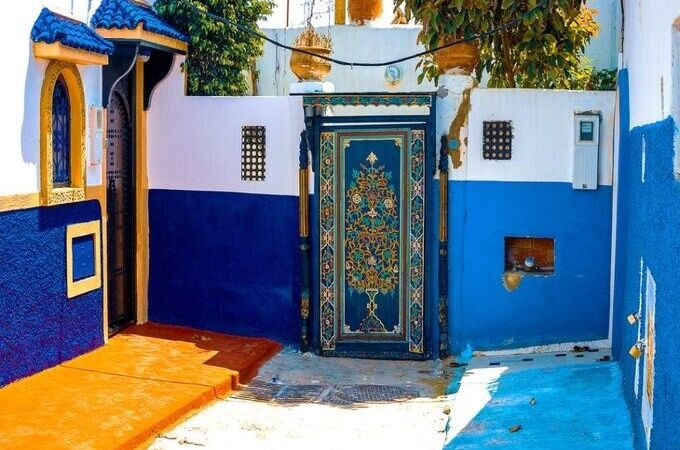
Many travelers first encounter the town through photographs of blue walls, painted steps, narrow lanes and doors framed by flowerpots. By the time they arrive, they are carrying a surprisingly precise visual expectation of what Chefchaouen is supposed to look like, often built from images taken at the quietest hour, from the most flattering angle and with every ordinary part of town carefully excluded.
The real place is more interesting because it is less controlled.
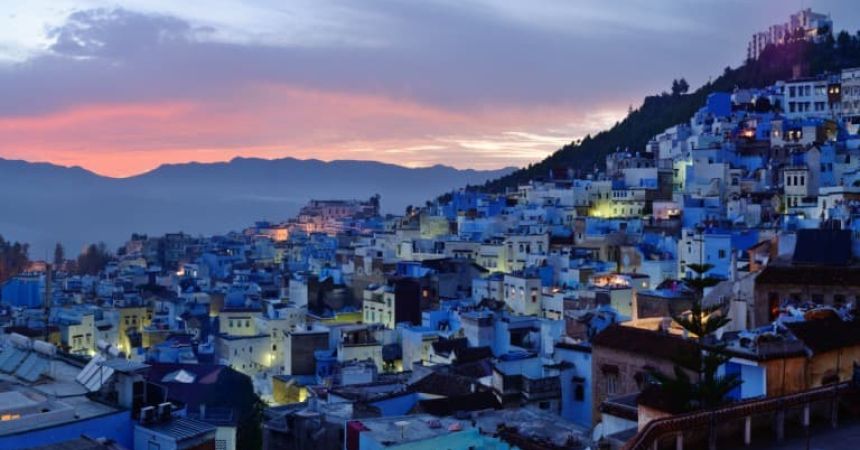
Chefchaouen sits in the Rif Mountains of northern Morocco, and its setting matters almost as much as the color that made it famous. Streets rise and fall, houses climb into the surrounding terrain, everyday life continues behind the photogenic façades, and the medina is compact enough to feel intimate without becoming visually repetitive.
The blue paint is certainly part of the experience.
It just should not become the only reason you look.
Chefchaouen works best when travelers treat the town as a place to spend time rather than a set of backgrounds to collect. Once the photography pressure disappears, the medina, hills, cafés, local food and changing light start to feel much more coherent.
The Blue Is Real, but Instagram Has Edited the Town for You
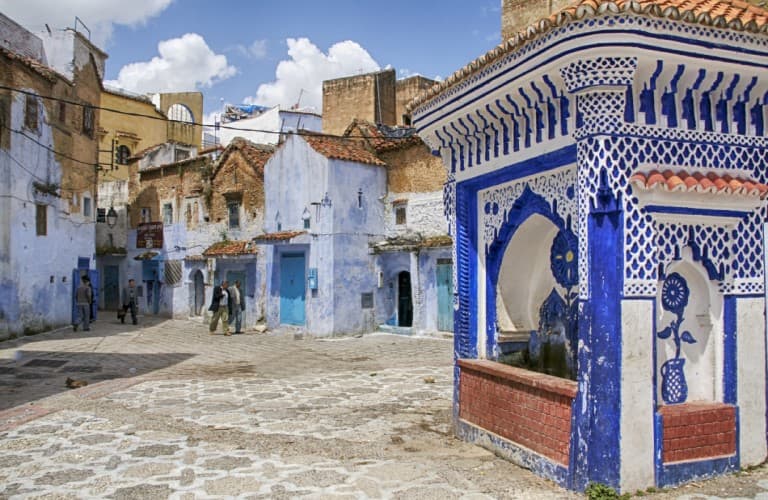
Chefchaouen is genuinely blue in many parts of its old town, but not every wall, street and doorway looks like the photographs that dominate social media.
Some façades are intensely painted, others softer or weathered, and parts of the town are plainly ordinary. Laundry appears, delivery vehicles stop where they need to, shop signs interrupt clean compositions and residents walk through exactly the frame a visitor had hoped would remain empty.
That is not a failure of the destination.
It is evidence that you have arrived somewhere people actually live.
This distinction is important because travelers can spend their first hour searching for a version of Chefchaouen that existed only after cropping and color adjustment.
The better approach is to let the town look inconsistent.
The blue becomes more interesting when it appears beside stone, greenery, shadow, mountain light and ordinary urban life rather than functioning as a theme-park color scheme.
Chefchaouen’s Rif Mountain Setting Changes How the Town Feels
It is easy to describe Chefchaouen as “the Blue City” and accidentally erase the landscape around it.
The town’s position in the Rif Mountains gives it a scale and atmosphere very different from Morocco’s flatter imperial cities. Streets climb, viewpoints appear naturally and the surrounding slopes remain visible enough that the medina never feels completely detached from the mountains.
This also has practical consequences.
A distance that looks short on a map can involve a meaningful climb, particularly for travelers moving between lower and upper parts of town. Comfortable footwear matters more than fashion, while travelers with mobility concerns should ask specific questions about hotel access rather than assuming that a compact medina automatically means an easy one.
Chefchaouen is walkable.
That does not mean it is flat.
The Best First Walk Is the One Without a Destination
Chefchaouen is one of the few Moroccan towns where a first walk benefits from very little ambition.
There is no need to begin by rushing toward a famous viewpoint or searching immediately for the most photographed stairway. The medina is small enough that orientation develops fairly quickly, and wandering without a rigid objective helps visitors understand the town’s scale before turning the day into a checklist.
This is especially useful because the narrow lanes change character with elevation and time of day.
A street that seems busy in the late morning may feel completely different in the early evening, while areas that initially appear residential can contain small shops or cafés that become familiar after a second pass.
The town is compact enough to reward repetition.
That is a different kind of value from a destination where every wrong turn creates another twenty minutes of navigation.
Photography Is Better When You Stop Hunting for “The Spot”
Chefchaouen attracts photographers precisely because the medina contains an enormous number of small visual compositions.
This is also why chasing famous locations can become counterproductive.
Once everybody knows the same staircase, doorway or alley, the location becomes crowded with visitors waiting for a clean frame. Meanwhile, several streets away, equally interesting light may be falling across an ordinary blue wall that nobody has designated essential.
Photographers usually do better here when they watch for relationships rather than landmarks: shadow across painted surfaces, laundry against blue walls, people moving through narrow streets, small architectural details, mountain light and changes in color between morning and late afternoon.
This approach also produces images that feel more like Chefchaouen and less like reproductions of photographs you had already seen before the trip.
Early Morning Helps Photographers, but It Should Not Control Everyone Else
There is an obvious advantage to walking early if you want quieter streets and softer light.
That does not mean every traveler needs to set an alarm.
Couples who prefer slow breakfasts, families with children or travelers arriving late the previous evening may enjoy Chefchaouen far more by beginning naturally and accepting that the medina will contain other people.
The town does not stop being attractive once cafés open and visitors appear.
In fact, some travelers prefer the visual and social activity of a lived-in medina to the almost empty atmosphere of early morning.
The useful question is not “What time should everyone visit Chefchaouen?”
It is “What part of the experience matters most to you?”
Photography may justify an early start.
Relaxation may justify sleep.
Plaza Uta el-Hammam Works Best as a Place You Return To
The central square naturally becomes one of the easiest orientation points in Chefchaouen.
Rather than treating it as a single sightseeing stop, use it as part of the town’s daily rhythm.
You may pass through in the morning, return for lunch, sit there later with tea and find it entirely different again in the evening. This repeated use turns the square from an attraction into a piece of personal geography.
That matters in a small town.
Once a few places become familiar, the medina stops feeling like somewhere you are merely visiting and begins to feel temporarily usable.
Travelers considering Private Chefchaouen Morocco Tours often benefit more from this slower familiarity than from adding another distant stop simply because the itinerary has space.
The Kasbah Adds Context Without Needing to Dominate the Visit
Chefchaouen’s Kasbah gives travelers a historical anchor within a town that is often discussed almost entirely through color and photography.
That context is useful because it reminds visitors that Chefchaouen has a history extending far beyond modern tourism imagery. The structure, gardens and related spaces can help place the medina within a broader story without requiring the visit to become museum-heavy.
This balance suits the town well.
Chefchaouen does not need an entire day of formal historical sightseeing to feel meaningful, yet a little historical context prevents the blue architecture from becoming decorative scenery without explanation.
The strongest visit usually contains both.
Enough interpretation to understand where you are, followed by enough free time to enjoy being there without another explanatory stop every twenty minutes.
The Spanish Mosque Is About the Walk as Much as the View
The hilltop viewpoint associated with the Spanish Mosque has become one of the most familiar perspectives over Chefchaouen, particularly around sunset.
The appeal is obvious.
From above, the town’s relationship with the surrounding Rif landscape becomes much clearer, and the medina can be seen as a whole rather than as a sequence of narrow streets.
The practical point is that reaching the viewpoint involves an uphill walk.
For travelers who have already spent much of the day climbing through the medina, this additional effort should be considered honestly rather than treated as a compulsory ending.
Sunset can also attract many visitors, which means the experience may be lively rather than solitary.
Neither fact reduces the value of the view.
They simply make the real experience different from a photograph showing one person alone above a silent blue town.
Chefchaouen Rewards People Who Sit Down Before They Are Tired
One of the most common mistakes in compact destinations is assuming that because distances are short, breaks are unnecessary.
Chefchaouen’s slopes make that logic unreliable.
A morning of wandering, repeated short climbs, stopping for photographs and moving between different levels can gradually become more tiring than the map suggests.
This is a good place to normalize frequent café stops.
Tea, coffee or lunch does not interrupt the exploration; it gives the town another dimension. Watching people move through a square or lane while you sit still can reveal more about daily rhythm than another twenty minutes of purposeful walking.
Travel becomes more human when pauses happen before exhaustion rather than after it.
Food Should Not Be Reduced to “Try a Tagine”
Generic Morocco food advice does very little for Chefchaouen.
The useful experience is less about completing a national dish checklist and more about allowing meals to suit the town’s slower pace.
A long lunch can be justified simply because the terrace is pleasant and nobody needs to be anywhere else immediately. Local cheeses, breads, olives and regional preparations may also reflect northern Morocco in ways that differ from meals elsewhere in the country.
The point is not to build a separate culinary guide into this destination page.
It is to avoid treating food as generic Morocco content copied from city to city.
Travelers using Chefchaouen Cultural Holidays should expect the town’s food experience to work best when meals are allowed to become part of the pace rather than another item scheduled between viewpoints.
Shopping in Chefchaouen Is Easier When You Avoid “Blue Souvenir Syndrome”
A destination known for one visual identity inevitably produces souvenirs built around that identity.
Blue textiles, decorative objects and photography-inspired products are easy to find, but travelers should resist buying something solely because it appears to belong perfectly inside the color story of the town.
Instead, ask whether the object itself interests you.
Look at workmanship, material and whether you would still want it if it were not surrounded by blue walls and holiday excitement.
The compact medina makes comparison easier because returning to a shop is often realistic.
That removes some of the pressure to decide immediately.
A souvenir should remind you of Chefchaouen after you leave.
It should not become evidence that Chefchaouen temporarily convinced you to like something blue.
Day Trip or Overnight? The Question Is Really About Light and Pressure
Chefchaouen is frequently visited as a day trip or short stop, and that can work well depending on where the traveler is coming from.
The difference between a day visit and overnight stay is less about adding another attraction and more about removing time pressure.
A day visitor experiences the town between arrival and departure.
An overnight visitor gains early morning, evening and the freedom to revisit areas under different light.
The useful comparison is therefore about how the town changes, not how many sights fit:
| What changes | Day visit | One overnight | Two nights |
|---|---|---|---|
| Photography | Midday conditions dominate | Morning/evening light becomes available | You can wait for conditions instead of chasing them |
| Walking pace | More purposeful | More spontaneous | Repetition becomes part of the experience |
| Viewpoints | Need to fit transfer schedule | Sunset becomes easier | Weather can influence timing |
| Meals | Usually scheduled around sightseeing | Dinner becomes part of town life | Food can follow appetite |
| Medina familiarity | Mostly exploration | Some streets become recognizable | The town starts feeling temporarily familiar |
| Pressure | Departure time remains visible | Much lower | Minimal |
This table deliberately measures pressure and visual opportunity, not itinerary value.
That is the real overnight decision in Chefchaouen.
The Town Is Small Enough That Two Nights Can Feel Luxurious
Travelers sometimes worry that two nights are too much because the medina is compact.
That depends on whether travel value is being measured by attraction count.
A second night does not necessarily add more things to see. It adds another morning, another evening and enough familiarity that you can return somewhere without feeling that repetition is wasting time.
For photographers and slow travelers, that can be valuable.
For someone who prefers continuous novelty and has limited days in Morocco, one night may be entirely sufficient.
This is where Customized Northern Morocco Tours can be useful: duration should respond to travel style rather than assuming every destination needs the same number of nights.
Chefchaouen is a particularly clear example of how a small place can absorb time without needing to manufacture activity.
Travelers With Mobility Concerns Should Check the Hotel, Not Just the Town
“Chefchaouen is walkable” is technically true and operationally incomplete.
The real issue is where your accommodation sits relative to vehicle access, stairs and steep lanes.
A beautiful riad high inside the medina may be perfect for a traveler comfortable with climbs and deeply inconvenient for someone with limited mobility or heavy luggage.
Ask where the nearest vehicle drop-off point is.
Ask whether stairs are involved.
Ask how steep the final approach feels in practice.
These questions matter more than broad statements about accessibility.
A compact historic town can still create difficult last hundred meters.
Rain Changes the Blue Rather Than Ruining It
Travelers often imagine Chefchaouen only under clear skies.
Cloud and rain create a different visual experience, sometimes intensifying color and reducing harsh light while also making stone streets more slippery.
This means weather changes priorities rather than automatically destroying the day.
A rainy morning may favor slower medina exploration, cafés and photography in sheltered areas, while viewpoints can be postponed if visibility improves later.
Comfortable footwear becomes more important, particularly on slopes.
The best response is flexibility.
Chefchaouen is too compact to require a rigid plan when weather shifts.
You can change the order of almost everything without losing the town.
Chefchaouen Should Not Become Your Entire Rif Mountains Strategy
The town sits within a mountain region, but that does not make a Chefchaouen stay equivalent to exploring the Rif Mountains more broadly.
Travelers interested in substantial hiking or wider rural landscapes need a different level of planning from visitors who mainly want the town and nearby viewpoints.
This is an important cluster boundary.
Chefchaouen owns the blue-town experience within its mountain setting.
It should not absorb every Rif trail, trekking route or rural excursion simply because those activities are geographically nearby.
Keeping that distinction clear makes both the destination content and the actual itinerary stronger.
Families Usually Enjoy the Town More When Photography Is Not the Main Activity
Children can tire very quickly of waiting while adults photograph the same blue staircase from four angles.
Chefchaouen works better for families when photography happens incidentally within a broader day.
Walk, stop for food, explore the Kasbah, choose a viewpoint according to energy and allow children to notice details adults may overlook.
The compact scale is an advantage because it reduces long transfers within the town, while the hills can provide enough physical movement to keep the day active.
Parents should still be realistic about stroller use on uneven or steep lanes.
A destination being visually charming does not make every street stroller-friendly.
Solo Travelers Often Find Chefchaouen Easy to Settle Into
There is a difference between traveling alone in a large city and alone in a compact town where familiar corners develop quickly.
Chefchaouen can feel manageable because walking distances are modest and the central medina becomes recognizable without requiring extensive navigation.
Solo travelers can stop whenever they want, photograph at their own pace and eat without needing to coordinate another person’s preferences.
The main advantage is not independence itself.
It is how quickly the town stops feeling anonymous.
By the second day, a café may already feel familiar.
That is a pleasant form of travel confidence.
Chefchaouen Is Most Disappointing When It Is Treated as Evidence
Some travelers arrive almost as if they need to prove they have visited.
Find the blue staircase.
Take the photograph.
Locate the viewpoint.
Move on.
This makes sense in a compressed itinerary, but it reduces Chefchaouen to visual evidence of Morocco rather than a place with its own rhythm.
The town becomes more rewarding when one or two hours are allowed to accomplish nothing.
No famous street.
No viewpoint.
No shopping objective.
Just walking until something catches your attention.
This advice would be irresponsible in a destination where missing a timed attraction means losing the opportunity entirely.
Chefchaouen gives travelers much more room.
Its scale makes unstructured time unusually affordable.
Who Should Prioritize Chefchaouen?
Chefchaouen is particularly rewarding for photographers, couples, solo travelers and visitors who appreciate visually distinctive historic towns without needing an intense sightseeing schedule.
It also suits travelers building a northern Morocco route and those who want a quieter urban experience between larger cities.
Someone with very limited time who is primarily motivated by imperial history, desert landscapes or major archaeological sites may reasonably place it lower on the list.
That is not a judgment on quality.
It is itinerary discipline.
Chefchaouen’s strongest value comes from atmosphere, visual identity and pace, which means it is most rewarding when travelers have enough time to notice those things rather than simply collect the expected photographs.
12 Chefchaouen Questions That Usually Appear Only After Booking
1. Is Chefchaouen really as blue as photographs make it look?
Many parts of the medina are strongly blue-painted, although photographs often select the most visually consistent streets and exclude ordinary façades. Expect a genuinely distinctive blue town, but not a perfectly uniform set where every wall has been prepared for photography.
2. Is one day enough if I mainly want to photograph Chefchaouen?
A day can cover substantial parts of the compact medina, but an overnight provides access to different light, quieter periods and less pressure to move continuously. Photographers often gain more from changing conditions than from simply extending walking distance.
3. Is Chefchaouen difficult for travelers who dislike hills?
The town involves noticeable slopes and stairs in some areas, so travelers sensitive to climbs should choose accommodation carefully and pace the day realistically. Vehicle access does not reach every medina property, making hotel location especially important for mobility planning.
4. Can I visit the Spanish Mosque without doing a serious hike?
The walk is generally approached as a relatively short uphill outing rather than serious trekking, though the incline can still feel demanding after a full day in the medina. Wear sensible footwear and assess your energy instead of treating sunset as compulsory.
5. Does Chefchaouen feel overcrowded during the day?
Popular lanes and photo locations can become busy, particularly during periods with many day visitors. The medina is larger than its most photographed corners, however, so moving away from obvious spots and allowing more time usually produces a less concentrated experience.
6. Is Chefchaouen mainly worthwhile for Instagram and photography?
No. Photography is a major attraction, but the Rif setting, Kasbah, local food, compact medina and slower urban rhythm provide enough interest for travelers who rarely photograph anything. The town is most satisfying when visual appeal becomes one layer rather than the entire purpose.
7. Should I stay inside the medina or somewhere with easier road access?
Choose according to luggage, mobility and how strongly you value atmosphere. Medina accommodation can place you directly inside the experience, while properties with easier vehicle access reduce climbing and luggage complications. The most photogenic hotel is not automatically the most practical.
8. Will rainy weather make Chefchaouen not worth visiting?
Rain changes the experience but does not remove it. Blue surfaces can photograph beautifully under softer light, although steep stone streets may become slippery. Flexible travelers can prioritize cafés, sheltered medina areas and indoor visits until conditions improve.
9. Is two nights too much in such a small town?
Not for travelers who enjoy photography, slow mornings and repeated wandering. Two nights allow the town to be experienced without a day-trip clock, while fast-paced visitors primarily interested in the main visual highlights may reasonably prefer one overnight.
10. Can families use a stroller comfortably in Chefchaouen?
Not everywhere. Slopes, stairs, narrow lanes and uneven surfaces can make stroller use awkward in parts of the medina. Families should check accommodation access and expect that carrying younger children may occasionally be easier than relying on wheels throughout the day.
11. Does Chefchaouen work well as a break between larger Moroccan cities?
Yes, because its compact scale and slower rhythm contrast strongly with larger urban destinations. It can provide a useful pause without becoming a resort stop, particularly for travelers who still want architecture, food and local life around them.
12. What is the most common planning mistake with Chefchaouen?
Treating the town as a photography assignment with a fixed list of blue locations. This encourages rushed movement between familiar compositions and leaves little time for the mountain setting, cafés, local rhythm and spontaneous streets that make the destination feel like more than an image.

A travel professional specializing in tailor-made travel planning, guest experience management, and multi-destination tourism operations.
With over 23 years of experience in the travel industry, he designs and manages private and cultural tours for international travelers across Türkiye, Greece, Egypt, Jordan, Morocco, and other destinations.
He has strong expertise in both online and face-to-face guest communication, sales processes, and end-to-end travel operations.
Working closely with hotels, travel agencies, and local partners, he ensures smooth coordination and high-quality travel experiences at every stage of the journey.
His focus is on delivering personalized, reliable, and seamless travel experiences for international guests worldwide.