Getting Around Cappadocia: How to Travel Between the Sights
Updated: August 2026
Cappadocia can look surprisingly compact when you first open a map. Göreme, Uçhisar, Ortahisar, Ürgüp and Avanos appear close together, famous valleys fill the spaces between them, and photographs often create the impression that travelers simply walk out of their cave hotel and wander from one attraction to the next. That impression lasts until you start calculating how to reach an underground city, combine several viewpoints in one afternoon or travel to Ihlara Valley without spending half the day changing transportation.
The most practical way to get around Cappadocia is not to choose one transport method for the entire stay. For most first-time visitors, the better approach is to walk where the landscape itself is part of the experience, use taxis or local transportation for straightforward town-to-town journeys, and arrange a guided tour or private vehicle when sightseeing involves widely separated locations.
Renting a car can work extremely well for independent travelers who are comfortable driving and want complete control over their schedule, but it is not something every visitor needs.
Understanding that distinction makes Cappadocia much easier to explore.
Cappadocia Is a Region, and That Is the First Transport Lesson
One of the most common planning mistakes is treating Cappadocia as though it were a town.
It is a historical and geographical region containing several tourism bases and attractions spread across a broad landscape. Göreme may feel like the center of a visitor's Cappadocia experience, particularly because so many hotels, restaurants and activities operate around it, but staying there does not put every important sight within walking distance.
Uçhisar rises above the landscape to the southwest. Avanos sits beside the Kızılırmak River to the north. Ürgüp and Ortahisar occupy another part of the central tourism zone, while major underground cities and Ihlara Valley require substantially more deliberate transportation planning.
This geography explains why arguments about the single “best” way to get around Cappadocia are rarely useful.
Walking can be wonderful for one journey and completely unrealistic for the next.
The transport method should follow the geography rather than the other way around.
Think in Sightseeing Zones Rather Than Individual Attractions
A more efficient Cappadocia day begins by grouping places that naturally belong together.
Travelers sometimes select five attractions from a list because each sounds interesting, only to discover that their choices lie in several directions and require constant backtracking. The resulting day contains plenty of Cappadocia, but too much of it is viewed through a vehicle window.
Before deciding whether you need a car, taxi or organized tour, look at the type of day you are creating.
| What Your Day Involves | Most Practical Approach | Main Advantage | Common Planning Mistake |
|---|---|---|---|
| Central Göreme | Walking | No transport dependency | Hiring a vehicle unnecessarily |
| Nearby towns | Dolmuş or taxi | Simple regional movement | Expecting door-to-door public transport |
| Valley exploration | Walking + planned pickup | Landscape becomes the journey | Forgetting the return logistics |
| Several central sights | Private car or organized tour | Efficient sequencing | Too many separate taxi rides |
| Underground city day | Organized/private transport | Easier long-distance movement | Underestimating regional distances |
| Ihlara area | Organized/private transport | Better use of sightseeing time | Treating it as a nearby valley |
| Independent multi-stop day | Rental car | Full schedule control | Overloading the route |
| Hotel change with luggage | Transfer or taxi | Door-to-door convenience | Assuming a short distance is an easy walk |
This is a better way to think about transportation because it starts with what you are actually trying to accomplish.
Göreme Is Walkable, but Cappadocia Is Not
Göreme is one of the easiest places to stay without a car.
Restaurants, shops, accommodation and several useful viewpoints are concentrated around town, while walking naturally forms part of the experience. Travelers comfortable on foot can explore a surprising amount without arranging transportation every time they leave the hotel.
That does not make all of Cappadocia walkable.
The surrounding terrain contains slopes, unpaved surfaces and exposed sections, while distances that appear manageable on a map can feel quite different after several hours of sightseeing. Summer heat, winter conditions and the steep approach to some cave hotels also change what counts as an easy walk.
Walking works particularly well when the route itself is worthwhile. Moving through a valley is not merely transportation between two coordinates; the landscape is what you came to see.
Walking several kilometers beside a busy road simply to avoid paying for transportation offers no equivalent benefit.
That distinction sounds obvious, yet it can transform the way a Cappadocia itinerary is built.
A Dolmuş Is Useful When Your Journey Matches Its Purpose
Local minibuses, commonly called dolmuş, can be useful for moving between some of Cappadocia's main towns, particularly for travelers who are not in a hurry and prefer independent travel.
They should not, however, be imagined as a tourist shuttle network connecting every valley entrance, viewpoint and archaeological site.
A dolmuş is most valuable when your destination aligns naturally with an existing town-to-town service. If you want to move between established settlements and have flexibility with timing, local transport can keep costs down without requiring a rental car.
The experience becomes less efficient when a sightseeing day requires several remote stops.
Waiting, changing transportation and then arranging the final distance to an attraction can consume considerably more time than the map suggests. What appears to be a cheap transport strategy can gradually turn into an expensive use of a limited holiday day.
Public transport is therefore a tool rather than a philosophy.
Use it when the route fits.
Taxis Solve Short Logistics Better Than Entire Sightseeing Days
Taxis are useful in Cappadocia because they can fill the gaps between walking, public transportation and organized sightseeing.
Perhaps you finish a valley walk somewhere different from where you started. Maybe dinner is in another town, or you want to reach a viewpoint without turning the journey into a lengthy walk. A taxi can solve these situations efficiently.
The economics change when you begin constructing an entire multi-stop sightseeing day from separate taxi journeys.
At that point, a private vehicle or organized tour may offer better continuity, particularly if the route includes waiting time and attractions outside the central area.
It is also sensible to arrange important journeys in advance rather than assuming a taxi will always appear immediately at a remote trail exit or viewpoint.
Cappadocia is not central Istanbul, where passing transportation is part of the urban environment.
The more remote your destination, the more useful advance planning becomes.
Underground Cities Change the Transportation Equation
The underground cities are where many independent transport plans begin to become more complicated.
Sites such as Kaymaklı and Derinkuyu lie outside the immediate Göreme-centered sightseeing area, so visiting them requires more deliberate movement than walking to a nearby viewpoint or taking a short ride between central towns.
It is possible to approach parts of Cappadocia independently, but the important question is not simply whether transportation exists.
Ask what the journey costs in time and complexity.
If reaching one site independently requires coordinating several transport stages and then repeating the process afterward, a guided or private arrangement can recover hours that would otherwise disappear into logistics.
This is particularly relevant on shorter visits.
A traveler with five days can tolerate experimentation more easily than someone with two full sightseeing days.
For travelers interested in combining these farther locations efficiently, our Cappadocia underground city and valley tours can integrate transportation with sightseeing rather than treating each transfer as a separate problem.
Ihlara Valley Is Not Just Another Valley Near Göreme
The word “valley” can be misleading in Cappadocia.
Travelers hear about Love Valley, Pigeon Valley, Rose Valley and Ihlara Valley and understandably imagine attractions belonging to roughly the same geographical scale.
Ihlara changes the calculation.
It lies significantly farther from the central tourism towns and is generally incorporated into a broader day rather than treated as an easy walk from a Göreme hotel.
This makes transportation especially important. Spending several hours assembling independent connections may technically save money while reducing the amount of time available for the place itself.
The distinction is fundamental to good Cappadocia planning:
independent travel is valuable when it creates freedom; it is less valuable when it creates waiting.
For a remote sightseeing day, efficient transportation often gives you more independence once you arrive because you have preserved the time needed to explore.
Renting a Car Gives Freedom, but Freedom Has a Job Description
A rental car can be excellent in Cappadocia.
Travelers who enjoy driving, want to stop spontaneously for photographs and prefer building their own sequence of towns and attractions can gain considerable flexibility. It also becomes attractive when several independently minded travelers are sharing the cost.
The mistake is assuming that having a car automatically produces a better trip.
Someone staying in Göreme, joining organized sightseeing on one day and spending another walking through nearby valleys may barely use it. The vehicle then becomes something to park rather than something that improves the itinerary.
Drivers should also remember that navigation does not eliminate geography. Trying to visit too many locations because they all appear accessible by car can create a rushed day filled with short stops.
The purpose of renting a car should be route freedom, not attraction accumulation.
If you know exactly what that freedom will allow you to do differently, a car may be worthwhile. If you cannot identify the benefit, you may not need one.
A Guided Day Can Be a Transportation Decision, Not Just a Guiding Decision
Some travelers dismiss organized sightseeing because they associate independence with finding their own transportation.
In Cappadocia, the two issues are not always the same.
A guided day can be useful because attractions are geographically dispersed and transportation, entrance timing and route order are already integrated. This becomes particularly valuable when the day reaches beyond the central Göreme area.
That does not mean every day should be organized.
A strong Cappadocia stay can combine a structured day covering distant attractions with an independent day spent walking, exploring Göreme or moving casually between nearby towns.
Travel style does not need ideological consistency.
You can enjoy complete independence on Tuesday and appreciate someone else solving the logistics on Wednesday.
For visitors who prefer that balance, small-group Cappadocia sightseeing tours can handle geographically complicated days while leaving other parts of the stay completely open.
Walking Is Transportation Here, Not Merely an Outdoor Activity
In many destinations, hiking is something scheduled separately from sightseeing.
Cappadocia blurs that boundary.
A valley walk can connect settlements, viewpoints and landscapes while simultaneously becoming one of the most memorable parts of the day. This makes walking unusually valuable as a genuine transportation method.
The key is planning the exit.
A beautiful downhill walk loses some of its charm when you reach the end and discover that your hotel is several kilometers away with no transportation arranged.
Before beginning a point-to-point route, know where you expect to finish, whether you will walk onward and how you will return if necessary.
Footwear matters as well. Cappadocia's paths can involve loose surfaces, slopes and uneven terrain, so city shoes chosen for restaurants are not automatically suitable for valley movement.
Walking gives you access to Cappadocia at its best, but only when the logistics at both ends make sense.
Sunrise Creates a Completely Different Transport Problem
Cappadocia begins unusually early.
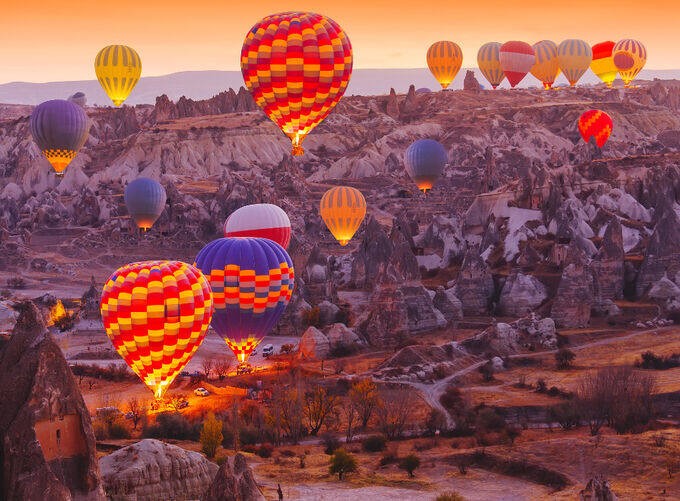
Travelers taking a hot-air-balloon flight may leave their hotels before normal daytime transport patterns have begun, while people heading to viewpoints to watch balloons also move around the region before sunrise.
This is not the moment to improvise.
If an activity includes hotel pickup, confirm the arrangements beforehand. If you are independently visiting a sunrise location, establish how you will get there and back before going to sleep.
The same principle applies when a balloon flight is cancelled because of weather. A cancellation can change the morning unexpectedly, but it should not create a transportation crisis.
Pre-dawn Cappadocia rewards preparation because the landscape may be awake before the transport system you planned to rely upon.
Luggage Can Turn a Short Journey Into the Wrong Journey
Distances around Göreme can look trivial until you add a suitcase.
Cave hotels are one of Cappadocia's great pleasures, but their locations can involve slopes, steps and narrow approaches. Dragging luggage uphill over uneven surfaces is not a meaningful form of cultural immersion.
When changing hotels or moving between Cappadocia towns with baggage, door-to-door transportation is usually worth considering even when you would happily walk the same distance without luggage.
This is particularly important for older travelers, families and anyone carrying multiple suitcases.
Transport decisions should reflect the journey you are actually making rather than the journey a fit traveler with a daypack could theoretically complete.
A five-minute taxi can occasionally improve a morning far more than its distance suggests.
Winter Changes Mobility Before It Changes the Attractions
Cappadocia remains fascinating in winter, particularly when snow transforms the valleys and fairy chimneys, but transportation planning needs greater flexibility.
Snow, ice and low temperatures can affect walking surfaces, roads and the practicality of reaching exposed areas. A route that would be an enjoyable walk in September may require a different decision in January.
This is where rigid pre-trip plans become unhelpful.
Check actual conditions and allow local information to influence the day. If roads or paths are affected, forcing an itinerary simply because it was written weeks earlier rarely improves the experience.
The best transportation strategy in Cappadocia is adaptable throughout the year, but winter makes that flexibility especially valuable.
Older Travelers Should Think About Terrain Before Distance
Cappadocia can be enjoyed without undertaking demanding walks, although mobility needs should influence transportation planning from the beginning.
The challenge is often not the number of kilometers.
It is the combination of slopes, steps, uneven ground and entrances within historical sites. Some cave environments and underground cities also involve confined or steep passages that transportation cannot solve once you arrive.
For travelers who prefer less walking, private transportation can reduce unnecessary movement between attractions and allow the day's pace to be adjusted more easily.
Our private Cappadocia tours with flexible transportation are particularly useful when mobility, timing or individual sightseeing priorities make a standard route less suitable.
Good transportation does not eliminate Cappadocia's terrain.
It makes sure your energy is spent where the experience is worth it.
Can You Explore Cappadocia Without Renting a Car?
Yes. For most first-time visitors, renting a car is not essential.
A practical stay can combine walking around Göreme and nearby landscapes, local transport or taxis for straightforward journeys, and pre-arranged transportation for sightseeing days that reach farther across the region.
That combination often works better than forcing every journey into one transport category.
Travelers who value complete independence and intend to visit multiple dispersed locations may prefer a rental car. Those who would rather concentrate on sightseeing than navigation may find guided or private transportation more efficient.
What matters is not whether you can say you explored Cappadocia independently.
What matters is how much Cappadocia you experienced rather than how much time you spent arranging the next ride.
The Best Way to Get Around Cappadocia
For most first-time travelers, the strongest strategy is a mixed transport approach.
Walk when the landscape makes the journey worthwhile. Use a dolmuş when an existing local route conveniently connects the towns you want to visit. Take a taxi when it solves a specific short-distance problem. Choose organized or private transportation when the day involves underground cities, Ihlara or several widely separated attractions. Rent a car when independent route control genuinely adds value to your trip.
Cappadocia does not reward loyalty to one transportation method.
It rewards understanding distance.
Once you recognize that Göreme is a walkable base rather than the whole region, transport decisions become much easier, sightseeing days stop losing hours to unnecessary connections, and the extraordinary landscape begins to feel considerably more accessible.
Frequently Asked Questions About Getting Around Cappadocia
1. Do I need to rent a car in Cappadocia?
No. Most first-time visitors can explore Cappadocia by combining walking, local transportation, taxis and organized or private sightseeing. A rental car becomes most useful when you specifically want independent control over a multi-stop route involving several dispersed locations.
2. Is Göreme easy to explore on foot?
Central Göreme is very walkable for travelers comfortable with hills and uneven surfaces, with hotels, restaurants and nearby viewpoints accessible without a vehicle. Remember that Cappadocia extends far beyond Göreme, so walking alone cannot efficiently cover the entire region.
3. What is a dolmuş in Cappadocia?
A dolmuş is a local minibus used for transportation between certain towns and communities. It can be useful for straightforward regional journeys, although visitors should not expect it to function as a door-to-door tourist shuttle connecting every valley, viewpoint and archaeological attraction.
4. Are taxis useful for getting around Cappadocia?
Yes, particularly for short transfers, evening journeys, hotel movements and situations where a valley walk finishes away from your starting point. For a full day involving numerous distant attractions, repeatedly using separate taxis may become less practical than arranged transportation.
5. Can I visit Cappadocia's underground cities without a tour?
Independent visits are possible, but transportation requires more planning because major underground cities lie beyond the immediate Göreme tourism zone. Travelers should compare the time and complexity of independent connections with the convenience of organized or private transport before deciding.
6. What is the easiest way to reach Ihlara Valley?
For most short-stay visitors, organized or private transportation is the most practical approach because Ihlara lies considerably farther from Göreme than the nearby central valleys. Independent travel can work, but the additional logistics should be weighed against available sightseeing time.
7. Is driving in Cappadocia difficult?
Travelers comfortable with independent driving can find a rental car useful for exploring dispersed attractions and making spontaneous stops. Navigation is only part of the decision, however; parking, seasonal road conditions and realistic daily distances should also influence whether renting makes sense.
8. Can I walk between towns in Cappadocia?
Some settlements and attractions can be connected through enjoyable walking routes, particularly when valleys form part of the journey. Walking beside ordinary roads merely to avoid transportation is less rewarding, so route quality should matter alongside the distance shown on a map.
9. How should I get around Cappadocia before sunrise?
Pre-sunrise transportation should normally be arranged beforehand. Balloon experiences commonly involve organized pickup arrangements, while travelers independently visiting sunrise viewpoints should establish their transportation before the morning rather than assuming normal daytime taxis or public services will be immediately available.
10. What is the best transport option when traveling with luggage?
A taxi or pre-arranged transfer is usually the most comfortable choice when changing hotels or towns with substantial luggage. Cappadocia's hills, steps and uneven surfaces can make apparently short walking distances unnecessarily difficult when travelers are pulling suitcases.
11. Is Cappadocia difficult to get around for older travelers?
Not necessarily, although terrain deserves more attention than distance alone. Private or pre-arranged transportation can reduce unnecessary walking between attractions, while individual sites may still involve slopes, steps or uneven surfaces that should be considered when designing each sightseeing day.
12. What is the best overall way to get around Cappadocia?
For most visitors, a mixed approach works best: walk around Göreme and suitable valleys, use taxis or local transport for simple journeys, and choose organized or private transportation for geographically dispersed attractions where independent connections would consume valuable sightseeing time.

A travel professional specializing in tailor-made travel planning, guest experience management, and multi-destination tourism operations.
With over 23 years of experience in the travel industry, he designs and manages private and cultural tours for international travelers across Türkiye, Greece, Egypt, Jordan, Morocco, and other destinations.
He has strong expertise in both online and face-to-face guest communication, sales processes, and end-to-end travel operations.
Working closely with hotels, travel agencies, and local partners, he ensures smooth coordination and high-quality travel experiences at every stage of the journey.
His focus is on delivering personalized, reliable, and seamless travel experiences for international guests worldwide.