
UNESCO World Heritage Sites in Greece: Which Ones Belong in Your Trip?
Updated: August 2026
Greece has enough internationally recognized heritage to create a tempting but rather exhausting travel objective: see as many UNESCO World Heritage Sites as possible.
That is rarely the best way to experience them.
Some UNESCO properties sit naturally inside journeys travelers are already likely to make. If you spend several days in Athens, the Acropolis requires almost no geographical compromise. If you are staying on Rhodes or Corfu, internationally significant heritage can become part of an island holiday without introducing another hotel or transportation day.
Others ask much more of the itinerary. Delphi draws you away from Athens into the mainland landscape; Meteora takes the journey north and changes its historical character almost completely; Olympia becomes much more logical within a Peloponnese route than as an isolated pin pursued simply because UNESCO recognizes it.
The practical question is therefore not:
“How many UNESCO sites does Greece have?”
A traveler needs a different answer:
“Which UNESCO experiences add enough to my particular Greece journey to justify the time required to reach them?”
Once you plan that way, UNESCO status stops being a collection exercise and becomes a useful tool for choosing between very different versions of Greek heritage.
Greece's UNESCO Story Is Much Broader Than Ancient Temples
First-time visitors understandably associate Greek heritage with Classical antiquity. The Acropolis has become almost visual shorthand for the country, while Delphi, Olympia and Mycenae reinforce an image dominated by ancient sanctuaries, theaters and archaeological ruins.
Greece's UNESCO landscape is considerably broader.
Meteora introduces Orthodox monastic heritage within an extraordinary natural setting. The Medieval City of Rhodes moves the historical lens toward fortified medieval urbanism. Corfu Old Town reflects a different Mediterranean history, while Byzantine and Paleochristian monuments elsewhere in Greece reveal periods that visitors concentrating entirely on Classical archaeology can easily overlook.
This diversity should influence selection.
If your itinerary already contains the Acropolis, Delphi and Mycenae, adding another ancient site merely because it carries UNESCO status may provide less contrast than introducing a Byzantine, medieval or later urban environment.
UNESCO planning becomes more rewarding when the objective shifts from quantity to historical range.
Begin With Heritage That Is Already Inside Your Route
Before changing a single hotel, examine where you are already going.
This is the easiest way to add cultural depth without turning the vacation into a heritage marathon.
Travelers spending time in Athens already have direct access to the Acropolis. Someone choosing Rhodes for beaches and island time can experience its medieval heritage while remaining on the same island. Corfu creates a similar opportunity, although its UNESCO character and architectural history are entirely different.
This principle sounds simple, yet it corrects a common itinerary problem.
Travelers often search “best UNESCO sites in Greece,” find an impressive location hundreds of kilometers from their existing route and then reorganize several days around reaching it. Meanwhile, internationally important heritage sitting directly within destinations they have already chosen receives only a hurried visit.
The first UNESCO site to prioritize is often not the highest ranked online.
It is the one that already belongs to the journey.
The Acropolis Has an Unusual Advantage: Almost No Additional Geography
The Acropolis is one of Greece's most significant UNESCO experiences and one of the easiest to integrate operationally because Athens is already a major international gateway and destination.
That does not mean the Acropolis should be rushed simply because it is convenient.
Its advantage is that travelers can give it meaningful time without adding another intercity transfer or hotel. The Acropolis Museum, surrounding archaeological landscape and historic center also allow the experience to develop within a broader Athens stay.
Our dedicated Athens and Acropolis content owns the detailed visit planning. From a UNESCO-selection perspective, the point is different.
If Athens already belongs in your journey, the Acropolis offers exceptionally high heritage value for very little additional logistical commitment.
That makes it an obvious foundation rather than a site that needs to compete with Delphi, Olympia or Meteora for exactly the same role.
Delphi Earns Its Place Through Landscape as Much as Archaeology
Delphi requires a more deliberate decision.
Unlike the Acropolis, it does not simply appear within the international gateway where many travelers are already staying. Visiting Delphi means allocating mainland travel time, whether it is approached as a longer excursion or incorporated into a broader route.
Why make the effort?
Because Delphi contributes something the Acropolis cannot reproduce.
The sanctuary's relationship with the mountain landscape is fundamental to the experience, while its association with Apollo and the ancient oracle introduces a different relationship between religion, communities and sacred geography.
For travelers already planning several archaeological sites, this difference matters.
Delphi should not be selected simply because it is another famous ancient place. It earns its itinerary space when the traveler wants to experience an archaeological sanctuary whose physical setting remains central to understanding why the location feels exceptional.
Meteora Is Not a Substitute for Delphi
Delphi and Meteora are frequently placed into the same mainland planning conversation because both require leaving Athens, yet they offer almost opposite heritage experiences.
Delphi pulls the traveler toward the ancient Greek religious world.
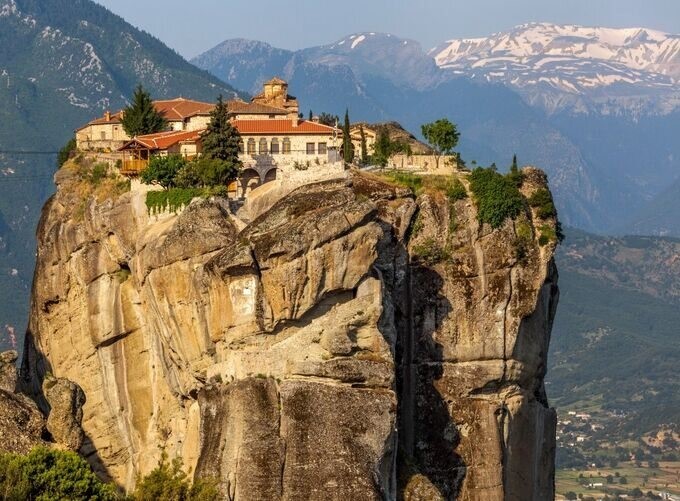
Meteora introduces monasteries, Orthodox Christian heritage and a dramatic rock landscape where human construction and natural setting become inseparable.
That contrast makes combining them attractive for travelers allocating several days to mainland Greece, but it does not mean everybody should attempt both.
Meteora represents a greater geographical commitment than simply adding another Athens attraction. Once it enters the journey, transport and overnight strategy become important, and its value should be judged accordingly.
If you have only a short Greece vacation dominated by islands, forcing Meteora into the middle can distort the entire itinerary.
If mainland heritage is one of the reasons you came to Greece, the calculation changes completely.
The Peloponnese Rewards Clustering Instead of Individual Site Chasing
The Peloponnese contains several internationally important heritage experiences, including archaeological places associated with Olympia, Mycenae and Epidaurus.
Their geographical relationship creates an opportunity.
Rather than treating each as an isolated excursion from Athens, travelers with sufficient time can approach the Peloponnese as a connected mainland chapter, using a road-based route to combine heritage with towns, landscapes and ordinary travel time between sites.
This makes Mycenae particularly different from Meteora from an itinerary perspective. Mycenae can belong naturally to an Argolis journey that also incorporates other meaningful stops, whereas Meteora pulls the route into a separate northern direction.
Olympia asks for greater commitment again, particularly when the rest of the Peloponnese is not otherwise included.
This is where UNESCO status should never override route logic.
A site can be globally important and still be the wrong addition to a seven-day vacation.
A UNESCO Commitment Matrix for Real Greece Trips
Rather than ranking sites by fame, compare what they require from the itinerary.
| UNESCO Experience | Route Commitment | Natural Role in a Trip | Strongest Reason to Include |
|---|---|---|---|
| Acropolis of Athens | Low if staying in Athens | Core Athens sightseeing | Classical Athens without additional travel |
| Delphi | Medium | Mainland extension | Sanctuary, archaeology and mountain setting |
| Meteora | High | Northern mainland chapter | Monastic heritage and exceptional landscape |
| Mycenae & Tiryns | Medium | Argolis/Peloponnese route | Bronze Age monumental culture |
| Olympia | High | Deeper Peloponnese circuit | Ancient sanctuary and athletic heritage |
| Sanctuary of Asklepios at Epidaurus | Medium | Argolis route | Healing sanctuary and theater tradition |
| Medieval City of Rhodes | Low when staying on Rhodes | Island holiday | Medieval fortified urban heritage |
| Old Town of Corfu | Low when staying on Corfu | Ionian island stay | Fortified Mediterranean urban history |
The most useful column is not “famous for.”
It is route commitment.
That tells you whether a UNESCO experience complements the holiday you already want or requires the holiday to be redesigned around it.
Rhodes Shows Why an Island Holiday Can Still Be a Heritage Journey
Rhodes is particularly useful for travelers who dislike the false choice between cultural travel and island time.
The Medieval City of Rhodes allows a beach-oriented journey to contain substantial historical depth without requiring a separate mainland detour. Its fortifications and urban fabric also provide a strong visual counterpoint to the Classical ruins travelers may have encountered in Athens.
This contrast is important.
A trip combining the Acropolis with Rhodes does not simply deliver two UNESCO labels. It exposes the traveler to two radically different periods and ways of understanding Greece's position in the eastern Mediterranean.
That is far more valuable than selecting sites because they belong to the same historical category.
The dedicated Rhodes guide should own what to see and how to experience the island. Here Rhodes demonstrates a planning principle:
sometimes the most efficient UNESCO addition is heritage embedded inside a destination chosen for entirely different reasons.
Corfu Adds a Heritage Language the Cyclades Cannot Provide
Corfu performs a similar logistical role while contributing a completely different visual story.
Travelers arriving with an image of Greek islands dominated by whitewashed Cycladic villages encounter something else in Corfu Town. Fortifications, urban form and architectural influences reveal the Ionian island's historical relationship with the wider Mediterranean.
That makes Corfu valuable within a heritage itinerary not because it resembles ancient Athens, but because it does not.
For travelers considering Greek heritage journeys linking mainland and island culture, choosing one island with a substantial historic urban environment can sometimes create greater cultural variety than adding another archaeological day to the mainland.
Again, UNESCO designation becomes useful when it reveals contrast rather than merely status.
Thessaloniki Rewards Travelers Interested in the Greece Between Antiquity and the Islands
Northern Greece deserves particular attention from travelers whose historical interests extend beyond Classical antiquity.
Thessaloniki contains important Paleochristian and Byzantine monuments, giving the city a very different heritage profile from Athens. For someone already traveling north, especially as part of a broader mainland journey, this can deepen the historical range substantially.
For someone spending a week between Athens and Santorini, however, adding Thessaloniki solely for UNESCO completion makes little operational sense.
This is the distinction the entire article is designed to protect.
Importance does not automatically create itinerary relevance.
A UNESCO property should be judged partly by whether it strengthens the route already being built.
Mystras Can Be Extraordinary and Still Not Belong in Your First Greece Trip
Mystras illustrates the same principle beautifully.
Its Byzantine heritage and hillside setting make it historically significant and visually memorable, but reaching it requires a commitment to the Peloponnese that not every first-time itinerary can support.
Travelers already exploring southern mainland Greece have a completely different decision from travelers based in Athens for three nights before flying to an island.
This is why lists titled “10 UNESCO Sites You Must Visit in Greece” are not especially useful.
There is no universal must-visit list.
There are sites that make sense for particular routes, interests and available time.
Mystras becomes considerably more valuable when it belongs to a journey rather than functioning as an isolated trophy destination.
Do Not Turn UNESCO Status Into an Obligation
UNESCO recognition identifies heritage of outstanding universal value; it does not mean every traveler needs to redesign a vacation around every designated property.
If your main purpose is a relaxed island holiday, there is nothing culturally inadequate about seeing the Acropolis in Athens and then spending the rest of the trip on islands.
Likewise, a traveler fascinated by Byzantine history may reasonably devote more time to Meteora, Thessaloniki or Mystras while skipping several famous Classical sites.
The correct heritage itinerary reflects curiosity rather than external pressure.
This becomes particularly important on shorter trips, where every distant UNESCO addition can displace something else: a beach afternoon, an unscheduled evening, a second night in a destination or simply enough time to appreciate the previous site.
Heritage needs attention more than it needs volume.
Children Need Contrast More Than UNESCO Credentials
Families should be especially cautious about collecting archaeological sites simply because adults consider them important.
Children who enjoy the Acropolis may not automatically want three additional days of ancient foundations and museums.
Contrast can solve that problem.
A theater, fortified medieval town, monastery landscape and ancient sanctuary create more varied experiences than four superficially similar archaeological days. Mythology, architecture and stories about how people actually used places can also make heritage more tangible.
For families, UNESCO status is therefore best used as a quality filter rather than a scheduling instruction.
Choose the sites whose physical environments are likely to engage the people actually traveling.
Decide Whether Another UNESCO Site Is Worth Another Hotel
Hotel changes are a useful reality check.
If a UNESCO site requires a new overnight base, ask what else that move enables. Does it open a meaningful mainland route? Does it introduce a historical period not represented elsewhere? Can the surrounding region justify more than a single attraction?
If the answer is yes, the additional night may be entirely worthwhile.
If the only benefit is checking another UNESCO property off the list before immediately moving again, reconsider.
Travelers choosing privately guided Greek UNESCO routes can often gain more from connecting several complementary sites geographically than from treating every property as an independent excursion.
The route should make the heritage easier to understand, not merely easier to count.
Seven Days and Fourteen Days Require Different UNESCO Ambitions
A one-week Greece journey should remain selective.
If Athens is included, the Acropolis already provides a major UNESCO experience. One mainland extension such as Delphi may be enough, particularly when several nights are also reserved for islands.
At around two weeks, the possibilities change. A traveler can allocate a meaningful mainland segment to Delphi and Meteora, develop a Peloponnese route, or combine Athens with an island whose historic center carries UNESCO recognition.
Longer journeys should not automatically double the number of sites.
Additional time can instead make the same heritage experiences better by reducing rushed transfers and allowing towns and landscapes around the monuments to become part of the trip.
The Best UNESCO Route Is Usually the One With the Greatest Contrast
If you remember only one planning principle from this guide, use this one.
Do not ask how many UNESCO properties can fit.
Ask how differently each selected place helps you understand Greece.
The Acropolis can introduce Classical civic and sacred architecture. Delphi places ancient religion inside a powerful landscape. Meteora moves the journey into Orthodox monastic culture. Rhodes reveals medieval fortification and Mediterranean history. Corfu offers another urban and architectural layer, while the Peloponnese can connect Bronze Age, Classical and Byzantine experiences within a wider road journey.
Those differences are the reason to travel between them.
For visitors exploring cultural Greece tours beyond the familiar islands, UNESCO recognition can provide an excellent framework, but it should remain exactly that: a framework.
The strongest journey is not the one that returns home with the largest UNESCO count.
It is the one where each additional place changes your understanding of the country enough to justify the journey required to reach it.
Frequently Asked Questions About Greece's UNESCO Heritage
1. How many UNESCO sites should I realistically include in a first Greece trip?
There is no ideal number. A shorter trip may feel complete with the Acropolis and one contrasting mainland or island property, while longer journeys can support more. Historical variety and travel time matter more than maximizing the number of designations visited.
2. Can I experience meaningful UNESCO heritage without leaving Athens?
Yes. The Acropolis provides one of Greece's most significant UNESCO experiences within Athens itself. Travelers interested in heritage do not need to add a distant mainland journey simply to make the vacation culturally substantial, particularly when available time is limited.
3. Is Delphi or Meteora easier to add to an Athens-based itinerary?
Delphi generally represents a smaller geographical commitment, while Meteora takes the journey farther into mainland Greece and often deserves more time. The decision should also consider interests, because the two offer fundamentally different ancient and monastic heritage experiences.
4. Does it make sense to combine Delphi and Meteora?
It can, particularly when several days are allocated to mainland Greece. Their historical contrast is a strength rather than a weakness. However, travelers with a short island-focused vacation should consider whether the additional movement would consume too much of the available trip.
5. Should I choose Olympia or Mycenae when my time is limited?
Mycenae often integrates more naturally into a shorter Argolis or Peloponnese extension from Athens, whereas Olympia usually requires deeper commitment to the peninsula. Historical interests should still determine the choice rather than geography alone.
6. Can I have a beach holiday and still experience UNESCO sites?
Absolutely. Rhodes and Corfu demonstrate particularly well how internationally recognized historic environments can coexist with island vacations. Travelers can also experience the Acropolis before continuing to beaches, creating cultural depth without turning the entire journey into an archaeological circuit.
7. Are all Greek UNESCO sites related to ancient Greece?
No. Greece's UNESCO heritage extends beyond Classical and Bronze Age archaeology to Byzantine, Paleochristian, medieval and later cultural landscapes. Choosing sites from different periods can provide a much broader understanding of Greek history than concentrating entirely on ancient ruins.
8. Do I need a rental car to visit several UNESCO properties?
Not necessarily, although road transportation can make some mainland combinations more efficient. The appropriate solution depends on the route, while organized excursions, private transfers and other transportation options can support travelers who prefer not to drive during their Greece journey.
9. Are UNESCO sites in Greece interesting for children?
They can be, particularly when destinations provide contrasting environments rather than consecutive archaeological visits. Medieval fortifications, theaters, monasteries, mythology and dramatic landscapes may engage younger travelers more effectively than emphasizing dates, designations and architectural terminology.
10. Is UNESCO status a good reason to change my island itinerary?
Only when the site genuinely matches your interests. Traveling far out of the way solely to collect another designation can weaken an otherwise coherent trip. Heritage already embedded in destinations such as Rhodes or Corfu often creates a more natural experience.
11. How can I avoid archaeological fatigue on a heritage-focused Greece trip?
Alternate historical periods and types of experience rather than scheduling similar ruins every day. Combining archaeological sites with towns, landscapes, monasteries, island time and unscheduled periods gives travelers time to process what they have seen before encountering another major heritage site.
12. What is the biggest mistake when planning a UNESCO-focused Greece journey?
Treating every designated property as equally relevant to your itinerary can produce excessive travel and repetitive sightseeing. Start with the route you genuinely want, then select UNESCO experiences that introduce meaningful historical or geographical contrast without forcing the entire vacation to serve a checklist.

A travel professional specializing in tailor-made travel planning, guest experience management, and multi-destination tourism operations.
With over 23 years of experience in the travel industry, he designs and manages private and cultural tours for international travelers across Türkiye, Greece, Egypt, Jordan, Morocco, and other destinations.
He has strong expertise in both online and face-to-face guest communication, sales processes, and end-to-end travel operations.
Working closely with hotels, travel agencies, and local partners, he ensures smooth coordination and high-quality travel experiences at every stage of the journey.
His focus is on delivering personalized, reliable, and seamless travel experiences for international guests worldwide.